
A Black detective calls the Ku Klux Klan on the phone, puts on his best white-guy voice, and gets himself inducted as a card-carrying member. That premise sounds like a Saturday Night Live sketch, but Spike Lee plays it dead serious, and the result lands harder than most prestige dramas dare to.
Ron Stallworth’s real story gives Lee exactly the ammunition he needs to connect 1970s Colorado Springs to a present that, by the film’s final minutes, refuses to stay historical.
Detailed Summary
Ron Stallworth Joins the Force
Ron Stallworth (John David Washington) becomes the first Black officer in the Colorado Springs Police Department. His boss assigns him to the records room, but Ron pushes for undercover work. He gets his shot monitoring a speech by civil rights activist Kwame Ture, where he meets local Black Student Union president Patrice Dumas (Laura Harrier).
Ron and Patrice connect immediately, though the tension between his badge and her politics runs through every scene they share. She distrusts cops on principle. He hides what he does for a living.
The Phone Call That Starts Everything
Ron spots a Klan recruitment ad in a newspaper and calls the number on a whim. He speaks in a practiced, neutral white voice and expresses interest in joining. A local Klan member named Walter Breachway responds warmly and sets up a meeting.
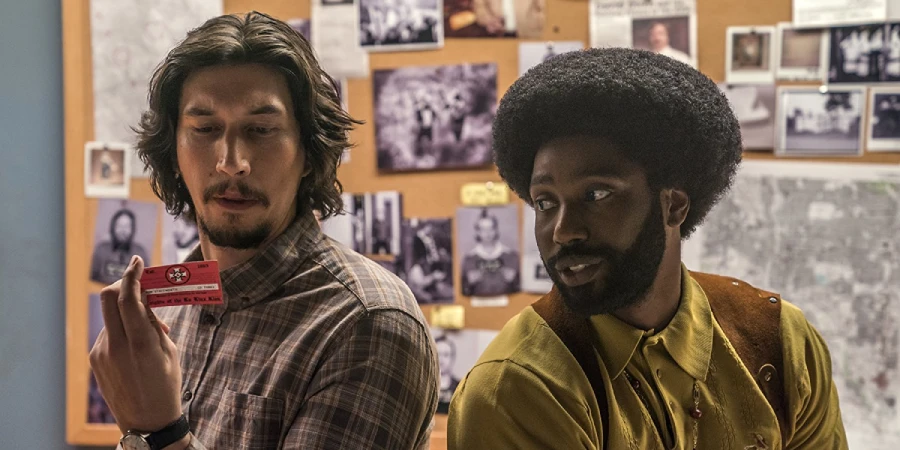
Ron cannot show up in person, so he recruits his Jewish colleague Flip Zimmerman (Adam Driver) to be his physical stand-in. Ron handles all phone communication. Flip meets the members face to face while Ron coaches him from the other end of the line.
Getting Inside the Klan
Flip attends Klan meetings and earns the group’s trust, despite the constant threat of exposure. One member, Felix Kendrickson (Jasper Paäkkönen), is convinced Flip is Jewish and pushes hard to prove it. Felix subjects Flip to a lie detector test in a genuinely nerve-shredding scene, and Flip keeps his composure without flinching.
Ron, meanwhile, keeps talking on the phone with David Duke (Topher Grace), the Klan’s Grand Wizard. Duke likes Ron. He calls him a good, upstanding white man. Ron even gets Duke to send him a signed membership card, which becomes one of the film’s best running jokes.
Patrice and the Surveillance Subplot
Ron’s superiors assign him to surveil Patrice and the Black Student Union, treating the civil rights organization as a threat. Ron reports back what he finds, but he never truly believes the assignment is legitimate. His growing feelings for Patrice sharpen the conflict between his loyalty to the department and his own identity.
Lee uses this subplot to make a pointed argument: the police department fears Black activists more than it fears the Klan. Ron’s bosses spend more energy watching Patrice than shutting down the white supremacists down the street.
The Threat Gets Real
Felix and his wife Connie (Ashlie Atkinson) plan to bomb a rally organized by Patrice and the Black Student Union. The operation shifts from an interesting undercover gimmick into a genuine race against time. Ron works to stop the attack while keeping his cover intact.
Patrice is at the rally. Ron cannot warn her without exposing the investigation. Flip and the police ultimately intercept Connie before she can detonate the bomb, and Felix is arrested. The relief is real, but it does not last long.
Betrayal by the Institution
After the case wraps, Ron’s superior shuts the entire operation down. No charges stick. The investigation gets buried. Ron tears up his David Duke membership card in disgust, and the camera holds on his face long enough to make sure you feel the weight of that moment.
His relationship with Patrice reaches a breaking point when she discovers he is a cop. She feels betrayed. He tries to defend his belief that change can come from within the system. Neither of them fully convinces the other.

Movie Ending
Ron and Patrice reconcile at his apartment, and the film seems ready to close on a note of cautious hope. Then a knock at the door pulls them to the window. A burning cross lights up the darkness outside, set there by Klan members who have discovered Ron’s identity. Lee frames the two of them staring out at the flames, their faces lit by the orange glow.
That image would be enough for most directors. Lee does not stop there.
He cuts directly to documentary footage from the Charlottesville, Virginia events of 2017: white nationalists marching with torches, the car attack that killed Heather Heyer, and then-President Trump’s remarks about “very fine people on both sides.” The screen goes black and white. A title card announces Heyer’s name. This is not a subtle pivot. Lee plants the film’s thesis in neon letters: the Klan Ron infiltrated in the 1970s never disappeared. It put on a tie and ran for office.
Topher Grace’s David Duke is played with precise, chilling politeness throughout the film, and that choice pays off completely here. By the time real footage of Duke appears in the Charlottesville material, the connection between the fictional past and the documented present feels less like editorializing and more like evidence. Audiences debated whether Lee’s choice to end with real-world footage was too blunt. It is blunt. That is exactly the point.
Are There Post-Credits Scenes?
No, there are no post-credits scenes. Lee ends on the documentary footage and the black-and-white image, and that is where the film stops. Staying through the credits adds nothing extra, but the closing sequence hits hard enough that many viewers sit through them anyway.
Type of Movie
BlacKkKlansman is a biographical crime drama with strong comedic elements woven throughout. It plays many scenes for dark, uncomfortable laughs before yanking the rug out with something genuinely disturbing. Lee calls it a “joint” rather than a film, his longstanding signature for work he considers personal.
Tonally, it shifts between procedural thriller, social satire, and outright political provocation. That tonal juggling act does not always land perfectly, but when it clicks, the whiplash is the whole point.
Cast
- John David Washington – Ron Stallworth
- Adam Driver – Flip Zimmerman
- Laura Harrier – Patrice Dumas
- Topher Grace – David Duke
- Jasper Paäkkönen – Felix Kendrickson
- Ashlie Atkinson – Connie Kendrickson
- Ryan Eggold – Walter Breachway
- Corey Hawkins – Kwame Ture
- Harry Belafonte – Jerome Turner
- Alec Baldwin – Dr. Kennebrew Beauregard
Film Music and Composer
Terence Blanchard composed the score. A longtime Spike Lee collaborator, Blanchard has scored nearly every Lee film since Jungle Fever (1991). His work here blends jazz-influenced orchestration with moments of stark, unsettling quiet.
Period music anchors the 1970s setting effectively. Cornelius Brothers and Sister Rose appear on the soundtrack, and Lee leans into soul and funk to keep the film grounded in its era without turning into a nostalgia exercise. Blanchard’s original score pulls in the opposite direction, injecting a modern unease that keeps the period setting from feeling safely distant.
Filming Locations
Principal photography took place primarily in New York, standing in for Colorado Springs. Much of the film was shot in and around Ossining and other upstate New York locations. Using New York for a Colorado story might seem like a compromise, but the production design team fills the interiors with such precise period detail that the geography rarely intrudes.
Some scenes were shot in Troy, New York, whose older commercial architecture matched the early-1970s Colorado Springs look the production needed. Lee and his team dressed streets and storefronts to push the illusion. The fact that it works as well as it does is a credit to production designer Wynn Thomas, a regular Lee collaborator.
Awards and Nominations
BlacKkKlansman won the Jury Grand Prix at the Cannes Film Festival in 2018, which represented a major moment for Lee, whose relationship with major festival prizes had been complicated for years. The film received six Academy Award nominations, including Best Picture, Best Director (Spike Lee’s first directing nomination), and Best Supporting Actor for Adam Driver. It won Best Adapted Screenplay at the Oscars, with the award going to Charlie Wachtel, David Rabinowitz, Kevin Willmott, and Spike Lee.
Lee famously tried to leave the ceremony early after Green Book won Best Picture that night, and his reaction became one of the more talked-about moments of that awards season.
Behind the Scenes Insights
- Spike Lee initially passed on the project. Producer Jordan Peele pursued him aggressively and eventually convinced him to direct.
- Jordan Peele produced the film through his company Monkeypaw Productions, fresh off the success of Get Out (2017).
- John David Washington is the son of Denzel Washington, a fact the film’s promotional material played up, though John David had already built his own career before this role.
- The real Ron Stallworth consulted on the production and approved of how his story was portrayed.
- Topher Grace spent significant time researching David Duke‘s public speaking patterns and mannerisms to find the character’s unsettling affability.
- Adam Driver wore a wire for many of his undercover scenes on set, staying in character between takes to maintain the pressure Flip operates under.
- Lee opened the film with a clip from Gone with the Wind and a monologue by Alec Baldwin as a fictional white supremacist propagandist, setting the film’s combative tone from the first frame.
Inspirations and References
The film adapts Ron Stallworth‘s memoir Black Klansman (2014), in which he documents his real undercover infiltration of the Colorado Springs chapter of the Ku Klux Klan. Stallworth’s account is stranger than fiction: he really did speak with David Duke by phone and receive a membership card.
Lee layers in overt references to Birth of a Nation (1915), D.W. Griffith’s viciously racist film that the Klan uses as a recruitment and celebration tool within BlacKkKlansman itself. Lee’s contempt for Griffith’s legacy is a recurring theme across his career.
Harry Belafonte’s character narrates the real history of the lynching of Jesse Washington in 1916, a documented atrocity that Lee intercuts with the Klan’s gleeful screening of Birth of a Nation. That intercutting is the most formally audacious sequence in the film, and in my view the most effective.
Alternate Endings and Deleted Scenes
No officially confirmed alternate ending or significant deleted scenes have been made public for this film. Lee and his collaborators have not discussed a substantially different version of the ending in interviews available on record.
Given Lee’s tendency toward extended cuts and his history with director’s cuts on other projects, a longer assembly cut likely exists somewhere, but no details about cut material have surfaced publicly.
Book Adaptations and Differences
The film adapts Stallworth’s memoir Black Klansman. Several key elements in the film are invented or significantly altered for dramatic effect. In Stallworth’s book, there is no bombing plot and no Patrice Dumas; the romantic subplot is a screenwriting addition.
Flip Zimmerman’s character is a composite and fictionalized version of the real white officer who posed in person, and his Jewish identity, while dramatically important to the film, is a creative elaboration. Lee and his co-writers used the true story as a springboard rather than a blueprint, which is the right call. The real story is fascinating but would not sustain a feature film on its own.

Memorable Scenes and Quotes
Key Scenes
- The lie detector scene: Felix presses a gun-detector against Flip’s chest and studies his face for any reaction. Driver sits completely still, sweat visible, jaw tight. The silence in the room lasts long enough to become physically uncomfortable for the audience.
- Harry Belafonte’s testimony intercut with the Klan screening: An elderly Jerome Turner describes the 1916 lynching of Jesse Washington to a group of young Black students. Lee cuts between Turner’s grieving face and the white Klan members cheering Birth of a Nation on a projector screen. It is the film’s moral center.
- Ron’s first phone call to the Klan: Washington shifts his vocal register mid-sentence, testing his white voice like a musician warming up. The comedy is immediate, but there is something deeply uncomfortable underneath it.
- The burning cross at the window: Lee frames Washington and Harrier from behind as orange light floods Ron’s apartment. Neither speaks. The camera holds the shot.
- The Charlottesville documentary footage: Lee cuts from fiction to real-world footage without warning. The tonal collision is jarring and fully intentional.
Iconic Quotes
- “With the right white man, we can do anything.” (Ron Stallworth)
- “God bless white America.” (Ron Stallworth, dripping with irony)
- “America would never elect somebody like David Duke president… would they?” (Ron Stallworth)
- “Stop being a slave to another man’s ideology.” (Patrice Dumas)
Easter Eggs and Hidden Details
- Lee opens the film with the famous tracking shot of wounded Confederate soldiers from Gone with the Wind, immediately signaling his argument about how cinema has mythologized white supremacy.
- Ron’s afro pick has a raised fist handle, a small but consistent visual nod to Black Power symbolism that appears throughout his scenes.
- The fictional organization in the opening monologue, delivered by Alec Baldwin’s character, mirrors the language and cadence of actual white nationalist propaganda films from the era.
- Patrice’s apartment walls are covered with posters of Black political and cultural figures, each one placing her firmly in a specific ideological tradition without a word of dialogue.
- Topher Grace’s David Duke wears a small American flag pin throughout, a detail that connects him visually to mainstream political figures rather than fringe extremists.
Trivia
- The real Ron Stallworth kept his signed David Duke membership card for decades after the investigation.
- Spike Lee dedicated the film to Heather Heyer, who was killed in Charlottesville in 2017.
- John David Washington based aspects of Ron’s phone manner on his father Denzel’s vocal delivery, an admitted influence he discussed in press interviews.
- Topher Grace was cast partly because Lee wanted an actor who could make David Duke seem charming and non-threatening rather than cartoonishly villainous.
- Lee wore a Prince jersey to the Oscars ceremony where the film was nominated, a tribute to the late musician.
- Corey Hawkins, who plays Kwame Ture, had previously played a lead role in Straight Outta Compton (2015).
- Jordan Peele’s involvement was reportedly what persuaded major studios to take the project seriously as a commercial proposition.
Why Watch?
Watch it for the Harry Belafonte sequence alone: Lee intercuts a survivor’s testimony about a real 1916 lynching with Klan members cheering Birth of a Nation, and the formal collision between those two images does more political work than most entire films manage. John David Washington carries the film with a confidence that does not announce itself; he is funny, then wounded, then furious, sometimes within a single scene. This is Spike Lee at his most purposeful.
Director’s Other Movies
- She’s Gotta Have It (1986)
- Do the Right Thing (1989)
- Mo’ Better Blues (1990)
- Jungle Fever (1991)
- Malcolm X (1992)
- Crooklyn (1994)
- Clockers (1995)
- 25th Hour (2002)
- Inside Man (2006)
- Chi-Raq (2015)
- Da 5 Bloods (2020)