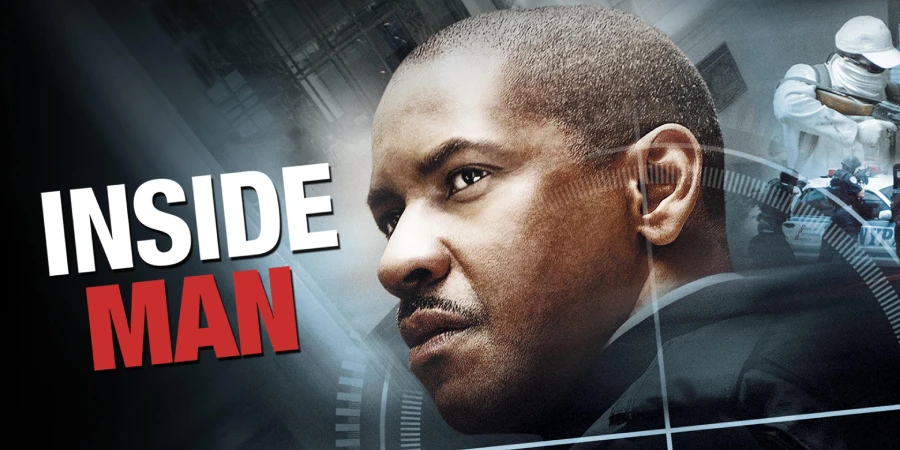

A masked man tells you the perfect robbery is already over before you witness a single crime. That opening confession is Spike Lee’s cleverest trick in Inside Man, a Wall Street heist thriller hiding a war crime inside a hostage standoff. Nobody dies, and nothing appears stolen. Yet one man loses everything.
Detailed Summary
A Confession From a Cell
Dalton Russell speaks straight to camera from a cramped gray room. He promises to explain the who, what, when, where and why of a flawless bank robbery. His stated motive is almost insulting in its simplicity: because he can.
Lee plants the solution in the first ninety seconds. Viewers just lack the context to read it. That swagger sets the tone for everything that follows.
Four Painters Walk Into a Bank
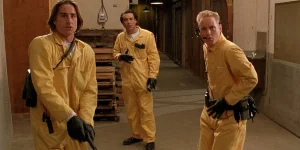
Four figures in painters’ overalls enter the Manhattan Trust branch on Exchange Place. Doors get chained, cameras go dark, and roughly fifty customers and employees end up herded into the back.
Russell runs his crew with military calm. His accomplices answer only to Steve, Steve-O and Stevie, aliases chosen so nobody can slip and reveal a real name.
Hostages Become Robbers
Every captive strips and changes into identical overalls and masks. Phones go into a bucket, and faces disappear behind cheap plastic.
From outside, distinguishing a hostage from a criminal becomes impossible. Meanwhile, the crew starts hammering at a supply room wall. Everyone watching assumes a tunnel to the vault is underway.
Detective Keith Frazier Takes the Case
Detective Keith Frazier catches the job alongside his partner Bill Mitchell. He negotiates well, yet his career has stalled: internal affairs suspects him of pocketing $140,000 from a drug bust.
Captain John Darius and his tactical team want to storm the building immediately. Frazier prefers to keep talking, which hands Russell exactly what the plan requires, namely time.
Arthur Case Hires a Fixer
Arthur Case, the bank’s founder and chairman, panics for reasons unrelated to cash. He calls Madeleine White, a Manhattan power broker who solves unsolvable problems for very rich clients.
White leans on the Mayor and walks straight through the police perimeter. Her assignment is narrow: keep the contents of safe deposit box 392 out of everyone’s hands.
Misdirection After Misdirection
Russell floods the investigation with noise. He plays a recording of a speech in Albanian, later traced to Enver Hoxha, sending detectives chasing an Eastern European gang that does not exist.
He also stages an execution in full view of the police. Officers believe a hostage has been shot dead. Nobody has.
Demands arrive on a schedule: buses, a plane, food for the captives. Each one exists purely to keep the clock ticking.
The Sikh Hostage and a City on Edge
Police release a hostage named Vikram Walia and immediately tear off his turban. Officers shove him between them while he asks, first politely and then furiously, where his rights went.
Frazier jokes that Vikram can at least still get a cab. That exchange doubles as Lee’s sharpest commentary on post-9/11 New York, delivered in nine seconds of dialogue.
Frazier Starts Reading the Room
Details stop adding up for Frazier. Not a dollar has moved, the demands feel theatrical, and the bank’s leadership behaves far too nervously for a routine robbery.
White approaches him with an offer wrapped around a threat. Her mere presence tells Frazier that something in that vault outranks money.
Box 392 and a Wartime Secret
Russell locates the box himself and reads what Case buried inside. Documents, a ledger and a Cartier diamond ring reveal that Manhattan Trust was founded on money made by collaborating with the Nazis.
Case betrayed a Jewish friend and profited from the Holocaust. Six decades of philanthropy since then amount to laundered reputation.
White discovers the truth as well, though her loyalty stays bought. Case, for his part, never pretends innocence when pressed.
The Hostages Walk Free
After a day of stalling, the crew pushes everyone out at once. Fifty identically dressed people stumble onto Exchange Place with their hands raised.
Police cannot separate victims from suspects. Three robbers simply walk out inside that crowd and evaporate into the city.



Movie Ending
Frazier’s team breaches a building holding nobody at all. No tunnel exists, no vault has been cracked, and bank executives insist that nothing is missing.
Interrogations go nowhere, because some of the witnesses are the thieves. Frazier sits across a table from his own suspects without ever knowing it.
Russell, crucially, never left. He sealed himself behind a false wall in the supply room, using debris from that pointless digging as camouflage, then waited out the entire investigation.
For a week he lives in a space barely bigger than a closet. He sleeps, eats and listens while the case cools and the reporters drift away.
Then he strolls out of the front door with a bag of diamonds. Frazier, returning for one last look at box 392, brushes past him in the doorway and hears a polite apology.
During that contact, Russell slips the Cartier ring into Frazier’s coat pocket. A note tucked alongside it offers three words of instruction: follow the ring.
Frazier finds both later and finally reads the whole design. His investigation had functioned as somebody else’s delivery system for justice.
He confronts White, who confirms enough and warns him about the men Case knows. Undeterred, Frazier carries the ring into Case’s office and lays out what it proves.
Case realizes his sealed past has become police evidence. Nothing about his fortune, his name or his legacy survives that conversation intact.
Audiences most often ask whether anyone actually died, and the answer is nobody. Both the shooting and the tunnel were performances staged for an audience of cops.
A second common question concerns the theft itself. Case cannot report the diamonds stolen, because reporting them means admitting the box existed and explaining where those stones came from.
Russell therefore commits a crime with no victim willing to name it. He robs a man who has no legal standing to complain.
Frazier’s own troubles ease as the standoff resolves in his favor. His career survives; his conscience, notably, is the thing the film cares about.
Lee lets the finale sit in real moral discomfort. A guilty man loses his name, a thief keeps his diamonds, and the law arrives late and slightly compromised.
Are There Post-Credits Scenes?
No. Inside Man contains no post-credits or mid-credits scene, and the story concludes fully in its final minutes.
Sticking around still has one reward. Terence Blanchard’s score gives way to the film’s signature track, which bookends the picture with real style.
Type of Movie
Classify it first as a heist thriller, then as a police procedural. Underneath both sits a moral drama about stolen money and inherited guilt.
Lee balances tension with a loose, talky humor that keeps the standoff human. Characters bicker, insult each other and complain about pizza while lives hang in the balance.
Social commentary threads through every act. Racial profiling, class privilege and post-9/11 paranoia all get screen time, though never at the expense of pace.
Cast
- Denzel Washington – Detective Keith Frazier
- Clive Owen – Dalton Russell
- Jodie Foster – Madeleine White
- Christopher Plummer – Arthur Case
- Willem Dafoe – Captain John Darius
- Chiwetel Ejiofor – Detective Bill Mitchell
- Kim Director – Stevie
- James Ransone – Steve-O
- Waris Ahluwalia – Vikram Walia
- Cassandra Freeman – Sylvia
Film Music and Composer
Terence Blanchard composed the score, continuing one of modern cinema’s most durable director and composer partnerships. He had already worked with Lee across numerous films stretching back to the late 1980s.
Blanchard trained as a jazz trumpeter in New Orleans and played with Art Blakey’s Jazz Messengers early in his career. His writing here mixes orchestral suspense with jazz phrasing and South Asian textures.
Most listeners remember the opening track above all. Chaiyya Chaiyya Bollywood Joint reworks A. R. Rahman’s celebrated song from Dil Se.., with Panjabi MC adding a hip hop spine.
Choosing that song was a statement of intent. Lee announces a New York built from a dozen cultures before a single word of dialogue arrives.


Filming Locations
Production shot in New York City, and specifically in Lower Manhattan’s financial district. Lee treats those streets as a character rather than a backdrop.
Exchange Place provides the exterior of the fictional Manhattan Trust bank. Narrow canyons of stone and glass make the police cordon feel genuinely claustrophobic.
Setting the story on Wall Street sharpens the theme considerably. A building constructed on Nazi money sits comfortably among institutions with their own uncomfortable histories.
Street-level New York does the rest. Vendors, gawkers, cabs and cops crowd the frame, giving the standoff a texture that a studio backlot could never fake.
Awards and Nominations
Inside Man never entered the major awards conversation and picked up no Oscar or Golden Globe nominations. Critics were warm, audiences were warmer, and the film’s real trophy was commercial success rather than statuettes.
Behind the Scenes Insights
- Russell Gewirtz wrote the screenplay as a spec script, and it became his first produced feature credit.
- Ron Howard was attached to direct at an earlier stage before Spike Lee took the project.
- Brian Grazer produced through Imagine Entertainment, with Universal Pictures releasing the film in March 2006.
- Lee and Denzel Washington had already made three films together, so this marked their fourth collaboration.
- Lee’s trademark double dolly shot appears in the film, gliding a character forward as though floating.
- Clive Owen spends the bulk of his screen time behind a mask, leaving his voice to carry the performance.
- The picture became the highest-grossing release of Lee’s career, a rare mainstream blockbuster from a fiercely independent voice.
- Blanchard recorded a score that leans on rhythm rather than melody, keeping the standoff tense without overwhelming dialogue.
Inspirations and References
Gewirtz wrote an original screenplay, so no single source text exists. Influences, however, are not hard to spot.
Critics regularly place the film beside Dog Day Afternoon, another New York hostage story built on crowds, media and personality. The Taking of Pelham One Two Three belongs in that lineage too.
Historically, the Case subplot draws on a genuine and ugly reality. Banks and financiers profited from Nazi-era assets, and postwar restitution fights over that money continued for decades.
Lee layers contemporary references on top of the heist. Racial profiling, surveillance and the treatment of Sikh and Muslim New Yorkers after 2001 shape several key scenes.
Alternate Endings and Deleted Scenes
No alternate ending has ever surfaced, and the theatrical cut remains the only version in circulation. Lee’s finale was clearly the intended one from the screenplay stage.
Home video releases did include supplementary material, deleted footage among it. Nothing cut from the film changes the mechanics of the robbery or the fate of any character.
Trimming appears to have targeted the hostage interviews and street-level texture. Those sequences enrich the world, yet the plot survives their absence without a scratch.
Book Adaptations and Differences
Inside Man is not based on a book. Russell Gewirtz created the story and characters for the screen, and no novel, memoir or comic preceded the film.
Comparisons to source material are therefore impossible. Anyone hunting for a literary companion will find only the screenplay itself.
A follow-up did eventually arrive on screen. Inside Man: Most Wanted landed in 2019 as a direct-to-video sequel, without Lee or Washington involved.

Memorable Scenes and Quotes
Key Scenes
- Russell’s opening address to camera, delivered from a cell that turns out to be his hiding place.
- The forced costume change, when fifty hostages become visually identical to the men holding them.
- The staged execution outside the bank doors, which convinces the entire police command that a captive has died.
- Vikram Walia’s release and the removal of his turban, followed by his blunt complaint about civil rights.
- The boy’s violent video game, watched by Russell with visible disgust in the middle of a robbery.
- Madeleine White’s first meeting with Arthur Case, where the job description quietly becomes a confession.
- The mass release of hostages, filmed as chaos, with the robbers walking free in plain sight.
- The doorway brush between Russell and Frazier, where a ring changes pockets and the case cracks open.
Iconic Quotes
- Dalton Russell: “Pay strict attention to what I say.”
- Dalton Russell, on motive: “Because I can.”
- Keith Frazier, to Vikram: “I bet you can get a cab, though.”
- Vikram Walia, in reply: “That’s one of the perks.”
- Dalton Russell’s note to Frazier: “Follow the ring.”
Easter Eggs and Hidden Details
- Russell’s description of his location as a cell is literal, and the film hands you the twist before the robbery even begins.
- The Albanian audio played to police comes from a speech by Enver Hoxha, Albania’s longtime communist leader.
- The brutally violent video game watched by a young hostage was invented for the film as a jab at the industry.
- Madeleine White’s client roster includes a relative of Osama bin Laden, a detail that quietly defines her ethics.
- The fictional bank’s name, Manhattan Trust, plants an irony about trust in the story’s very first frames.
- Lee’s floating double dolly shot appears as a signature stamp, recognizable to anyone who has seen his earlier work.
- The pizza delivered to the hostages arrives with a police listening device, a gag the robbers anticipate and defeat.
Trivia
- Universal released the film in March 2006, and it went on to become Spike Lee’s biggest commercial hit.
- Denzel Washington and Lee had previously worked together on Mo’ Better Blues, Malcolm X and He Got Game.
- Waris Ahluwalia, who plays Vikram, is a designer and jewelry maker as well as an actor.
- Clive Owen and Denzel Washington share remarkably little unmasked screen time for two leads in the same building.
- Chiwetel Ejiofor made the film before his later run of major leading roles, and he holds his own against a stacked cast.
- Christopher Plummer plays perhaps the most quietly damning role of his late career in barely a handful of scenes.
- Talk of a proper sequel with Lee and Washington circulated for years without ever reaching production.
Why Watch Inside Man?
Few thrillers respect an audience this much. Lee delivers a heist with no shootouts, a villain with a conscience and a banker whose fortune curdles on screen. Washington, Owen and Foster are all working at full power. Ultimately, it rewards a second viewing more than most.
Director’s Other Movies
- She’s Gotta Have It (1986)
- Do the Right Thing (1989)
- Mo’ Better Blues (1990)
- Jungle Fever (1991)
- Malcolm X (1992)
- Crooklyn (1994)
- Clockers (1995)
- He Got Game (1998)
- Summer of Sam (1999)
- 25th Hour (2002)
- Chi-Raq (2015)
- BlacKkKlansman (2018)
- Da 5 Bloods (2020)
Recommended Films for Fans
- Dog Day Afternoon (1975)
- The Taking of Pelham One Two Three (1974)
- Heat (1995)
- The Usual Suspects (1995)
- The Negotiator (1998)
- Fuze (2025)
- Ocean’s Eleven (2001)
- The Town (2010)
- Hell or High Water (2016)
- Widows (2018)