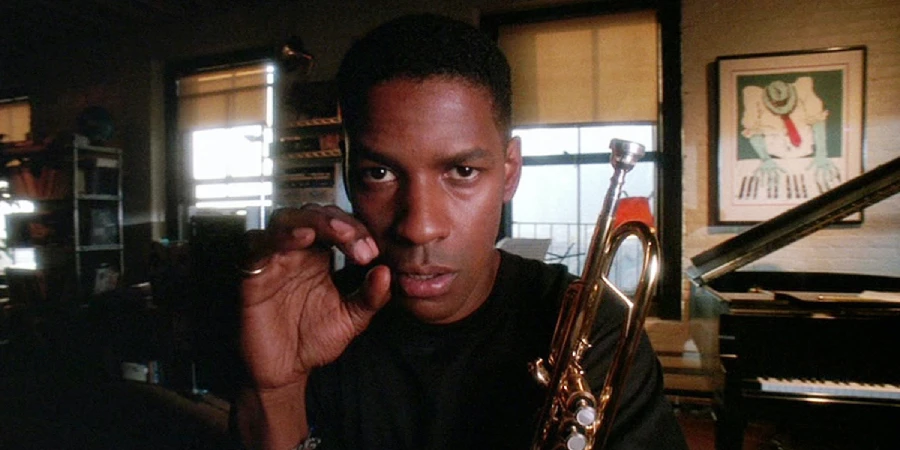

Spike Lee shot the opening scene of Mo’ Better Blues with young Bleek Gilliam practicing trumpet while his friends play outside, and that single image locks in everything the film will spend two hours unpacking. Denzel Washington plays Bleek as a man so deep inside his music that he barely registers the people orbiting him. Lee frames jazz not as a backdrop but as a compulsion that crowds out love, loyalty, and basic human decency. This is a film about a gifted man who is also, for most of its runtime, a genuinely selfish one.
Detailed Summary
Young Bleek and the Trumpet
Before the credits finish, Lee plants his thesis. Young Bleek wants to go outside and play with his friends. His mother refuses, insisting he practice. His father quietly disagrees but loses the argument. Bleek stays inside, pressing his lips to the trumpet while the sounds of childhood drift through the window.
That early scene is not just backstory. It establishes that Bleek’s devotion to music was partly imposed, partly chosen, and has always required sacrifice of human connection.
Adult Bleek and the Bleek Quintet
Adult Bleek, played by Washington, leads his own jazz group in Brooklyn. His manager and childhood friend Giant, played by Spike Lee himself, handles bookings with spectacular incompetence. Giant gambles heavily and owes money to two low-level gangsters, Madlock and Rod.
Bleek treats Giant with a mix of affection and contempt. He keeps him around out of loyalty but never lets him forget who the real talent is. That dynamic bristles with tension from their very first shared scene.
Clarke and Indigo: Bleek’s Two Women
Bleek juggles two relationships simultaneously and sees nothing wrong with that. Clarke Betancourt, played by Cynda Williams, is a singer who wants to perform with the quintet. Indigo Downes, played by Joie Lee, is warmer, more grounded, and clearly more invested in Bleek than he is in her.
Bleek schedules both women for the same evening on more than one occasion. He is not charming about it. Washington plays these scenes with a cool arrogance that makes Bleek hard to root for but impossible to look away from.
Giant’s Debt Spirals Downward
Giant’s gambling debts grow past the point of manageable. Madlock and Rod pressure him repeatedly. Giant keeps borrowing from Bleek and keeps losing. His inability to stop gambling reads less like a character flaw and more like a full addiction Lee refuses to soften or excuse.
Bleek bails Giant out financially more than once but never addresses the root problem. He hands over money and walks away. That passivity, dressed up as generosity, carries its own moral charge.
Tension Inside the Quintet
Saxophonist Shadow Henderson, played by Wesley Snipes, emerges as the creative and commercial rival inside the band. Shadow wants more solo time. He wants to pursue a more accessible sound. Audiences respond to him warmly.
Bleek resists every suggestion. His grip on artistic control is absolute, and watching Snipes simmer through rehearsals and gigs is one of the film’s real pleasures. Shadow is not wrong about the music. He is also not entirely right about everything else.
Clarke Moves Toward Shadow
Clarke grows frustrated with Bleek’s emotional unavailability. She wants inclusion, recognition, a future. Bleek offers none of those things in any meaningful way. Shadow moves in on her, and she lets him.
When Bleek discovers the relationship, his reaction is more wounded pride than genuine grief. Lee shoots the confrontation in a cramped apartment with flat, harsh light, and Washington’s face cycles from disbelief to coldness in about four seconds. It is a sharp, precise piece of acting.
The Beating
Giant’s debt finally catches up with both of them. Madlock and Rod ambush Giant and Bleek outside a club. They beat Giant badly. Then they turn on Bleek.
One of them shoves a trumpet into Bleek’s mouth and slams it. His lip is shattered. For a trumpet player, that injury is not just physical damage. It ends the life he has built entirely around one physical capability.
Bleek’s Attempt at a Comeback
After a period of recovery, Bleek attempts to perform again. He walks onstage at a club where the Bleek Quintet, now led by Shadow, is playing. He asks to sit in. Shadow gives him the stage.
Bleek plays. It is awful. His lip will not cooperate, his tone is gone, and the notes that once came effortlessly now resist him. Washington plays the scene without vanity, letting Bleek fail fully and publicly. That scene hurts to watch, which is exactly the point.
Bleek Goes to Indigo
Stripped of music, Bleek shows up at Indigo’s door late at night. He has nothing to offer except his finally undivided self. He asks her to marry him. Indigo, who has every reason to say no, says yes.
This moment divides audiences. Some read it as earned redemption. Others read it as Bleek replacing one obsession with another. Lee does not entirely resolve that ambiguity, and he deserves credit for leaving it open.
Movie Ending
Lee closes the film with a structural mirror of its opening. Bleek and Indigo are now married with a young son. The boy is outside, playing with other kids. Bleek calls him in to practice trumpet.
Indigo watches and says, quietly but firmly, that it is Sunday and the boy should be allowed to play. Bleek backs down. He lets his son go outside.
That single act is the payoff for the entire film. Young Bleek was never given that choice. His mother won that argument, and the result was a virtuoso who barely knew how to be a person. Adult Bleek, humbled and changed, makes a different call.
It is a quiet ending, almost domestic in its simplicity. Lee resists any grand musical flourish. No trumpet swells on the soundtrack. The boy runs outside into sunlight, and the film cuts. The restraint here is exactly right, and it makes the ending land harder than any conventional triumph would.
Are There Post-Credits Scenes?
Mo’ Better Blues has no post-credits scene. Once the film ends, it ends. No bonus footage, no Easter egg sequence, nothing. You can leave when the credits roll.
Type of Movie
Mo’ Better Blues is a drama with a strong musical identity. It sits in the tradition of American films about artistic obsession and the personal wreckage that ambition can leave behind.
The tone shifts across its runtime. Early sections carry a loose, almost playful energy. As Giant’s debts tighten and Bleek’s relationships collapse, the film darkens considerably. By the final act, it is something closer to a quiet tragedy that refuses to fully declare itself as one.
Cast
- Denzel Washington – Bleek Gilliam
- Spike Lee – Giant
- Wesley Snipes – Shadow Henderson
- Joie Lee – Indigo Downes
- Cynda Williams – Clarke Betancourt
- Giancarlo Esposito – Left Hand Lacey
- Bill Nunn – Bottom Hammer
- John Turturro – Moe Flatbush
- Nicholas Turturro – Josh Flatbush
- Dick Anthony Williams – Big Stop Williams
- Abbey Lincoln – Bleek’s mother
- Ossie Davis – Bleek’s father
Film Music and Composer
Branford Marsalis served as the film’s music supervisor and was central to shaping its jazz sound. The actual trumpet performances attributed to Bleek were performed by Terence Blanchard, who also composed the score. Blanchard’s contributions to the film go well beyond a typical film scoring assignment.
Blanchard’s trumpet work gives Bleek’s playing a genuine voice. When the performance on stage collapses after the injury, audiences who know jazz feel the specific wrongness in those notes. That specificity is what separates the music here from decorative movie jazz.
The score moves between lush orchestral passages and tight, small-group jazz. Blanchard treats the two modes as emotional registers rather than genre labels, deploying each depending on whether Bleek is in his element or stumbling outside it.


Filming Locations
Mo’ Better Blues was shot primarily in Brooklyn, New York, the borough Lee has treated as home territory across much of his career. The club scenes used real New York locations dressed to feel lived-in rather than constructed.
Brooklyn’s streets, stoops, and apartment buildings give the film a texture that a studio lot could not replicate. Bleek’s world feels specific and local, which makes his insularity more believable. A man this rooted in a place can convince himself the world extends only as far as his next gig.
Lee shot scenes in and around Fort Greene, Brooklyn, a neighborhood with deep ties to the African American artistic community. That choice grounds the film’s cultural identity without ever needing to explain itself.
Awards and Nominations
Cynda Williams received some recognition for her performance as Clarke, and the film earned attention during its release year, but Mo’ Better Blues did not accumulate a significant awards profile at major ceremonies. It performed respectably at the box office and earned strong critical coverage, but the awards conversation that year moved past it quickly.
Behind the Scenes Insights
- Denzel Washington trained seriously on trumpet for the role, learning proper embouchure and fingering so his physical performance would read as authentic on screen.
- Terence Blanchard and his band performed all the music live on set during filming, which gave the club scenes an energy that playback rarely produces.
- Spike Lee cast his sister Joie Lee as Indigo and his father Bill Lee composed music for some of his earlier films, making this a partly family production in both spirit and execution.
- Wesley Snipes also trained on saxophone to make Shadow’s performances credible.
- The casting of John Turturro and Nicholas Turturro as the club owners Moe and Josh Flatbush drew criticism from some Jewish organizations who felt the characters played into stereotypes. Lee defended his choices publicly.
- Lee wrote the script partly as a tribute to his father, Bill Lee, a jazz bassist who he felt the music industry had treated unfairly.
Inspirations and References
Lee has cited his father’s career as a jazz musician as the primary emotional engine behind the film. Bill Lee worked as a bassist for years without achieving the commercial recognition his talent arguably warranted. That frustration feeds directly into Bleek’s story, even if the characters share no direct biographical overlap.
The film also draws on a long tradition of American narratives about artistic obsession crowding out personal happiness. Lee was aware of those predecessors and was more interested in a specifically Black American jazz world than in the generic “tortured artist” template.
Certain visual and structural choices nod to classic Hollywood musicals and backstage dramas, but Lee filters them through his own documentary-influenced street aesthetic. The combination feels intentional rather than inconsistent.
Alternate Endings and Deleted Scenes
No widely documented alternate ending or significant deleted scene package for Mo’ Better Blues has entered the public record. Lee has discussed the film extensively in interviews over the years without flagging a substantially different cut.
Given that Lee was working with a degree of studio backing through Universal, some negotiation over content almost certainly happened at the scripting stage, but specifics of what was cut or changed before production have not been detailed in available sources.
Book Adaptations and Differences
Mo’ Better Blues is not based on a book or previously published source material. Spike Lee wrote the original screenplay himself. No comparison to a source novel or story applies here.

Memorable Scenes and Quotes
Key Scenes
- The opening trumpet practice: Young Bleek plays alone while friends’ voices drift through the window, his mother standing firm and his father silent. Two minutes of screen time that the rest of the film unpacks.
- Bleek scheduling both women: Washington keeps his voice flat and his body language unbothered as he manages two simultaneous relationships with the administrative calm of a man booking studio time. The comedy and the ugliness share the same beat.
- Shadow’s saxophone solo at the club: Snipes takes the spotlight and the crowd responds, and Lee shoots Bleek watching from the side with an expression that mixes pride, jealousy, and something that might be fear.
- The beating outside the club: Shot with sudden, ugly violence after a film full of smooth surfaces. The trumpet forced into Bleek’s mouth is one of Lee’s most visceral images.
- Bleek’s failed comeback performance: Washington stands at the microphone and plays badly, and Lee holds on him long enough that the discomfort becomes almost unbearable. No cutaways, no mercy.
- The final scene with Bleek’s son: Bleek calls the boy inside, Indigo intervenes quietly, and Bleek lets the boy go. Thirty seconds of action that pays off two hours of character work.
Iconic Quotes
- Bleek to Giant: “You are my manager and my friend. But if you ever put my music in jeopardy again, you won’t be either.”
- Giant, repeatedly: “It’s mo’ better.” (His recurring phrase, which gives the film its title and doubles as his personal philosophy of wishful optimism.)
- Indigo to Bleek: “You have two women and you’re treating both of us like we’re second.”
Easter Eggs and Hidden Details
- The name “Bleek” is not accidental. It rhymes with and evokes “bleak,” a quiet signal about where this story is headed long before the beating happens.
- Spike Lee includes a reference to Brooklyn’s Fort Greene neighborhood, the same community that appears across several of his films, building a loose cinematic geography of Black Brooklyn life.
- Bill Lee, Spike’s father, appears in a small role in the film, continuing a tradition Lee established in earlier work of casting his father as a kind of living tribute.
- The trumpet that gets forced into Bleek’s mouth is specifically his own instrument, the one he has played throughout the film. The symbolic violence of destroying the thing he loves most with the thing he loves most is not subtle, but it lands.
- Lee shoots the two women, Clarke and Indigo, in noticeably different color temperatures in early scenes. Clarke gets warmer, more saturated lighting. Indigo’s scenes skew cooler and more natural. As Bleek’s arc resolves, those palettes begin to reverse.
Trivia
- Terence Blanchard went on to become one of the most prominent jazz composers working in film, with much of his later career growing directly from the visibility this film gave him.
- Denzel Washington and Spike Lee would not work together again for decades after this film, despite the clear chemistry between Washington’s disciplined screen presence and Lee’s maximalist direction.
- Wesley Snipes had appeared in Lee’s Jungle Fever and Do the Right Thing, making him a recurring collaborator during this period of Lee’s career.
- Cynda Williams was a relatively unknown actress at the time of casting. Lee took a significant chance on her, and her performance as Clarke remains her most prominent screen work.
- The film’s title comes from dialogue rather than from the jazz terminology one might expect. Giant uses the phrase “mo’ better” as a general expression of approval, and Lee lifted it for the title.
- Ossie Davis and Abbey Lincoln, cast as Bleek’s parents, were themselves serious figures in African American cultural and artistic life, lending a quiet authority to even their limited screen time.
Why Watch?
Washington’s performance here is the most interesting work he did before his Oscar win for Training Day, precisely because Bleek is not designed to earn affection. Watching a movie star play a man who genuinely fails the people around him, without redemptive softening until the very last scene, is rarer than it should be. Lee and Washington together make Bleek’s selfishness specific and human rather than symbolic, and that specificity is what makes the final thirty seconds hit as hard as they do.
Director’s Other Movies
- She’s Gotta Have It (1986)
- School Daze (1988)
- Do the Right Thing (1989)
- Jungle Fever (1991)
- Malcolm X (1992)
- Crooklyn (1994)
- Clockers (1995)
- He Got Game (1998)
- Summer of Sam (1999)
- 25th Hour (2002)
- Inside Man (2006)
- BlacKkKlansman (2018)
Recommended Films for Fans
- Round Midnight (1986)
- Bird (1988)
- Do the Right Thing (1989)
- Jungle Fever (1991)
- Kansas City (1996)
- Whiplash (2014)
- La La Land (2016)
- Ma Rainey’s Black Bottom (2020)