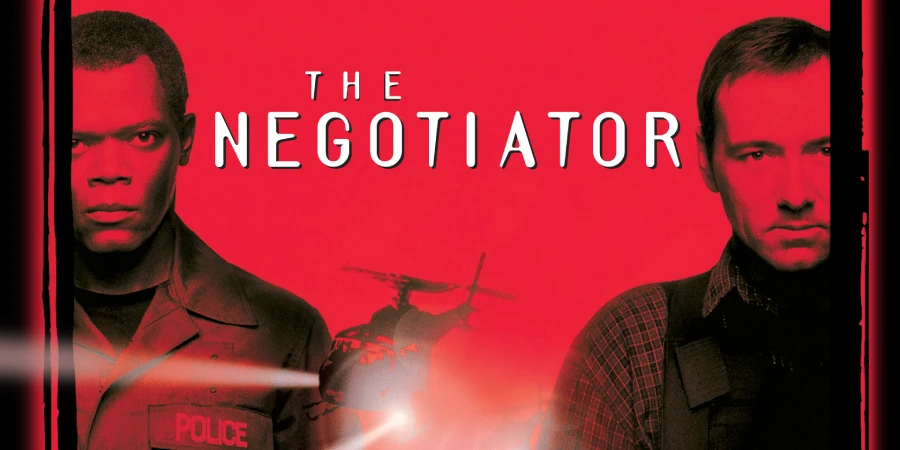

Samuel L. Jackson holds a gun to his own head in the first reel, and somehow that is not even close to the most audacious thing The Negotiator pulls off. F. Gary Gray’s 1998 thriller runs on a blunt, electrifying premise: a hostage negotiator takes hostages. Jackson plays Danny Roman, a Chicago cop so desperate to prove his innocence that he commits the very kind of crime his career was built on stopping. Paired against Kevin Spacey at the absolute peak of his screen charisma, the film delivers two hours of verbal combat that most action thrillers do not even attempt.
Detailed Summary
Danny Roman, the Best in the Business
We meet Danny Roman as a legend. His colleagues respect him, his bosses trust him, and he talks a suicidal man off a ledge in the opening sequence with calm, almost surgical precision. Gray frames this scene in tight close-ups, showing Roman’s face reading the man across from him like a book, measuring every micro-expression.
Roman’s personal life looks good too. He is engaged, financially stable, and talking about the future. That stability makes what follows hit harder.
The Frame-Up
Roman’s partner, Nate Roenick, tells him that someone inside the police department has been skimming from the disability pension fund. Roenick has evidence. Before he can hand it over, he turns up dead, shot in what the department rules a suicide.
Internal Affairs investigator Terence Niebaum starts sniffing around Roman instead. Roman quickly realizes the evidence has been manipulated to point directly at him. Someone with access, someone inside the department, set him up to take the fall for the embezzlement and for Roenick’s murder.
Roman Takes Hostages
Cornered and facing arrest, Roman does something that should be career suicide: he takes Niebaum and several others hostage inside the Internal Affairs office building. His logic is ruthless and clear. Nobody will listen to an accused cop, but everyone will listen to a hostage situation.
He uses the one skill nobody can take from him. Roman runs the negotiation from the inside, controlling the pace, feeding information to the outside, buying himself time to find proof.
Sabian Is Called In
Roman’s one condition for talking to anyone: he wants Chris Sabian, a negotiator from a different district, someone Roman has never met and therefore cannot have corrupted. Sabian, played by Kevin Spacey with a low-key confidence that becomes genuinely riveting to watch, arrives already knowing this situation is a trap.
Sabian has his own careful style. Where Roman is instinct and pressure, Sabian is patience and silence. Gray stages their first phone call beautifully, cutting between two men who are essentially playing the same game from opposite sides of a building wall.
The Investigation Inside the Siege
While holding his hostages, Roman interrogates Niebaum and searches for evidence connecting the real embezzlers. He finds enough threads to confirm his suspicion: the conspiracy reaches high into the department, involving a shadowy figure connected to the pension fund scheme.
His hostages include Niebaum, an aide named Maggie, and a few others who become part of Roman’s effort to expose the truth. Roman keeps them physically unharmed, but the psychological pressure he applies to Niebaum is relentless.
The Walls Close In
Outside, the police commander Frost and a tactical team grow increasingly impatient. A sniper nearly kills Roman early on. Corrupt officers on the scene are actively trying to end the standoff with Roman dead, because a dead Roman cannot testify.
Sabian keeps threading the needle, stalling the tactical teams while quietly starting to believe Roman’s story. Jackson plays Roman’s desperation with full-body intensity, pacing the office, gripping doorframes, his voice cracking at precise moments when the control slips.
Niebaum’s Fate
Niebaum refuses to cooperate. Near the climax, someone shoots him from outside the building, killing him before he can confirm anything. Roman is horrified. This is not his doing, and both he and Sabian understand immediately that someone on the outside wanted Niebaum silenced permanently.
That murder inside a supposedly controlled perimeter proves that Roman’s conspiracy theory is not paranoia. Someone with authority over the tactical operation just committed a murder to protect themselves.

Movie Ending
Sabian crosses into the building to meet Roman face to face, a move that surprises everyone outside and signals that he has effectively switched allegiances from the command post to the truth. Their meeting inside the office is the film’s best scene: two skilled professionals, both armed, both suspicious, circling each other and slowly, reluctantly, choosing to trust.
Roman and Sabian piece together that Commander Grant Frost and his associate Adam Beck are the architects of the pension fund theft and Roenick’s murder. Beck is the one who shot Niebaum from the perimeter. The evidence Roman has gathered, combined with Niebaum’s files, gives them something to work with.
Sabian gets the proof out. Roman surrenders, but not before the corrupt officers make one last attempt to kill him during the arrest. Beck pulls a weapon on Roman in front of witnesses. Roman draws and fires first, killing Beck. Frost, cornered and exposed, shoots himself rather than face arrest.
Roman walks out alive, cleared of the charges against him. He is not entirely free of consequences, but the people who murdered his partner are dead or exposed. Sabian, who risked his career by walking into that building, watches Roman come out with something close to professional respect.
Gray closes on a note that earns its emotion without reaching for it. Roman and Sabian share a quiet exchange, two men who understand each other’s craft in a way nobody else in that parking lot does. Gray keeps the camera at a distance here, letting the physical space between the men say what dialogue does not need to.
Are There Post-Credits Scenes?
The Negotiator has no post-credits scene. Gray wraps everything cleanly before the credits begin, and nothing follows them.
Type of Movie
This is a thriller with strong procedural elements. Gray and screenwriters James DeMonaco and Kevin Fox root the film in police department politics, giving it a grounded texture that pure action films ignore.
The tone stays tense and adult throughout. There is action, but verbal confrontation drives more of the film than gunfire does. Think of it as a pressure-cooker drama that occasionally explodes rather than a shoot-em-up that occasionally slows down to talk.
Cast
- Samuel L. Jackson – Danny Roman
- Kevin Spacey – Chris Sabian
- David Morse – Commander Grant Frost
- Ron Rifkin – Terence Niebaum
- John Spencer – Commander Al Travis
- J.T. Walsh – Inspector Rudy Timmons
- Siobhan Fallon Hogan – Maggie
- Paul Giamatti – Rudy Timmons (note: Walsh and Giamatti both appear in key supporting roles)
- Regina Taylor – Karen Roman
- Bruce Beatty – Palermo
Film Music and Composer
Graeme Revell composed the score. Revell built a career in tense, urban-flavored genre pictures, and his work here leans into synth-heavy textures layered with orchestral elements.
The music rarely tries to swell emotionally. It sits under scenes like ambient pressure, amplifying tension without explaining it. That restraint suits the film well, because the dialogue is already doing the heavy lifting.
Filming Locations
Principal photography took place in Chicago. Gray uses the city’s brutalist architecture and industrial interiors to great effect, particularly the office building siege sequences, which feel genuinely claustrophobic partly because the spaces themselves are oppressive.
Chicago also provides authentic texture for the police department world the film inhabits. These are not glossy precinct sets. Gray shoots in spaces that look bureaucratic and worn, which makes the corruption feel plausible rather than cinematic shorthand.
Awards and Nominations
The Negotiator did not receive major awards attention despite its commercial success. Jackson and Spacey received some recognition in critics’ circles for their performances, but the film did not crack major awards season conversations that year.
Behind the Scenes Insights
- Jackson and Spacey reportedly had limited time on set together before filming their key scenes, which some accounts suggest actually helped the natural wariness between their characters.
- F. Gary Gray had come off Set It Off (1996) before taking this project, and he pushed for a grounded, practical approach to the action rather than stylized set pieces.
- J.T. Walsh, who plays Inspector Rudy Timmons, died before the film was released, making this one of his final screen appearances.
- The production made extensive use of real Chicago city buildings rather than constructed sets, which added logistical complexity but paid off visually.
- Gray kept the two lead actors separated during prep in certain respects to preserve the sense that Roman and Sabian genuinely do not know each other.
Inspirations and References
DeMonaco and Fox drew from real-world hostage negotiation methodology and documented cases of police corruption. The procedural accuracy around negotiation tactics, the way Roman reads and manipulates his counterpart, reflects genuine crisis negotiation training principles.
Films like Dog Day Afternoon (1975) cast a long shadow over any movie about a siege from the inside. Gray and his writers seem aware of that lineage and consciously push their protagonist into morally complex territory rather than casting him as a pure victim.
Alternate Endings and Deleted Scenes
No widely documented alternate endings or significant deleted scenes have entered the public record for this film. Gray’s cut appears to be the version closest to the intended final product.
Some pacing edits were made in post-production, particularly to tighten the second act, but specifics of what was cut have not been detailed in available production materials.
Book Adaptations and Differences
The Negotiator is not based on a book. DeMonaco and Fox wrote an original screenplay. A novelization was published to accompany the film’s release, but the screenplay came first.

Memorable Scenes and Quotes
Key Scenes
- The opening negotiation: Roman talks a man down from a rooftop ledge, and Gray shoots it in near-silence, Roman’s voice the only instrument that matters.
- Roman takes the building: Jackson moves through the Internal Affairs offices with a controlled fury, and the camera stays close, almost uncomfortably so, refusing to give the scene the wide shot that would make it feel like spectacle.
- The first Sabian phone call: Two voices, two silences, two men sizing each other up through dead air.
- Sabian walks into the building: He steps past the police line without authorization, and Gray holds on the faces of the officers who watch him go, none of them willing to stop him.
- Niebaum’s murder: A shot from outside, through glass, and Roman stares at the body knowing this changes everything and proves everything simultaneously.
- Beck’s death: Roman draws and fires in a single motion when Beck raises his gun, and the film does not slow it down or glamorize it.
Iconic Quotes
- “Don’t you talk to me about hostages. I know more about this situation than you’ll ever know.” – Danny Roman
- “You think I’m going to do this without checking every angle?” – Chris Sabian
- “I’m a cop. I know how this works. They’ll kill me in the street and call it justified.” – Danny Roman
Easter Eggs and Hidden Details
- The disability pension fund at the center of the conspiracy is a pointed thematic choice: the crime targets officers who were hurt in the line of duty, which adds a particular ugliness to the corruption.
- Roman’s negotiation tactics inside the siege mirror, almost point for point, standard crisis negotiation protocol, which gives attentive viewers an ironic second layer as they watch him deploy his own tools against himself.
- Gray places a visible American flag in several key interior shots, a background detail that quietly underlines the institutional betrayal at the story’s center.
- Sabian’s first appearance finds him in a domestic setting rather than a professional one, establishing immediately that his priorities run differently from the department men surrounding Roman.
Trivia
- The Negotiator was one of the first major studio films to pair two Black leads in a prestige thriller of this scale and budget, which was a notable industry moment in 1998. (Note: Spacey is white; Jackson carries the film as the sole lead.)
- J.T. Walsh completed all his scenes before his death in February 1998; the film was released in July of that year.
- Gray was in his late twenties when he directed this film, making him one of the younger directors to helm a production of this scope at a major studio.
- DeMonaco, one of the screenwriters, would go on to write and direct The Purge franchise, a very different kind of film about institutional breakdown.
- The film performed solidly at the box office and introduced many audiences to Spacey in a non-villainous role, which was a slight shift from his Usual Suspects and Se7en persona at the time.
Why Watch?
Watch it for the forty-five minutes when Jackson and Spacey are finally in the same room, circling each other with nothing but words and body language as weapons. Jackson’s hands are constantly moving in that sequence, touching walls, adjusting his grip, betraying the exhaustion under the performance of control. No other mainstream thriller from that decade gives its two leads that much verbal room to work.
Director’s Other Movies
- Friday (1995)
- Set It Off (1996)
- The Italian Job (2003)
- Be Cool (2005)
- Law Abiding Citizen (2009)
- Straight Outta Compton (2015)
- The Fate of the Furious (2017)