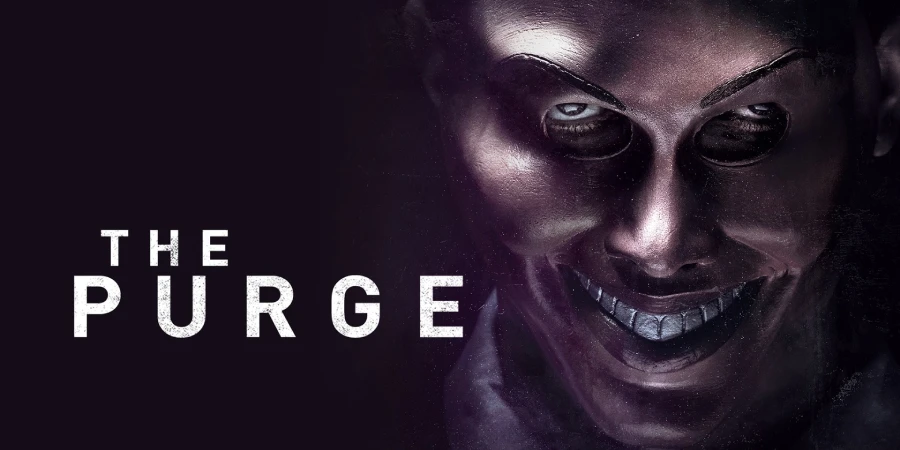

One night a year, all crime is legal in America, and a family with a state-of-the-art security system lets a stranger inside. That single bad decision drives The Purge forward with the relentless logic of a nightmare. Writer-director James DeMonaco built his 2013 home-invasion thriller around a genuinely unsettling premise, one that doubles as a critique of class privilege and suburban self-deception. What keeps it interesting is how the Sandin family’s safety net fails them in every way that actually matters.
Detailed Summary
The World of the Purge
The Purge opens with surveillance footage of real Purge violence, played over a cheerful electronic tone. It is 2022. A political movement called the New Founding Fathers of America rules the country, and one night per year, from 7 p.m. to 7 a.m., all criminal activity is legal.
Crime and unemployment are near zero in this America. The official line is that Purging lets citizens release aggression. A darker implication hangs over everything: the poor and vulnerable bear the brunt of the violence while the wealthy lock their doors and wait it out.
Meet the Sandins
James Sandin sells high-end home security systems, and his sales have boomed precisely because of the Purge. He lives in a large suburban house with his wife Mary, teenage daughter Zoey, and younger son Charlie. James has made a fortune off his neighbors’ fear.
His neighbors resent him quietly for it. We see that resentment early, in polite smiles that do not reach anyone’s eyes. That social tension pays off in a big way before the film ends.
Lockdown Begins
At 7 p.m., James activates the home’s security: steel shutters roll down over windows and doors, cameras cover every angle, and the family settles in for the night. Zoey’s older boyfriend Henry hides inside the house without anyone knowing. Charlie watches the security feeds on his tablet.
Charlie spots a bleeding, desperate Black man outside screaming for help. Against his father’s wishes, Charlie disarms the security system and lets the man inside. That single act of childhood compassion unravels everything.
The Stranger and the Hunters
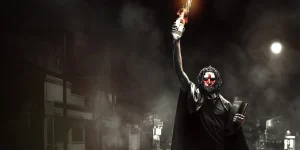
Soon a group of wealthy, mask-wearing young people surrounds the Sandin house. Their leader, a polished and disturbingly calm young man, addresses the family via intercom. He demands that the Sandins hand over the Bloody Stranger, as the group has been hunting him.
If the family refuses, the group will break through the security system and kill everyone inside. James wants to hand the stranger over. Mary is less certain. Charlie hides the stranger and refuses to reveal his location.
Henry’s Attack and the Family Fracture
Zoey’s boyfriend Henry emerges and shoots James, trying to kill him so Zoey will be forced to leave with him. James survives, but the wound slows him significantly for the rest of the film. Henry dies in the confrontation.
James and Mary now have to secure the house, find the hiding stranger, and fend off an incoming attack, all while injured. Charlie roams the house with a remote-controlled camera robot, trying to locate the stranger before his parents do. The family fractures under pressure exactly when it needs to hold together.
The Purgers Break In
James calls back the leader and refuses to surrender the stranger. Time runs out. The group cuts the power and tears through the security shutters with heavy equipment. Once inside, they spread out and begin hunting methodically.
James takes out several of them in brutal, close-quarters fights. His performance here is one of the film’s better surprises; Ethan Hawke plays James as a man who is competent with violence but visibly disgusted by himself each time he uses it. That self-disgust reads clearly on his face in the hallway scenes, lit mostly in blue-gray shadow.
The Stranger Fights Back
The Bloody Stranger, played by Edwin Hodge, is not passive. He arms himself and fights alongside the family once it becomes clear that surrendering means death for him and possibly for them too. His dynamic with the Sandins carries a complicated charge; they saved him, yes, but they also almost handed him over.
Charlie finds the stranger and makes the moral case for protecting him. That argument lands differently once you remember that Charlie’s comfortable life was funded by tools designed to keep people like the stranger out.
The Neighbors Arrive
Just when the Purge group seems defeated, the neighbors arrive. Not to help. They come armed, entering the house and subduing James and Mary at gunpoint. They announce their intention to kill the entire Sandin family during the remaining Purge window.
Their grievance is class-based: James got rich selling security while looking down on the neighborhood, or so they believe. Their smiles are absolutely chilling. This is the film’s sharpest scene, and it works because DeMonaco planted those strained smiles in the first act.
Movie Ending
Mary pleads for her family’s lives as the neighbors close in, weapons raised. Then the Bloody Stranger reappears. He disarms the neighbors and lines them up at gunpoint. Rather than executing them, he tells them to stop.
Mary takes the lead here. She orders the neighbors out of her house with cold, quiet authority. Nobody dies in that final confrontation. The Purge ends at 7 a.m., sirens sound, and the violence officially closes for another year.
Zoey, James, Mary, and Charlie survive. The Bloody Stranger survives. He walks out into the morning light as the sirens fade. No catharsis arrives, just an uncomfortable return to normalcy.
What the ending refuses to resolve is the point. James nearly sent a man to his death to protect property and comfort. The neighbors nearly committed murder over resentment and envy. Charlie was the only one who acted from genuine moral instinct, and he is twelve years old. DeMonaco frames the final shot of the family sitting in silence as something closer to shame than relief. That quiet discomfort is the film’s real last word.
Are There Post-Credits Scenes?
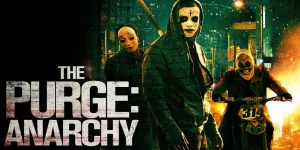
The Purge has no post-credits scene. Once the credits roll, it is over. No teasers, no sequels set up on screen, though the franchise did continue with The Purge: Anarchy in 2014.
Type of Movie
The Purge is primarily a home-invasion thriller with strong elements of dystopian science fiction and social horror. Its tone is tense and claustrophobic, especially once the purgers breach the house. DeMonaco keeps the horror grounded rather than supernatural.
The film has a satirical streak running underneath the genre mechanics. It is not subtle about its class commentary, but it earns its cynicism by paying off every social detail it sets up in act one.
Cast
- Ethan Hawke – James Sandin
- Lena Headey – Mary Sandin
- Max Burkholder – Charlie Sandin
- Adelaide Kane – Zoey Sandin
- Edwin Hodge – Bloody Stranger
- Rhys Wakefield – Polite Leader
- Tony Oller – Henry
- Arija Bareikis – Mrs. Halverson
- Tom Yi – Mr. Halverson
Film Music and Composer
Nathan Whitehead composed the score for The Purge. His work here leans into electronic tones and dissonant strings, keeping the sound palette cold and mechanical to match the film’s sterile suburban setting. The score rarely telegraphs scares directly; it tends to unsettle rather than startle.
Whitehead returned to score later entries in the franchise. His background includes work across horror and thriller projects, and The Purge put him on the map as a composer comfortable with sustained dread rather than jump-scare punctuation.
Filming Locations
The Purge was shot primarily in Los Angeles, California. Production used a house in a residential neighborhood to achieve that specific brand of upper-middle-class suburban comfort. The production design leans into clean lines, wide hallways, and expensive-looking finishes, all of which become oppressive once the shutters come down.
Keeping the film almost entirely inside one location was a deliberate choice, driven partly by budget and partly by dramatic purpose. The house functions as a trap, not a sanctuary. Every room the family retreats to becomes another corner to be backed into.
Awards and Nominations
The Purge did not receive significant awards attention from major bodies. Its recognition came commercially rather than critically, grossing well above its modest budget and launching a franchise.
Behind the Scenes Insights
- James DeMonaco wrote the screenplay after a road-rage incident in which a friend’s calm response to an aggressive driver made him wonder what would happen if people could act on their worst impulses without legal consequence.
- The film was produced by Jason Blum under Blumhouse Productions, using the low-budget, high-concept model that Blumhouse had already proven with Paranormal Activity.
- Ethan Hawke was drawn to the project partly because of the political subtext, describing the premise as a way to explore American attitudes toward violence and economic inequality.
- Rhys Wakefield based his performance as the Polite Leader partly on the performative politeness of cult recruiters, keeping his voice warm while his eyes register nothing.
- The production shot on a tight schedule, a common Blumhouse constraint that forced quick decisions and kept the energy on set urgent.
- Much of the film relies on practical lighting, using the house’s interior fixtures and handheld camera work to create a sense of claustrophobia without relying heavily on post-production effects.
Inspirations and References
DeMonaco has cited American political anxiety and gun culture as direct inspirations. The concept of state-sanctioned violence as social control draws on real historical examples of governments using fear to manage populations. The film does not reference a specific historical event, but the New Founding Fathers clearly evoke authoritarian nationalism.
Classic home-invasion films like Straw Dogs (1971) and Funny Games (1997) are obvious reference points in terms of genre mechanics. The Purge borrows the locked-house structure from both but adds the institutional layer that neither of those films uses.
Richard Connell’s short story The Most Dangerous Game, in which humans hunt other humans for sport, hovers in the background of every scene where the masked group stalks the property. DeMonaco has not named it specifically as a source, but the connection is hard to miss.
Alternate Endings and Deleted Scenes
No officially released alternate ending exists for The Purge. Blumhouse did not include alternate cut material on standard home releases. Some deleted scenes exist but have not been widely distributed or documented in detail.
Early drafts of the screenplay reportedly explored a broader societal view of Purge Night rather than limiting the action to one house. That wider scope eventually became the approach for The Purge: Anarchy.
Book Adaptations and Differences
The Purge is an original screenplay, not based on a book or any other pre-existing source material. James DeMonaco wrote it directly for the screen. No novel adaptation of the original film exists as a source text to compare against.
Memorable Scenes and Quotes
Key Scenes
- Charlie disarming the security system and letting the Bloody Stranger inside, a quiet, devastating moment of moral courage that the film immediately punishes him for.
- The Polite Leader’s first intercom address to the family, shot from outside the house so we see his mask-wearing group in the background while he speaks with casual warmth about killing.
- Ethan Hawke’s hallway fight sequence, lit in near-darkness with blue-gray shadows, where James takes out multiple purgers and looks genuinely horrified at his own efficiency.
- The neighbors arriving with weapons drawn, their polished suburban clothes contrasting directly with their intent, which is the film’s most pointed image of how thin the social contract actually is.
- Mary’s final confrontation with the neighbors, in which she chooses not to execute them and calmly orders them out, a restraint that reads as both moral and exhausted.
Iconic Quotes
- “Blessed be our New Founding Fathers and America, a nation reborn.” (The official Purge commencement announcement)
- “We paid for our safety with your life.” (Charlie to the Bloody Stranger)
- “Release the beast.” (Polite Leader, describing the philosophy behind the Purge)
- “Take your hands off my family.” (Mary Sandin, to the neighbors)
Easter Eggs and Hidden Details
- The surveillance footage that opens the film is shot in different aspect ratios and camera qualities to suggest real archival video, grounding the fictional world immediately in something that feels documented.
- James’s sales trophies are visible throughout the house, constant background reminders that his comfort was purchased by selling fear to his community.
- Charlie’s remote-controlled camera robot has a smiling face drawn on it, a visual detail that makes the device feel childlike while it moves through scenes of escalating violence.
- The Polite Leader’s mask is deliberately blank and smooth-featured, designed to suggest wealth and absence of identity simultaneously.
- Several of the purger group wear preppy, clean clothing rather than tactical gear, a visual signal that they are doing this for entertainment rather than necessity.
- Edwin Hodge’s character, the Bloody Stranger, appears in subsequent Purge franchise installments, connecting the films across their different storylines.
Trivia
- The Purge was made on a reported budget of around $3 million and grossed over $89 million worldwide, making it one of Blumhouse’s most profitable early productions.
- James DeMonaco both wrote and directed the film, which is unusual for a first major studio release in the horror-thriller space.
- Lena Headey was filming Game of Thrones around the same period, which made scheduling a challenge.
- Rhys Wakefield is Australian, and his American accent in the film was noted by several critics as one of the more unsettling elements of his performance.
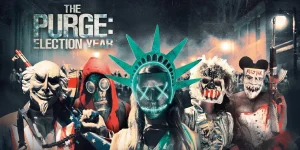
- The franchise expanded to include four sequels and a television series, making the Purge concept one of the more durable dystopian properties in recent American horror.
- DeMonaco originally conceived of the Purge as a near-future American reality, placing the story just close enough to the present to feel like a genuine extrapolation rather than pure fantasy.
Why Watch?
Rhys Wakefield alone is worth the runtime. His Polite Leader keeps his voice warm and his eyes empty for the entire film, and that specific performance captures something genuinely disturbing about how violence gets dressed up in manners. DeMonaco’s screenplay plants its class critique in act one and actually pays it off, which is rarer than it should be in genre filmmaking.