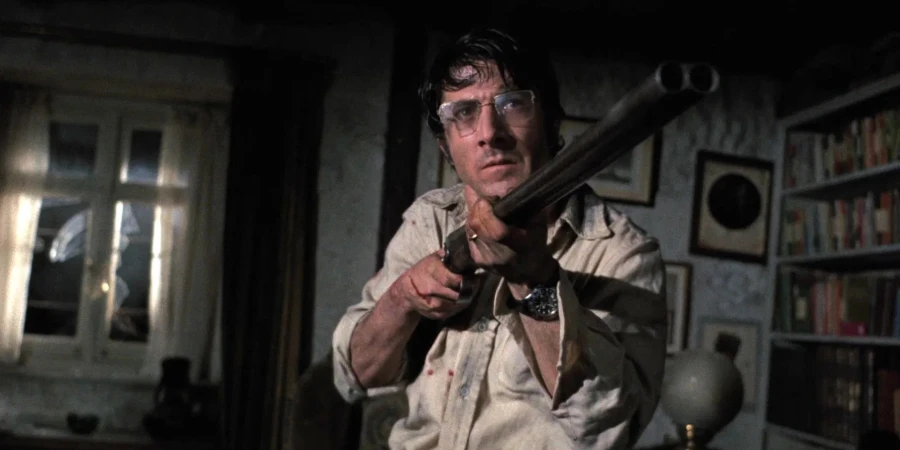

Dustin Hoffman playing a meek American mathematician who ultimately beats a man to death with a poker is not the premise you expect from a prestige 1971 drama. Sam Peckinpah’s Straw Dogs dropped into cinemas and immediately became one of the most argued-about films of its decade, accused of misogyny, celebrated for its unflinching portrait of male violence, and banned in the UK for nearly two decades. It is a film that refuses to let its audience feel comfortable, and that discomfort is the whole point.
Detailed Summary
David and Amy Arrive in Cornwall
David Sumner, played by Dustin Hoffman, is an American astrophysicist who moves with his young British wife Amy to her childhood home in rural Cornwall. He wants quiet and distance from the political unrest back in the United States. What he gets instead is a suffocating, hostile village that reads his gentleness as weakness from the first scene.
Amy, played by Susan George, has local roots, but she is not welcomed warmly either. Her past with Charlie Venner, one of the men hired to repair the Sumner property, simmers from the moment he appears. Peckinpah frames the village men watching Amy constantly, their eyes tracking her like she is inventory.
The Locals and the Power Games Begin
Charlie Venner and his crew begin working on the garage roof, and from day one they undermine David in small, deliberate ways. They steal his cat, kill it, and hang it in his wardrobe. David finds it but says almost nothing. His silence reads as dignity to him and as cowardice to everyone else in the film.
David retreats into his mathematical work, barely registering how much Amy is suffering. Peckinpah shoots her restlessness with a sharp, almost impatient camera. She walks through the house barefoot, braless under a tight sweater, and the film presents this as simultaneously her freedom and her vulnerability, never quite letting the viewer off the hook for noticing.
The Rape Scene
This is the sequence the film will never escape. Charlie lures David away on a pheasant shoot, and while David is gone, Charlie goes to the farmhouse and rapes Amy. Peckinpah shoots the early part of the assault with an ambiguity that remains genuinely controversial: Amy initially appears to respond to Charlie, and the film seems to suggest a complicated history between them. Then a second man, Norman Scutt, arrives and rapes her violently while Charlie holds her down. There is no ambiguity in that second assault.
Susan George’s performance during this sequence is one of the most underrated pieces of acting in 1970s cinema. She does not simply play a victim. She plays a woman experiencing several contradictory emotions simultaneously, which is exactly what makes the scene so hard to watch and so hard to categorize. Peckinpah forces you to sit in the discomfort rather than letting the editing resolve it into something cleaner.
Amy never tells David what happened. She carries it alone, and that silence shapes everything that follows.
David’s Obliviousness and the Village’s Escalation
David continues to absorb insults and provocations without retaliation. He gets into a minor altercation with the locals at a church social. He is physically smaller than most of the village men, quieter, slower to anger. Hoffman plays this not as spinelessness but as a man who has genuinely never been tested, someone who believes civilization is an argument you win with words.
Peckinpah keeps tightening the frame. Shots of the farmhouse feel more enclosed as the film progresses. The fog rolls in off the Cornish moors and the light turns grey and flat. Nothing about the visual world of this film lets you breathe easily.
Tom Hedden and Henry Niles
A subplot involving Tom Hedden, a violent local drunk played by Peter Vaughan, runs alongside the main tension. Hedden’s daughter has been seen with Henry Niles, a simple-minded local man. When she goes missing, Hedden and his mob assume Niles is responsible. David accidentally hits Niles with his car in the fog, injuring him, and brings him back to the farmhouse to protect him while seeking help.
This is the moral hinge of the film. David is protecting a man he does not know, a man the village wants to destroy without a trial. His decision to stand firm is the first genuinely clear moral choice he makes, and it is what triggers the final siege.
Movie Ending
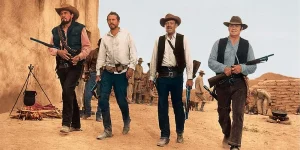
Hedden’s mob arrives at the Sumner farmhouse demanding Niles. David refuses to hand him over. What follows is one of the most sustained and viscerally staged siege sequences in American cinema from that era. Peckinpah shoots it with the same methodical buildup he brought to The Wild Bunch, letting dread accumulate before the violence explodes.
David fights back. Not symbolically. He pours boiling oil on one attacker. He drops a heavy weight on another. He shoots multiple men. Hoffman plays the transformation with a terrifying calm: David’s face does not twist into rage. He becomes efficient, methodical, almost serene. That serenity is more disturbing than any amount of screaming would have been.
Charlie Venner gets inside the house and corners Amy. She shoots him dead with a shotgun, finally acting against the man who raped her. Tom Hedden kills Henry Niles inside the house before David finishes off Hedden himself with a poker. When the smoke clears, most of the mob is dead or fled.
David drives the surviving attacker away from the farm. Niles sits in the back seat, still injured. As they head down the dark road, Niles says he does not know his way home. David replies, quietly, “That’s okay. I don’t either.” Peckinpah freezes the film there. David has won his siege, but he has no idea what he has done to himself or what he is returning to. The line is not triumphant. It is genuinely lost.
Audiences frequently debate whether the ending endorses David’s violence or condemns it. Peckinpah does not answer that question. He just drives the car into the dark and lets you sit with it. That refusal to resolve the moral question is the film’s most provocative choice and, in my view, its most honest one.
Are There Post-Credits Scenes?
Straw Dogs has no post-credits scene. The film ends with the car driving into darkness, and Peckinpah had no interest in softening that exit with anything additional. Walk out when the credits roll, and walk out thinking.
Type of Movie
Straw Dogs is a psychological thriller with strong elements of siege drama and social commentary. Its tone is cold, oppressive, and relentless. It belongs to a specific strain of 1970s cinema that weaponizes genre conventions to interrogate masculinity and violence rather than celebrate them.
This is not a film you watch for entertainment in the traditional sense. It wants to make you uncomfortable and then ask you why you kept watching. Peckinpah builds tension the way a pressure cooker works: no release valve until everything blows.
Cast
- Dustin Hoffman – David Sumner
- Susan George – Amy Sumner
- Peter Vaughan – Tom Hedden
- T.P. McKenna – Major Scott
- Del Henney – Charlie Venner
- Ken Hutchison – Norman Scutt
- Colin Welland – Reverend Hood
- David Warner – Henry Niles
- Peter Arne – John Niles
Film Music and Composer
Jerry Fielding composed the score for Straw Dogs. Fielding had a long working relationship with Peckinpah, having also scored The Wild Bunch. His work here is sparse and unsettling rather than melodic, using low string arrangements and sudden silences to amplify the film’s creeping dread.
Fielding received an Academy Award nomination for his score on this film. His approach treats silence as an instrument, letting the ambient sound of the Cornish countryside do as much tonal work as any orchestration. The effect is a score that feels like held breath.
Filming Locations
Principal photography took place in Cornwall, England, primarily around the village of St. Buryan and the surrounding countryside. The isolated, fog-prone landscape was not a backdrop but a character. Peckinpah used the grey light and the tight, low-horizon topography to make David and Amy feel genuinely trapped.
The farmhouse exterior was a real Cornish property. Shooting on location rather than on a studio lot gave the village scenes a texture that would have been impossible to manufacture. You can feel the damp in the stone walls.
Awards and Nominations
Jerry Fielding’s score earned an Academy Award nomination for Best Original Dramatic Score. Beyond that recognition, the film did not collect major awards hardware, partly because its controversy made it a difficult film for awards bodies to embrace publicly at the time.
Behind the Scenes Insights
- Peckinpah and Hoffman clashed repeatedly during production. Peckinpah reportedly used psychological pressure on Hoffman to keep him off-balance, mirroring David Sumner’s position in the story.
- Susan George has spoken in interviews about how physically and emotionally demanding the rape sequence was to film. She reportedly had limited support on set during those days of shooting.
- Peckinpah shot extensively on location in Cornwall during winter conditions, which contributed to the grey, isolated atmosphere but created genuine hardship for cast and crew.
- The film was shot partly at Pinewood Studios for interior sequences, with Cornwall locations used for exteriors.
- Peckinpah’s working style involved multiple camera setups running simultaneously, a technique he also used on The Wild Bunch to capture action from angles that could not be replicated.
- The dead cat in the wardrobe was a real practical effect. Crew members reportedly found filming that scene unsettling out of all proportion to its screen time.
Inspirations and References
Gordon M. Williams wrote the novel The Siege of Trencher’s Farm in 1969, and that book served as the direct source material for the film. Peckinpah and co-writer David Zelag Goodman made significant changes, particularly in shifting the emphasis from the siege itself to the psychological deterioration of the central marriage and the question of masculine identity.
Peckinpah was also deeply influenced by Konrad Lorenz’s writings on aggression and human nature, particularly the idea that violence is not a corruption of civilization but an engine within it. That thesis runs through the film’s bones.
The title itself comes from a Chinese philosophical text. Lao Tzu wrote about straw dogs as ritual objects used in ceremonies and discarded without sentiment afterward. Peckinpah saw David Sumner as a man who had made himself into a straw dog, ceremonially harmless, until circumstance burned away the ritual.
Alternate Endings and Deleted Scenes
No widely documented alternate ending exists for Straw Dogs. Peckinpah was known for shooting extensive coverage and fighting with studios over final cuts on other projects, but the ending of this film appears to have survived largely as he intended it.
Some trimming reportedly occurred for various national releases due to censorship requirements, particularly around the rape sequence. Certain cuts removed or shortened the ambiguous first portion of that scene, which actually distorted the film’s moral complexity rather than protecting audiences from it.
Book Adaptations and Differences
Straw Dogs adapts The Siege of Trencher’s Farm by Gordon M. Williams. In the novel, the protagonist is less intellectually self-aware and the violence of the siege is less morally loaded. Williams wrote a more conventional thriller structure, with the siege functioning primarily as a survival narrative.
Peckinpah’s film shifts the center of gravity entirely. David Sumner becomes a man whose passivity is a philosophical position, not just a personality trait. The rape of Amy, which occurs in the source material, takes on far greater weight in the film because Peckinpah links it directly to David’s obliviousness and the film’s wider argument about male ego and protection.
Peckinpah also invented the closing line. That final exchange in the car has no direct equivalent in Williams’s novel, and it is the detail that most clearly signals what kind of film Peckinpah was actually making.

Memorable Scenes and Quotes
Key Scenes
- The cat in the wardrobe: David opens the wardrobe door, finds his cat hanging there, and closes it again. He says nothing to Amy. Hoffman plays the moment with a stillness that tells you exactly how David handles threat: he files it away and pretends it is not there.
- The rape sequence: Shot with deliberately shifting tonal registers, moving from something that appears consensual into an act of clear brutality. Peckinpah refuses to cut away or to let the editing do moral work the screenplay will not do.
- David’s first kill during the siege: He pours boiling oil through a trapdoor onto a man climbing up from below. The camera holds on his face: no horror, no hesitation, just focus. It is the most chilling moment of Hoffman’s performance.
- Amy shooting Charlie: She picks up the shotgun and fires. There is no dramatic pause, no monologue. She does it, and Peckinpah cuts immediately to the aftermath. The directness of the edit is more powerful than any drawn-out confrontation scene would have been.
- The final car ride: The car moves slowly down a dark country road. Peckinpah shoots it from outside, the headlights the only light source. The frame feels enormous and empty around that small vehicle.
Iconic Quotes
- “This is my house.” David, during the siege, refusing to surrender Niles. Four words that mark the exact moment the film’s thesis locks into place.
- “I don’t know my way home.” / “That’s okay. I don’t either.” The final exchange between Niles and David, and the line that has generated more critical discussion than almost any other in the film.
- “Get out of my house!” David screaming at the mob, his voice cracking. Hoffman lets the voice break in a way that sounds less heroic and more desperate, which is exactly right.
Easter Eggs and Hidden Details
- The title card placement and font at the film’s opening use a deliberately plain style, stripping away any genre signaling. Peckinpah wanted no visual cues that told the audience what kind of film they were watching before it began.
- David’s chalkboard equations are visible in several scenes. They are legitimate mathematical notation, not prop gibberish, which grounds his character as genuinely intellectual rather than performatively so.
- The church social scene mirrors the siege structurally: David is surrounded, outnumbered, and finds no support from the community around him. Peckinpah stages it as a dry run for the farmhouse confrontation.
- Amy’s wardrobe choices shift across the film. Her early clothing is casual and open. As the threat in the village intensifies, she begins layering more clothing, a physical change that Peckinpah never draws attention to but that tracks precisely with the screenplay’s emotional arc.
- Charlie Venner never appears in close-up during the siege. Peckinpah keeps him in mid-shot or wider, shrinking him from the figure of threat he was earlier in the film into something smaller once David stops being afraid.
Trivia
- Straw Dogs was effectively banned in the UK for nearly two decades. The British Board of Film Classification refused to grant it a home video certificate until 2002, citing the rape sequence and its perceived ambiguity.
- Dustin Hoffman was cast partly against type. His screen persona at the time leaned toward the intellectual and passive, most famously from The Graduate, which made his eventual violence in this film far more shocking to 1971 audiences than it might have been with a different lead.
- Sam Peckinpah himself appears briefly in the film as a passerby. This was a habit he maintained across several of his productions.
- A remake was produced in 2011, directed by Rod Lurie and transposing the setting to the American South. Most critics found it significantly less effective than the original.
- Peckinpah reportedly described the film as being about “the inevitability of violence” and considered it one of his most personal projects despite, or perhaps because of, the intense difficulties of production.
- Susan George was 21 years old during filming. She was one of the most prominent young British actresses of her generation and took the role partly because of its dramatic demands, fully aware of the controversy it would generate.
Why Watch?
Dustin Hoffman pouring boiling oil through a trapdoor with a calm, empty expression is one of the great slow-burn payoffs in 1970s cinema, and you only get to that moment because Peckinpah spent ninety minutes making you believe this man was incapable of it. Watch it because very few films earn their violence this meticulously, and even fewer have the nerve to refuse you a clean verdict once it arrives.
Director’s Other Movies
- The Wild Bunch (1969)
- Ride the High Country (1962)
- The Getaway (1972)
- Pat Garrett and Billy the Kid (1973)
- Bring Me the Head of Alfredo Garcia (1974)
- Cross of Iron (1977)
- The Osterman Weekend (1983)
Recommended Films for Fans
- Deliverance (1972)
- The Wild Bunch (1969)
- Funny Games (1997)
- A Clockwork Orange (1971)
- Assault on Precinct 13 (1976)
- Straw Dogs (2011) – remake
- Hardcore (1979)