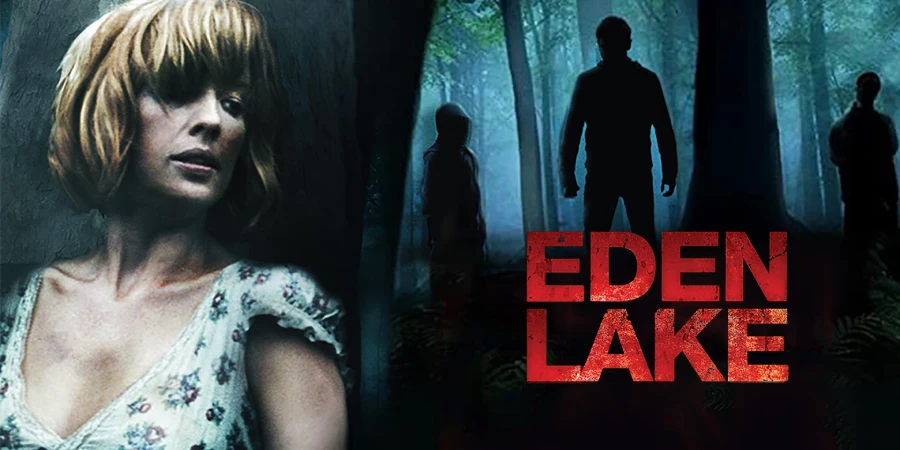

Somewhere in the English countryside, a child smiles at you and you feel your stomach drop. Eden Lake does something genuinely nasty: it takes the sun-drenched British holiday aesthetic and fills it with dread before a single act of violence occurs. Director James Watkins built his debut feature on a simple, brutal premise, and he committed to it without flinching. This film earns its reputation not through spectacle but through sustained, grinding discomfort.
Detailed Summary
The Couple Arrives at the Lake
Steve and Jenny, played by Michael Fassbender and Kelly Reilly, drive out to Eden Lake for a romantic weekend. Steve has a ring in his pocket. He plans to propose at this secluded quarry lake before it gets developed into a luxury resort.
Their arrival already signals trouble. A group of local teenagers occupies the beach, playing aggressive music and letting their dog roam. Steve tries to politely ask them to turn it down. The kids stare back with that particular brand of teenage contempt that makes adults feel small and ridiculous.
Escalating Confrontations
Steve retrieves his car keys from Brett, the group’s ringleader, after the kids steal them as a prank. Brett, played with frightening naturalism by Jack O’Connell, is not cartoonishly evil at this point. He reads as a bored, status-obsessed teenager who sees Steve as a target worth humiliating.
Steve confronts the group a second time when their dog runs off with the couple’s belongings. During a struggle, the dog bites Steve, and he ends up accidentally killing it when he defends himself. This moment is the true point of no return. Brett’s humiliation curdling into rage is the engine that drives everything that follows.
The Hunt Begins
Brett escalates from harassment to outright violence. He and his crew steal Steve and Jenny’s car, stranding them in the woods. When Steve tries to recover the vehicle, Brett stabs him in the neck with a piece of wire.
What follows is a sustained chase through the forest. Steve is wounded and increasingly incapacitated. Jenny desperately tries to keep him moving and find help. Watkins strips away every safety net: no phone signal, no passing strangers, no conveniently heroic adults.
Steve’s Capture and Torture
Brett’s gang catches Steve and ties him to a tree. What happens next is one of the most difficult sequences in modern British horror. Brett passes a knife around the group, pressuring each member to cut Steve. He films it on a mobile phone, using social performance and peer pressure to implicate everyone.
One member, Paige, carves her name into Steve’s chest. Another kid, Ricky, clearly wants no part of it, but Brett’s grip on the group’s social hierarchy makes refusal nearly impossible. O’Connell plays Brett with a cold, coercive authority that feels grounded in real adolescent pack dynamics rather than genre cliche.
Jenny witnesses part of the torture from hiding but cannot save Steve alone. She flees to find help.
Jenny’s Desperate Search for Help
Jenny reaches a road and flags down a car. Relief evaporates almost immediately: the driver turns out to be connected to the teenagers. He takes her directly into danger rather than away from it.
She finds a house and bangs on the door. An older woman lets her in. Jenny tries to explain, tries to call the police. Then she recognizes objects in the house, a football trophy, photographs, and realizes this is Brett’s family home. This scene is quietly devastating because it exposes the social web protecting the teenagers.
Brett’s Accidental Death and Its Consequences
Jenny eventually gets hold of Steve’s car. She drives through the woods, frantically searching for Steve. In a moment of terrible accident, she runs over and kills Brett.
This shifts the moral calculus completely. Jenny is now a killer, even if accidentally. The film refuses to let her remain a clean victim. Watkins uses this moment to implicate the audience, who has been rooting for exactly this kind of reversal, and then makes them feel the weight of it.
Ricky, the reluctant gang member, helps Jenny briefly and confirms Steve is dead. His assistance is short-lived: the other gang members murder him for it. Ricky’s death is the film’s most purely tragic beat, because he was trying to do the right thing.
Movie Ending
Jenny escapes into the night, burned, bloodied, and barely functional. She stumbles onto a road and sees lights. A house party is in full swing. She hammers on the door and collapses into the arms of strangers who appear to be adults.
That relief lasts about thirty seconds. Jenny hears Brett’s name mentioned with grief and recognition. She looks up and realizes she has crawled directly into a party full of Brett’s family, friends, and community. These are the parents, aunts, uncles, and neighbors of the teenagers who just spent the night torturing and killing her partner.
Brett’s father, played by Shaun Dingwall, steps forward. He has already been told a version of events that casts the teenagers as victims and Steve and Jenny as aggressors who killed his son. The room closes in around Jenny. Adults who should be her rescuers become her captors.
Jenny is locked in a room upstairs. She can hear the adults discussing what to do with her. One voice suggests letting her go. Brett’s father silences that suggestion. What happens to Jenny after the door locks is left off screen, but the film communicates it with absolute clarity through the sounds she makes and the expressions on the faces of the people downstairs.
Watkins cuts to black before showing anything explicit, but nobody in the audience is confused. Jenny dies, almost certainly killed by the very adults who represent societal order and safety. The final image, a close-up of a door, is one of the bleakest endings in British genre cinema. It argues that the teenagers’ violence did not come from nowhere; it was shaped by every adult in that room.
Are There Post-Credits Scenes?
Eden Lake has no post-credits scene. Once the screen goes dark, the film is over. Sitting through the credits hoping for relief or a twist will only deepen the misery, which is arguably the correct experience.
Type of Movie
Eden Lake is a British survival horror film with strong elements of social thriller. Its tone is relentlessly bleak, rooted in class anxiety and the failure of adult authority.
It belongs to a specific mid-2000s wave of European and British horror that prioritized psychological punishment over supernatural threat. Think less haunted house and more sociological dread.
Cast
- Kelly Reilly – Jenny
- Michael Fassbender – Steve
- Jack O’Connell – Brett
- Thomas Turgoose – Cooper
- Finn Atkins – Paige
- Shaun Dingwall – Brett’s Father
Film Music and Composer
David Julyan composed the score. Julyan had previously worked with Christopher Nolan on Memento and The Descent‘s Neil Marshall, making him a natural fit for psychological tension. His work on Eden Lake leans into low drones and sparse, unsettling textures rather than conventional horror stings.
Julyan’s score mostly stays out of the way during the action sequences, letting ambient forest sound and silence do the work. That restraint is the right call. A more aggressive score would have softened the film’s documentary-like grip on reality.
Filming Locations
Principal photography took place in Buckinghamshire, England. Longborough Quarry and surrounding woodland areas provided the isolated lakeside and forest environments central to the story.
Choosing a real English quarry rather than a purpose-built set grounds the film in a recognizable landscape. Anyone who grew up in the English Midlands or South will recognize that particular flat light, those birch trees, and that quality of still water. Familiarity makes the threat feel closer.
Awards and Nominations
Eden Lake received attention on the British genre festival circuit after its release. Jack O’Connell’s performance drew particular recognition from critics as a breakthrough turn, though the film did not land significant mainstream awards nominations.
Behind the Scenes Insights
- Jack O’Connell was a teenager himself during filming, which added a layer of real unease to his dynamic with the adult cast.
- Director James Watkins drew on anxieties about class division in contemporary Britain as a conscious thematic foundation for the script.
- Kelly Reilly performed many of her woodland chase sequences herself, which shows in the physical authenticity of those scenes.
- Thomas Turgoose, known from This Is England, was cast partly because of his ability to portray working-class adolescent authenticity without caricature.
- Watkins reportedly kept the young cast and adult cast somewhat separate on set to maintain a natural tension between the two groups.
Inspirations and References
Watkins cited British class anxiety as the film’s primary conceptual engine. Eden Lake sits in conversation with tabloid-era moral panics about feral youth and antisocial behavior that dominated British public discourse in the mid-2000s.
The film also draws on the American backwoods survival horror tradition, films like Deliverance and The Hills Have Eyes, but relocates that framework to suburban and semi-rural England. Replacing hillbilly strangers with teenagers from the nearest council estate makes the threat far more specific and far more uncomfortable.
Wes Craven’s work on stripping away middle-class safety in horror was likely an influence on the overall structural approach.
Alternate Endings and Deleted Scenes
No officially released alternate ending for Eden Lake exists in the public domain. Watkins has spoken about the importance of committing to the bleak conclusion rather than softening it, which suggests earlier versions of the script may have offered Jenny more agency or survival.
No significant deleted scenes have been made available through home video releases.
Book Adaptations and Differences
Eden Lake is not based on a book. James Watkins wrote the original screenplay. No novelization of the film is in wide circulation.


Memorable Scenes and Quotes
Key Scenes
- Brett forcing each gang member to take a turn cutting Steve while filming on his phone: the camera watches the reluctant kids’ faces rather than the wounds, which is the smarter choice.
- Jenny realizing she is inside Brett’s family home, her face cycling through relief, confusion, and horror in about four seconds of silence.
- Steve’s death: confirmed off screen, communicated through Ricky’s expression, which trusts the audience more than a graphic reveal would.
- Jenny running over Brett: shot from outside the car, a wet thud, brake lights, silence.
- Ricky’s murder by his own friends after helping Jenny: the film’s most purely cruel moment, precisely because he earned nothing but death for doing the right thing.
- The final door closing on Jenny: no score, no dialogue, just the sound of a latch clicking into place.
Iconic Quotes
- “You started it.” Brett, deflecting responsibility with the casual logic of adolescent grievance.
- “It’s just a dog.” Steve, which turns out to be the worst possible thing to say at the worst possible moment.
Easter Eggs and Hidden Details
- Brett’s mobile phone filming of the torture foreshadows the real-world phenomenon of filmed gang violence that was becoming a news story in Britain at the time of production.
- Jenny’s patterned dress at the start of the film is pale and floral, coded as soft and unthreatening; by the end she wears only torn, dark clothing, a visual shift that tracks her transformation from holiday-maker to survivor.
- The resort development sign near the lake appears in the opening frames. It signals that this space is already contested, already being taken from working-class locals, before a single character speaks.
- Steve’s proposal ring is never mentioned again after the attack begins. It sits in his pocket, a symbol of the future the film is about to erase.
Trivia
- James Watkins went on to direct The Woman in Black, a much bigger-budget horror production, but Eden Lake remains his most discussed work among genre critics.
- Jack O’Connell credits this film as a key early role that helped establish his dramatic range before his later work in Starred Up and Unbroken.
- Michael Fassbender took the role of Steve before his mainstream breakthrough in Hunger, also released in 2008, making that year a significant one for his career.
- Kelly Reilly’s performance requires her to be on screen and physically active for nearly the entire second and third acts, a grueling physical commitment that few mainstream horror films ask of a female lead.
- The film’s UK rating required no cuts despite its intensity, which surprised some distributors given the sustained nature of the violence against adults and children alike.
Why Watch?
Kelly Reilly carries the entire second half of this film on a performance built out of exhaustion, animal fear, and something harder to name: the specific shame of someone who followed every rule and got punished for it anyway. Watch it for that performance, and for a screenplay that refuses to let class politics stay comfortably subtext. Eden Lake puts its thesis in the hands of a locked door and trusts you to feel it.
Director’s Other Movies
- The Woman in Black (2012)
- The Woman in Black 2: Angel of Death (2014) – producer
Recommended Films for Fans
- Funny Games (1997)
- The Descent (2005)
- Ils (Them) (2006)
- Martyrs (2008)
- Severance (2006)
- Straw Dogs (1971)
- Deliverance (1972)