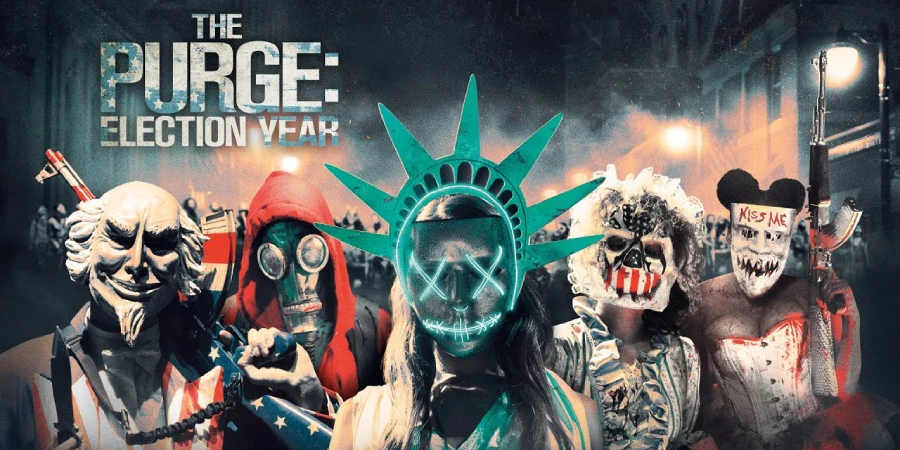

Forget subtlety. The Purge: Election Year puts a presidential candidate on the run during a night of legalized murder and dares you to call it on-the-nose. Director James DeMonaco leans so hard into the political allegory that the film essentially becomes a campaign ad for overthrowing a murderous ruling class, complete with white-robed killers in patriotic costumes and a villain called the New Founding Fathers of America. It is pulpy, loud, and frequently ridiculous, and that is precisely why it works.
Detailed Summary
The Opening Flashback: Charlie Roan’s Trauma
The film opens eighteen years before its main events. A young girl watches her family get executed during a Purge night by a sadistic killer who forces her to participate in a twisted game of Russian roulette. She survives by sheer luck and fury.
That girl grows up to be Senator Charlie Roan, played by Elizabeth Mitchell. Her entire political platform centers on abolishing the Purge, which makes her an existential threat to the New Founding Fathers of America.
The NFFA’s Plan to Eliminate Roan
With Election Day approaching and Roan polling dangerously high, the New Founding Fathers of America (NFFA) change a critical Purge rule. For the first time, government officials at all levels lose their protected status. Translation: they want Roan dead before she can win.
Minister Edwidge Owens, a religious fanatic who functions as the NFFA’s spiritual mouthpiece, delivers sermons framing the Purge as holy sacrifice. His scenes are some of the most chilling in the film precisely because the performance never winks at the audience.
Leo Barnes Returns
Leo Barnes, played by Frank Grillo, is back from The Purge: Anarchy. He now serves as Roan’s head of security. Leo is all business, all muscle, and Grillo plays him with a tight-jawed intensity that anchors every scene he occupies.
When the NFFA removes his team’s weapons cache through a fabricated security scare, Leo and Roan are forced out of their safe house and into the streets. The trap springs cleanly, and the two of them are suddenly very vulnerable.
Joe Dixon’s Bodega
Small business owner Joe Dixon, played by Mykelti Williamson, runs a corner store he has protected through previous Purge nights. His insurance company just cancelled his Purge coverage, forcing him and his young employee Marcos to guard the place themselves with rifles and attitude.
Joe’s storyline introduces some dark comedy into the proceedings. A group of teenage girls, furious that Joe caught them shoplifting, returns on Purge night specifically to destroy his store. Their giggling menace, complete with “Purge mobiles” covered in Christmas lights, is one of the film’s more genuinely unnerving images.
The Underground Resistance
Leo and Roan eventually connect with Dante Bishop, leader of an anti-Purge resistance group based out of a church serving as a medical sanctuary. Bishop, played by Edwin Hodge, has appeared in previous franchise entries, giving the series a rare sense of continuity.
Dante and his group have their own plan for Purge night. They want to assassinate the NFFA leadership during their annual private ritual at a cathedral, before Roan can win through the ballot box. This creates the film’s central tension: electoral change versus armed uprising.
The Cathedral Ritual
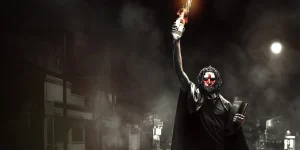
The NFFA’s inner circle gathers at a cathedral each Purge night for a ceremony in which a human sacrifice is offered up to bless the nation. It is genuinely disturbing staging, priests in white robes chanting while wealthy donors watch a bound victim await slaughter like a spectator sport.
Roan is captured by the NFFA and brought to this ritual to serve as the sacrifice. The imagery here, a sitting senator bound on an altar while robed figures chant, is about as subtle as a brick to the skull. DeMonaco is not interested in plausible deniability about what he is saying.
The Rescue and the Choice
Leo, Marcos, Joe, and Dante’s resistance fighters breach the cathedral. The firefight is brutal and efficiently staged, with Grillo doing most of his own physical work and it shows. Bodies drop fast and DeMonaco does not linger on individual deaths the way lesser action directors do.
Dante moves to execute the NFFA leadership personally. Roan stops him. She wants the process to play out through democracy, not revenge. It is the film’s moral hinge point and, honestly, one of the stronger screenplay choices in the franchise.
Movie Ending
Roan survives the night. Leo gets her out of the cathedral alive, and Dante reluctantly stands down from his assassination plan. The NFFA leadership escapes immediate justice, but they have lost their window to kill Roan before the election.
A title card reveals the outcome: Senator Charlie Roan wins the presidential election. The Purge is set to be abolished. Crowds celebrate in the streets with a joy that feels genuinely earned after ninety minutes of dread.
The final image complicates everything, though. News footage shows NFFA supporters rioting in response to the election result, and a chyron hints that the fight is far from over. DeMonaco refuses a clean ending. Winning an election, he suggests, does not dismantle a system that powerful overnight. It is a smarter conclusion than the film probably deserved, and it seeds the ground for the next installment without feeling like a cheap cliffhanger.
Are There Post-Credits Scenes?
The Purge: Election Year has no post-credits scene. Once the final title cards play out, the film is done. You can leave when the credits roll.
Type of Movie
This is a political action thriller with heavy doses of horror atmosphere and social satire. The tone swings between siege thriller and angry op-ed, occasionally pausing for dark comedy before snapping back to genuine menace.
It plays closer to an action film than a horror film, but the Purge franchise’s DNA keeps enough dread in the air to satisfy genre fans. Think less slasher and more Escape from New York filtered through a Bernie Sanders rally.
Cast
- Frank Grillo – Sergeant Leo Barnes
- Elizabeth Mitchell – Senator Charlie Roan
- Mykelti Williamson – Joe Dixon
- Joseph Julian Soria – Marcos
- Betty Gabriel – Laney Rucker
- Edwin Hodge – Dante Bishop
- Kyle Secor – Minister Edwidge Owens
- Terry Serpico – Earl Danzinger
Film Music and Composer
Nathan Whitehead composed the score. He worked on previous entries in the franchise, and his work here keeps a consistent sonic identity across the series. Whitehead layers industrial percussion with choir elements, which suits the film’s blending of political pageantry and street-level violence.
The use of licensed music deserves mention. Tracks playing over Purge night sequences add a particular kind of wrongness: familiar pop songs mutated into something sinister by their context. It is a trick the franchise uses well, and Election Year makes good use of it.
Filming Locations
Principal photography took place in and around Philadelphia, Pennsylvania. The city’s architecture gives the film a gritty, working-class texture that suits a story set among ordinary people trying to survive. Row houses and corner stores read immediately as lived-in American neighborhoods.
Several key sequences were shot on Philadelphia streets at night. That ground-level urban geography makes the chaos feel grounded rather than staged, which matters a great deal for a franchise that lives or dies by its sense of place.
Awards and Nominations
The Purge: Election Year did not receive significant awards attention from major bodies. Its reception was primarily commercial rather than critical, and no major nominations followed its release.
Behind the Scenes Insights
- Frank Grillo performed many of his own stunts, consistent with his approach on The Purge: Anarchy and his action work elsewhere.
- Director James DeMonaco has stated that the political climate surrounding the 2016 U.S. presidential election directly shaped the screenplay’s sharpened satire.
- DeMonaco deliberately structured the film so that the threat comes from government and wealthy elites rather than random street violence, inverting the focus of the first film.
- Betty Gabriel, who plays Laney, drew significant attention from horror fans after this role and went on to Get Out shortly after.
- The production used practical street sets extensively, aiming to keep the environment tactile and real rather than relying on digital augmentation for the chaos.
Inspirations and References
DeMonaco has cited Jonathan Swift as an influence on the franchise’s satirical approach. The Purge as a concept echoes Swift’s A Modest Proposal, where a horrific policy is presented with bureaucratic sincerity to expose the cruelty underneath official language.
The film also draws from American political horror in a more direct lineage: films like They Live and Escape from New York, where genre mechanics carry explicit critiques of power structures. The NFFA owes a clear debt to John Carpenter’s vision of a corporate-controlled America.
Real-world concerns about income inequality and racialized violence in America fed into the screenplay. DeMonaco has been open about viewing the Purge as a metaphor for policies that disproportionately harm poor and minority communities while protecting the wealthy.
Alternate Endings and Deleted Scenes
No officially confirmed alternate endings or substantial deleted scenes have been released for Election Year. DeMonaco has not publicly detailed significant cut material from this installment.
Some minor trimming during post-production was acknowledged in general terms by the filmmakers, but nothing of structural significance has surfaced in home release materials.
Book Adaptations and Differences
The Purge: Election Year is not based on a book. It is an original screenplay by James DeMonaco, the third script he wrote for the franchise he created.

Memorable Scenes and Quotes
Key Scenes
- The opening Russian roulette sequence: Young Charlie forced to choose her own fate while her family lies dead around her. Shot in cold blue light with almost no score, it is the franchise’s most quietly devastating opening.
- The Purge mobile girls: Three teenagers in glittering outfits riding a decorated car toward Joe’s store, singing cheerfully while armed with weapons. The image sticks with you because it fuses festivity with genuine menace in a way that feels uniquely American.
- The cathedral sacrifice ritual: Robed figures, chanting, candlelight, a bound prisoner on an altar. DeMonaco shoots it like a Renaissance painting gone wrong, with the camera pulling back slowly to reveal the full scope of the audience watching from pews.
- Roan stopping Dante’s assassination: Roan physically steps between Dante and the NFFA leaders, choosing democratic process over immediate revenge. It is a small gesture loaded with weight because the film has earned it.
Iconic Quotes
- “Keep America great.” (NFFA slogan, which landed with eerie prescience given subsequent real-world political rhetoric)
- “I’m not going to let you throw everything away. Not like this.” (Roan to Dante, at the film’s moral turning point)
- “This is our time. This is our night.” (Joe Dixon, rallying himself before Purge night begins)
Easter Eggs and Hidden Details
- Dante Bishop appears in both The First Purge prequel and the original film, making him one of the few characters to thread across multiple franchise entries. His presence in Election Year rewards attentive series viewers.
- Background news broadcasts during early scenes include polling data and political commentary that mirrors real American cable news aesthetics closely enough to briefly pass for actual footage.
- Joe’s bodega contains a small American flag displayed prominently near the register throughout his scenes, a recurring visual note about who the film considers the true patriot in its story.
- The NFFA’s ceremonial robes feature subtle variations in embroidery suggesting hierarchy within the organization, visible in wide shots of the cathedral scene if you look at collar detailing.
- Several background Purgers wear masks referencing earlier franchise imagery, a nod to the series’ own visual vocabulary.
Trivia
- The phrase “Keep America great” appeared in this film before it gained real-world political notoriety, which led to significant online discussion after the 2016 election cycle.
- Frank Grillo lobbied to return as Leo Barnes after Anarchy, making Leo one of the rare franchise protagonists to anchor two consecutive films in the series.
- James DeMonaco wrote and directed all three of the first Purge films, an unusual degree of creative control for a franchise of this commercial scale.
- The film was released on July 1, 2016, positioning it close to American Independence Day, a scheduling choice that aligned with its patriotic imagery and political commentary.
- Betty Gabriel’s performance as Laney caught the attention of Jordan Peele, who cast her in Get Out (2017).
- The franchise’s commercial success despite modest production budgets made it one of Blumhouse Productions’ most reliable moneymakers through its first three entries.
Why Watch?
Frank Grillo does more with a silent glance across a burning street than most action leads manage with a full monologue, and watching him work in the cathedral sequence alone justifies the runtime. Election Year is also the entry where the franchise’s political anger fully crystallizes into something with genuine bite, not just mood. See it for Grillo, stay for the satirical fury.
Director’s Other Movies
- The Purge (2013)
- The Purge: Anarchy (2014)
- The First Purge (2018) – written by DeMonaco, directed by Gerard McMurray