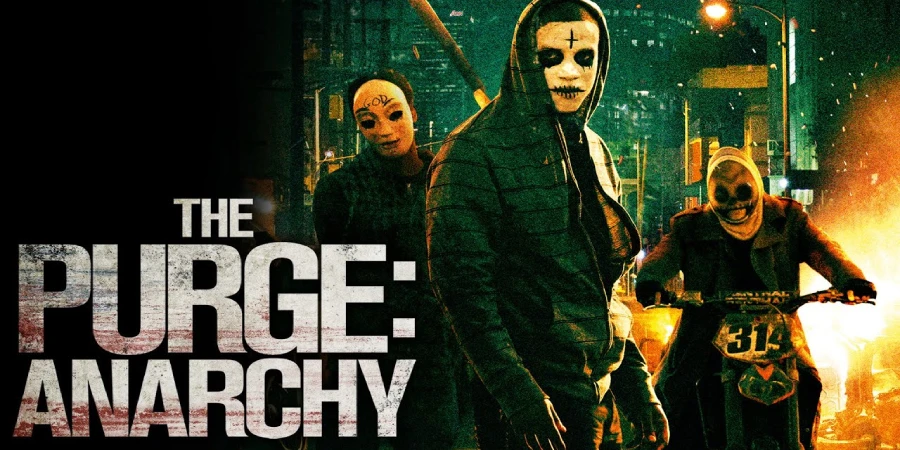

Forget the haunted house, forget the slasher in the suburbs: The Purge: Anarchy takes the franchise’s premise outside, and suddenly the whole sick concept starts working. Writer-director James DeMonaco ditches the claustrophobic home-invasion format of the first film and drops us into the streets of Los Angeles on Purge Night, where ordinary people without panic rooms or private security become immediate targets. This is a lean, mean thriller that actually remembers it has something to say about class, race, and who a society decides is disposable.
Detailed Summary
The Setup: Three Groups, One Night
The Purge: Anarchy follows three separate groups whose fates collide on the night of the annual Purge, when all crime is legal for twelve hours. First, we have Sergeant Leo Barnes (Frank Grillo), a grieving father driving into the city with one goal: kill the drunk driver who murdered his son. Second, a young couple, Shane (Zach Gilford) and Liz (Kiele Sanchez), get stranded when their car is deliberately sabotaged.
Third, a mother-daughter pair, Eva Sanchez (Carmen Ejogo) and Cali (Zoe Soul), are dragged from their apartment building by a paramilitary unit hired to kill them. Leo happens to be driving past and pulls all four survivors into his armored vehicle. From that moment, the film becomes a survival gauntlet through a city actively hunting them.
The Streets Come Alive
DeMonaco wastes no time showing us how the other half Purges. Rich people hunt from trucks with spotlights. Street gangs settle scores in alleyways. A group of anti-Purge rebels, led by a man named Carmelo Johns (Michael K. Williams), broadcasts revolutionary messages and ambushes government vehicles.
Leo’s car eventually gets destroyed, forcing the group on foot. They navigate through neighborhoods that feel genuinely alive with dread, graffiti-tagged walls, distant gunfire, and bodies already piling up. Leo has no interest in playing babysitter; he makes this clear repeatedly, and that tension between his personal mission and his growing protectiveness of the group drives the film’s best scenes.
The Wealthy Hunt the Poor
Eva’s neighbor, Big Daddy (Jack Conley), turns out to be a government-affiliated Purge operative whose crew has been systematically clearing out low-income apartment buildings. This is the film’s sharpest political needle: the government is not just allowing the Purge, it is orchestrating it to reduce the poor population. Cali already suspects this, and watching her be proven right is quietly devastating.
The group gets captured and auctioned off at a wealthy socialite’s mansion, where the ultra-rich pay to hunt human prey in a controlled indoor setting. This sequence is the film’s most pointed satire. Men in tuxedos bid on frightened civilians with the casual enthusiasm of a wine auction.
Leo’s Mission Derailed
During the auction chaos, Leo and the group escape with help from one of the mansion’s servants. Leo eventually finds his target, Warren Grass, the man who killed his son. He corners Grass at gunpoint, ready to complete the revenge he planned all year. Grass begs, and Leo hesitates long enough for his conscience to catch up to his grief.
Leo does not pull the trigger. He walks away. It is not a triumphant moment of moral clarity so much as a man choosing to survive his own worst impulse. Grillo plays it with his jaw set and his eyes doing all the work, no speech, no tears, just a man putting the gun down and walking back to people who need him alive.
Carmelo’s Rebels Enter the Picture
Carmelo’s anti-Purge resistance shows up to rescue the group from the streets during their final desperate push to safety. Carmelo’s forces ambush Big Daddy’s paramilitary convoy in a firefight that gives the film its most kinetic sequence. Leo, injured but functional, fights alongside people he never agreed with ideologically, which adds a layer of moral complexity the film earns rather than lectures about.
Big Daddy gets killed during the fight, closing the loop on Eva and Cali’s storyline. Leo gets the group to safety just as the sirens signal the end of Purge Night.
Movie Ending
Leo gets shot during the final confrontation and appears mortally wounded. Eva, who has developed genuine affection for him throughout the night, cradles him in the street as the end-of-Purge sirens wail. Then Leo opens his eyes. He survives. It is a classically genre-satisfying beat, and DeMonaco earns it because the film never promised us a happy ending.
What lingers is not the survival but what it costs everyone to get there. Shane and Liz reconcile after nearly dying while their relationship was already dissolving. Eva and Cali are alive but their neighbor, their building, their sense of safety: all gone. The film cuts to morning light over a still-burning city and lets that image sit without a bow on it.
Carmelo broadcasts another message, promising that resistance will continue. His presence throughout the film functions as a counter-narrative to the government’s framing of the Purge as cathartic and necessary. By ending on his voice, DeMonaco plants a flag: this story is not over, and neither is the rot underneath it.
Leo’s decision not to kill Warren Grass is the emotional resolution the film has been building toward. Revenge, the film argues, would have made him the Purge’s willing participant rather than its reluctant survivor. He refuses that, and the choice reframes him from vigilante to protector for the sequel setup that follows in later entries.
Are There Post-Credits Scenes?
The Purge: Anarchy does not include any post-credits scenes. You can leave when the credits roll. Nothing is hiding there.
Type of Movie
This is a dystopian action thriller with strong horror and social satire elements. Its tone is grimly serious with flashes of dark irony, particularly in the wealthy-auction sequence. Do not expect jump scares; expect sustained dread and the specific discomfort of watching a nightmare that feels about three policy decisions away from plausible.
Cast
- Frank Grillo – Sergeant Leo Barnes
- Carmen Ejogo – Eva Sanchez
- Zoe Soul – Cali
- Zach Gilford – Shane
- Kiele Sanchez – Liz
- Michael K. Williams – Carmelo Johns
- Jack Conley – Big Daddy
- Noel Gugliemi – Tio
- Edwin Hodge – Bloody Stranger
Film Music and Composer
Nathan Whitehead composed the score. His work here favors low, industrial drones and percussive tension-building over melodic themes, which suits the film’s stripped-down, street-level aesthetic. You will not walk out humming anything, but that is by design: the score exists to keep your nerves frayed rather than your emotions guided.
The sound design does as much work as the music. Distant sirens, the crackle of Purge Night broadcasts, and muffled screams from offscreen build an atmosphere that the score reinforces rather than replaces. It is a smart collaboration between departments that many genre films get wrong.
Filming Locations
Principal photography took place in Los Angeles, California. Production used real streets and buildings dressed to look like a near-future version of the city rather than purpose-built sets, which gives the film a gritty texture that a studio backlot would have scrubbed clean.
Shooting at night in urban LA allowed the production design team to layer in details: boarded storefronts, Purge Night graffiti, improvised fortifications on apartment buildings. Those real architectural bones make the world feel inhabited and consequential. A city you actually recognize being destroyed is scarier than a fictional one.
Awards and Nominations
The Purge: Anarchy was not a major awards contender. It received attention primarily from genre-focused critics and audiences rather than awards bodies, and its cultural conversation happened at the box office and in op-ed columns rather than at ceremonies.
Behind the Scenes Insights
- Director James DeMonaco intentionally expanded the scope after feeling the first film’s home-invasion format limited the premise’s potential for social commentary.
- Frank Grillo performed many of his own physical sequences, and his background in combat sports training is visible in the way Leo moves: compact, economical, and unsentimental.
- DeMonaco wrote the Leo Barnes character with Grillo specifically in mind after working with him on the first Purge film, where Grillo had a smaller role.
- Production designed several versions of Purge Night street dressing to reflect different socioeconomic neighborhoods, giving each location its own visual texture rather than a uniform apocalyptic look.
- The film was shot largely at night, which created real logistical challenges for the crew but added an authenticity to the fatigue visible on actors’ faces during extended sequences.
Inspirations and References
The Purge: Anarchy draws heavily from John Carpenter’s Escape from New York, particularly in its use of a single hardened protagonist navigating a lawless urban zone. The structural influence is direct: one competent man, multiple vulnerable people, one night to get out.
DeMonaco has cited class warfare in American political history as a key thematic inspiration. The film’s most pointed ideas about the government engineering poverty reduction through legalized murder echo critiques found in works like Battle Royale and various dystopian literary traditions that imagine state-sanctioned violence as population control.
The masked vigilante aesthetic and the television-broadcast framing of Purge Night as civic ritual gesture toward Guy Debord’s concept of spectacle as social control, though the film wears that influence lightly enough that you can enjoy the action without a theory textbook in hand.
Alternate Endings and Deleted Scenes
No officially released alternate endings for The Purge: Anarchy exist in the public domain. The home video release includes some additional footage, but nothing that fundamentally changes the story’s shape or the ending’s meaning.
DeMonaco has discussed in interviews that earlier drafts of the script gave Leo a darker fate, leaning harder into the franchise’s bleaker impulses. The decision to keep him alive was partly commercial, partly narrative: his survival set up the character’s return in The Purge: Election Year.
Book Adaptations and Differences
The Purge: Anarchy is not based on a book. It is an original screenplay by James DeMonaco, building on the universe he created for the first film. No source novel exists to compare it against.
Memorable Scenes and Quotes
Key Scenes
- The apartment abduction: Big Daddy’s military convoy arriving in near-silence to drag residents out of their homes is the film’s most chilling sequence. The orderly, bureaucratic nature of the operation is what makes it terrifying.
- The mansion auction: Wealthy guests in formal wear bidding on human lives while string quartet music plays in the background. DeMonaco frames the hunters and the hunted in the same wide shot, refusing to let the camera look away.
- Leo and the Grass confrontation: Leo pressing the gun to Warren Grass’s head and then slowly lowering it. Grillo does not deliver a monologue. He breathes, he pauses, and he walks away. Silence carries the scene.
- The street ambush by Big Daddy’s crew: The first time the group realizes they are being hunted by a coordinated force rather than random Purgers. The shift from chaotic street danger to organized pursuit changes the film’s register entirely.
- Carmelo’s broadcast: Michael K. Williams delivering a revolutionary address over hijacked Purge Night feeds. Williams brings genuine conviction to what could have been a speechifying cameo.
Iconic Quotes
- “I am not a good man.” (Leo Barnes, making no promises to the people he is protecting)
- “They use the Purge to get rid of the people that they don’t want: the homeless, the poor.” (Cali, articulating the film’s thesis before the plot confirms it)
- “You do not have to do this.” (Warren Grass, begging Leo for his life in the final confrontation)
Easter Eggs and Hidden Details
- Edwin Hodge’s “Bloody Stranger” connects the film to the first Purge: his character appears in both films, quietly building a throughline in the franchise’s mythology about people who resist the ritual.
- Several background extras wear masks that reference historical atrocities and political figures, a recurring design language throughout the franchise that rewards close attention to crowd scenes.
- The NFFA (New Founding Fathers of America) propaganda posters visible throughout the city echo real-world political poster design from 20th-century authoritarian regimes, right down to color palette and font choices.
- Big Daddy’s military unit uses government-issue vehicles with subtle NFFA insignia, visually confirming the government’s involvement before the screenplay states it outright.
- Carmelo’s pirate broadcast interrupting official Purge Night programming mirrors real-world instances of signal hijacking, giving his resistance movement a grounded, DIY credibility.
Trivia
- The Purge: Anarchy significantly outperformed its predecessor at the box office, opening to strong numbers and validating Universal’s decision to expand the franchise’s scope.
- Frank Grillo had previously appeared in the first Purge film in a supporting role, and his performance there directly inspired DeMonaco to build the sequel around him.
- DeMonaco wrote and directed both films back to back, establishing himself as the primary creative voice of the franchise before other directors later took entries in the series.
- Michael K. Williams, best known for Omar Little in The Wire, was cast partly because his screen presence could make a revolutionary cameo feel substantial rather than decorative.
- The film’s marketing leaned heavily on the franchise’s concept rather than its cast, a deliberate strategy that positioned The Purge brand itself as the selling point.
- Zoe Soul’s Cali is consistently the sharpest political voice in the film, and several critics noted that her character articulates the film’s critique more clearly than any other character at any point in the franchise.
Why Watch?
Frank Grillo carries this film on his back with a performance that turns genre minimalism into genuine character work: every grimace, every loaded silence, every deliberate choice not to speak does more than a lesser film’s entire third act would. DeMonaco’s decision to set the sequel on open streets rather than in a secured home transforms the first film’s clever-but-limited premise into something with actual political teeth. If you have ever wanted a thriller that makes you genuinely uncomfortable about the world outside the cinema, this one does that job with efficient, unfussy craft.