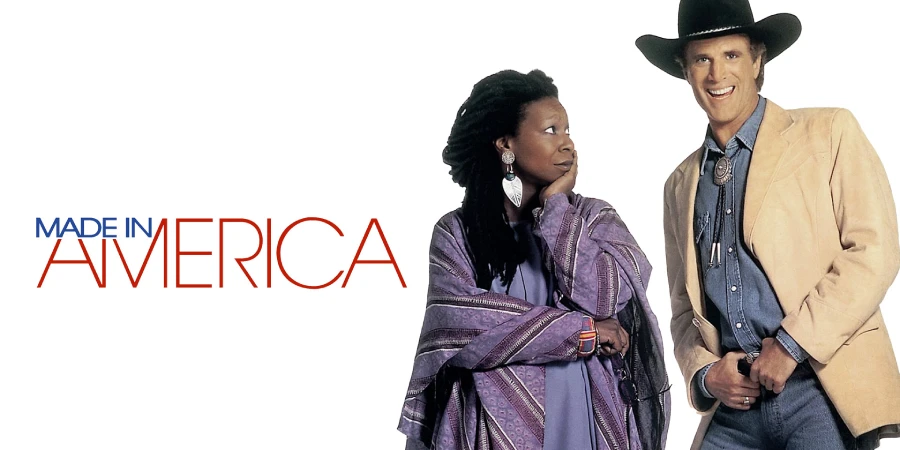

A sperm bank mix-up sounds like pure comedy gold, and Made in America (1993) absolutely leans into that premise with gleeful energy. Whoopi Goldberg and Ted Danson share a crackling, chaotic chemistry that drives this feel-good story about identity, family, and the very unexpected ways people find each other. What makes the film stick, however, is its surprisingly warm heart beneath all the broad laughs. It is a crowd-pleaser that earns its sentiment.
Detailed Summary
Sarah’s Discovery Changes Everything
Teenage Zora Mathews (Nia Long) grows up knowing her father died before she was born. Her mother, Sarah Mathews (Whoopi Goldberg), raised her alone in Oakland, running an Afrocentric bookstore. Zora always believed her father was a Black man chosen carefully by her mother through a sperm bank.
Curiosity gets the better of Zora. She sneaks into the sperm bank records and discovers the shocking truth: her biological father is Hal Jackson (Ted Danson), a loud, white, used-car salesman famous for his outrageous local television commercials. This revelation hits Zora like a freight train.
Zora Confronts Hal
Zora decides to investigate Hal before telling her mother anything. She observes him at his dealership, watching this flamboyant, well-meaning goofball in his natural habitat. Hal has no idea he even donated sperm years ago, let alone that a child resulted from it.
Eventually, Zora introduces herself to Hal. His reaction is equal parts shock and bewilderment. However, once the reality sinks in, Hal genuinely wants to connect with this daughter he never knew existed.
Sarah Finds Out and Reacts Badly
Sarah learns the truth, and her reaction is fierce. She feels betrayed by the sperm bank, which she had specifically used because she wanted a Black biological father for her child. A clerical or matching error at the bank led to Hal’s donation being used instead.
Sarah confronts Hal directly, and their personalities clash almost immediately. She finds him crass, culturally oblivious, and nothing like the man she imagined fathering her daughter. In contrast, Hal finds Sarah rigid and hostile, though he remains determined to be part of Zora’s life.
Hal’s Bumbling Attempts at Connection
Hal starts inserting himself into Zora’s world, often with well-intentioned but clumsy results. He tries to bond with her over shared interests and attends events in her life, sometimes making things awkward by being aggressively cheerful and culturally tone-deaf. Zora finds him both irritating and oddly endearing.
Meanwhile, Hal’s romantic life complicates matters further. His girlfriend Stacy (Jennifer Tilly) is younger, bubbly, and not exactly thrilled about this new family dynamic suddenly entering their relationship. Tension simmers on multiple fronts.
Sarah and Hal’s Unlikely Bond Develops
Despite their rocky start, Sarah and Hal keep crossing paths. Their bickering gradually softens into something warmer. Both of them care deeply about Zora, and that shared love becomes an unexpected common ground.
Romantic sparks begin to fly between Sarah and Hal, much to everyone’s surprise, including their own. Sarah resists the attraction, viewing it as absurd and inconvenient. Nonetheless, the pull between them keeps growing stronger as the story progresses.
A Crisis Raises the Stakes
Zora gets into a serious accident involving a motorcycle, which lands her in the hospital and forces Sarah and Hal into the same waiting room. Fear for Zora strips away their defenses completely. Facing a potential tragedy together accelerates their emotional connection in a way that bickering never could.
Fortunately, Zora recovers. However, the hospital sequence marks a clear turning point for all three characters. It forces honesty and vulnerability in ways that the comedic sparring earlier in the film never quite achieved.

Movie Ending
Sarah and Hal stop fighting their feelings and acknowledge their romantic connection openly. Hal’s relationship with Stacy ends, making way for something more genuine with Sarah. Zora, who spent the whole film anxiously watching these two orbit each other, finally gets to see her unconventional family take a real shape.
Hal fully embraces his role as Zora’s biological father, not just as a legal or biological curiosity but as an actual presence in her life. Sarah accepts that family does not always look the way you planned it. In addition, she accepts that love can arrive from the most improbable direction imaginable.
The film closes on a warmly optimistic note. All three characters move forward together, a blended, racially mixed, and deeply unlikely family unit. It is a resolution that prioritizes emotional truth over tidy logic, and it works because the performances sell every beat of it.
Are There Post-Credits Scenes?
Made in America does not include any post-credits scenes. Once the credits roll, the story is fully told. You can safely leave your seat.
Type of Movie
Made in America is a romantic comedy with strong family drama undertones. Its tone stays consistently warm and crowd-friendly throughout. Broad physical humor and sharp verbal sparring coexist with genuinely touching moments about identity and belonging.
It sits comfortably in the early-1990s tradition of feel-good comedies built around mismatched personalities forced into proximity. Notably, it also engages with themes of racial identity and cultural pride more directly than most mainstream comedies of its era attempted.
Cast
- Whoopi Goldberg – Sarah Mathews
- Ted Danson – Hal Jackson
- Nia Long – Zora Mathews
- Will Smith – Tea Cake Walters
- Jennifer Tilly – Stacy
- Paul Rodriguez – Jose
- Peggy Rea – Ruthanne
Film Music and Composer
Mark Isham composed the score for Made in America. Isham built his reputation on versatile, emotionally intelligent work that could shift easily between genres. His score here supports the comedic and tender tones of the film without overwhelming either.
The soundtrack also features contemporary R&B and pop tracks that grounded the film in its early-1990s Oakland setting. Music plays a key role in establishing cultural texture, particularly in scenes connected to Sarah’s Afrocentric world. It reinforces the film’s sense of place and community.



Filming Locations
Made in America filmed primarily in and around Oakland, California. Oakland’s distinct character and cultural identity were not just backdrop choices; they were integral to the story’s themes. Sarah’s Afrocentric bookstore and community feel authentic because the setting itself carries that authenticity.
Scenes at Hal’s car dealership also used real locations in the area, giving his loud, commercial world a grounded physical reality. The contrast between Sarah’s culturally rich neighborhood and Hal’s flashy dealership environment reinforces their personality clash visually, not just through dialogue.
Awards and Nominations
Made in America did not receive significant awards attention or major nominations during its release cycle. It performed respectably at the box office but largely stayed off the awards circuit entirely.
Behind the Scenes Insights
- Whoopi Goldberg and Ted Danson were actually in a real-life romantic relationship during production, which added an extra layer of genuine chemistry to their on-screen dynamic.
- Their off-screen relationship became tabloid news, particularly after a controversial appearance Danson made at a Friars Club roast in 1993.
- Will Smith took the supporting role of Tea Cake while his career was still primarily associated with The Fresh Prince of Bel-Air, making this one of his early theatrical film appearances.
- Director Richard Benjamin focused heavily on keeping the comedic tone light and accessible, aiming for broad audience appeal rather than sharp satirical edges.
- The sperm bank premise gave the filmmakers a built-in mechanism to address interracial family dynamics without the story feeling preachy or issue-driven.
Inspirations and References
Made in America draws on a long tradition of mistaken identity and family discovery comedies. The premise updates classic screwball comedy mechanics for a contemporary setting with a specific racial and cultural dimension added to the mix.
The film also reflects early-1990s mainstream Hollywood’s growing, if still cautious, engagement with stories about Black American family life and identity. It does not pretend to be a serious social document, but the cultural backdrop of Sarah’s Afrocentric community gives it more texture than a purely mechanical comedy would offer.
Alternate Endings and Deleted Scenes
No widely documented alternate endings or significant deleted scenes for Made in America have entered the public record. The theatrical cut represents the version of the film that reached audiences. No major home video release included notable cut content.
Book Adaptations and Differences
Made in America is not based on a book. It is an original screenplay. Consequently, there are no source material comparisons to draw.



Memorable Scenes and Quotes
Key Scenes
- Zora sneaking into the sperm bank and discovering Hal’s identity as her biological father, a moment that sets the entire story in motion with perfect comic timing.
- Sarah and Hal’s explosive first meeting, where two completely incompatible personalities collide and immediately start generating comedic sparks.
- Hal attending a cultural event in Sarah’s community and struggling hilariously to fit in, showcasing Ted Danson’s physical comedy skills at their most committed.
- The hospital waiting room scene, where genuine fear strips away the comedy and reveals the emotional core both characters have been guarding.
- Zora watching Sarah and Hal’s relationship shift, realizing her unconventional family is actually becoming real rather than just chaotic.
Iconic Quotes
- “I am not your father.” (Hal, in shocked denial upon first meeting Zora, before gradually accepting the truth.)
- Sarah to Hal: “You are absolutely nothing like what I had in mind.” (A line that captures their central tension perfectly.)
Easter Eggs and Hidden Details
- Sarah’s bookstore is stocked with titles and imagery that reinforce her Afrocentric values; careful viewers can spot specific books and artifacts in background shots that add depth to her character without a single line of dialogue.
- Hal’s car dealership commercials within the film parody real low-budget local TV advertising tropes of the era with sharp accuracy.
- Will Smith’s character Tea Cake serves partly as a grounded foil to Hal, and several of his scenes quietly highlight the cultural contrast at the film’s center without drawing attention to themselves.
- Costume choices for Sarah consistently reflect Afrocentric design aesthetics, reinforcing her identity and values visually throughout every scene she appears in.
Trivia
- Whoopi Goldberg and Ted Danson’s real-life relationship made their casting feel almost like a meta-joke to audiences who followed entertainment news at the time.
- Will Smith received positive notices for his supporting work here, and the film contributed to building momentum for his transition into major theatrical film roles.
- Richard Benjamin had already established himself as a director comfortable with comedy featuring strong female leads before taking on this project.
- The film opened to moderate critical reception but performed well enough commercially to be considered a success for its budget and profile.
- Jennifer Tilly’s comedic energy as Stacy earned her consistent notice in reviews, even in a relatively limited supporting role.
Why Watch?
Made in America offers sharp comic chemistry between two genuinely charismatic leads, wrapped around a premise that still feels fresh. Whoopi Goldberg commands every scene, and Ted Danson commits fully to the absurdity. Furthermore, the film’s warm treatment of racial identity and blended family dynamics gives it more substance than its breezy runtime suggests.
Director’s Other Movies
- My Favorite Year (1982)
- Racing with the Moon (1984)
- City Heat (1984)
- Little Nikita (1988)
- Mermaids (1990)
- Milk Money (1994)
Recommended Films for Fans
- Boomerang (1992)
- Jungle Fever (1991)
- Sister Act (1992)
- Father of the Bride (1991)
- Losing Isaiah (1995)
- Guess Who’s Coming to Dinner (1967)