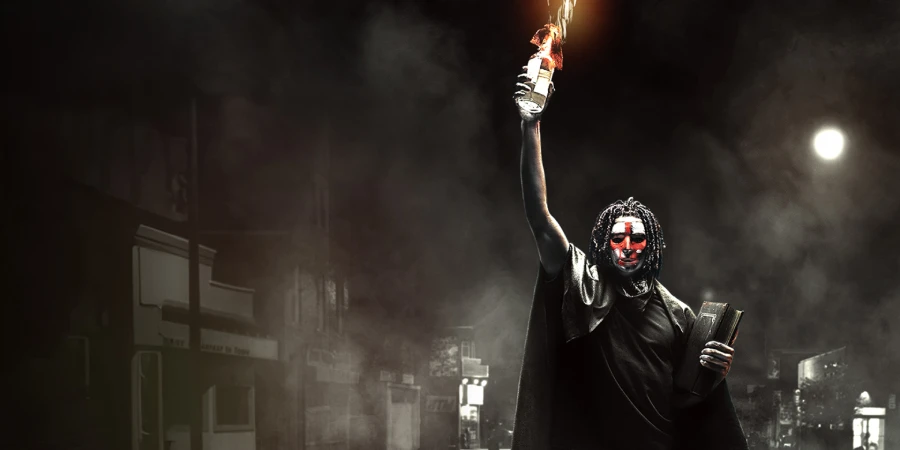

A social experiment that gives poor Black residents of Staten Island twelve hours to kill each other for cash: that is the pitch for The First Purge, and director Gerard McMurray commits to it fully. This 2018 prequel strips away any pretense of franchise mythology and plants the story in a housing project where the government is the real predator. Marielle James, a community organizer, watches her neighborhood get weaponized from the inside. What follows is one of the franchise’s most politically charged entries, arriving at a moment when American anxiety about institutional racism was impossible to ignore.
Detailed Summary
The NFFA’s Social Experiment Is Announced
A political party called the New Founding Fathers of America (NFFA) has risen to power on a platform of crime reduction. Their solution is designed by Dr. Updale, a sociologist who believes that allowing people to vent violent impulses one night per year will lower overall crime rates. Staten Island’s low-income population gets selected as the test site for this first experimental purge.
Citizens who stay on the island during the twelve-hour event receive a cash payment. Those who actively participate earn more. The NFFA frames this as an opportunity, but it is clearly designed to eliminate a community it views as expendable.
Meeting the Characters on the Ground
Dmitri is the local drug kingpin who controls the neighborhood and initially decides to sit the night out. His ex-girlfriend Nya is a fierce community activist who publicly opposes the experiment. Her younger brother Isaiah has a personal score to settle with a feral, drug-addicted man named Skeletor.
Skeletor is one of the film’s most unsettling early figures. He mutilates himself and grins at the camera in the NFFA’s pre-purge psychological evaluations. He represents the genuinely disturbed minority the NFFA hopes to channel as a weapon.
The Purge Begins and Nothing Happens
When the sirens go off, almost nobody acts. Residents throw block parties, hold prayer vigils, and simply go about their lives. Dr. Updale watches the data feeds with growing concern because the violence she predicted never materializes.
This is arguably the film’s sharpest political moment. The NFFA’s theory that poor people are inherently violent collapses the moment real people behave like real people. The community’s non-participation exposes the experiment’s racist assumption before a single shot is fired.
Isaiah’s Revenge Attempt and Skeletor’s Rampage
Isaiah arms himself and goes looking for Skeletor, who attacked him earlier in the film by slashing his neck with a box-cutter blade. He finds Skeletor, but the man has gone fully feral and is already killing indiscriminately. Nya races into the streets to pull her brother out of danger.
Skeletor’s arc ends abruptly and violently. He does not survive the night. Isaiah’s revenge fantasy collapses when he realizes Skeletor is not a human target anymore but a symptom of what the experiment unleashes in people pushed to the edge.
The NFFA Sends in Outside Mercenaries
With the community refusing to deliver the bloodshed the NFFA needs to justify national rollout, government operatives flood Staten Island with paid mercenaries and gang members from outside the area. These men wear glowing contact lenses, Ku Klux Klan robes, and neo-Nazi uniforms, which McMurray frames as a deliberate visual provocation.
Dr. Updale is horrified. She tells the NFFA chief that they are contaminating her experiment. They murder her immediately, making her the first casualty of the government’s own cover-up.
This pivot is where the film shifts from political thriller to action movie. It loses some nuance, but gains momentum.
The Massacre at Nya’s Community Center
Mercenaries dressed as Klansmen storm a church and community center where residents have taken shelter. They execute people methodically and without hesitation. It is the film’s most brutal sequence, shot with a flat, surveillance-footage quality that makes the violence feel bureaucratic rather than cinematic.
Nya barely escapes. The sequence drives home what the film has been building toward: the purge is not a random event. It is a coordinated extermination program run by the state.
Dmitri Becomes the Hero
Dmitri learns that Nya and the remaining survivors are trapped in their apartment building. He arms his crew and fights back. What follows is a building-by-building gunfight that leans heavily into action genre conventions.
Dmitri moves through the corridors with military precision, taking down mercenary after mercenary. Actor Y’lan Noel carries these sequences entirely on physicality: square shoulders, controlled breathing, and a stillness between bursts of violence that makes Dmitri feel genuinely dangerous rather than just dramatically convenient.
Dmitri Rescues Nya and Isaiah
Dmitri finds Nya and Isaiah and fights his way out of the building with them. Several of his crew members die in the process. He and Nya share a moment of exhausted acknowledgment at the end, not quite a reconciliation, but a recognition that they both survived something designed to kill them.
Isaiah, who started the film chasing petty revenge, ends it having witnessed what real violence looks like at scale. His character arc closes quietly and without a triumphant note.
Movie Ending
When the purge sirens end and daylight comes, Dmitri stands in a ruined neighborhood surrounded by bodies the NFFA’s mercenaries left behind. He and Nya are alive. Isaiah is alive. Almost everyone else they knew is not.
Dr. Updale is already dead, silenced before she could object further. The NFFA announces the experiment a success and begins planning a nationwide rollout. This is the gut-punch: the community’s survival is irrelevant to the political machinery. The government simply adjusts the data and moves forward.
Audiences most often ask whether Dmitri and Nya get back together. They do not, at least not explicitly. McMurray leaves that thread deliberately unresolved. The more important question the ending raises is whether the community will organize and resist before the next purge, and the film refuses to answer it.
What makes the ending linger is not a twist but a context shift. The final frames present the experiment as the founding document of a twelve-film mythology. Knowing where the franchise goes makes Dmitri’s small victory feel tragic rather than hopeful. He saved a few dozen people. A nation gets twelve hours of open season as a direct result of this night.
Are There Post-Credits Scenes?
The First Purge does not include any post-credits scenes. You can leave when the credits roll. There is no additional footage, tease, or stinger waiting for you at the end.
Type of Movie
The First Purge is a political action thriller with strong elements of horror. Its tone shifts noticeably across the runtime: the first half plays as a slow-burn sociological drama, and the second half accelerates into corridor-action territory.
The film belongs to a rare subcategory of genre cinema that uses exploitation-movie mechanics to deliver pointed social commentary about race, poverty, and institutional violence in America.
Cast
- Y’lan Noel – Dmitri
- Lex Scott Davis – Nya
- Joivan Wade – Isaiah
- Mugga – Dolores
- Luna Lauren Velez – Dr. Updale
- Kristen Solis – Selina
- Rotimi Paul – Skeletor
- Mo McRae – 7 (mercenary commander)
- Marissa Drummond – Elsa
Film Music and Composer
Kevin Lax composed the score for The First Purge. His work here leans on low-frequency drones and percussive tension rather than melodic themes, which suits the film’s surveillance-state aesthetic well.
The score largely stays out of its own way, which is a smart choice. When the mercenaries arrive, Lax shifts to harder, more industrial textures that signal the government’s presence before the Klan costumes do. The film also uses licensed hip-hop and rap tracks throughout to ground the Staten Island setting in something culturally specific rather than generic urban shorthand.
Filming Locations
The First Purge was shot primarily in New York, with significant production in Buffalo, New York standing in for the Staten Island setting. Buffalo’s older residential architecture and housing projects provided the visual texture McMurray needed to sell a community that looks genuinely lived-in.
Shooting in a real urban environment rather than on a backlot gives the film a grittiness that some of the earlier franchise entries lacked. The narrow hallways and concrete stairwells of the apartment building sequences feel less like a movie set and more like a place where people actually live, which makes the violence in those spaces feel more immediate.
Awards and Nominations
The First Purge did not earn significant awards recognition from major industry bodies. Its cultural conversation happened largely outside awards circuits, in political commentary and social media rather than in nomination announcements.
Behind the Scenes Insights
- Director Gerard McMurray was the first Black director to helm a Purge franchise film. He brought a personal perspective to the material that writer and franchise creator James DeMonaco acknowledged was different from his own vantage point.
- Y’lan Noel, primarily known at the time for his television work, underwent significant physical training to prepare for Dmitri’s action sequences in the film’s second half.
- The KKK and neo-Nazi imagery in the mercenary costumes was a deliberate creative decision by McMurray, not a last-minute provocation. He has spoken in interviews about wanting to make the government’s white supremacist undertones explicit rather than symbolic.
- James DeMonaco wrote the screenplay but chose not to direct, stepping back from the director’s chair for the first time in the franchise after directing the first three films.
- Production used real surveillance-style cameras for certain sequences to visually reinforce the idea that the NFFA is watching and documenting everything that happens during the experiment.
- Rotimi Paul reportedly stayed in character as Skeletor between takes on some shooting days, which unnerved several members of the cast and crew.
Inspirations and References
James DeMonaco has cited concerns about economic inequality and American political dysfunction as the foundational inspiration for the entire Purge franchise. For this prequel specifically, the targeting of a low-income Black community draws a direct line to real American histories of state-sanctioned violence against Black neighborhoods.
The COINTELPRO program, the Tulsa Race Massacre, and broader discussions of urban renewal as a mechanism of displacement all inform the film’s premise, even if the script never names them directly. McMurray brought additional context from his own community’s relationship with policing and institutional neglect.
Genre-wise, the film owes a debt to 1970s blaxploitation cinema: a Black community fighting back against a corrupt white power structure, with a charismatic street-level hero at the center. Dmitri reads as a direct descendant of those archetypes, updated for a post-Obama political moment.
Alternate Endings and Deleted Scenes
No officially confirmed alternate endings or significant deleted scenes from The First Purge have been released publicly by Universal Pictures or the filmmakers. McMurray has not publicly detailed any major sequences that were cut or reworked before release.
Some tonal shifts between the film’s two halves suggest that earlier cuts may have weighed the political drama more heavily against the action sequences, but without official confirmation this remains speculation.
Book Adaptations and Differences
The First Purge is not based on a book. It is an original screenplay by James DeMonaco, written as a prequel to the franchise he created. No source novel, graphic novel, or short story underlies the story.

Memorable Scenes and Quotes
Key Scenes
- Skeletor’s psychological evaluation: Rotimi Paul grins into a handheld camera, pupils dilated, skin marked with self-inflicted wounds. He whispers about wanting to hurt people. It is two minutes of genuinely disturbing screen presence that sets the film’s threat level before the purge even starts.
- The block party during the purge: Residents dance, drink, and celebrate in the streets while the NFFA monitors data feeds showing almost no violence. A woman holds up a sign that reads “Not Today.” It is quietly the film’s most powerful image.
- The Klan mercenaries storm the community center: McMurray frames the attackers in wide shots that emphasize their number and uniformity against the scattered, unarmed civilians. The robes photograph as white against the dark interior, a color choice that feels anything but accidental.
- Dmitri’s corridor fight: Shot in tight quarters with practical lighting flickering overhead, Dmitri moves through a hallway and neutralizes four mercenaries without cutting away to safety. Y’lan Noel’s physicality does the heavy lifting here.
- Dr. Updale’s murder: An NFFA official shoots her mid-sentence while she is objecting to their data manipulation. No dramatic buildup, no close-up. She simply stops existing. It is one of the most efficiently brutal moments in the franchise.
Iconic Quotes
- “They’re not purging. They’re having a party.” (NFFA official, watching the experiment fail)
- “This experiment is not science anymore.” (Dr. Updale, confronting the NFFA about the mercenaries)
- “You can’t own me.” (Nya to Dmitri, establishing her independence early in the film)
Easter Eggs and Hidden Details
- Several participants in the purge wear glowing colored contact lenses distributed by the NFFA, which double as tracking devices. This detail foreshadows the government’s total surveillance operation before it becomes plot-relevant.
- Background signage and graffiti in the housing project includes phrases referencing real political movements, placed deliberately by the production design team to root the film in contemporary activism rather than pure dystopia.
- Dr. Updale’s clipboard paperwork, visible in close-up during her introductory scene, includes language referencing crime rate projections by demographic group, a visual reference to real-world predictive policing controversies.
- The NFFA’s branding colors and visual design echo real American political imagery closely enough that the film effectively asks viewers to map the fictional party onto existing political formations without naming them.
- Dmitri’s apartment contains framed photographs and personal objects that suggest a fuller life and domestic history, details that make his eventual heroism feel less like a genre convenience and more like a personal decision.
Trivia
- The First Purge is the fourth film in the franchise chronologically by release date but the first in the story’s internal timeline.
- Y’lan Noel was cast primarily on the strength of his work in the HBO series Insecure. This film marked his first major theatrical lead role.
- The production team consulted with residents of low-income New York communities during development to ensure the portrayal of housing project life felt accurate rather than exploitative.
- Gerard McMurray previously directed Burning Sands (2017), a Netflix film about hazing in Black fraternities, which established his interest in institutional violence as subject matter before he joined the Purge franchise.
- The film’s marketing campaign included fake NFFA political ads that circulated on social media before release, playing up the franchise’s tradition of blurring fictional political propaganda with real media formats.
- Several critics noted at release that the film’s premise became more pointed following real political events in 2017 and 2018, which the filmmakers acknowledged in press interviews without claiming to have predicted specific incidents.
Why Watch?
Y’lan Noel’s corridor fight sequence alone earns this film two hours of your time: it is choreographed with a restraint and spatial clarity that most action franchises abandon entirely. McMurray also makes the bold choice to show the purge failing on its own terms before the government rigs it, which reframes every film in the franchise as a story about manufactured violence rather than human nature. Watch it as the political foundation it actually is.
Director’s Other Movies
- Burning Sands (2017)