A man falls from a chalet window in the French Alps, and for two and a half hours, director Justine Triet refuses to tell you whether his wife pushed him. That refusal is the whole point. Anatomy of a Fall won the Palme d’Or at Cannes in 2023, and it earned every centimeter of that prize by treating its audience as intelligent adults who can sit with radical ambiguity. Sandra Voyter is either a murderer or a grieving widow, and Triet never blinks.
Detailed Summary
The Opening and the Body
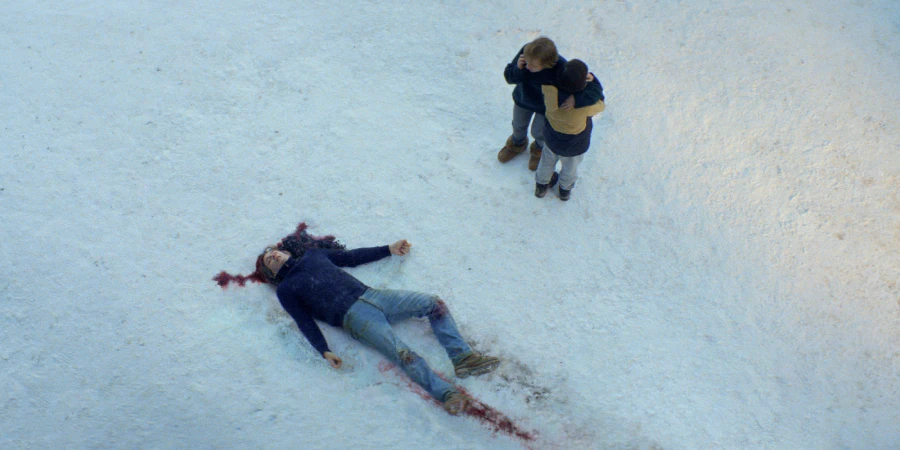
We meet Sandra Voyter, a successful German-French novelist, at her remote mountain chalet near Grenoble. She gives an interview to a young woman, but the conversation gets drowned out by deafeningly loud music pumping from upstairs, where her husband Samuel is working. Sandra’s blind son Daniel takes his dog Snoop for a walk. When Daniel returns, he finds his father dead in the snow below a top-floor window.
Samuel’s death looks like a fall. It could be a jump. It could be a push. Police investigators note a head wound inconsistent with a simple fall, and Sandra quickly becomes the prime suspect.
Sandra on Trial
Months later, Sandra stands trial for murder. Her lawyer and former lover, Maitre Vincent Renzi, defends her. French prosecutors paint Sandra as a calculating, unfaithful woman who resented Samuel’s creative stagnation and wanted out of the marriage.
Sandra had published a novel that borrowed heavily from Samuel’s personal stories without his consent. Samuel had given up his own writing career after the family relocated from London to the French Alps, partly to support Sandra, partly after Daniel’s accident, which Samuel blamed himself for. The marriage was rotting quietly under the snow.
The Audio Recording
Prosecutors produce a devastating piece of evidence: an audio recording Samuel made on his phone the day before he died, capturing a vicious argument between him and Sandra. The argument is in English, French, and German, shifting languages as the emotional temperature rises. Sandra admits to hitting Samuel during the fight but insists she did not kill him.
This scene is the film’s centrepiece, and it earns that status fully. Sandra Huller plays Sandra’s reaction to hearing the recording in court with incredible restraint, her jaw tightening, her eyes staying flat. You watch her deciding, in real time, what version of herself to present to the jury.
Daniel as the Emotional Core
Daniel, played with quiet devastation by Milo Machado Graner, sits through the trial watching his mother be dissected. He loved his father deeply. He also noticed things a blind child notices: sounds, silences, the weight of footsteps in the house.
A psychologist hired by the prosecution argues that Sandra manipulated Daniel psychologically. The film never fully endorses or dismisses this claim, which is exactly the right choice.
Samuel’s Depression and the Accident
Testimony and flashback reveal that Samuel had been taking antidepressants. Prosecutors suggest he was mentally unwell enough to have jumped. Defense argues Sandra pushed him during a renewed argument. Neither side can prove their version definitively.
Daniel’s partial blindness, caused by a head injury after Samuel left him unsupervised, haunts everything. Samuel carried guilt about that accident for years. Whether that guilt became unbearable is a question the film leaves open.

Movie Ending
Daniel becomes the person who tips the scales. After spending the trial in agonized silence, he sits alone at night and reconstructs the day of Samuel’s death in his head, replaying sounds and movements. He concludes, or chooses to conclude, that his father jumped. He tells his mother he believes her.
His testimony shifts the trial’s momentum. Sandra is acquitted. She walks free, and the film ends with her sitting on the floor of the chalet, petting Snoop. Daniel comes downstairs and lies beside her in silence.
What makes the ending genuinely unsettling is how much weight it places on Daniel’s reasoning. He is eleven years old, blind, grieving, and desperate to keep the parent he still has. His conclusion feels emotionally necessary rather than logically airtight. Triet is asking whether any verdict in a case like this can be more than that: emotionally necessary, structurally tidy, humanly insufficient.
Sandra’s acquittal is not a triumph. Her relief in that final scene reads as exhaustion more than innocence. She got what she needed. Whether she deserved it is a question the camera refuses to answer.
Are There Post-Credits Scenes?
Anatomy of a Fall has no post-credits scenes. Once the final image fades, the film is done. Sit with the discomfort; that is the intended experience.
Type of Movie
This is a legal drama and psychological thriller, though neither label captures it fully. Triet builds it like a courtroom procedural but uses that structure to stage a deep and uncomfortable examination of marriage, memory, and the limits of truth.
Tonally, the film is cold and precise without ever becoming clinical. It trusts discomfort over resolution.
Cast
- Sandra Huller – Sandra Voyter
- Swann Arlaud – Maitre Vincent Renzi
- Milo Machado Graner – Daniel Voyter
- Antoine Reinartz – Prosecutor
- Samuel Theis – Samuel Maleski
- Jehnny Beth – Dr. Marge Berger
Film Music and Composer
Anatomy of a Fall does not have a credited original composer; instead, director Justine Triet and music supervisor Thibault Deboaisne built the film’s auditory landscape using pre-existing and adapted music.
One key musical moment involves the loud piece Samuel plays before his death: 50 Cent’s “P.I.M.P.”, blasting from the upstairs studio at an absurd volume. Its appearance early in the film is almost comical, but in retrospect it functions as a provocation, a signal of a marriage in open warfare.


Filming Locations
Principal photography took place in the French Alps, primarily around the Isere department near Grenoble. The chalet’s isolation is not decorative. Its remoteness removes witnesses, traps the family in each other’s company, and strips Sandra of any alibi network a busier life might have provided.
Interior courtroom scenes ground the film in French legal procedure and architecture, giving the trial sequences a sense of institutional weight that American courtroom dramas often lack.
Awards and Nominations
Anatomy of a Fall won the Palme d’Or at the 2023 Cannes Film Festival. It received five Academy Award nominations, including Best Picture and Best Original Screenplay, winning for Best Original Screenplay for Justine Triet and Arthur Harari.
Sandra Huller received a Best Actress nomination at the Academy Awards. The film also received nominations at the BAFTA Awards and won numerous César Awards, including Best Film and Best Director for Justine Triet.
Behind the Scenes Insights
- Justine Triet co-wrote the screenplay with her partner Arthur Harari. The two drew on personal knowledge of long-term creative partnerships and what resentment can quietly do to them.
- Sandra Huller filmed much of her role in her third language, switching between French, English, and German across scenes and sometimes mid-scene, which mirrors the character’s own linguistic displacement in France.
- Milo Machado Graner had very limited acting experience before this film. Triet’s decision to cast an untrained child in such a demanding role was a gamble that paid off completely; his performance in the witness stand is the best single scene in the film.
- The dog Snoop, a Border Collie-Australian Shepherd mix, became a minor celebrity after the film’s release. His calm, watchful presence in key scenes is no accident; Triet reportedly worked carefully on how and when to place him in frame.
- Triet’s speech upon accepting the Palme d’Or made headlines for its pointed political commentary about the French government’s pension reform, drawing criticism from French officials and sparking public debate.
Inspirations and References
Triet cited real French criminal cases involving circumstantial evidence as research material. She was interested in cases where the domestic interior becomes a crime scene and where the prosecution must reconstruct private life through inference.
The film also engages with a long tradition of literary fiction about marriage as a site of power struggle, from August Strindberg‘s theatrical conflicts to the contemporary domestic noir genre popularized in English-language fiction over the last decade. Sandra’s status as a novelist who mines real life for material echoes debates about autofiction, a form prominent in French literary culture through writers like Annie Ernaux.
Alternate Endings and Deleted Scenes
No officially confirmed alternate endings or significant deleted scenes have been made public by the filmmakers. Given how precisely calibrated the final cut feels, it is easy to believe Triet knew exactly where she was going from the start.
Book Adaptations and Differences
Anatomy of a Fall is an original screenplay, not based on any book or prior source material. Triet and Harari wrote it directly for the screen.

Memorable Scenes and Quotes
Key Scenes
- The argument recording played in court: Hearing Sandra and Samuel tear each other apart in three languages, while the courtroom and Sandra herself listen in frozen silence, is one of the year’s most uncomfortable film experiences. You feel like you are eavesdropping on something private and irretrievable.
- Daniel on the witness stand: A child explaining his own mental reconstruction of his father’s death, speaking to a room full of adults who need his answer to mean something definitive, is devastating precisely because you know it cannot be definitive.
- Sandra’s deposition about her marriage: She describes the slow collapse of their relationship with a clinical honesty that makes her seem both sympathetic and cold. Huller never plays for sympathy, which makes every moment of it credible.
- The opening interview drowned out by music: Triet establishes the entire domestic dynamic in two minutes. You know this is a house where communication has broken down so completely that one partner literally plays deafening music over the other’s voice.
Iconic Quotes
- “I’m not on trial for being a bad wife.” Sandra’s response when the prosecution pushes moral judgment beyond legal fact.
- “You adapt, or you don’t.” Sandra’s description of what she expected from Samuel about relocating to France, a line that cuts in multiple directions depending on what you believe about her.
Easter Eggs and Hidden Details
- Snoop’s behavior: Pay attention to where the dog positions himself relative to Sandra throughout the film. He stays close to her in nearly every domestic scene, which some viewers read as a subtle signal of her innocence and others read as Triet playing with audience instincts about animals as truth detectors.
- The music volume: Samuel cranks “P.I.M.P.” to a level that prevents normal conversation. In a film about a man whose voice was being drowned out by his wife’s success, the literalism of that choice is not accidental.
- Sandra’s novel: References to her book mirror events in the film closely enough that you can read her fiction as a partial confession, or as simply what writers do, depending on your read of the character.
- Language shifts in the argument: When Sandra and Samuel switch to English during the fight, it functions as a kind of neutral ground, a language neither of them fully owns emotionally, which paradoxically allows them to say crueler things.
Trivia
- Anatomy of a Fall ran for approximately two and a half hours, an unusual length for a Palme d’Or winner in an era when streaming habits push toward shorter runtimes.
- Sandra Huller also appeared in The Zone of Interest in 2023, making her one of the rare actors with two major prestige films generating awards conversation in the same year.
- Justine Triet became only the third woman in Cannes history to win the Palme d’Or as director.
- The film’s title in French is Anatomie d’une chute, and the word “chute” means both “fall” and “downfall,” a double meaning the film exploits fully.
- The courtroom scenes required Triet to research French legal procedure in depth, since French trials operate quite differently from the Anglo-American adversarial system most international audiences recognize from film and television.
Why Watch?
Sandra Huller gives a performance so precisely controlled that you spend two and a half hours trying to catch her lying, and you never quite manage it. That sustained uncertainty, built from her performance and Triet’s refusal to offer a single scene of definitive clarity, is genuinely rare in fiction filmmaking. Watch it to be reminded that a film can ask a direct question and owe you absolutely nothing in the way of an answer.
Director’s Other Movies
- Sibyl (2019)
- In Bed with Victoria (2016)