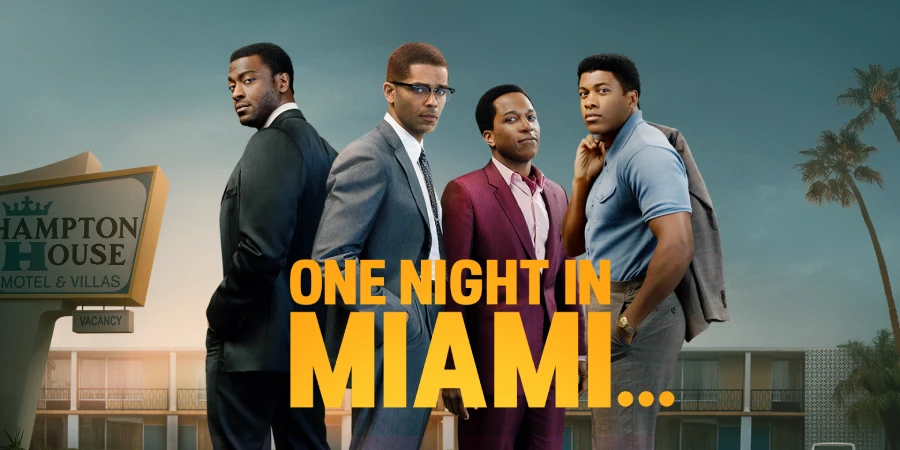

Four Black icons walk into a motel room in 1964, and what follows is one of the most quietly electric arguments ever put on screen. Regina King’s directorial debut drops Cassius Clay, Malcolm X, Sam Cooke, and Jim Brown into a single night in Miami, right after Clay’s shocking win over Sonny Liston, and lets them fight each other with words. Kemp Powers adapted his own stage play, and the seams of that origin barely show. This is a film about what Black excellence owes, what it costs, and who gets to define it.
Detailed Summary
Opening Vignettes: Four Men Before the Night
King opens with four short vignettes, each introducing one of the central figures. Jim Brown visits a white Southern landowner named Mr. Carlton, someone Brown considered a father figure, only to be turned away at the door because Carlton will not invite a Black man inside his home.
Cassius Clay shadowboxes and clowns his way through a press conference, performing the brash persona that obscures his real anxieties. Sam Cooke plays a supper club full of white faces and gets politely booed when he attempts a personal song. Malcolm X spends a quiet moment with his daughters, and the warmth there cuts against his public image sharply.
These vignettes do not feel like prologue. They set up each man’s wound before the room ever fills.
The Liston Fight and the Motel Room
Clay defeats Sonny Liston on February 25, 1964, in Miami Beach. Rather than celebrate publicly, he retreats with his three friends to a motel room at the Hampton House, a Black-owned establishment in Miami’s Overtown neighborhood, because Clay cannot enter white-owned hotels as freely as his fame might suggest.
Malcolm X has organized the gathering. He brings no alcohol because of his Islamic faith, only vanilla ice cream and a few sodas. The contrast between the modest setting and the historic weight of the night becomes the film’s central visual joke, and its central serious point.
The Tension Between Malcolm and Cooke
Malcolm X pushes Sam Cooke hard. He argues that Cooke wastes his genius performing for white audiences, writing pop songs instead of protest music. Malcolm holds up Bob Dylan’s “Blowin’ in the Wind” as evidence that a young white man is doing more for the civil rights struggle than Cooke is.
Cooke rejects this framing furiously. He argues that owning your business, controlling your masters, and building wealth is a form of revolution that Malcolm does not respect. Leslie Odom Jr. plays this defensiveness with visible, physical discomfort, his jaw tight, his smiles forced, every compliment received like a small injury.
This is the film’s best argument. Neither man is wrong, and King refuses to crown a winner.
Clay’s Announcement and Malcolm’s Grief
Clay reveals to his friends that he plans to announce his conversion to Islam and his membership in the Nation of Islam the following morning. Jim Brown reacts with alarm, worried about Clay’s career and safety. Malcolm greets the news with visible joy.
Below the surface, Malcolm carries something heavier. His relationship with Elijah Muhammad is fracturing, and he confides to Brown that the Nation may already be moving against him. Aldis Hodge plays Brown as the group’s pragmatist, the one most attuned to political consequence, and his concern here lands with real weight.
Clay and Malcolm’s Private Moment
The film’s most tender scene puts Clay and Malcolm alone together. Malcolm admits he has been using Clay, pushing the fighter toward a public declaration partly to protect his own standing within the Nation. Eli Goree plays Clay’s hurt not as rage but as quiet devastation, his voice dropping, his body going still.
Malcolm tells Clay that whatever his own fate, Clay is the future. He needs Clay to carry something forward. It reads as both manipulation and genuine love, and the ambiguity is the point.
Jim Brown’s Quiet Moral Center
Brown mostly listens. He is the one who steps outside, who deflects, who watches. Hodge gives the character a stillness that makes every word Brown does speak land harder than the arguments swirling around him.
Brown has already decided to leave the NFL to pursue acting, a choice the others find baffling. His confidence in that decision, undefended and unargued, sits in contrast to the verbal combat Cooke and Malcolm wage all night.



Movie Ending
Cooke leaves the motel room before dawn. He goes home and writes “A Change Is Gonna Come,” the song that Malcolm had essentially dared him to produce. King shows Cooke alone at a piano, working through the melody, and it is the film’s single most emotionally direct image.
The next morning, Clay announces to the world that he is a member of the Nation of Islam. He will soon take the name Muhammad Ali. Malcolm stands nearby, smiling, knowing this may be one of his last public moments of triumph before his own organization turns against him.
Title cards close the film. Malcolm X was assassinated in February 1965, less than a year after this fictional night. Sam Cooke was shot and killed in December 1964, months after writing the song the film positions as his defining act. The cards do not editorialize. They let the timing speak.
What stings is the structure King builds around those facts. She spends ninety minutes showing you these men at their most alive, most argumentative, most themselves, and then the title cards strip them away in two sentences each. It earns its grief without asking for it.
Are There Post-Credits Scenes?
One Night in Miami… has no post-credits scene. Once the title cards finish, the film is done. Stay if you need a moment, but nothing new is coming.
Type of Movie
This is a historical drama with strong elements of conversation film and political theater. The tone shifts between warm camaraderie, sharp ideological debate, and genuine grief. It is largely confined to a single room, which gives it a stage-play intimacy that the widescreen format occasionally strains against, though King mostly makes that tension productive.
Cast
- Kingsley Ben-Adir – Malcolm X
- Eli Goree – Cassius Clay (Muhammad Ali)
- Aldis Hodge – Jim Brown
- Leslie Odom Jr. – Sam Cooke
Film Music and Composer
Terence Blanchard composed the score. Blanchard is a jazz trumpeter and longtime Spike Lee collaborator, and his work here keeps the music subordinate to the dialogue, which is exactly the right call. A score that competed with these performances would have been a disaster.
Sam Cooke’s actual recordings appear in the film, including “A Change Is Gonna Come.” Hearing the real song after watching Odom Jr. build toward it all night is one of those moments where a soundtrack choice does more than any needle drop has a right to do.



Filming Locations
Production shot primarily in New Orleans, Louisiana, standing in for Miami. The Hampton House Motel, the real location of the historical gathering, still exists in Miami’s Overtown neighborhood but was not used for principal photography.
New Orleans provided period-appropriate architecture and, practically, a more accessible production environment. The choice to recreate rather than shoot on location means the film’s Miami is slightly artificial, a quality that actually reinforces its stage origins rather than fighting them.
Awards and Nominations
Leslie Odom Jr. received an Academy Award nomination for Best Supporting Actor and a Golden Globe nomination in the same category. Kemp Powers received a Writers Guild of America nomination for his adapted screenplay.
Regina King received a Golden Globe nomination for Best Director, making her one of a very small number of women nominated in that category at the time. The film did not win in any of these categories, which remains a genuine upset when you measure Odom Jr.’s performance against the competition that year.
Behind the Scenes Insights
- Regina King had the four leads rehearse together extensively before shooting began, building the group chemistry that makes the motel room feel lived-in rather than staged.
- Kemp Powers adapted his own 2013 stage play, which meant he arrived on set as both writer and protective custodian of the material.
- Leslie Odom Jr. did much of his own singing for the film’s musical sequences, which required vocal preparation alongside dramatic rehearsal.
- Eli Goree studied Clay’s physicality and speech patterns extensively, particularly the rhythm of Clay’s verbal performances during press events.
- King deliberately kept the visual approach simple inside the motel room, resisting the urge to open the space up with elaborate camera movement, so that the actors’ faces carry the film’s full weight.
- The film was released on Amazon Prime Video in January 2021 after a limited theatrical run in December 2020, which shaped how audiences first encountered it.
Inspirations and References
The film adapts Kemp Powers’s 2013 stage play of the same name. Powers based the play on the historical fact that Cassius Clay, Malcolm X, Sam Cooke, and Jim Brown did spend time together around the night of the Liston fight, though the specific conversations are invented.
Powers has cited the tradition of August Wilson’s Pittsburgh Cycle as a key influence on his approach to writing Black men in conversation, particularly Wilson’s method of letting argument carry historical weight without reducing characters to symbols.
Malcolm X’s autobiography, co-written with Alex Haley, informed the screenplay’s handling of Malcolm’s complicated relationship with Elijah Muhammad and his growing doubts about the Nation of Islam during this period.
Alternate Endings and Deleted Scenes
No officially documented deleted scenes or alternate endings have been released publicly for One Night in Miami… Given the film’s origins as a stage play and the relatively contained scope of production, it is likely that the final cut reflects a tightly controlled creative vision with minimal excised material. Nothing has surfaced to suggest otherwise.
Book Adaptations and Differences
One Night in Miami… adapts a stage play, not a novel. Kemp Powers wrote the original play in 2013, and it received productions in London and Los Angeles before King brought it to screen.
The film adds the four opening vignettes, which do not exist in the original play. On stage, the audience meets all four men already inside the motel room. King’s decision to give each character a solo introduction before the group dynamic takes over is the film’s most significant structural change from its source material, and it works. It makes the room feel earned rather than given.


Memorable Scenes and Quotes
Key Scenes
- Jim Brown at Mr. Carlton’s house: Brown stands on the porch, tie straight, smile fixed, waiting for an invitation that never comes. The camera holds on his face as understanding sets in. No speech, no confrontation, just Brown walking back to his car alone.
- Malcolm challenging Cooke with Bob Dylan: Malcolm holds up “Blowin’ in the Wind” as an indictment, and Odom Jr.’s Cooke nearly shakes with the effort of not exploding. The room gets very small.
- Clay and Malcolm alone: Goree drops the showman entirely. For about four minutes, Clay sits quietly while Malcolm talks, and the silence between lines carries more than the words do.
- Cooke at the piano: A brief, late image of Cooke working through the melody of “A Change Is Gonna Come.” King holds on his hands moving across the keys before cutting away.
- The morning announcement: Clay steps into public life as a Muslim convert while Malcolm watches. Both men know something is ending even as something begins.
Iconic Quotes
- “You need to decide if you’re going to be a man or a symbol. Because right now, you’re not even giving yourself the option of being a man.” (Malcolm X to Clay)
- “I don’t own a song. Somebody else owns my songs. You know what that means? It means they own a piece of me.” (Sam Cooke)
- “I’m the heavyweight champion of the world. Nobody tells me what to do.” (Cassius Clay)
- “I’m not the one, Jim. I never was. He is.” (Malcolm X, speaking of Clay)
Easter Eggs and Hidden Details
- The Hampton House Motel was a real landmark in Miami’s Overtown neighborhood, a hub for Black performers and visitors during segregation. Naming it specifically grounds the fiction in documented history.
- Malcolm’s insistence on vanilla ice cream is a small but pointed detail: a man of serious political purpose reduced to celebrating with a child’s treat in a room he cannot truly enjoy.
- Cooke’s supper club vignette features an almost entirely white audience, which visually echoes Malcolm’s later critique before Malcolm has even appeared on screen. King seeds the argument before the argument begins.
- The television in the motel room stays on during parts of the night, with news coverage murmuring in the background, a reminder that the outside world is already spinning the story of Clay’s win without any of these men’s input.
- Jim Brown’s relative silence across the night mirrors his real-life reputation during this period as someone who communicated through action rather than public declaration.
Trivia
- Kemp Powers wrote the screenplay himself, making him the rare writer who adapted his own stage play for film, which likely explains how tightly the dialogue holds up under close viewing.
- One Night in Miami… was Regina King’s feature directorial debut. She had previously directed television episodes but had never helmed a theatrical film.
- Cassius Clay did publicly announce his Nation of Islam membership the day after the Liston fight, on February 26, 1964, which the film accurately represents as the morning following the fictional motel gathering.
- Sam Cooke recorded “A Change Is Gonna Come” in 1963 and released it in late 1964, months before his death. The film slightly compresses the timeline to place its creation on or near this fictional night.
- Leslie Odom Jr. is primarily known as a stage actor and singer, most famously from Hamilton, which made his casting as Sam Cooke feel pointed: a man who built his name in musical theater playing a man who built his in soul music.
- The four leads had no prior ensemble history together, which makes the lived-in quality of their group dynamic in the motel room a genuine acting achievement.
Why Watch?
Odom Jr.’s Sam Cooke is the reason. Watching him absorb Malcolm’s challenge, defend himself with arguments about economic power, and then wordlessly concede by sitting down at a piano is acting that makes you rethink what a “supporting” performance is supposed to do. King builds a film around four equal forces and somehow lets one of them quietly take the whole thing home.
Director’s Other Movies
- One Night in Miami… (2020)
Recommended Films for Fans
- Malcolm X (1992)
- Ali (2001)
- The Butler (2013)
- Selma (2014)
- Ma Rainey’s Black Bottom (2020)
- Judas and the Black Messiah (2021)
- Rustin (2023)