
Pearl Harbor is the backdrop, but From Here to Eternity has almost nothing to do with war. What it actually cares about is the slow suffocation of good people inside a system designed to reward cowardice and punish integrity. Fred Zinnemann shot the whole thing in stark black and white, and every high-contrast frame feels like a document of institutional rot.
This is a film where the most honest characters lose, and that stings precisely because no villain twirls a mustache.
Detailed Summary
Prewitt Arrives at Schofield Barracks
Private Robert E. Lee Prewitt transfers to a new company at Schofield Barracks in Hawaii. He is a gifted bugler and a former regimental boxing champion who has sworn off fighting after accidentally blinding a sparring partner.
Captain Holmes wants Prewitt on the boxing team. When Prewitt refuses, Holmes quietly authorizes a campaign of harassment designed to break him down.
Warden and Karen
First Sergeant Milton Warden is the functional backbone of the company, doing the actual work that Holmes takes credit for. He begins a dangerous affair with Karen Holmes, the captain’s wife, almost immediately after they meet.
Karen is not simply a bored officer’s wife. She carries real grievance: Holmes gave her a venereal disease, and after a miscarriage her husband refused to let her have more children. Her relationship with Warden is sharp and deliberate, not impulsive.
Prewitt and Maggio
Private Angelo Maggio becomes Prewitt’s closest friend. Frank Sinatra plays Maggio as a wiry, combustible kid who picks fights he cannot finish and loves with genuine warmth.
Maggio’s run-ins with Sergeant “Fatso” Judson, a sadistic stockade guard, set up the film’s most viscerally upsetting thread. Fatso takes a personal interest in punishing Maggio, and it is clear from early on that this will not end cleanly.
The Harassment Campaign and Prewitt’s Resistance
Holmes’s men assign Prewitt every miserable duty available. They humiliate him publicly and physically. Prewitt endures it all with a quiet fury that the actor Montgomery Clift communicates almost entirely through stillness, a clenched jaw, and eyes that refuse to drop.
Prewitt will not box. His refusal is the moral spine of the film, and Zinnemann never lets the audience forget what it costs Prewitt to hold that line.
Lorene and Prewitt’s Love Story
Prewitt meets Alma, a hostess at a social club who goes by the professional name Lorene. Donna Reed plays her with a careful dignity that is easy to underestimate; Lorene is saving money to go home and reinvent herself as a respectable woman.
Their relationship develops genuine tenderness. Prewitt falls hard. Lorene’s feelings are real but guarded by her practical ambitions, and that friction gives their scenes a subtle, honest tension.
Maggio’s Fate
Maggio goes AWOL and falls into Fatso’s hands at the stockade. Ernest Borgnine plays Fatso without a single moment of softening, a man who enjoys cruelty the way some people enjoy a hobby.
Maggio escapes but dies in Prewitt’s arms from the beatings he received. His death is quiet and almost gentle on screen, which makes it worse. Prewitt sits with the body long enough that the grief becomes physical.
Prewitt Kills Fatso
Prewitt finds Fatso outside a bar and kills him in a knife fight. He is wounded in the process. This is the moment where Prewitt’s careful self-restraint finally breaks, and Clift plays the aftermath as exhaustion rather than triumph.
Prewitt goes into hiding at Lorene’s apartment. He is now a wanted man, sheltered by the woman who loves him but cannot fully commit to a future with a buck private.
Warden’s Promotion Problem
Karen tells Warden she will divorce Holmes if Warden applies for Officer Candidate School. She needs a future with some security, not an endless affair. Warden genuinely loves her, but he resists the idea of becoming an officer because he despises what officers in his world actually are.
He never applies. His pride and his contempt for the rank outweigh his desire for Karen, and that is a quietly devastating character admission.

Movie Ending
On December 7, 1941, Japanese aircraft attack Pearl Harbor and Schofield Barracks. Warden grabs a machine gun and returns fire from a rooftop with a physical ferocity that feels like the first uncomplicated action he has taken in the entire film. His soldiers follow his lead because he is, whatever his rank, the real commander.
Prewitt hears the attack from Lorene’s apartment and decides he has to return to his unit. He slips out at night, and when he fails to identify himself to a military patrol, the soldiers open fire and kill him. He dies in a field, in the dark, killed by his own side. It is not a heroic death. It has no ceremony.
Holmes is quietly pushed out. Colonel Slater confronts him with evidence of his conduct, and Holmes resigns his commission rather than face formal charges. The system does not punish him publicly; it simply removes him with minimum noise, which is its own kind of indictment.
Karen and Warden say goodbye with full knowledge that what they had is over. She boards a ship for the mainland. Warden watches her go and then walks back to work. He made his choice, and the film refuses to romanticize it.
On the same ship, Lorene tells another passenger that her fiance was killed at Pearl Harbor, a decorated soldier and a hero. It is a lie. Prewitt was a fugitive killed by friendly fire, and Lorene rewrites his story to fit the version of life she has always planned for herself. It is not cruel; it is survival. But it is also the film’s final, clean-eyed note about how institutions and individuals both construct the stories they need to keep going.
Are There Post-Credits Scenes?
From Here to Eternity has no post-credits scene. Films of this era did not use that convention. When the picture ends, it ends.
Type of Movie
This is a drama with strong romantic and military threads. The tone is serious and largely pessimistic, though never melodramatic in the way that 1950s studio pictures often were.
It fits comfortably alongside films about institutional corruption and personal compromise. The war setting is almost incidental; the film belongs more to the tradition of character studies than to combat pictures.
Cast
- Burt Lancaster – Sergeant Milton Warden
- Montgomery Clift – Private Robert E. Lee Prewitt
- Deborah Kerr – Karen Holmes
- Donna Reed – Alma “Lorene” Burke
- Frank Sinatra – Private Angelo Maggio
- Ernest Borgnine – Sergeant “Fatso” Judson
- Philip Ober – Captain Dana Holmes
- Mickey Shaughnessy – Sergeant Leva
- Jack Warden – Corporal Buckley
Film Music and Composer
George Duning composed the score. His work here is restrained, which suits the film perfectly. Duning avoids swelling romanticism and lets the drama breathe.
The recurring bugle motif tied to Prewitt is the score’s most pointed choice. Prewitt is defined by his bugling, and Duning uses that instrument as a recurring emotional marker without overplaying it.
The song “Re-enlistment Blues,” performed in the film, comes directly from James Jones’s novel. Sinatra’s Maggio gets a moment with it, and it lands as both entertainment and commentary on the characters’ trapped circumstances.



Filming Locations
Principal photography took place in Hawaii, primarily at Schofield Barracks on Oahu. The U.S. Army cooperated with the production, which gave Zinnemann access to authentic military facilities and equipment.
Shooting at the actual barracks added a documentary texture that studio backlot work simply cannot replicate. When Warden fires from a rooftop during the attack sequence, the geography feels real because it largely is.
Some interior scenes shot at Columbia Pictures studios in Hollywood provided controlled environments for the more intimate dramatic sequences. The contrast between the two environments is mostly invisible in the final cut, which speaks well of the production’s discipline.
Awards and Nominations
From Here to Eternity won eight Academy Awards at the 1954 ceremony, including Best Picture, Best Director for Fred Zinnemann, Best Supporting Actor for Frank Sinatra, and Best Supporting Actress for Donna Reed. It received thirteen nominations total.
Sinatra’s win is widely credited with reviving his career. Donna Reed’s win remains one of the more surprising upsets in Oscar history, given that her role had been substantially softened from the novel. Both wins were fully deserved.
Behind the Scenes Insights
- Frank Sinatra reportedly lobbied hard for the role of Maggio, even offering to work for a drastically reduced fee. His career was in serious decline at the time, and the performance genuinely saved it.
- Montgomery Clift was a committed practitioner of Method acting, and his physical preparation for the boxing scenes was extensive. His brooding naturalism put pressure on every other actor in his scenes to match his intensity.
- Deborah Kerr was known primarily for genteel, proper roles before this film. Columbia cast her specifically to subvert that image, and the strategy worked.
- Fred Zinnemann insisted on shooting in Hawaii rather than recreating the setting on a studio backlot. Columbia’s management initially resisted the cost.
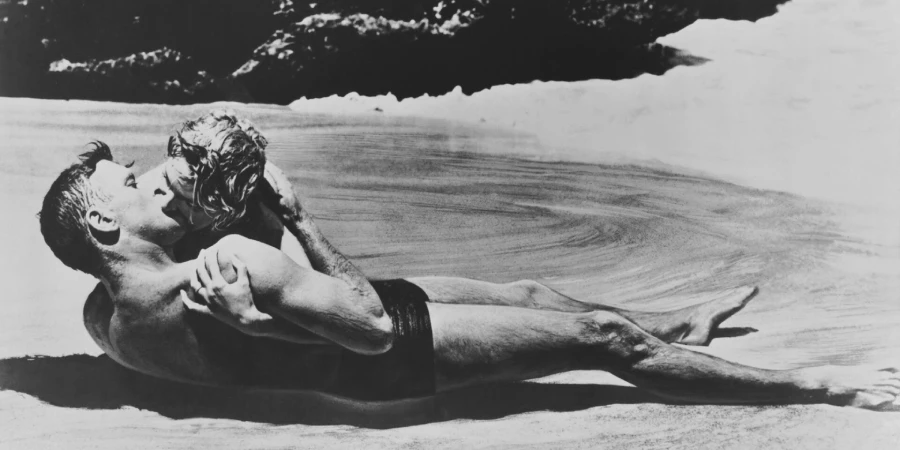
- The famous beach scene between Lancaster and Kerr required careful negotiation with the Production Code censors. Zinnemann framed it to suggest intimacy without violating the strict standards of the era.
- Eli Wallach was originally considered for the role of Maggio before Sinatra secured it.
- Columbia Pictures chief Harry Cohn owned the rights to Jones’s novel and faced intense public skepticism about whether the studio could adapt such a frank book without gutting it.
Inspirations and References
From Here to Eternity adapts James Jones’s novel of the same name, published in 1951. Jones drew heavily from his own experience as a soldier stationed at Schofield Barracks before and during the Pearl Harbor attack.
Jones’s novel was considered shocking for its direct treatment of military corruption, sexuality, and institutional cruelty. The film softened several elements, most significantly Lorene’s profession, but kept the novel’s core argument about what the Army does to its best people.
Alternate Endings and Deleted Scenes
No widely documented alternate ending exists for the theatrical release. The Production Code did require adjustments to certain scenes, particularly those involving Lorene’s work at the social club, which in the novel is explicitly a brothel.
Some dialogue and thematic content from Jones’s novel was cut entirely during adaptation. Screenwriter Daniel Taradash made significant choices about what to preserve and what to set aside, and he received an Academy Award for his screenplay.
Book Adaptations and Differences
James Jones’s novel runs to over eight hundred pages and contains considerably more graphic content than the film could accommodate under the Production Code. The Army itself receives far harsher treatment in the book.
Alma’s profession as a prostitute in the novel becomes the euphemistic “social club hostess” in the film. This change softens her character’s circumstances without entirely erasing the economic desperation behind her choices.
Several supporting characters and subplots from the novel were cut entirely. Jones’s book is sprawling and sociological; Taradash’s screenplay is tight and character-focused. Both work on their own terms, but they are genuinely different experiences.



Memorable Scenes and Quotes
Key Scenes
- The beach scene: Warden and Karen kiss in the surf as a wave rolls over them. Lancaster physically lifts Kerr, and the camera shoots them at water level. It is visually simple and remains one of the most replicated images in American cinema.
- Maggio’s death: Prewitt cradles Maggio in the dark while Sinatra plays the scene with almost nothing, just labored breathing and fading eye contact. It is the best work Sinatra ever put on film.
- Prewitt’s bugling: Prewitt plays “Taps” at a bugling competition, and Clift’s physical commitment to the scene (he actually learned the instrument for the role) gives it a quiet authority that a lesser actor would have faked away.
- The Pearl Harbor attack: Warden mounts a rooftop with a machine gun while everyone else scrambles for cover. Lancaster plays it as controlled aggression, a man finally given permission to be exactly what he is.
- Lorene’s final lie: On the ship home, Lorene tells a stranger her fiance died heroically at Pearl Harbor. Reed delivers it with composed sadness, neither ashamed of the lie nor comfortable with it.
Iconic Quotes
- “A man don’t go his own way, he’s nothing.” (Prewitt)
- “Nobody ever lies about being lonely.” (Karen)
- “If a man don’t go his own way, he’s nothing.” (Prewitt, repeated as a kind of personal creed throughout the film)
Easter Eggs and Hidden Details
- The bugle calls Prewitt performs are historically accurate to U.S. Army practice of the period, a detail that required real research and performance preparation from Clift.
- Fatso Judson wears his stockade authority like armor throughout the film, but careful viewers notice he is always physically positioned to block exits in his scenes with Maggio, a staging choice that reinforces his role as captor even in unofficial settings.
- Karen’s costuming shifts subtly across the film. Early scenes put her in lighter, more formal dress; her scenes with Warden gradually introduce looser, less guarded clothing, a visual shorthand for what the affair unlocks in her.
- Prewitt’s bugle is present in nearly every scene where he is emotionally at rest, and conspicuously absent in scenes where the harassment has truly gotten to him.
Trivia
- Frank Sinatra won the role of Maggio after a screen test that reportedly moved producer Buddy Adler to tears.
- Donna Reed was primarily known as a wholesome leading lady before this film. Playing a woman who earns her living in a brothel (however it was coded for the screen) was a genuine stretch, and her Oscar win surprised many industry observers.
- The film was one of the highest-grossing pictures of 1953.
- Montgomery Clift actually learned to play the bugle for his role as Prewitt, a commitment that reflects the seriousness he brought to every project.
- Deborah Kerr and Burt Lancaster had never worked together before this film. Their chemistry in the beach scene required very little development time, which surprised the crew.
- James Jones served at Schofield Barracks and was present during the Pearl Harbor attack, making his source novel partly autobiographical.
- Fred Zinnemann had already directed High Noon the year before, establishing himself as one of Hollywood’s most reliable directors of morally serious films.
Why Watch?
Montgomery Clift’s performance as Prewitt is a case study in how to play principled stubbornness without making the character tedious. Watch specifically for how Clift handles the harassment scenes: no speechifying, no visible self-pity, just a body absorbing punishment and staying upright. Sinatra matches him beat for beat, and that pairing alone justifies two hours of your time.
Director’s Other Movies
- The Search (1948)
- High Noon (1952)
- Oklahoma! (1955)
- A Hatful of Rain (1957)
- The Nun’s Story (1959)
- The Sundowners (1960)
- Behold a Pale Horse (1964)
- A Man for All Seasons (1966)
- The Day of the Jackal (1973)
- Julia (1977)
- Five Days One Summer (1982)
Recommended Films for Fans
- High Noon (1952)
- On the Waterfront (1954)
- Paths of Glory (1957)
- The Best Years of Our Lives (1946)
- A Streetcar Named Desire (1951)
- Bad Day at Black Rock (1955)
- Some Like It Hot (1959)
- The Young Lions (1958)