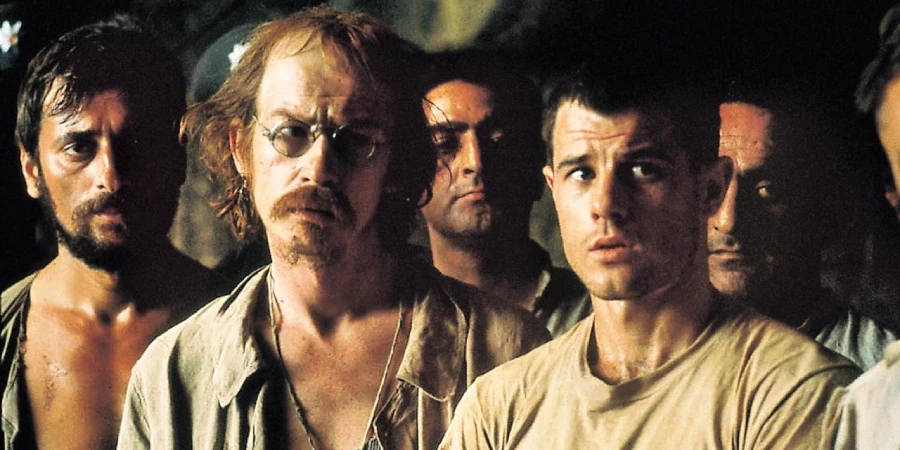

Billy Hayes smuggled two kilograms of hashish taped to his body at Istanbul’s Yesilcoy Airport in 1970, got caught thirty seconds before boarding his plane, and inadvertently handed Hollywood one of its most brutal prison films. Director Alan Parker and screenwriter Oliver Stone turned Hayes’s memoir into a film that still makes audiences sweat in their seats. Stone won an Oscar for it. Parker made you feel every stone wall.
Detailed Summary
The Arrest at the Airport
Billy Hayes, played by Brad Davis, wraps packages of hashish around his torso and attempts to board a flight home to the United States from Istanbul. A routine security sweep catches him almost immediately. Turkish authorities strip him, discover the drugs, and arrest him on the spot.
What follows is a humiliating interrogation sequence. Billy’s Turkish girlfriend watches helplessly. His American passport means nothing here.
The Initial Sentencing
A Turkish court sentences Billy to a relatively short prison term, roughly four years. It feels survivable. Billy’s family and girlfriend Susan fly over, hope stays alive, and Parker lets the audience exhale just long enough to make what comes next worse.
That false sense of relief is one of Parker’s sharpest directorial moves in the first act.
Life Inside Sagmalcilar Prison
Sagmalcilar is loud, crowded, and violent. Billy meets a small group of Western inmates: Jimmy Booth, a crass but loyal American played by Randy Quaid, and Erich, a calm Swedish inmate played by Norbert Weisser. They carve out a fragile community inside the chaos.
Parker shoots the prison as a labyrinth. Corridors feel endless. Guards appear suddenly, without warning, and Billy learns fast that survival requires submission, or at least the performance of it.
The Sentence Is Extended
Just as Billy nears the end of his term, Turkish authorities revisit his case. They reclassify his offense from simple possession to drug smuggling, a far more serious charge. His sentence balloons to thirty years.
This is the scene that breaks everything open emotionally. Brad Davis lets the news register on his face in slow, awful stages. You watch him calculate thirty years. You watch him stop calculating.
Courtroom Speech
Billy delivers a furious, raw courtroom address after the extended sentence comes down. He calls the Turkish legal system corrupt, condemns the judges directly, and tells them they are a “a nation of pigs.” It is an act of total self-destruction dressed up as defiance.
Stone’s script gives Davis one of the film’s great speeches here. Davis delivers it with his whole body shaking, not performing anger but barely containing it.
Deterioration and the “Wheel”
Billy’s mental state collapses under the extended sentence. Parker focuses obsessively on a recurring image: inmates walking in a slow circle in the prison courtyard, called the wheel. Billy joins them, shuffling, vacant, losing track of time and self.
These sequences are the film’s most disturbing. Parker strips away narrative momentum entirely and just shows you the grind. Some critics found this overlong; this critic thinks it earns every uncomfortable minute.
Attempted Escape and Punishment
Billy and Jimmy attempt an escape through the prison’s lower levels. It fails. Guards catch them, beat them severely, and transfer Billy to a ward for the criminally insane.
The insane ward is a new level of horror. Inmates rock, scream, and stare. Billy becomes one of them in appearance if not yet in mind.
The Killing of Rifki
A Turkish prisoner named Rifki has been informing on the Western inmates throughout. He engineers the failed escape to get Billy punished more severely. When Billy discovers this betrayal, he confronts Rifki in a storage room.
What happens next is genuinely shocking. Billy slams Rifki’s head against a hook on the wall, impaling him through the tongue. Parker does not cut away. The violence is sudden, close, and ugly, not stylized in any way that softens it.
Movie Ending
Billy gets transferred to the less brutal Island Prison, partly through the efforts of his father back in America lobbying officials. A Turkish guard named Hamidou, who has been Billy’s most sadistic tormentor throughout the film, attempts to assault Billy sexually in a private room. Billy fights back and, in the struggle, kills Hamidou by driving his head into a coat hook on the wall.
With Hamidou dead, Billy steals the guard’s uniform, walks out of the prison, and makes it to the ferry. He crosses to the mainland, reaches the Greek border, and crosses it. He is free.
Parker frames the escape with a kind of disbelieving lightness. After two hours of confinement and punishment, Billy simply walks out. The uniform works. Nobody stops him. The very ease of it feels like the cruelest joke the film could play on the audience after everything we have watched.
Text on screen confirms that the real Billy Hayes reached Greece and eventually returned to the United States. Parker ends on Brad Davis’s face as he crosses into Greece, eyes wide, not quite processing freedom yet. It is the right note to end on: survival without triumph, relief without joy.
Are There Post-Credits Scenes?
No. Midnight Express has no post-credits scene of any kind. When the film ends, it ends completely. Sit with it.
Type of Movie
Midnight Express is a biographical prison drama with elements of a survival thriller. Its tone is relentlessly oppressive, occasionally spiked with moments of dark camaraderie among the Western inmates.
Parker keeps the film operating at a sustained level of dread. There are no genre-comfort releases. No action-movie catharsis. Just pressure, accumulating.
Cast
- Brad Davis – Billy Hayes
- Irene Miracle – Susan
- Bo Hopkins – Tex
- Randy Quaid – Jimmy Booth
- John Hurt – Max
- Norbert Weisser – Erich
- Paolo Bonacelli – Rifki
- Paul L. Smith – Hamidou
- Mike Kellin – Mr. Hayes
Film Music and Composer
Giorgio Moroder composed the score, and it is one of the most influential film soundtracks of the late 1970s. Moroder brought his synthesizer-driven electronic sound, already famous from his work with Donna Summer, directly into the prison corridors of the film.
The main theme, often called “Chase”, pulses with a mechanical urgency that perfectly mirrors Billy’s psychological entrapment. It won Moroder the Academy Award for Best Original Score. His work here helped push electronic music firmly into mainstream cinema.
What makes the score so effective is that it never feels like a comment on the action. It feels like a symptom of it, an anxiety running underneath every scene.

Filming Locations
Despite the story being set entirely in Turkey, production did not film in Turkey. Parker shot the bulk of the film in Malta, using the country’s stone architecture and older prisons to double for Istanbul.
Malta’s fortified, labyrinthine structures gave the film exactly the claustrophobic visual quality Parker needed. The thick walls, narrow corridors, and harsh Mediterranean light do heavy atmospheric work throughout.
Some exterior sequences were filmed in London. The choice to avoid Turkey entirely was partly logistical and partly diplomatic, given how unfavorably the film portrays the Turkish justice system.
Awards and Nominations
Midnight Express received six Academy Award nominations, including Best Picture and Best Director for Alan Parker. It won two: Best Adapted Screenplay for Oliver Stone and Best Original Score for Giorgio Moroder.
Stone’s Oscar win was his breakthrough moment as a screenwriter. The film also received Golden Globe recognition, including a win for Best Drama Film.
Behind the Scenes Insights
- Brad Davis prepared intensively for the role, losing significant weight to portray Billy’s physical deterioration across the timeline.
- Oliver Stone wrote the screenplay while still a relatively unknown writer, drawing on his own experiences of brief incarceration to shape the emotional texture of confinement.
- Alan Parker reportedly maintained a tense relationship with Stone over the screenplay’s more extreme elements, including the level of anti-Turkish sentiment baked into the script.
- The real Billy Hayes later expressed discomfort with how Turkish people are portrayed in the film, acknowledging that Stone and Parker exaggerated the hostility for dramatic impact.
- John Hurt‘s portrayal of Max required him to convey long-term institutional damage almost entirely through physical stillness and a particular quality of blankness that Hurt pulls off with very little dialogue.
- Parker cast mostly unknown actors deliberately, wanting no star-power familiarity to insulate audiences from the harshness of what they were watching.
Inspirations and References
The film is based directly on the memoir Midnight Express, written by Billy Hayes with journalist William Hoffer, published in 1977. Hayes documented his actual arrest, imprisonment, and escape.
“Midnight Express” was prison slang for escape. Hayes used it as his central metaphor throughout the book.
Stone’s adaptation took significant creative liberties, amplifying violence, distorting the portrayal of Turkish characters, and compressing events. The film functions less as a faithful document and more as an emotional nightmare version of Hayes’s experience.
Alternate Endings and Deleted Scenes
No officially confirmed alternate ending exists for Midnight Express. Parker’s cut has remained the definitive and only widely known version since its release.
Some trimmed footage from production has been referenced in interviews, mostly relating to earlier prison scenes, but nothing substantial has ever surfaced in a home release or special edition.
Book Adaptations and Differences
Stone’s screenplay departs from Hayes’s memoir in several significant ways. In the real account, Hayes’s escape was less dramatic and did not involve killing a guard. Parker and Stone invented the Hamidou killing to provide a violent, climactic release point.
The book portrays Turkish prison life with more nuance than the film allows. Hayes himself has noted that many of the Turkish prisoners he knew were decent people, a complexity the film largely discards.
The romantic subplot involving Susan is also heightened considerably from the source material. Parker needed an emotional anchor outside the prison walls, and Susan serves that structural function more than a biographical one.
Memorable Scenes and Quotes
Key Scenes
- The airport arrest: Billy’s face the instant he realizes the security sweep has found the drugs, a slow freeze before everything collapses.
- The courtroom speech: Davis shaking with barely controlled fury, his voice cracking on the word “pigs,” every judge in the room staring at him with cold contempt.
- The wheel: Long, hypnotic, circular shots of inmates shuffling in the courtyard while Moroder’s score drones beneath. Time stops having meaning.
- Billy and Susan separated by glass: She presses her bare skin against the visitation window, an act of desperate intimacy that the glass turns into agony. Davis’s hands press flat against his side of it.
- The Rifki killing: No music, no warning, just a sudden violent act in a cramped room that Parker refuses to make look clean or justified.
- The escape: Billy walking through corridors in a stolen uniform, his eyes down, every second feeling like the last before someone stops him.
Iconic Quotes
- “I’m so tired. I’m so tired of being afraid.” – Billy Hayes
- “For a nation of pigs, it sure is funny you don’t eat them.” – Billy Hayes, courtroom speech
- “Hamidou is not a bad man. He just works in a bad place.” – Max
- “I just wish the world was twice as big and half of it was still unexplored.” – Max
Easter Eggs and Hidden Details
- The film’s title never appears in dialogue. Parker trusts audiences to research the prison slang “midnight express” on their own.
- Moroder’s score subtly shifts in tempo throughout the film, getting fractionally slower during the wheel sequences to mirror Billy’s mental dissolution.
- Parker frames guard Hamidou almost always from a low angle, making him physically loom over every inmate in the frame. When Billy finally kills him, Parker shoots from a high angle for the first time.
- The visitation glass scene was lit specifically so that both Billy and Susan appear washed out, almost colorless, suggesting their vitality is draining through the separation.
- Randy Quaid’s Jimmy Booth wears the same shirt in almost every prison scene, a continuity choice that quietly reinforces the stasis and repetition of incarceration.
Trivia
- The real Billy Hayes was not entirely pleased with the film’s portrayal of Turkish people and has publicly said so multiple times over the decades since release.
- Brad Davis died in 1991. He kept his HIV diagnosis private during the later years of his life, fearing it would end his career. His performance here remains his most celebrated work.
- Oliver Stone used his Oscar winnings to fund his early directing career.
- Parker originally struggled to cast the role of Billy Hayes because he wanted an unknown face, not a recognizable star.
- The film generated significant diplomatic controversy, with the Turkish government formally objecting to its depiction of Turkish courts and prisons.
- John Hurt received a BAFTA nomination for his work as Max, a supporting role that runs only a fraction of the film’s total screen time.
- Giorgio Moroder recorded the score using synthesizers at a time when electronic film scores were still considered experimental and commercially risky.
Why Watch?
Brad Davis’s performance deserves to be discussed alongside the best work of his generation, and it rarely is. Watch this film to understand what a screen actor can do with deterioration as a physical process: the weight loss, the posture collapsing by degrees, the eyes going somewhere else. Parker builds a prison around a performance, not the other way around.
Director’s Other Movies
- Bugsy Malone (1976)
- Fame (1980)
- Shoot the Moon (1982)
- Pink Floyd: The Wall (1982)
- Birdy (1984)
- Angel Heart (1987)
- Mississippi Burning (1988)
- The Commitments (1991)
- Evita (1996)
- Angela’s Ashes (1999)
Recommended Films for Fans
- Papillon (1973)
- Cool Hand Luke (1967)
- Escape from Alcatraz (1979)
- The Shawshank Redemption (1994)
- Midnight Cowboy (1969)
- Brokedown Palace (1999)
- Return to Paradise (1998)