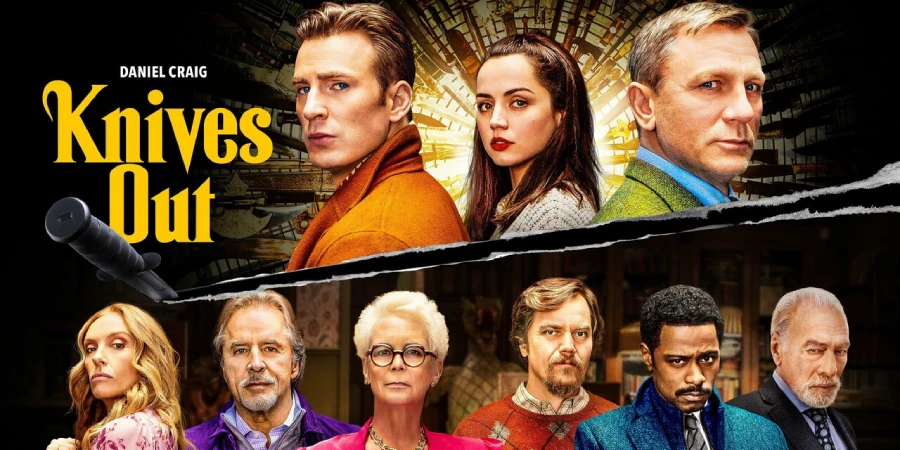

Rian Johnson’s Knives Out pulls off something genuinely rare: it reveals its central twist in the first act and still keeps you gripping your armrest until the final frame. This is a whodunit that dares to tell you whodunit early, then bets everything on character, wit, and a brilliantly layered second mystery. Marta Cabrera, a nurse, becomes both suspect and detective in a story that skewers wealth, privilege, and family dysfunction with gleeful precision. Johnson didn’t just make a mystery; he reinvented one.
Detailed Summary
The Thrombey Estate and the Morning After
Crime novelist Harlan Thrombey is found dead in his study the morning after his 85th birthday party. His throat has been cut, and the death initially looks like suicide. Harlan was rich, beloved publicly, and apparently despised privately by almost everyone in his family.
Two detectives arrive to investigate: the local Lieutenant Elliott and the hired private investigator Benoit Blanc, played with magnificent eccentricity by Daniel Craig. Blanc has been anonymously hired to look into the death, a detail that nags at him throughout the film. Meanwhile, every member of the Thrombey family has a motive.
Meet the Family: A Rogues’ Gallery of Greed
Linda Drysdale, Harlan’s daughter, runs a self-made real estate empire, though Harlan secretly funded its foundation. Her husband Richard carries on an affair and fears Harlan knew about it. Their son Hugh, who goes by Ransom, is the family black sheep, openly contemptuous of everyone around him.
Walt Thrombey, Harlan’s son, manages the publishing rights to Harlan’s books. Harlan had just fired him. Joni, the widow of Harlan’s deceased son, has been double-dipping her daughter’s tuition payments through Harlan for years, and Harlan discovered the fraud. In short, nearly every family member had a fresh grievance on the night of the party.
Marta’s Secret: The Real Story of That Night
Detectives interview Marta Cabrera, Harlan’s nurse and closest confidante, and everyone insists she is like family. Marta, however, has a remarkable condition: she physically vomits whenever she lies. This makes her an inadvertent, perfect truth-teller.
Through flashback, we see what actually happened that night. Marta accidentally administered a lethal dose of morphine to Harlan instead of his regular medication. In a remarkable act of calm, Harlan devised a plan to protect her, sending her away with a fake alibi and then taking his own life, knowing the morphine would kill him anyway.
The Will and the Bombshell
Harlan’s attorney arrives and reads a new will. Harlan left everything, including the estate and his entire fortune, to Marta alone. The family erupts in fury, and suddenly their performative warmth toward her evaporates entirely.
Ransom, interestingly, approaches Marta privately. He offers to help her keep the inheritance in exchange for a cut, claiming he knows something that can protect her. Marta, desperate and cornered, agrees to work with him.
Blanc Closes In
Blanc has been watching Marta carefully. He correctly deduces that she knows more than she is saying, and he brings her into his investigation as a partner rather than a suspect. Marta walks a razor-thin line, trying to help Blanc without exposing herself.
Meanwhile, someone sends an anonymous tip to a gossip reporter about Marta’s role in Harlan’s death. Threats escalate. A family member tries to blackmail her. Consequently, the pressure on Marta builds from every direction simultaneously.
Blanc, however, notices something crucial. He obtains a toxicology report on Harlan’s body. The report shows no trace of a morphine overdose. Harlan, it turns out, was not dying from the injection at all. Marta had grabbed the correct vial that night; she had given him the right medication without realizing it.


Movie Ending
Here is where Knives Out snaps shut its trap with satisfying precision. Marta did not kill Harlan. She gave him the correct dose. Harlan died believing he was protecting her from a mistake that never actually happened. Someone else, therefore, had already set events in motion to frame her.
All evidence points toward Ransom Drysdale. He had switched the labels on Marta’s medication vials before the party, intending for her to accidentally kill Harlan, discredit herself, and allow the original will to stand with the family inheriting everything. Ransom expected the overdose to be discovered and Marta to take the blame. Harlan’s spontaneous suicide foiled that plan.
Blanc confronts Ransom at the Thrombey estate. Ransom, panicked, grabs a knife and lunges at Marta. The knife, however, is a theatrical prop from the estate’s collection and does not harm her. Ransom crumbles, and the police arrest him. His scheme, his arrogance, and his contempt for everyone around him undid him completely.
Marta inherits everything. In the film’s final image, she stands on the balcony of the Thrombey estate holding a mug that reads “My House, My Rules, My Coffee,” looking down at the squabbling, defeated family below. It is a quietly triumphant image, funny and pointed, that crystallizes the film’s entire argument: genuine decency wins, and inherited entitlement loses.
For audiences curious about who hired Blanc, this remains deliberately ambiguous. Johnson has suggested it may have been Harlan himself, anticipating something was wrong, or possibly Ransom attempting a double-bluff that backfired. The ambiguity is intentional and thematically satisfying.
Are There Post-Credits Scenes?
Knives Out contains no post-credits scenes. Once the final image of Marta on the balcony fades, the film is complete. You can safely leave your seat the moment the credits roll.
Type of Movie
Knives Out is a whodunit mystery with strong comedic elements and sharp social satire. It operates primarily as a crowd-pleasing genre film but layers in pointed commentary on class, immigration, and inherited privilege. Tonally, it balances warm humor with genuine tension.
Johnson described it as a modern Agatha Christie story, and that framing holds. It feels classical in structure yet thoroughly contemporary in its concerns. Audiences who enjoy genre entertainment with actual ideas underneath will find it deeply satisfying.
Cast
- Daniel Craig – Benoit Blanc
- Ana de Armas – Marta Cabrera
- Chris Evans – Hugh “Ransom” Drysdale
- Jamie Lee Curtis – Linda Drysdale
- Michael Shannon – Walt Thrombey
- Don Johnson – Richard Drysdale
- Toni Collette – Joni Thrombey
- Lakeith Stanfield – Lieutenant Elliott
- Christopher Plummer – Harlan Thrombey
- Katherine Langford – Meg Thrombey
- Jaeden Martell – Jacob Thrombey
- Riki Lindhome – Donna Thrombey
- K Callan – Great Nana
- Frank Oz – Alan Stevens (Harlan’s attorney)
Film Music and Composer
Nathan Johnson, director Rian Johnson’s cousin and long-time collaborator, composed the score. Nathan Johnson has scored all of Rian’s feature films, making him a consistent creative partner across very different genres. His background spans experimental music and traditional orchestral work.
For Knives Out, he crafted a score that leans into plucked strings, harpsichord-adjacent textures, and playful woodwinds. The music evokes classic mystery films without feeling like pastiche. It suits the film’s tone of warm genre affection perfectly.


Filming Locations
Principal photography took place in and around Massachusetts. The Thrombey estate scenes used Ames Free Library and surrounding properties in North Easton, along with the Crane Estate in Ipswich for exterior shots. These grand, old New England properties gave the film exactly the right atmosphere of old money and faded grandeur.
Boston and its surrounding areas provided urban scenes and interiors. Shooting in New England was a deliberate creative choice; the setting anchors the story in a very specific American mythology of inherited wealth and old family names. Visually, the locations do substantial narrative work.
Awards and Nominations
Knives Out earned an Academy Award nomination for Best Original Screenplay for Rian Johnson, a significant achievement for a genre film. It also received nominations from the Writers Guild of America and numerous critics’ circles.
Ana de Armas received considerable awards attention for her performance, winning several critics’ association awards and earning nominations from major guilds. The film performed strongly across the awards season as a popular and critical favorite, even if its Oscar campaign ultimately fell short in most categories.
Behind the Scenes Insights
- Rian Johnson wrote the role of Benoit Blanc specifically with Daniel Craig in mind. Craig, eager to play against his James Bond image, accepted enthusiastically.
- Chris Evans reportedly jumped at the chance to play a villain, having spent years playing the heroic Captain America in Marvel films.
- Johnson spent years developing the script, deliberately studying the structure of classic Agatha Christie novels before writing a single scene.
- The production designed the Thrombey house so that every room reflects the personality of the family member who occupies it most, a detail visible on repeat viewings.
- Ana de Armas worked closely with Johnson to develop Marta’s physicality, particularly the vomiting reflex, ensuring it played as character detail rather than cheap comedy.
- Filming wrapped before Johnson knew whether any distributor would pick the film up; Lionsgate acquired it and gave it a wide theatrical release.
- The knife circle set piece, featuring knives arranged in a circular pattern around Harlan’s chair, became one of the film’s most iconic visual motifs.
Inspirations and References
Agatha Christie is the film’s most obvious and openly acknowledged inspiration. Johnson studied Christie’s structural techniques, particularly her use of false solutions and reader misdirection. He wanted to honor that tradition while subverting it in modern terms.
Johnson has also cited Columbo as an influence, specifically its inverted mystery structure where the audience knows the culprit early. In addition, the film engages with the tradition of classic Hollywood golden-age mysteries, films built around charming detectives and ensemble casts of suspects in confined spaces.
Thematically, the film draws on contemporary American debates around immigration, class mobility, and who truly “deserves” wealth. Marta’s undocumented family background and her position as a caretaker speak directly to real social tensions, not just genre conventions.
Alternate Endings and Deleted Scenes
Johnson has not publicly released significant deleted scenes or discussed major alternate endings for Knives Out. The film’s structure was apparently locked early in the writing process, and the core mystery mechanics left little room for radical alternative conclusions.
Some minor scenes were trimmed in editing for pacing, but nothing that changes the plot has surfaced publicly. Johnson tends to work from tightly structured scripts, which limits the volume of material cut during production.
Book Adaptations and Differences
Knives Out is an entirely original screenplay written by Rian Johnson. It is not based on any novel, short story, or pre-existing intellectual property. Johnson conceived the story, characters, and mystery structure from scratch.
A novelization of the film was released, but it follows the film rather than preceding it. Therefore, no source text exists against which to compare the movie’s creative choices.
Memorable Scenes and Quotes
Key Scenes
- Harlan calmly orchestrating his own death to protect Marta, a genuinely moving and unexpected act of sacrifice in the film’s first act.
- Blanc’s “donut hole” monologue, in which he describes the case as a donut within a donut, a hole within a hole, brilliantly capturing the film’s layered mystery structure.
- The will reading, in which Marta inherits everything and the family’s performative warmth toward her instantly evaporates.
- Marta vomiting on Ransom in the car as he presses her with lies, a scene that is simultaneously gross, funny, and narratively important.
- The final confrontation at the estate, in which Ransom lunges at Marta with a prop knife, and the entire scheme collapses in an instant.
- Marta standing on the balcony with her mug, looking down at the defeated family below, the film’s perfect final image.
Iconic Quotes
- “I suspect foul play. I have eliminated no suspects.” – Benoit Blanc, establishing his investigative stance early.
- “It’s a donut. The hole of the donut. But the donut hole has its own hole in the center. So it’s a donut hole in a donut hole.” – Blanc, explaining the mystery’s structure with absurd precision.
- “My house, my rules, my coffee.” – the mug Marta holds in the film’s final shot, a perfect encapsulation of her arc.
- “I didn’t do it for you.” – Ransom, stripping away any pretense of family loyalty during his unraveling.
- “You have a regurgitative reaction to lying. You are, in fact, the perfect witness.” – Blanc to Marta, making her involuntary honesty a plot asset.
Easter Eggs and Hidden Details
- Harlan’s study is filled with knives from his mystery novel covers, and the circular knife display behind his chair visually echoes the film’s poster art.
- Jacob Thrombey is seen recording family members on his phone throughout the party scenes, a subtle visual motif about surveillance and exposure within families.
- Ransom’s sweater, a thick cable-knit design, became a cultural phenomenon and is widely read as a visual signal of his false warmth masking cold calculation.
- Marta’s nationality changes depending on which family member describes her background, a running detail that underlines how the family sees her as an abstraction rather than a person.
- The board game boxes visible in background shots are carefully chosen puzzle and mystery games, reinforcing the film’s genre self-awareness.
- Blanc is first introduced listening to a recording of Sondheim’s work, a nod to the theatrical, puzzle-box nature of his character.
- The vial labels that Ransom switched are briefly visible in the background of an early scene, rewarding attentive viewers on rewatch.
Trivia
- Daniel Craig filmed Knives Out during a break from completing No Time to Die, his final Bond film.
- Christopher Plummer was in his late eighties during filming, and the production accommodated his schedule and physical requirements carefully.
- Johnson chose to shoot on film rather than digital, giving the movie a warmer, slightly grainy visual texture that suits its classical mystery tone.
- Rian Johnson made Knives Out independently after the divisive reception to Star Wars: The Last Jedi, returning to a smaller, personal project he had long wanted to make.
- Chris Evans’s Ransom was originally a smaller role; Johnson expanded it significantly after Evans came aboard and the character’s chemistry with the story became clear.
- Lionsgate acquired the film at the Toronto International Film Festival for a reported 40 million dollars, a substantial sum for an original mystery film.
- The film grossed over 300 million dollars worldwide against a production budget of approximately 40 million dollars, making it a major commercial success.
- Netflix subsequently acquired the rights to two sequels, Glass Onion: A Knives Out Mystery and a third untitled installment, for a reported 450 million dollars.
Why Watch?
Knives Out is the rare film that rewards both casual viewers and obsessive re-watchers equally. Johnson builds a mystery that is genuinely clever, genuinely funny, and powered by a lead performance from Ana de Armas that anchors every emotional beat. It respects your intelligence while also being enormously entertaining. Few films manage that balance so effortlessly.
Director’s Other Movies
- Brick (2005)
- The Brothers Bloom (2008)
- Looper (2012)
- Star Wars: The Last Jedi (2017)
- Glass Onion: A Knives Out Mystery (2022)
Recommended Films for Fans
- Clue (1985)
- Murder on the Orient Express (1974)
- Death on the Nile (1978)
- The Usual Suspects (1995)
- Glass Onion: A Knives Out Mystery (2022)
- Gosford Park (2001)
- Conclave (2024)
- Sleuth (1972)
- Parasite (2019)
- The Grand Budapest Hotel (2014)