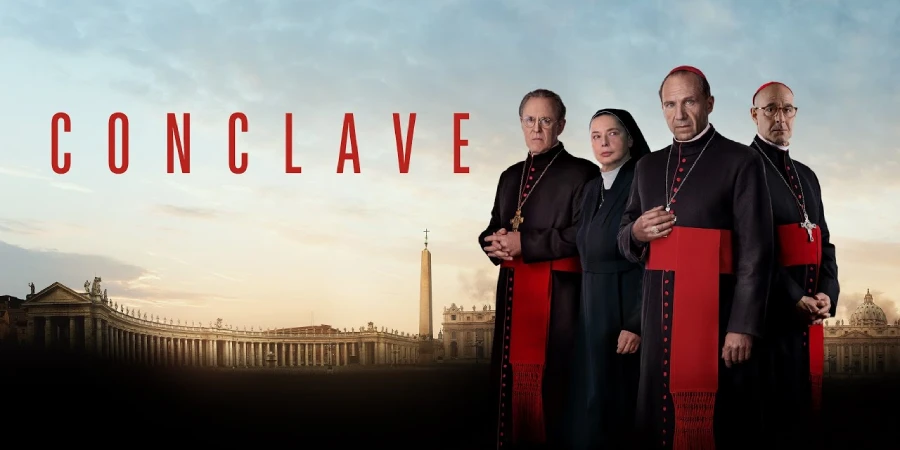
A dead pope, a sealed chapel, and a room full of men who all swear they never wanted the job. Conclave takes Vatican paperwork and turns it into a knife fight in cassocks. Edward Berger shoots whispered gossip like gunfire, then drops a closing secret that reframes the whole film. Everything below is spoiled, including that reveal.
Detailed Summary
A Pope Dies in the Night
The film opens on a corridor rush. Cardinals crowd a bedroom in the Casa Santa Marta, where the Pope has just died of a heart attack. Cardinal Thomas Lawrence, Dean of the College of Cardinals, arrives late and shaken.
Ritual takes over immediately. Officials remove the Fisherman’s Ring and break it, sealing the papal apartment. Lawrence, meanwhile, is left holding the machinery of a conclave he never wanted to run.
A Dean Who Wants Out
Lawrence has a private problem. He had already asked the late Pope to release him from his duties, citing a crisis of faith, and the Pope refused him.
Cardinal Aldo Bellini, his liberal ally, delivers the sting later: the Pope saw Lawrence as a manager rather than a shepherd. That judgment haunts every administrative decision he makes over the next few days.
The Candidates Assemble
Four names dominate the whispering. Bellini carries the progressive wing, Cardinal Joseph Tremblay plays the smooth Canadian moderate, Cardinal Joshua Adeyemi of Nigeria commands the conservative African bloc, and Cardinal Goffredo Tedesco wants the Latin Mass and a wall around tradition.
Archbishop Woźniak, the late Pope’s aide, then drops a bomb in Lawrence’s lap. He claims the Pope stripped Tremblay of his position on the final day of his life. Tremblay flatly denies it.
The Stranger from Kabul
A cardinal nobody recognizes checks in. Cardinal Vincent Benitez, serving in Kabul, was created in pectore, meaning the Pope appointed him in secret and told no one.
His paperwork holds up, so Lawrence seats him. Benitez says almost nothing in those early scenes, which is exactly why he unsettles the room.
A Homily About Doubt
Lawrence gives the pre-conclave homily and refuses to play it safe. He argues that certainty is the enemy of unity and asks God for a pope who sins and keeps going.
Conservatives read it as a campaign speech. As a result, Lawrence starts collecting votes he genuinely does not want.
The First Ballots
Voting fractures immediately. Bellini leads narrowly, Tedesco holds a hard bloc, Adeyemi climbs, and Lawrence picks up stray support that will not go away.
Bellini watches his numbers stall and turns bitter, warning that Tedesco in the chair would set the Church back decades. Nobody consolidates, so the smoke stays black.
Adeyemi’s Fall
Adeyemi surges in the third round and looks unstoppable. Then a nun named Sister Shanumi is assigned to kitchen duty, sees him, and breaks down in front of everyone.
Lawrence digs and finds the truth: Adeyemi fathered a child with her thirty years earlier, when she was nineteen. His candidacy dies within hours, and the timing of her transfer to Rome smells engineered.
Tremblay Under Suspicion
Monsignor O’Malley traces the paperwork back for Lawrence. Tremblay personally requested Shanumi’s assignment, which makes the scandal look like sabotage rather than coincidence.
Sister Agnes, who runs the sisters and misses nothing, then confirms the detail that closes the loop. She reminds Lawrence that nuns are treated as invisible, yet God gave them eyes and ears.
Breaking the Seal
Lawrence does the unthinkable and breaks the seal on the papal apartment. Inside he finds a report documenting Tremblay’s simony: cash and favors traded for votes.
He reads it aloud to the assembled cardinals. Tremblay collapses as a candidate, and with three frontrunners burned, Tedesco is suddenly close to winning.
Movie Ending
A suicide bombing tears through the area outside during the next round of voting. Windows blow inward, cardinals hit the floor bleeding, and the sealed chapel stops feeling like a sanctuary.
Tedesco seizes the moment. Standing among the debris, he demands a holy war and frames the attack as proof that his hardline vision was right all along.
Benitez answers him quietly, and the room turns. Having served in Congo, Baghdad and Kabul, he says he has seen what war does to actual people, and he tells Tedesco that the Church is now fighting itself. Faith, he argues, is not a thing you point at an enemy.
That speech wins the conclave. On the final ballot the cardinals elect Benitez, who chooses the name Innocent, and white smoke finally goes up.
Lawrence has one last thread to pull. He learns Benitez arranged a clinic appointment in Geneva, assumes it hid something ugly, and confronts him.
The truth lands sideways. Benitez was born with a uterus and ovaries, discovered years later during an appendectomy; the late Pope knew and appointed him anyway. He booked a hysterectomy, then cancelled it, deciding he had no right to alter what God made.
Lawrence says nothing to anyone. In the final scene he refuses the burden of another scandal, cracks open a window, and watches the nuns laughing in the courtyard below.
That closing image is the point. A film obsessed with sealed rooms and secret ballots ends with fresh air, a woman’s laughter, and a pope whose body quietly dismantles the institution’s oldest assumption about who gets to lead.
Are There Post-Credits Scenes?
No. Conclave has no mid-credits or post-credits scene, and the story closes fully with the window shot. Once the credits roll, you can leave without missing a thing.
Type of Movie
Call it a political thriller in religious clothing. Structurally it is a locked-room procedural, closer to Twelve Angry Men than to any conventional faith drama.
Tone runs cool, hushed and faintly comic. Berger finds real humor in petty ambition, then swaps it for dread the second a secret surfaces. Beneath the intrigue sits a sincere argument about doubt as a spiritual virtue.
Cast
- Ralph Fiennes – Cardinal Thomas Lawrence
- Stanley Tucci – Cardinal Aldo Bellini
- John Lithgow – Cardinal Joseph Tremblay
- Sergio Castellitto – Cardinal Goffredo Tedesco
- Lucian Msamati – Cardinal Joshua Adeyemi
- Carlos Diehz – Cardinal Vincent Benitez
- Isabella Rossellini – Sister Agnes
- Brían F. O’Byrne – Monsignor Raymond O’Malley
- Jacek Koman – Archbishop Woźniak
- Balkissa Maiga – Sister Shanumi
Film Music and Composer
Volker Bertelmann, who records experimental work as Hauschka, wrote the score. He had already won the Academy Award for Best Original Score for Berger’s All Quiet on the Western Front, so the pairing was no accident.
His approach here is deliberately abrasive. Jagged string clusters, low percussive hits and prepared piano textures give ceremonial scenes an undertow of threat.
The signature cue arrives with the balloting sequences, where a scraping, insistent string figure turns a ritual into a countdown. Silence does heavy lifting too, particularly around the bombing and the final confrontation. Bertelmann earned an Oscar nomination for the work.
Filming Locations
Rome supplied nearly everything. The Vatican does not permit dramatic filming inside its walls, so production designer Suzie Davies rebuilt the Sistine Chapel and the Casa Santa Marta at Cinecittà Studios.
Those recreations matter more than tourism would. Building the chapel gave Berger control of light, scale and camera height, letting him shoot Michelangelo’s Last Judgment as a silent jury hanging over the vote count.
Roman exteriors and period interiors fill in the rest of the city. Consequently the film feels institutional rather than picturesque: courtyards, corridors, plastic sheeting and umbrellas held up to block prying lenses.
Awards and Nominations
Conclave won the Academy Award for Best Adapted Screenplay for Peter Straughan, from eight nominations that included Best Picture, Best Actor for Ralph Fiennes, Best Supporting Actress for Isabella Rossellini, Best Original Score, Best Film Editing, Best Production Design and Best Costume Design.
British voters went further. At the BAFTAs the film took Best Film, Outstanding British Film, Adapted Screenplay and Editing.
It also won the Golden Globe for Best Screenplay. Notably, the Screen Actors Guild handed it Outstanding Performance by a Cast, the closest thing an ensemble gets to a group trophy.
Behind the Scenes Insights
- Carlos Diehz had no professional acting background. An architect by trade, he was cast as Benitez and carries the film’s biggest reveal in his first major screen role.
- Berger moved straight from the trenches of All Quiet on the Western Front to the Vatican, keeping the same interest in institutions that grind individuals down.
- The Sistine Chapel set at Cinecittà let the crew rig overhead shots that turn rows of red cardinals into geometric patterns.
- Costume designer Lisy Christl built the film’s color logic: crimson for the men who vote, white for the sisters who serve and observe.
- Rossellini appears in relatively little of the runtime, yet her single confrontation scene carried her to an Oscar nomination.
- Fiennes plays Lawrence almost entirely through restraint, and much of his performance is reaction rather than dialogue.
Inspirations and References
Robert Harris wrote the 2016 novel Conclave, and the film follows its architecture closely. Harris researched real papal election procedure, including the rules codified in Universi Dominici Gregis, which govern sequestration, ballot burning and the required two-thirds majority.
Real conclaves supplied the texture. Details like the extra omnes command, the chemical cartridges used to color the smoke and the sealing of the papal apartment all come from documented practice.
Thematically the film sits alongside classic jury dramas and Cold War espionage. Straughan previously adapted Tinker Tailor Soldier Spy, and that lineage shows in the paper trails and quiet betrayals.
Alternate Endings and Deleted Scenes
No alternate ending has been released. The film keeps the novel’s final revelation intact, and Berger has spoken about playing that moment small rather than turning it into a twist sting.
Home releases have not surfaced any significant cut sequences. What reached theaters appears to be the intended version, tightened in the edit rather than reshaped.
Book Adaptations and Differences
Yes, this adapts Harris’s novel, and the broad plot survives the jump. Several details shift, however.
The novel’s dean is Cardinal Jacopo Lomeli, an Italian; the film renames him Thomas Lawrence and makes him English for Fiennes. Benítez is Filipino and serving in Baghdad on the page, while the film relocates him to Kabul.
Sister Agnes gets more room on screen than in print, which sharpens the film’s argument about women watching everything and being credited with nothing. Both versions land on the same ending.
Memorable Scenes and Quotes
Key Scenes
- Lawrence’s homily on doubt, delivered to a room that immediately misreads it as ambition.
- Sister Shanumi’s breakdown in the dining hall, and the silence that follows.
- Adeyemi’s confession, where a decades-old secret erases a papacy in under ten minutes.
- The reading of the simony report aloud to the entire College.
- The bombing, filmed from inside the chapel as glass and dust swallow the ballots.
- Benitez’s rebuttal to Tedesco, the quietest speech in the film and the most decisive.
- The final conversation about Geneva, played as two men talking rather than a reveal.
Iconic Quotes
- Lawrence, on faith: “Certainty is the great enemy of unity.”
- Lawrence, praying for a leader who sins, asks forgiveness, and carries on.
- Sister Agnes, reminding Lawrence that God gave the invisible sisters eyes and ears.
- Bellini, arguing that no sane man would actually want the papacy.
- Benitez, on his body: “I am what God made me.”
Easter Eggs and Hidden Details
- Tortoises appear in the Vatican gardens, a nod to the real tortoises that live on the grounds.
- Michelangelo’s Last Judgment looms behind every count, placing damnation directly above the ambition.
- White umbrellas shield arriving cardinals from cameras, mirroring genuine Vatican practice during a sede vacante period.
- The broken Fisherman’s Ring in the opening functions as a visual thesis: authority is a physical object, and it can be smashed.
- Bellini’s smoking gives away the stress that his composed speeches try to hide.
- Nuns move constantly through the backgrounds of scenes, carrying trays and unlocking doors, long before the script admits they matter.
Trivia
- Peter Straughan, who won the Oscar for the screenplay, previously adapted Tinker Tailor Soldier Spy and Wolf Hall.
- Focus Features released the film in 2024, and it runs roughly two hours.
- Viewership spiked worldwide after the death of Pope Francis in April 2025, as audiences went looking for a primer on how conclaves work.
- Berger is German, while the production itself qualified as British, which is how it won Outstanding British Film at the BAFTAs.
- The chapel interior audiences see is a set, not a location, despite reading as the real thing.
- Fiennes received his second Academy Award nomination for acting with this role.
Why Watch?
Few thrillers extract this much tension from folded slips of paper. Fiennes anchors a razor-sharp ensemble, Berger stages ritual like warfare, and the ending genuinely earns its shock. Watch it for a smart, gorgeous film about doubt beating certainty.
Director’s Other Movies
- Jack (2014)
- All My Loving (2019)
- All Quiet on the Western Front (2022)
- Ballad of a Small Player (2025)