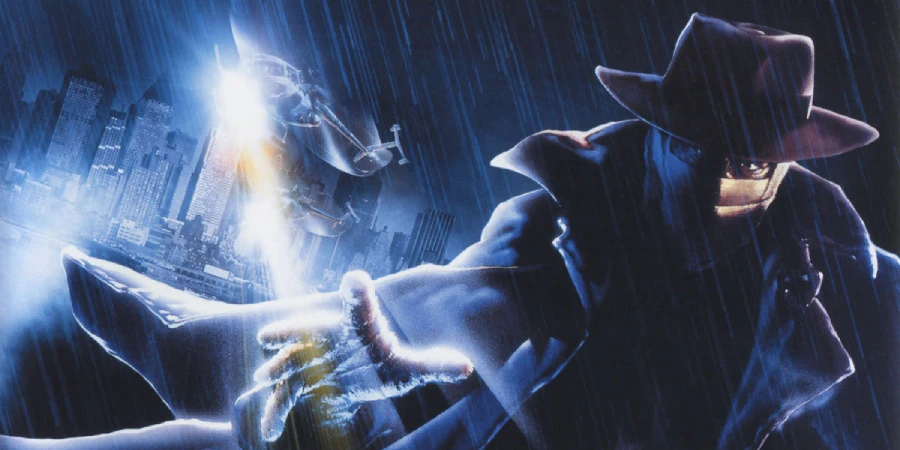

Sam Raimi took a character nobody had ever heard of and turned him into one of the most compelling superhero origin stories of the early 1990s. Darkman is a film about a man burned beyond recognition, rebuilt by science into something between a monster and a vigilante. Liam Neeson plays the role with raw, barely-contained fury, and the result is a pulpy, operatic revenge thriller that still holds up today. It deserved a much bigger audience than it got.
Detailed Summary
Peyton Westlake and the Synthetic Skin Experiment
Dr. Peyton Westlake works obsessively in his lab, developing a synthetic skin formula with enormous medical potential. His process almost works, but the artificial skin degrades after exactly 99 minutes of exposure to light, then rapidly liquefies. He keeps pushing forward, convinced he can crack the problem.
Meanwhile, his girlfriend Julie Hastings, a lawyer, stumbles onto a memo connecting a corrupt businessman named Louis Strack Jr. to criminal activity. She pockets the document without fully grasping the danger it represents. That single decision sets every terrible thing in the film into motion.
The Attack on the Lab
Strack sends his enforcer, Robert Durant, to retrieve the memo. Durant is a genuinely menacing villain with a habit of snipping off the fingers of his enemies with a cigar cutter. He and his gang invade Westlake’s lab, brutalizing him and destroying everything he has built.
They do not simply beat Westlake; they submerge him in a vat of boiling chemicals and blow up the lab, leaving him for dead. Consequently, Westlake’s body washes up in a river, barely alive. Medical workers haul him to a hospital, where surgeons perform a radical emergency procedure.
The Surgery That Creates Darkman
Surgeons, unable to identify him, perform an experimental operation that severs his spinothalamic nerve pathways. In theory, this eliminates his capacity to feel pain. In practice, it floods his adrenal system permanently, giving him unpredictable surges of superhuman strength.
However, the surgery also amplifies every emotion he experiences to an almost uncontrollable degree. Westlake becomes something new: capable of incredible physical feats, but emotionally unstable and volatile. His face remains a ruin of scar tissue, forcing him to cover himself entirely whenever he moves through the world.
Westlake Rebuilds Himself in Secret
Westlake eventually escapes the hospital and sets up a new lab inside an abandoned factory. He recreates his synthetic skin formula and uses it to mold perfect face masks of anyone he chooses. For the first time since the attack, he has a weapon.
He uses the masks to impersonate Durant’s men, gradually dismantling the gang from within. He also recreates his own face to spend stolen moments with Julie, who believes him dead. Those moments carry enormous emotional weight, because Westlake knows the 99-minute clock is always running.
The Crumbling Relationship with Julie
Julie, meanwhile, has started a new relationship with Strack, unaware that he orchestrated Westlake’s apparent death. Westlake watches this with barely suppressed anguish. His visits to her, wearing a mask of his own former face, grow increasingly desperate and erratic.
One heartbreaking scene takes place at a carnival, where Westlake wins Julie a pink elephant toy after a rigged game. His joy collapses when his mask begins to degrade in the sunlight, and his exposed, scarred face terrifies onlookers. His emotional implosion after this moment illustrates exactly how close to the edge he lives.
Westlake Systematically Destroys Durant’s Gang
Westlake moves through Durant’s organization methodically, impersonating gang members to create chaos and distrust. He engineers several confrontations that get members killed by their own associates. Durant, a smart and dangerous man, begins to suspect something is wrong, but he cannot pinpoint the threat.
In addition, Westlake’s attacks grow increasingly theatrical and violent. Raimi frames these sequences with comic-book energy, using Dutch angles and kinetic camera movement to make every confrontation feel outsized and exciting. Westlake is not a clean hero; he enjoys the violence more than he probably should.
The Memo and Strack’s True Agenda
Julie eventually realizes that Strack is not the philanthropist he presents himself to be. She recovers the incriminating memo and confronts him. Strack, who has been using her proximity to manage the situation, drops his charming facade entirely.
His actual plan involves illegally acquiring city land for a massive development project, with Durant handling the criminal muscle. Julie becomes a liability the moment she understands the full picture. As a result, Strack moves to neutralize her, which pulls Westlake back into direct, unavoidable conflict.

Movie Ending
Strack and Durant close in on Julie at a construction site atop an unfinished skyscraper. Westlake arrives to save her, and the final confrontation plays out across exposed steel beams high above the city, with vertigo-inducing cinematography amplifying every punch and fall.
Westlake kills Durant during the chaos, bringing down the gang that destroyed his life. He then faces Strack on a beam suspended over a catastrophic drop. Strack, cold and calculating even now, tries to negotiate. Westlake simply lets him fall.
Julie survives. She realizes Westlake has been alive all along, and the love between them reasserts itself powerfully in that moment. However, Westlake cannot return to a normal life. His face is ruined, his emotions are shattered, and he has become something society cannot accommodate.
In the final scene, Julie reaches out and touches Westlake’s arm. He gently withdraws from her and walks away into the crowd, pulling on a new face mask and vanishing among strangers. It is not a triumphant ending; it is a lonely one, and that loneliness is exactly what makes it linger.
Westlake chooses the city itself as his domain, taking on a new identity entirely. Raimi closes on a shot of Westlake walking away, anonymous and unknowable. The film argues, with genuine melancholy, that some damage cannot be undone and some people cannot come back from what was done to them.
Are There Post-Credits Scenes?
Darkman contains no post-credits scene. The film ends cleanly with Westlake disappearing into the city. Nothing follows the credits, so you are free to leave once they roll.
Type of Movie
Darkman occupies a fascinating generic middle ground. It functions primarily as a superhero origin story blended with a revenge thriller, but Raimi layers in elements of gothic horror, black comedy, and melodrama. The tone shifts from cartoonish villainy to genuine pathos within the same scene.
Notably, the film predates the modern superhero boom by over a decade and feels rawer and stranger than most entries in that genre today. It borrows heavily from Universal monster movies, particularly The Phantom of the Opera and Frankenstein. That monster-movie DNA gives it a texture most superhero films simply do not have.
Cast
- Liam Neeson – Peyton Westlake / Darkman
- Frances McDormand – Julie Hastings
- Larry Drake – Robert Durant
- Colin Friels – Louis Strack Jr.
- Nelson Mashita – Yakitito
- Jesse Lawrence Ferguson – Rudy Guzman
- Rafael H. Robledo – Smiley
- Danny Hicks – Skip
- Theodore Raimi – Rick
Film Music and Composer
Danny Elfman composed the score for Darkman, and his work here is among the most propulsive and emotionally rich of his career. Elfman was coming off Batman (1989) and Dick Tracy (1990), and he brought that same grandiose orchestral energy to Westlake’s story. His main theme is heroic and tragic in equal measure.
The score leans heavily on brass and choir, giving Darkman a mythic quality that the visuals fully support. Elfman treats Westlake as a tragic romantic figure rather than simply an action hero. That musical framing shapes how audiences feel about a character who does genuinely frightening things throughout the film.

Filming Locations
Darkman was primarily shot in Los Angeles, California. Industrial areas and urban locations around the city doubled as Westlake’s grimy, anonymous world. The abandoned factory setting feels authentic because production found real derelict spaces to use.
The climactic skyscraper sequence used a combination of real construction sites and studio-built sets. Raimi and his crew maximized vertical space to create genuine tension. Furthermore, the city itself functions almost as a character, its indifference to Westlake’s suffering becoming part of the film’s thematic argument.
Awards and Nominations
Darkman did not receive significant awards attention from major industry organizations. It performed solidly at the box office and earned praise from genre fans and critics, but awards bodies largely overlooked it.
Behind the Scenes Insights
- Sam Raimi originally wanted to direct a Batman or Shadow adaptation, but could not secure the rights to either property, so he created Darkman as an original character instead.
- Liam Neeson spent much of the shoot with extensive prosthetic makeup covering his face, which forced him to convey emotion almost entirely through voice and body language.
- Raimi drew heavily on his background in low-budget horror, using aggressive camera movement and unconventional angles that give the film its distinctive visual energy.
- Frances McDormand has spoken candidly in interviews about not being entirely happy with how her role was developed; she felt Julie lacked sufficient agency in the story.
- Raimi cast his brother Theodore Raimi in a small supporting role, continuing a tradition from his earlier films.
- The production used early digital compositing techniques alongside traditional practical effects and stunt work to achieve the more extreme sequences.
- Danny Elfman’s score was recorded before many visual effects shots were finalized, requiring careful coordination between the music team and post-production.
Inspirations and References
Raimi drew inspiration from classic Universal monster movies, particularly The Phantom of the Opera and The Hunchback of Notre Dame. Both stories center on disfigured men consumed by obsessive love and rage, which maps directly onto Westlake’s arc. That lineage gives Darkman a romantic-gothic undertone that sets it apart from its contemporaries.
In addition, the film reflects Raimi’s lifelong love of pulp fiction and golden-age comic books. However, Darkman was not adapted from any existing comic; Raimi and his collaborators built the character from scratch. The pulp sensibility shows in Durant’s theatrical villainy and the film’s gleeful escalation of every set piece.
Dick Tracy (1990) and Tim Burton’s Batman (1989) were clearly reference points for tone and visual style, even if Raimi’s film operates at a lower budget. Darkman positions itself within that late-1980s and early-1990s wave of stylized superhero films without simply copying them.
Alternate Endings and Deleted Scenes
No widely documented alternate ending for Darkman has surfaced through official studio releases or confirmed production materials. Raimi has discussed in interviews that the ending went through conceptual refinement during production, but specific alternate cuts have not been made publicly available.
Several scenes were trimmed for pacing during post-production, which is standard practice for a film of this scale and budget. Consequently, some moments that appear in promotional materials are slightly different from the final cut. No major deleted scene has been officially released or confirmed in detail.
Book Adaptations and Differences
Darkman is not based on a book, comic book, or any pre-existing literary property. Raimi and his co-writers created the character and story entirely from original concepts. A novelization of the film was published alongside its release, but that book derives from the film rather than the other way around.


Memorable Scenes and Quotes
Key Scenes
- The carnival scene, in which Westlake wins the pink elephant for Julie while his mask slowly deteriorates in the sunlight, collapsing his joy into horror within minutes.
- Durant’s gang invading and destroying Westlake’s lab, establishing the film’s brutal stakes early and removing any sense of safety from the story.
- Westlake’s first test of a face mask, quietly observing how long he has before it fails, capturing the tragic limitation at the center of his existence.
- The rooftop finale, with Westlake and Strack fighting on exposed steel beams high above the city, scored by Elfman’s surging orchestra.
- Westlake walking away from Julie at the end, pulling a new mask over his face and disappearing into the crowd, choosing anonymity over connection.
- Durant’s finger-clipping introduction, which instantly establishes him as a specific, theatrical kind of menace without requiring any backstory.
Iconic Quotes
- “I’m everyone and no one. Everywhere, nowhere. Call me… Darkman.”
- “Take the f*ing money!” (Westlake’s unhinged outburst at the carnival game operator, showing how completely his emotional regulation has collapsed.)
- “I’m learning to live with a lot of things.”
Easter Eggs and Hidden Details
- Sam Raimi makes a brief cameo appearance in the film, continuing the director’s tradition of inserting himself into his own work.
- Theodore Raimi’s character, Rick, is a small tribute to Raimi’s habit of casting family members in supporting roles across his filmography.
- Several camera angles and framing choices directly echo shots from Raimi’s earlier Evil Dead films, particularly the low-angle rushing shots moving through confined spaces.
- Durant’s cigar cutter, used to sever fingers throughout the film, reappears in a pivotal late scene as a callback that pays off his established characterization.
- The color palette of Westlake’s original lab, warm and cluttered, deliberately contrasts with the cold blues and grays of the industrial spaces he inhabits after the attack.
Trivia
- Several high-profile actors were reportedly considered for the lead role before Liam Neeson was cast, including Bill Paxton and various others, though confirmed specifics vary by source.
- Darkman spawned two direct-to-video sequels, neither of which featured Neeson or McDormand in their original roles.
- Universal Pictures gave Raimi a notably larger budget than his previous work, representing a significant step up from the Evil Dead films.
- Danny Elfman’s main theme for the film is frequently cited by film music enthusiasts as one of his most underappreciated scores.
- Raimi reportedly pitched the concept as a classic monster movie reimagined for a modern urban setting, which helped sell the unusual premise to studio executives.
- The film was produced before CGI became standard practice, so most of the practical effects involved physical stunts and in-camera techniques.
- A comic book series based on the film was published by Marvel Comics following the film’s release.
Why Watch?
Darkman offers something genuinely rare: a superhero story built on grief, disfigurement, and romantic tragedy rather than power fantasy. Liam Neeson commits fully to a physically and emotionally demanding role, and Raimi directs with kinetic invention. Moreover, Danny Elfman’s score elevates every scene it touches. Few genre films from this era feel this emotionally alive.
Director’s Other Movies
- The Evil Dead (1981)
- Evil Dead II (1987)
- Army of Darkness (1992)
- A Simple Plan (1998)
- For Love of the Game (1999)
- The Gift (2000)
- Spider-Man (2002)
- Spider-Man 2 (2004)
- Spider-Man 3 (2007)
- Drag Me to Hell (2009)
- Oz the Great and Powerful (2013)
- Doctor Strange in the Multiverse of Madness (2022)
- Send Help (2026)