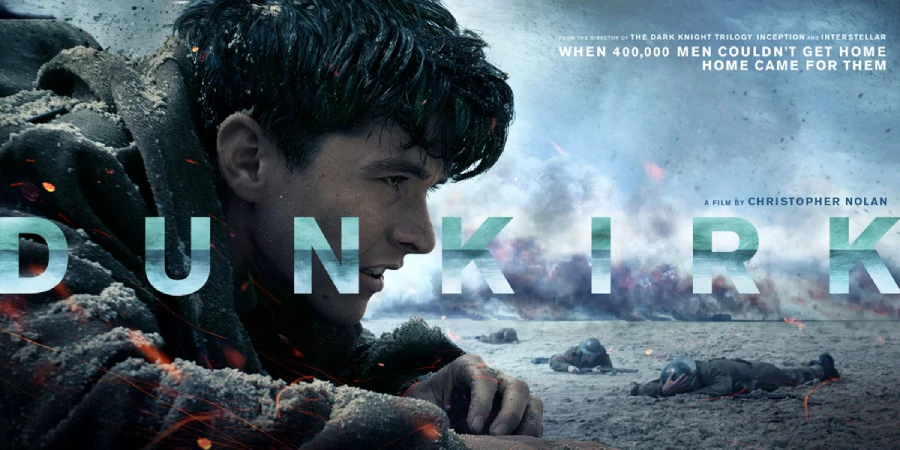

Christopher Nolan shot Dunkirk on 70mm IMAX film, and you feel every frame of it pressing against your chest. Three timelines run simultaneously, each operating at a different speed, and most viewers don’t fully register this structural trick until well into the film. It is a war movie where barely a word is spoken about strategy, politics, or heroism, because Nolan strips all of that away and leaves only the physics of survival.
Detailed Summary
The Mole: One Week on the Beach
We open on Tommy, a young British soldier, walking through the streets of Dunkirk as leaflets flutter down from the sky. German snipers open fire almost immediately, killing his companions one by one, until Tommy scrambles over a wall and collapses onto the beach alone.
What he finds there is not a rescue. It’s a queue. Hundreds of thousands of soldiers stand in long, silent lines extending into the sea, waiting for ships that keep arriving too slowly and sinking too fast.
Tommy befriends Gibson, another soldier he spots burying a body on the beach. Together they try repeatedly to board evacuation ships, and repeatedly fail. They steal onto a hospital ship, get thrown off, find a beached vessel, and hide inside it as German fighters strafe the hull with bullets.
Alex, a third soldier played with brittle hostility by Harry Styles, joins them. Alex becomes convinced that Gibson is not British at all, suspecting him of being a German spy. This paranoia eventually contributes to tragedy.
The Sea: One Day on the Water
Mr. Dawson receives the government’s call to requisition his civilian vessel. He decides to sail it himself rather than surrender it to the Navy. His teenage son Peter and Peter’s friend George come along.
En route across the Channel, they pull a shell-shocked soldier from the wreckage of a sunken ship. This man, credited only as The Shivering Soldier and played by Cillian Murphy, is so fractured by his experience at Dunkirk that he cannot function. When he realizes Dawson is sailing toward the battle rather than away from it, he physically struggles to take the wheel.
During this struggle, George falls down the stairs and suffers a severe head injury. He later dies. Peter chooses not to tell the traumatized soldier what happened, protecting the man from guilt he could not survive carrying.
The Air: One Hour in the Sky
Three RAF Spitfires fly toward Dunkirk at the start of this timeline. Farrier and Collins are the two we follow. Their leader is shot down almost immediately.
Collins goes down into the sea after a dogfight and has to be rescued from his sinking cockpit. Farrier continues flying, and we soon see that his fuel gauge is broken. He has no idea how much fuel he has left.
Still he keeps shooting down German planes. Methodically, without dramatic speeches or visible fear — because the soldiers on the beach below him need every second he can buy them.

Movie Ending
Farrier glides his Spitfire over the beach on fumes, shoots down one final German bomber that is targeting the evacuation fleet, and then lands on the French sand. His fuel is gone. He burns his plane so the Germans cannot use it, climbs out of the cockpit, and sits waiting to be taken prisoner. German soldiers walk toward him. He does not run. The film cuts away before we see his capture, which is the right call. Nothing more needs showing.
On the beach, the tide finally reaches the beached vessel where Tommy, Alex, and Gibson have been hiding. They float off and are picked up by Dawson’s civilian boat. As they pull away, Alex realizes Gibson never spoke because he was actually French, not a German spy, not a coward. Before anyone can act on this understanding, Gibson’s foot catches in a rope from the sinking ship and he is dragged underwater. Nobody saves him. The scene is brutal precisely because nobody is villainous; everyone is simply exhausted and terrified.
Tommy and Alex make it to England. On the train home, Alex reads aloud from a newspaper reporting Churchill’s famous speech about fighting on the beaches. Tommy stares out the window. He has survived, but the film refuses to let that survival feel triumphant in any clean way. The final image is Farrier, sitting in his burning plane, watching smoke rise.
What the ending argues is that Dunkirk was a defeat dressed in the language of a miracle. Three hundred thousand soldiers got home. France fell. The RAF pilot who made that possible is now a prisoner of war. Nolan holds both things at once, and refuses to let either cancel out the other.
Are There Post-Credits Scenes?
Dunkirk has no post-credits scenes whatsoever. Once the film ends, it ends. Nolan has never been interested in franchise setup, and this film especially has nothing to tie up in a stinger. You can leave when the credits begin.
Type of Movie
Dunkirk is a war film, but it behaves more like a thriller. Nolan deliberately stripped out the genre conventions of combat movies: no backstory speeches, no romantic subplots, no maps on tables with generals arguing strategy.
Tonally, it sits in a state of sustained dread. Even the moments of apparent rescue carry an undertow of anxiety. Call it a survival thriller set inside a historical catastrophe.
Cast
- Fionn Whitehead – Tommy
- Tom Glynn-Carney – Peter
- Jack Lowden – Collins
- Harry Styles – Alex
- Aneurin Barnard – Gibson
- Mark Rylance – Mr. Dawson
- Tom Hardy – Farrier
- Cillian Murphy – The Shivering Soldier
- Barry Keoghan – George
- Kenneth Branagh – Commander Bolton
- James D’Arcy – Colonel Winnant
Film Music and Composer
Hans Zimmer wrote the score for Dunkirk, and it is probably the most unusual work of his career. He built the soundtrack around the Shepard tone, an auditory illusion that creates the sensation of a pitch perpetually rising without ever resolving. You feel as though the tension is always climbing, never peaking.
Zimmer also incorporated the sound of a ticking watch, which Nolan himself provided. That watch belonged to Nolan’s father. This transforms what could have been a generic percussion choice into something genuinely personal.
The track “Supermarine” accompanies the aerial sequences and is among the most propulsive pieces Zimmer has written. It doesn’t score the dogfights so much as become them.

Filming Locations
Principal photography took place on the actual beaches of Dunkirk, France. Nolan insisted on this. Shooting where the real evacuation happened gave the production an authenticity no set could replicate. The sand is the same sand.
Additional aerial sequences were filmed over Northumberland in England. Urk in the Netherlands also served as a shooting location for certain maritime scenes.
Shooting in real locations with real IMAX cameras meant the production was committed to scale that CGI cannot fully fake. When you see hundreds of soldiers standing on that beach, a significant portion of what you’re seeing is real people in real wind.
Awards and Nominations
Dunkirk won three Academy Awards, for Film Editing, Sound Editing, and Sound Mixing. It received eight Oscar nominations in total, including Best Picture and Best Director for Nolan.
The sound awards were, for once, entirely appropriate. This film is built as much from sound design as from visuals, and those wins reflected genuine craft rather than consolation prizes.
Behind the Scenes Insights
- Nolan shot the film using actual IMAX cameras and 65mm film, prioritizing practical effects over digital work wherever possible.
- Tom Hardy spent much of his performance with his face covered by an oxygen mask, yet still managed to convey Farrier’s calm and resolve through his eyes and body posture alone. This is arguably the best piece of physical acting in the film.
- Real vintage Spitfires flew during production. The aerial sequences used a combination of actual aircraft and IMAX cameras mounted in and around them.
- Nolan deliberately kept the screenplay short, around 76 pages, because so much of the film communicates through image and sound rather than dialogue.
- Mark Rylance received no rehearsal time before filming his scenes on the water, which may explain why Mr. Dawson feels so lived-in and unperformed.
- The production acquired a fleet of actual Dunkirk “little ships,” civilian vessels that participated in the real 1940 evacuation.
- Nolan wanted no musical score during the final sequence on the train, letting the silence carry the weight of what Tommy has survived.
Inspirations and References
Nolan researched the Dunkirk evacuation of May to June 1940 extensively, an operation codenamed Operation Dynamo. Roughly 338,000 Allied soldiers were evacuated from the beaches and harbor of Dunkirk by a combination of Royal Navy vessels and civilian boats.
He cited Henri-Georges Clouzot’s The Wages of Fear as a tonal reference, particularly its approach to sustained mechanical dread. Nolan wanted to make a film about survival pressure rather than combat heroism.
He also drew on silent cinema techniques, using image and sound to communicate what dialogue would normally explain. The short script reflects this influence directly.
Alternate Endings and Deleted Scenes
No alternate endings or significant deleted scenes from Dunkirk have been officially released or publicly discussed by Nolan or the production. Given Nolan’s notoriously controlled filmmaking process and his tendency to shoot close to what he intends to cut, this is not surprising.
There are no known extended cuts or director’s cuts in circulation. What was released is what Nolan intended.
Book Adaptations and Differences
Dunkirk is not based on a specific book. Nolan wrote the screenplay himself, drawing on historical accounts of the evacuation rather than adapting a single source text. A novelization of the film was published after its release, but the film came first.



Memorable Scenes and Quotes
Key Scenes
- The opening: Tommy runs alone through Dunkirk’s streets while leaflets fall, his companions shot around him one by one. No music, only footsteps and gunfire.
- The hull sequence: Soldiers trapped inside the beached vessel listen to bullets punching holes in the metal around them, water seeping in with each hit.
- George’s fall: A quiet, terrible accident on Dawson’s boat that the film handles with more restraint than any Hollywood film would typically allow.
- Farrier’s final flight: The Spitfire gliding silently over the beach, engine dead, and soldiers below looking up at it. They start cheering. He cannot hear them.
- Alex reads the Churchill speech: Tommy stares out the train window while Alex reads aloud, and the gap between the public narrative and Tommy’s private experience becomes the whole point of the film.
- Gibson drowning: Sudden, preventable, and devastating precisely because everyone is too worn down to react in time.
Iconic Quotes
- Alex (reading from the newspaper): “Wars are not won by evacuations.”
- Mr. Dawson: “Men my age dictate this war. Why should we be allowed to send our children to fight it?”
- Commander Bolton: “I have a feeling they’re going to need us on the other side.”
Easter Eggs and Hidden Details
- The three timelines operate at different speeds: one week on the beach, one day at sea, one hour in the air. Most viewers don’t consciously notice this until the timelines converge, but it explains the unsettling feeling of time moving strangely throughout.
- The ticking sound layered into Zimmer’s score comes from a watch owned by Nolan’s father. It is a small personal detail embedded inside what appears to be pure sound design.
- When the three timelines finally synchronize, Farrier’s plane appears above Dawson’s boat and above the beach simultaneously. Watch for how the same aircraft shows up in all three stories at their point of convergence.
- Gibson never speaks a single line of English dialogue throughout the film. Every English-speaking character assumes this means he is hiding something. It never occurs to them that he simply does not speak the language.
- Commander Bolton stays on the beach after the British soldiers have evacuated. He is waiting to oversee the evacuation of French soldiers, a detail Nolan drops quietly and without underlining it.
- The Shepard tone in Zimmer’s score is technically never-ending; it loops in a way that means the film’s tension has no musical release point. This mirrors the structural choice of using a triptych of timelines that only converge rather than resolve.
Trivia
- Harry Styles was cast without Nolan knowing who he was. The audition process was kept deliberately anonymous, and Styles reportedly auditioned with many other young actors.
- The film runs approximately 106 minutes, making it one of Nolan’s shortest films.
- Nolan has stated that he visited Dunkirk and crossed the Channel on a small boat himself during pre-production research. The experience directly influenced how the sea sequences were shot.
- Tom Hardy’s dialogue in the film amounts to only a handful of lines. His face is covered for most of his screen time.
- The civilian “little ships” used in production included actual vessels that took part in the real 1940 evacuation.
- Nolan chose not to include any scenes from the German perspective, a deliberate decision to replicate the experience of soldiers who never saw or understood where the threat was coming from.
- Cillian Murphy’s character has no name in the film or its official credits. He is listed only as “The Shivering Soldier.”
- The film’s screenplay is reportedly one of the shortest Nolan has ever written, reflecting his intention to tell the story through image and sound rather than exposition.
Why Watch?
Watch Dunkirk because Tom Hardy acts an entire character arc through his eyes alone while wearing an oxygen mask for ninety percent of his screen time, and it works. Nolan builds a war film where not understanding what is happening to you is the whole point, and that structural choice produces genuine dread rather than manufactured suspense. You walk away feeling tired in a way that makes sense.
Director’s Other Movies
- Following (1998)
- Memento (2000)
- Insomnia (2002)
- Batman Begins (2005)
- The Prestige (2006)
- The Dark Knight (2008)
- Inception (2010)
- The Dark Knight Rises (2012)
- Interstellar (2014)
- Tenet (2020)
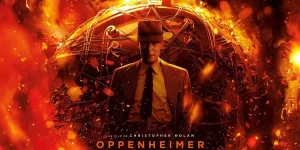
- Oppenheimer (2023)