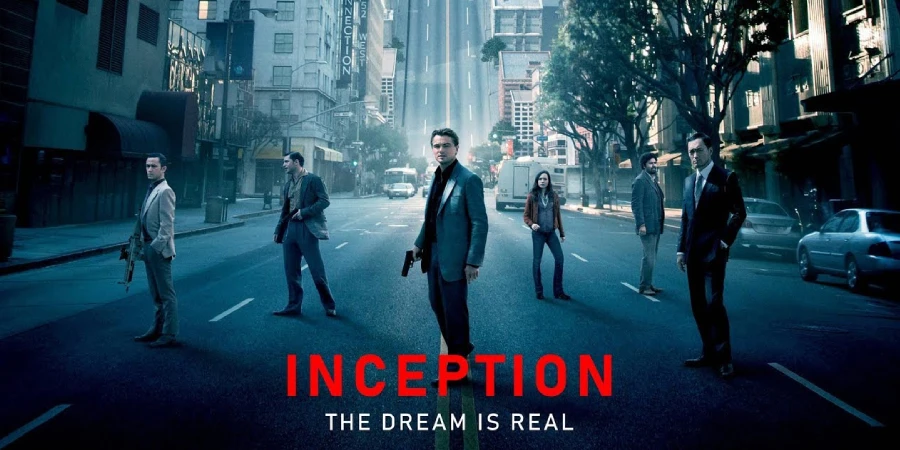

Christopher Nolan built a movie around a spinning top, and somehow that tiny prop still drives arguments fifteen years later. Inception drops you into a world where professional thieves steal secrets from people’s sleeping minds, then dares you to keep up without a map. Cobb, played by Leonardo DiCaprio, is a man so consumed by guilt that his own subconscious keeps trying to kill the people he works with. That tension between the job and the grief underneath it is what makes this film worth dissecting, scene by scene.
Detailed Summary
The Saito Test and Cobb’s Introduction
We meet Dom Cobb (Leonardo DiCaprio) washing up on a beach, then inside a Japanese castle being interrogated by an elderly man. This is a flash-forward we only understand much later. Cobb and his partner Arthur (Joseph Gordon-Levitt) are running an extraction job on a powerful businessman named Saito (Ken Watanabe), diving into his dreams to steal corporate secrets.
It goes badly. A projection of Cobb’s dead wife Mal (Marion Cotillard) sabotages the job by tipping Saito off that he is inside a dream. Saito reveals he already knew about the attempt; it was a test. He wants to hire Cobb for something far more difficult.
The Impossible Job: Inception
Saito’s offer is extraordinary. He wants Cobb to plant an idea in the mind of Robert Fischer (Cillian Murphy), heir to a rival energy empire, convincing Fischer to break up his father’s company. Cobb needs this job because Saito has the power to clear the murder charges that keep Cobb out of the United States and away from his children.
Cobb assembles a team. Arthur handles research. Ariadne (Elliot Page) joins as the new architect, the person who designs the dream spaces. Eames (Tom Hardy) is a forger who can impersonate people inside dreams. Yusuf (Dileep Rao) provides the powerful sedative that allows the team to go three dream levels deep. Browning (Tom Berenger) rounds things out as a disguised character used to manipulate Fischer.
Ariadne Learns the Rules and Discovers the Secret
Ariadne’s training scenes do double duty: they explain the mechanics of dreaming to the audience while simultaneously revealing Cobb’s dangerous secret. She discovers that Cobb carries a guilt-ridden projection of Mal in his subconscious, and that projection is violent, unpredictable, and capable of ruining any mission.
Ariadne enters Cobb’s private dream space and finds him replaying a memory of Mal stepping off a hotel ledge. She realizes the real psychological danger on this job is not Fischer’s security; it is Cobb himself.
Fischer’s Subconscious and the Three-Level Heist
On a long-haul flight, Yusuf sedates the entire team and Fischer alongside them. Level one is a rainy city street where Eames, disguised as Fischer’s godfather Browning, begins planting seeds of doubt about Fischer’s father. Fischer’s subconscious has been militarized, meaning trained projections attack anyone invading his mind.
A van chase through rain-soaked streets turns into a running action sequence. Saito takes a bullet and begins dying across all three dream levels, a complication nobody planned for. Arthur manages the physics of level two, a hotel where gravity shifts because a van is tumbling in free fall on level one above.
Level two is where the film’s most clever set piece lives: Arthur fights projections in a hallway where walls become floors and ceilings, staging a zero-gravity brawl that required genuinely rotating the set. Gordon-Levitt spent weeks rehearsing those moves and the physical commitment shows in every frame.
Level three is a snow-covered mountain fortress, Eames’s domain. The team plants the core idea in Fischer’s mind: his dying father wanted him to be his own man, not a copy. Fischer, emotionally devastated by a staged confrontation at his father’s bedside, accepts the idea as his own. That is the inception, quiet and devastating in its simplicity after all the firepower surrounding it.
Mal’s Intervention and the Limbo Problem
Mal’s projection shoots Fischer before the job completes, sending him into limbo, the deep unconscious void where time moves at near-infinite speed and where lost dreamers forget they are dreaming. Cobb and Ariadne go deeper to retrieve him.
In limbo, Cobb confronts the full truth about Mal. Years earlier, the two of them had grown old together in a self-created limbo world. Cobb performed inception on Mal himself, planting the idea that her world was not real so she would agree to leave. When they returned to reality, the idea took root too deep; Mal could no longer believe the real world was real, and she died by suicide on the ledge of a hotel room.
Cobb’s guilt is not just grief; it is responsibility. He broke her mind, and he knows it. The scene where he walks through their crumbling limbo city, remembering their constructed life, is the emotional core of the entire film.
The Return and the Wake-Up
Ariadne shoots Mal’s projection, freeing Fischer. She kicks herself out of limbo. Eames defibrillates Fischer on level three, allowing the idea to fully plant. One by one, the kicks send each team member back up through the levels.
Cobb stays behind in limbo to find Saito, who has been dying slowly across all three levels and has now aged to an old man in the void. Cobb convinces him to take a leap of faith. Both men wake up on the plane as it lands in Los Angeles.


Movie Ending
Saito makes a phone call. Customs waves Cobb through without incident. His father-in-law Professor Miles (Michael Caine) meets him at arrivals, and Cobb walks into his house to finally see his children’s faces. He spins his totem, a top that keeps spinning in dreams but falls in reality, then turns away before it stops.
Nolan cuts to black at exactly that moment. The top wobbles slightly, suggesting it might be about to fall. Whether it does is left permanently unanswered.
The debate has two clean sides. One reading says Cobb is still in a dream, possibly still in Saito’s limbo or one of his own making, and the reunion is a wish-fulfillment projection. Another reading points out that Cobb’s real totem was never the top; it was Mal’s top. His actual test of reality is his wedding ring, which he wears in dreams but not in waking life, and in the final scene he wears no ring.
There is a third angle worth taking seriously. The children are played by different, slightly older actors in the final scene compared to Cobb’s earlier memories. If this were a dream constructed from guilt, the children would look exactly as he remembered them. The fact that they have aged suggests Cobb really is home.
Nolan has consistently refused to resolve the question publicly, arguing the point is that Cobb himself stops caring whether it is real. He turns away from the top. After years of using the totem as a lifeline, he lets it go. That choice is the actual ending of his character arc, and it matters more than whatever the top does.
Are There Post-Credits Scenes?
Inception has no post-credits scenes. Nolan has never been interested in that convention, and this film ends with the hard cut to black after the top shot. Stay through the credits if you want to hear Hans Zimmer’s score in full, but nothing is waiting for you at the end.
Type of Movie
Inception is a science-fiction heist thriller with strong psychological drama running underneath the action. Tonally it is serious, almost relentlessly so. Nolan keeps humor minimal and mostly leaves it to Tom Hardy’s Eames to break the tension.
It plays by thriller pacing rules in its second and third acts while functioning as a grief narrative at its emotional center. Some critics filed it under “mind-bending puzzle film” and that label is fair but reductive; the puzzle mechanics exist to externalize Cobb’s internal collapse.
Cast
- Leonardo DiCaprio – Dom Cobb
- Joseph Gordon-Levitt – Arthur
- Elliot Page – Ariadne
- Tom Hardy – Eames
- Ken Watanabe – Saito
- Dileep Rao – Yusuf
- Cillian Murphy – Robert Fischer
- Marion Cotillard – Mal Cobb
- Michael Caine – Professor Miles
- Tom Berenger – Peter Browning
- Pete Postlethwaite – Maurice Fischer
- Lukas Haas – Nash
Film Music and Composer
Hans Zimmer composed the score, and it is arguably the most distinctive element of the entire production. His centerpiece track, “Time,” builds from a single piano note into a wall of strings and organ that arrives at the film’s final moments with enough emotional force to make grown adults stare at their hands afterward.
Zimmer also worked with a slowed, pitch-shifted version of Édith Piaf’s “Non, je ne regrette rien” as the film’s sonic DNA. Since Marion Cotillard had recently won an Oscar for playing Piaf, the choice carries a pointed irony. The song functions as the teams’ wake-up signal across dream levels, and slowing it down stretched a few seconds of music into the entire film’s runtime.
Zimmer and Nolan reportedly worked on the score simultaneously with production, an unusual approach that let the music shape the editing rather than just score it after the fact. That process produced something more integrated than a typical film score; you feel the bass before you consciously register it.


Filming Locations
Principal photography took place across multiple countries to match the globe-spanning scope of the story. Tokyo provided the opening Japanese castle sequence. Paris was used for Ariadne’s early architecture training scenes, including the famous folding-city sequence shot on location near the Pont de Bir-Hakeim bridge.
Tangier, Morocco served as the backdrop for Yusuf’s chemist den and surrounding street sequences. London hosted significant interior work and studio shooting. Calgary, Canada and the surrounding snowy mountains provided the alpine fortress used for dream level three.
Location diversity is not decorative here. Each dream level feeling genuinely distinct, urban then claustrophobic then arctic, reinforces the film’s structure and prevents the layered narrative from blurring together visually.
Awards and Nominations
Inception won four Academy Awards: Best Cinematography (Wally Pfister), Best Sound Editing, Best Sound Mixing, and Best Visual Effects. It received eight nominations total, including Best Picture and Best Original Screenplay.
Wally Pfister’s win for cinematography was well-deserved but almost beside the point; the visual achievement of this film is less about individual beautiful shots and more about the sustained coherence of building four visually distinct worlds simultaneously. His BAFTA win for the same category reinforced what working cinematographers already knew.
Behind the Scenes Insights
- Nolan shot the rotating hallway fight with a physically rotating set built on a giant gimbal. Joseph Gordon-Levitt and the stunt team trained for weeks specifically for that sequence.
- Nolan avoided using greenscreen wherever possible, preferring practical sets and real locations to keep the cast grounded in tactile environments they could physically react to.
- Wally Pfister shot the film on a combination of anamorphic 35mm and IMAX film, not digital, which contributes to the texture and weight of the larger action sequences.
- DiCaprio drew on his own research into dreams and the subconscious, including reading about lucid dreaming, to shape Cobb’s relationship with his constructed dream spaces.
- Nolan reportedly carried the original screenplay idea for nearly a decade before he had both the resources and the industry credibility to make it after The Dark Knight.
- The Paris folding sequence required a combination of in-camera forced perspective tricks and visual effects; the fold itself was partly practical and partly digital.
- Tom Hardy has said the Eames character gave him more physical and comedic freedom than almost any role he had played up to that point.
Inspirations and References
Nolan has cited the concept of lucid dreaming and the philosophical tradition questioning whether waking life is verifiable as key starting points. René Descartes and his demon hypothesis sit quietly in the film’s DNA, though Nolan never makes that explicit.
The architecture of the heist plot owes a clear debt to classic Hollywood heist films, with their ensemble teams, specialized roles, and layered plans designed to go wrong. James Bond’s globe-trotting operational energy is also visible, particularly in the production design.
Jorge Luis Borges and his short fiction about labyrinths, nested realities, and impossible architecture influenced Nolan’s thinking about Ariadne’s role as a designer of spatial logic. The chess-like structure of the dream heist, with rules established only to be broken, reflects that literary lineage.
Alternate Endings and Deleted Scenes
Nolan has not released a director’s cut or a version with alternate endings. No officially confirmed deleted scenes have been publicly released in any substantial form. Nolan runs a tight ship in post-production and does not typically circulate cut material.
There are reports that earlier drafts of the script placed the story entirely within a dream framework without the ambiguity, but Nolan revised toward the open ending specifically to keep Cobb’s emotional resolution separate from the metaphysical question. That revision was a smart call; a confirmed answer either way would have deflated the film rather than deepened it.
Book Adaptations and Differences
Inception is not based on any book, short story, or pre-existing intellectual property. Nolan wrote the screenplay himself as an original work. A tie-in prequel graphic novel titled Inception: The Cobol Job was produced alongside the film’s release to provide backstory on Cobb’s team, but that material supplements the film rather than sourcing it.


Memorable Scenes and Quotes
Key Scenes
- The Paris fold: Ariadne folds a Paris street upward on itself, with cafes and pavement rising vertically while she and Cobb walk underneath. Nolan holds on the full cityscape bending before cutting to Ariadne’s face. She is grinning. It is the most purely joyful shot in the film.
- The hallway fight: Arthur braces himself against a wall in a spinning corridor, then launches into a zero-gravity brawl against projections while the camera rolls with the set. No CGI replaces the physical performance, and the sequence remains one of cinema’s best practical action achievements.
- Mal on the ledge: Marion Cotillard stands barefoot on a hotel window ledge across the street from Cobb, her white nightgown catching wind, beckoning him to join her. It is a genuinely unsettling image that reframes everything you thought you understood about the opening act.
- Fischer at his father’s bedside: Robert Fischer sits with his dying father’s projection in the snow fortress, opens a safe, and finds a pinwheel from his childhood. Pete Postlethwaite delivers two lines with the quiet devastation of a man who ran out of time to say what mattered. Cillian Murphy does everything with his eyes in that moment.
- Cobb spinning the top: In the final seconds, Cobb sets the top spinning on a restaurant table, then walks toward his children without looking back. The camera holds on the top. It wobbles. Cut to black. That wobble is doing more narrative work than most films do in two hours.
Iconic Quotes
- “You’re waiting for a train. A train that will take you far away. You know where you hope this train will take you, but you can’t know for sure.” (Cobb, quoting Mal)
- “What is the most resilient parasite? A bacteria? A virus? An idea.” (Cobb)
- “Dreams feel real while we’re in them. It’s only when we wake up that we realize something was actually strange.” (Cobb)
- “You mustn’t be afraid to dream a little bigger, darling.” (Eames)
- “Do you want to take a leap of faith? Or become an old man, filled with regret, waiting to die alone?” (Cobb to Saito)
Easter Eggs and Hidden Details
- Cobb wears his wedding ring in every dream sequence but not in any waking-life scene. Many viewers missed this on first viewing, but it functions as a more reliable reality indicator than the spinning top.
- Ariadne’s name comes from Greek mythology; Ariadne gave Theseus a thread to navigate the labyrinth. She quite literally helps Cobb navigate his mental maze.
- Each dream level has a slightly different visual color grading: warmer and more golden in the real world, shifting toward cooler blue-grays as the levels deepen.
- The name Fischer is German for “fisherman,” and Cobb’s crew is essentially fishing in Fischer’s subconscious for emotional catch.
- In the opening beach scene, young Cobb is wearing the same clothes he wears at the very end of the film, the first visual cue that the elderly Saito scene in the castle is connected to the finale.
- Mal’s name means “evil” or “bad” in French, a quiet flag that her projection represents something destructive rather than genuinely her.
- The hotel lobby in dream level two is numbered so that room numbers do not follow logical sequence, a subtle environmental cue that reality is slightly off.
Trivia
- Nolan wrote his first version of the dream-heist concept when he was about 16 years old, long before he had any filmmaking career to speak of.
- The “BRAAAM” sound that dominated film trailers for years after Inception‘s release originated partly from Hans Zimmer’s score here, spawning countless imitations in action movie marketing.
- Elliot Page was cast as Ariadne partly because Nolan wanted someone who could ask obvious questions naturally without it feeling like exposition delivery. The character exists in part as an audience surrogate.
- Ken Watanabe learned many of his English lines phonetically and still gave a nuanced performance, which makes the final limbo scene land considerably harder when you account for that effort.
- Joseph Gordon-Levitt performed the majority of his own stunts in the rotating hallway sequence, staying on set during extensive rehearsals with the stunt team rather than stepping aside for a double.
- Cillian Murphy wore a fat suit and prosthetics to portray an older Robert Fischer in the dream sequences depicting Fischer’s aged subconscious projections.
- Hans Zimmer worked without seeing a completed cut of the film for much of the composition process, building the score based on script pages and conversations with Nolan.
- Nolan was inspired by the works of authors such as Jorge Luis Borges and Sigmund Freud, and films like The Matrix and Paprika. The concept of shared dreaming and layers of reality has deep philosophical roots.
Why Watch?
DiCaprio’s performance as Cobb is the most underrated element of this film; he anchors two hours of abstract architecture with a grief so specific and physical that you feel it even when you are still trying to remember which dream level you are on. Nolan designed a puzzle, but DiCaprio made it hurt. That combination, rigorous structure serving genuine emotional damage, is rare enough to demand your full attention.
Director’s Other Movies
- Following (1998)
- Memento (2000)
- Insomnia (2002)
- Batman Begins (2005)
- The Prestige (2006)
- The Dark Knight (2008)
- The Dark Knight Rises (2012)
- Interstellar (2014)
- Dunkirk (2017)
- Tenet (2020)
- Oppenheimer (2023)