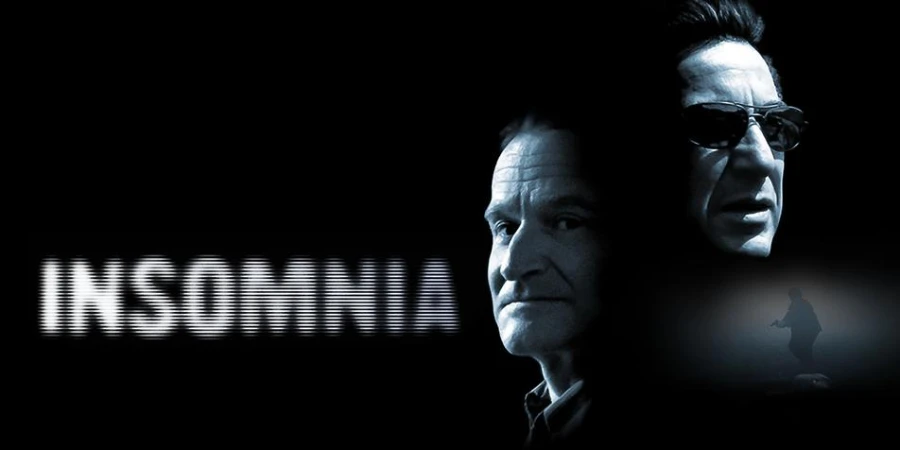

Al Pacino spends most of Insomnia squinting into blinding white light, and that is not accidental. Christopher Nolan shot this film in Alaska during summer, where the sun refuses to set, and he weaponizes that fact against every frame. A detective who cannot sleep, cannot lie quietly with his own guilt, cannot find darkness anywhere, literal or otherwise. Will Dormer is one of Pacino’s great late-career performances, and not nearly enough people say so.
Detailed Summary
Two Detectives Arrive in Nightmute
LAPD detectives Will Dormer and Hap Eckhart fly to Nightmute, Alaska, to assist local police in investigating the murder of a teenage girl named Kay Connell. Back in Los Angeles, Internal Affairs is investigating both men for evidence tampering. Hap has quietly agreed to cooperate with IA, and Dormer knows it.
That tension between the two men sits under every early conversation like a lit fuse. Dormer is not angry in any explosive way; he is cold, controlled, watching Hap the way you watch someone you used to trust.
The Fog Trap and Hap’s Death
Local detective Ellie Burr admires Dormer and has studied his casework closely. Dormer sets a trap for Kay’s suspected killer at a foggy beach, using the girl’s belongings as bait. During the chaotic pursuit through thick fog, Dormer shoots and kills Hap.
Nolan stages the fog sequence so that the viewer, like Dormer, cannot be certain what happened in those crucial seconds. A gun fires. A figure falls. The fog swallows everything. That ambiguity is deliberate and uncomfortable.
Dormer claims he mistook Hap for the suspect. Whether he genuinely did, or whether he seized an opportunity to silence his partner before the IA interview, the film refuses to answer cleanly. That refusal is one of its sharpest decisions.
Walter Finch Makes Contact
Walter Finch, a local crime novelist, was actually present at the beach that night. He saw Dormer shoot Hap. Finch calls Dormer and lays it out plainly: he will not reveal what he witnessed, and in exchange, Dormer will help frame Kay’s abusive ex-boyfriend Randy Stetz for the murder.
Robin Williams plays Finch, and casting a beloved comedian in this role is one of the most quietly inspired choices Nolan made. Williams strips every trace of warmth from the character. Finch is soft-spoken, bookish, almost gentle, which makes him far more unsettling than a conventionally menacing villain would be.
The Sleeplessness Takes Hold
Dormer cannot sleep. Partly it is the perpetual Alaskan daylight bleeding through every curtain gap. Partly it is guilt, either over Hap’s death or over years of a career built on bending rules for outcomes he believed were just. His perception begins to blur.
Pacino plays this deterioration physically. His eyes redden. His sentences lose their crispness. He starts making small errors. Nolan uses jump cuts and bleached-out visual textures to put the audience inside that exhausted, fractured headspace.
Dormer Plants Evidence
Dormer visits Finch’s remote cabin and plants Hap’s gun to implicate him. Finch anticipated this. He has already hidden the real evidence. Dormer is outwitted by a man he underestimated, and the film takes real pleasure in that reversal.
Ellie Burr Closes In
Ellie has been quietly investigating the circumstances of Hap’s death. She finds a bullet casing that does not match the suspect’s gun. Her admiration for Dormer is genuine, which makes her methodical dismantling of his alibi genuinely painful to watch. Hilary Swank plays this role with a restrained, almost sorrowful precision.
Ellie is the film’s moral spine. She is not cynical, not corrupt, not willing to look the other way even when the person she is looking at is someone she respected. That integrity, quiet and stubborn, drives the entire third act.
Dormer Confronts Finch
Dormer tracks Finch to his cabin for a final confrontation. Finch killed Kay after she rejected him; the film makes this explicit. Dormer, exhausted and morally compromised, still cannot bring himself to simply let it go. The two men struggle inside the cabin as it catches fire.
Movie Ending
Finch and Dormer fight in a burning cabin, and Finch gets hold of a gun. He shoots Dormer. Ellie arrives, shoots Finch dead, and cradles a dying Dormer on the dock outside.
Dormer asks Ellie to let it go, meaning the evidence she has found about Hap’s shooting. He wants her to suppress what she knows, just as he has suppressed and bent things across his whole career. Her answer is the emotional climax of the film.
She tells him she will not. She says she cannot. Dormer, with his last breath, says something close to agreement. He tells her not to lose sleep over it. It is the only moment of genuine peace he has had since arriving in Alaska, and it reads as relief rather than defeat.
Dormer dies. Ellie does not destroy the evidence. The film ends on her face, and on the implication that everything Dormer spent years protecting, his reputation, his legacy, his constructed idea of ends justifying means, will now be examined honestly.
What makes this ending land is that it refuses to let Dormer be either a hero or a pure villain. He genuinely wanted to catch killers. He also genuinely crossed lines to do it. His final act is not confession or absolution; it is simply the exhaustion of a man who stopped being able to tell the two apart.
Are There Post-Credits Scenes?
Insomnia has no post-credits scene. Nothing follows the credits. The film ends on the dock and stays there.
Type of Movie
Insomnia is a psychological thriller and neo-noir detective drama. Its tone is cold, exhausted, and morally grey throughout.
This is not a whodunit; the film identifies the killer early. The tension comes from watching a compromised detective navigate guilt, blackmail, and deteriorating judgment. It shares DNA with classic noir but replaces shadows with blinding white light, which is a genuine atmospheric inversion worth appreciating.
Cast
- Al Pacino – Will Dormer
- Robin Williams – Walter Finch
- Hilary Swank – Ellie Burr
- Maura Tierney – Rachel Clement
- Martin Donovan – Hap Eckhart
- Nicky Katt – Fred Duggar
- Paul Dooley – Chief Nyback
- Jonathan Jackson – Randy Stetz
Film Music and Composer
David Julyan composed the score. Julyan had worked with Nolan previously on Memento, and the two had developed a shared instinct for music that unsettles without announcing itself. His score for Insomnia leans into ambient textures and slow, grinding tension rather than traditional thriller cues.
The music rarely swells. It hums and drones, sitting just below conscious attention, which suits a film about a man whose mind will not quiet down. Julyan’s work here is, in this critic’s view, one of the most underrated thriller scores of the 2000s precisely because it does its job without calling attention to itself.


Filming Locations
Principal photography took place in British Columbia, Canada, with key sequences shot in and around Stewart and Hyder, towns sitting on the Alaska-British Columbia border. Some filming also took place in the broader British Columbia interior.
The locations were chosen for their specific quality of northern light. Nolan needed genuine, relentless daylight for the film’s central metaphor to work. A studio recreation would have looked wrong; the flatness and sheer vastness of the landscape needed to feel real and suffocating.
Log-strewn river sequences and the foggy beach scenes used the natural geography of the region to maximum effect. Nature in this film is not picturesque. It is indifferent, and its indifference mirrors Dormer’s psychological state precisely.
Awards and Nominations
Insomnia received generally strong critical notices but limited major awards attention. Robin Williams received some critics’ circle recognition for his performance, though the film did not figure prominently in the major Oscar or BAFTA categories that year.
Behind the Scenes Insights
- Insomnia is a remake of the 1997 Norwegian film of the same name, directed by Erik Skjoldbjærg. Nolan was hired to direct after his work on Memento attracted significant industry attention.
- Robin Williams reportedly wanted the role of Finch specifically. He was actively seeking to play against type after One Hour Photo, also released in 2002, and saw Finch as another opportunity to dismantle his public persona.
- Pacino and Nolan discussed Dormer’s physical deterioration in detail before shooting. Pacino committed to not sleeping well during production to keep his eyes genuinely bloodshot and tired-looking.
- Nolan shot some sequences under real midnight-sun conditions in the north, capturing actual perpetual daylight rather than relying entirely on artificial lighting setups.
- Hillary Swank has spoken about how much she valued working opposite Pacino, noting that his unpredictability in scenes kept her responses genuinely reactive rather than rehearsed.
- This was Nolan’s first studio film, produced by Warner Bros. and Section Eight, the production company run by Steven Soderbergh and George Clooney.
Inspirations and References
The film draws directly from the 1997 Norwegian film Insomnia, written by Nikolaj Frobenius and Erik Skjoldbjærg. That original film starred Stellan Skarsgård as a Swedish detective working in Norway, where the midnight sun served the same thematic function.
Screenwriter Hillary Seitz relocated the story to Alaska and deepened the Internal Affairs subplot, giving Dormer’s guilt a more specific professional context. The moral framework owes something to classic American noir, particularly the idea of the detective whose methods mirror the criminals he hunts.
Nolan has cited Michael Mann’s approach to urban procedurals as a reference point for how he wanted to handle the detective work sequences, favoring authenticity over stylization.
Alternate Endings and Deleted Scenes
No officially documented alternate ending for Insomnia has been released or confirmed in detail. The original Norwegian film ends with the detective dying before he can confess, which gives it a slightly different moral weight, and Nolan’s version adjusts this outcome deliberately.
Some deleted scenes were mentioned in production materials but have not been widely released or documented in enough detail to describe accurately here.
Book Adaptations and Differences
Insomnia (2002) is not based on a book. It is a remake of a film. The source material is the 1997 Norwegian feature, not a novel or short story.


Memorable Scenes and Quotes
Key Scenes
- The fog chase: Dormer pursues a figure through dense coastal fog, a gun fires, and Hap drops. The scene is shot with almost no score and very little dialogue, just footsteps, fog, and the sound of water. It is the film’s most uncomfortable three minutes.
- Finch’s first phone call: Williams speaks in a near-whisper, completely unhurried, as Dormer realizes this man has all the leverage. Pacino’s face does something interesting here: the exhaustion and the fear arrive simultaneously, and you can watch him calculating in real time.
- Dormer’s hotel room: He stuffs towels and clothing into every curtain gap trying to block the sunlight. The room looks like a cell he built himself. It is the clearest visual statement of his psychological state in the entire film.
- Ellie presents the bullet casing: Swank delivers this scene with no accusation in her voice, just facts, laid out carefully. It is more devastating than any confrontation scene because her tone is so genuinely respectful. She is not trying to catch him. She is just telling the truth.
- The dock confrontation: Finch and Dormer discuss guilt and justification in the cabin before it burns. Williams lets Finch be almost reasonable here, drawing a parallel between the two men that Dormer cannot refute and cannot accept.
Iconic Quotes
- “A good cop can’t sleep because he’s missing a piece of the puzzle. A bad cop can’t sleep because his conscience won’t let him.” (Finch to Dormer)
- “Don’t lose any sleep over it.” (Dormer, dying, to Ellie)
- “You made one mistake, Finch. You called me.” (Dormer)
Easter Eggs and Hidden Details
- The name Nightmute is not accidental. A place where night is muted, where darkness cannot arrive, mirrors Dormer’s inability to find psychological silence. Nolan approved the name with full awareness of that reading.
- In early scenes, Dormer is shot from slightly above, a subtle positioning that gradually shifts to slightly below eye level as his authority and moral standing erode across the film.
- Finch’s home is full of crime novels, some clearly positioned as his own work. The detail underlines that Finch has spent years intellectualizing violence, which may explain how he committed it without apparent panic.
- Ellie’s admiration for Dormer is established through her notes and case files, all visible on her desk in an early scene. She has studied him. This makes the final act’s reckoning especially pointed, because she knows exactly what she is dismantling.
- Dormer’s gun, shown clearly in early scenes, becomes the central ambiguous object of the film once the fog sequence occurs. Nolan frames it deliberately in Dormer’s holster during the setup, so the audience registers it before the chaos.
Trivia
- Robin Williams and Al Pacino had no significant prior connection before this film. Their chemistry in shared scenes came largely from rehearsal work Nolan arranged before principal photography began.
- Insomnia was released in 2002, the same year as Robin Williams’s other against-type performance in One Hour Photo. Both films arrived within months of each other and permanently complicated how audiences read his screen presence.
- Hilary Swank took the role of Ellie Burr between her two Oscar wins, after Boys Don’t Cry and before Million Dollar Baby, which makes her casting feel, in retrospect, perfectly calibrated for a character defined by moral backbone.
- Nolan has described this film as a deliberate exercise in restraint, a conscious effort to work within genre conventions rather than break them, which makes it an interesting counterpoint to the structural experiments of Memento and later films.
- The film’s aspect ratio and visual palette were chosen to maximize the flatness and bleaching of the Alaskan light, with cinematographer Wally Pfister deliberately avoiding warm color grading.
- Alaska-set crime fiction has a long literary tradition, and the production team researched actual Alaskan small-town police procedures to ground Ellie’s investigative work in something credible.
Why Watch?
Robin Williams whispering blackmail terms into a phone, completely serene, completely certain, is worth the price of admission on its own. Pacino matches him scene for scene, giving a performance built entirely on controlled collapse. Two actors working at full capacity against each other, inside a film that uses Alaska’s endless daylight as a physical manifestation of guilt, is a specific combination you will not find anywhere else.
Director’s Other Movies
- Following (1998)
- Memento (2000)
- Batman Begins (2005)
- The Prestige (2006)
- The Dark Knight (2008)
- Inception (2010)
- The Dark Knight Rises (2012)
- Interstellar (2014)
- Dunkirk (2017)
- Tenet (2020)
- Oppenheimer (2023)