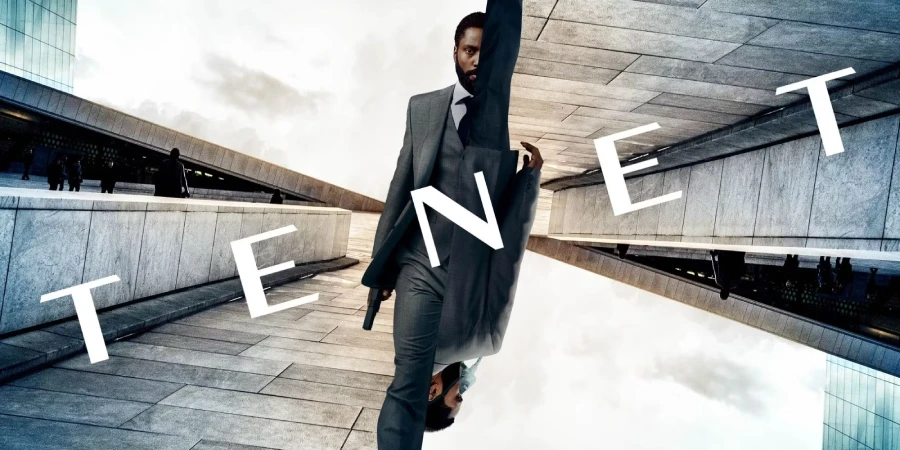

A bullet flies backward into a gun, and a spy thriller turns into a physics exam. Christopher Nolan built Tenet as a palindrome you can watch, a story that runs forward and backward at the same time. Everything below spoils it completely, from the opera siege to the final handshake. Buckle in.
Detailed Summary
The Kyiv Opera House Siege
Armed men storm a packed opera house in Kyiv. A CIA operative known only as the Protagonist moves through the chaos, posing as part of the extraction team, hunting a fellow agent and a mysterious artifact.
Someone in a mask saves his life with an impossible shot. That bullet travels backward, out of the wall and into the gun, and the shooter wears a red string on his backpack. Remember that string.
Ukrainian forces capture him. He swallows what he believes is a cyanide capsule, wakes up alive, and learns the whole nightmare was a loyalty test. His reward is a new job and a new identity.
Recruitment, the Word, and the First Inverted Bullet
A scientist named Barbara introduces him to inverted objects: bullets that fall up into your hand, ammunition whose entropy runs in reverse. She offers the film’s most quoted piece of advice, telling him not to understand it but to feel it.
Everything traces back to a future that is sending weapons and materials backward through time. The organization fighting that future calls itself Tenet, and the word opens doors.
In Mumbai, the Protagonist meets his handler and partner, Neil, a relaxed British operative with a physics degree and suspiciously good instincts. Together they bungee up a skyscraper to reach arms dealer Priya Singh, who reveals that the inverted rounds came from her own supply chain.
Kat, Arepo, and the Forged Goya
Priya points to Russian oligarch Andrei Sator, a man who talks directly to the future. His weak spot is his marriage.
Enter Katherine “Kat” Barton, an art appraiser trapped in a brutal relationship. She once authenticated a forged Goya drawing by an artist named Arepo, and Sator now holds that drawing as leverage over her and over custody of their son, Max.
The Protagonist offers her a deal: he will steal the forgery from the Oslo Freeport, a tax-free vault attached to an airport. She grants him access. Consequently, the operation gets its shape.
The Oslo Freeport and the 747
Neil devises a distraction with real weight. They hijack a Boeing 747, run it off the taxiway, and crash it into the freeport’s hangar to blow the fire doors.
Inside the vault, two masked men attack them. One fights the Protagonist backward, moving against time, and the Protagonist unmasks nothing before the figure escapes into a strange rotating chamber. He does not yet realize he has been fighting himself.
The Turnstile Revealed
Priya explains the machinery. A turnstile is an inversion device built from future technology, and stepping through it reverses your personal entropy while the world keeps running normally around you.
Inverted people breathe through masks because their lungs cannot process regular air. Fire freezes. Wind pushes the wrong way. Moreover, the rules never bend for narrative convenience, which is why the film demands a second viewing.
Sator hunts nine components of an object called the Algorithm, a device capable of inverting the entropy of the entire world. As a teenager he scavenged plutonium in the closed Soviet city of Stalsk-12, found buried gold and a message, and became the future’s errand boy.
The Tallinn Highway Chase
Tenet intercepts a convoy carrying plutonium-241, which is actually the ninth piece of the Algorithm hidden in a case. Cars race forward and backward along the same stretch of road, and the sequence plays as pure kinetic confusion until you know where to look.
Sator takes Kat hostage and forces the handover. He then shoots her with an inverted bullet, a wound that will kill her slowly unless she inverts too.
The Protagonist and Neil push her through a turnstile inside a shipping container. Meanwhile, the trio drive the highway again in reverse, watching their earlier selves from the other direction.
The Full Picture Comes Together
Back at the freeport, the Protagonist finally understands the vault fight. The masked opponent was his own inverted self, and every “coincidence” in the story was a plan he had not yet made.
Sator’s motive lands with genuine venom. Pancreatic cancer is killing him, and he has rigged a dead man’s switch to his heartbeat so that his death triggers the Algorithm and erases everyone else.
His final act is scheduled for a specific day at the hypocenter in Stalsk-12. Kat volunteers for the hardest job in the film: keeping her abusive husband alive and happy on his yacht until the last possible second.
Movie Ending
Two teams drop into Stalsk-12 in 1972 for the film’s centerpiece, a temporal pincer movement. Red team moves forward through ten minutes; blue team, led by Neil, moves backward through the same ten minutes, and each side feeds intelligence to the other.
A massive explosion tears the city apart while buildings simultaneously reassemble. Ives and the Protagonist reach the hypocenter and find the Algorithm already locked behind a gate, with a dead soldier lying beside it.
Volkov, Sator’s enforcer, has them pinned. Then the corpse springs up, unlocks the gate from the inside, takes a bullet meant for the Protagonist, and drops again. That soldier is Neil, and the red string on his backpack matches the shooter from the Kyiv opera house.
On the yacht in Vietnam, Kat cannot wait any longer. She shoots Sator dead before he reaches his own chosen moment, then dives off the boat to be picked up by Mahir.
Her timing works because the Algorithm never leaves the ground. Ives, the Protagonist, and Neil split the three pieces they recover and agree to hide them separately, since only the people who touched it can be trusted to bury it.
Then comes the gut punch. Neil straps his gear back on and heads for the turnstile, revealing that he has known the Protagonist for years from the other end of their friendship.
He explains that the Protagonist recruited him long ago, in Neil’s past and the Protagonist’s future. Their goodbye inverts the famous Casablanca line: for Neil, this is the end of a beautiful friendship, while for the Protagonist it is only the beginning.
Neil walks back into the tunnel knowing exactly how his story ends. He has already told the Protagonist that what happened, happened, and he treats his own death as a fact he chose to accept rather than a tragedy to dodge.
One thread remains. Priya has ordered Kat killed to tie off loose ends, so the Protagonist arrives outside a London school, shoots Priya, and lets Kat and Max walk away free.
That final act confirms the film’s biggest reveal. The Protagonist is not a pawn at all; he is the future founder of Tenet, the man who will hire Neil, brief Priya, and set the entire operation in motion. He describes himself as the protagonist, and for once the joke is load-bearing.
Audiences most often ask whether free will survives all this. Nolan’s answer sits in Neil’s fatalism and the Protagonist’s agency: the past cannot change, yet choosing to fulfill it is still a choice, and optimism is presented as the only workable strategy.
Are There Post-Credits Scenes?
No. Tenet has no post-credits scene, no mid-credits stinger, and no hidden sequel tease.
Nolan has never used the format in his films, and this one ends on the Protagonist walking away from the school. Stay for the credits only if you want to hear the closing track properly.
Type of Movie
Classify it as a science fiction espionage thriller with heavy action-blockbuster DNA. Nolan has described the project as his take on the spy genre, and the structure borrows freely from James Bond while the mechanics come from theoretical physics.
Tonally the film runs cold, clipped, and relentless. Characters trade exposition on the move, emotion arrives in short bursts, and the sound design keeps you slightly off balance for two and a half hours.
Kat’s storyline supplies the human warmth. In contrast to the puzzle-box mechanics, her fight for her son gives the finale an emotional stake that pure plotting could never manage.
Cast of Tenet
- John David Washington – The Protagonist
- Robert Pattinson – Neil
- Elizabeth Debicki – Katherine “Kat” Barton
- Kenneth Branagh – Andrei Sator
- Dimple Kapadia – Priya Singh
- Aaron Taylor-Johnson – Ives
- Clémence Poésy – Barbara
- Michael Caine – Sir Michael Crosby
- Himesh Patel – Mahir
- Martin Donovan – Fay
- Yuri Kolokolnikov – Volkov
- Fiona Dourif – Wheeler
Film Music and Composer
Hans Zimmer sat this one out, having committed to Dune. Nolan turned instead to Ludwig Göransson, and the swap reshaped the sound of a Nolan film.
Göransson built the score around synthesizers, distorted percussion, and recordings played in reverse. Sounds crawl backward under the action, which means the music itself performs inversion rather than describing it.
Standout cues include Rainy Night in Tallinn, Freeport, and Posterity. The end credits then hand off to Travis Scott, whose track The Plan was written for the film.
Göransson arrived with serious credentials. He had already won an Academy Award for his Black Panther score and built a long collaboration with Ryan Coogler, and his work on The Mandalorian showed the same appetite for unusual textures.
Filming Locations
Production spanned seven countries, and Nolan shot almost everything on location with IMAX and 65mm film. Digital set extensions were kept to a minimum.
Estonia supplied the film’s spine. Tallinn’s Linnahall concert venue stood in for the Kyiv opera house, while the Laagna Road, a sunken highway cutting through the city, hosted the reversed car chase after authorities closed it for weeks.
Norway provided the freeport. Crews used Oslo Airport for the 747 sequence, which is why the hangar exteriors look convincingly functional.
Italy covered the sun-drenched material, with the Amalfi Coast standing in for Sator’s yacht scenes. Meanwhile, India delivered the Mumbai skyscraper sequence and Priya’s rooftop lair.
The United Kingdom handled London locations plus stage work, and the United States covered California, including the airfield at Victorville where the plane crash was staged. Stalsk-12 was created largely in the field rather than on a computer.
Awards and Nominations
Tenet won the Academy Award for Best Visual Effects and picked up a nomination for Best Production Design. Andrew Jackson led the winning effects team.
At the BAFTAs the film also took the prize for special visual effects. Admittedly, the awards haul was modest for a Nolan release, and the pandemic-scarred release window did the campaign no favors.
Behind the Scenes Insights
- Nolan bought a real retired Boeing 747 and crashed it into a hangar rather than relying on miniatures or digital effects. He has said the practical option worked out cheaper than building the shot in a computer.
- Robert Pattinson reportedly read the screenplay inside a locked room at Warner Bros., a security measure that has become studio legend.
- Stunt performers and actors trained to fight, run, and drive in reverse so that footage played backward would look natural.
- John David Washington performed a large share of his own stunts, including the freeport brawl against an inverted opponent.
- Hoyte van Hoytema shot the film using IMAX cameras for a substantial portion of the runtime, forcing custom rigs for cramped car interiors.
- Jennifer Lame edited the picture, joining a Nolan production for the first time.
- Kenneth Branagh had already worked with Nolan on Dunkirk before taking the villain role here.
- Warner Bros. pushed the film into theaters in the late summer of 2020, making it one of the first major studio releases to attempt a pandemic-era rollout.
Inspirations and References
Nolan has said the core idea gestated for roughly two decades before he committed it to a screenplay. His stated ambition was to make a spy movie with the emotional scale of an epic, and Bond’s influence sits on the surface.
Physics supplied the mechanics. Notably, the notion of antimatter behaving like ordinary matter moving backward through time descends from the Feynman and Wheeler discussions of positrons, and Nolan consulted physicist Kip Thorne, a collaborator since Interstellar.
The strongest reference is buried in the names. Nolan drew on the Sator Square, an ancient Latin palindrome arranged as a five-by-five grid, and the film’s architecture mirrors that word puzzle exactly.
Cinema history gets its nod too. That closing exchange between Neil and the Protagonist inverts the last line of Casablanca, and the gesture doubles as a thesis statement.
Alternate Endings and Deleted Scenes
Nolan is famous for shooting close to his script and rarely releasing cut material. No alternate ending for Tenet has surfaced, and the home release carried behind-the-scenes documentary content instead of deleted scenes.
What the film does contain is a structural trick that feels like an alternate version. Several sequences replay from the inverted perspective, so you effectively watch two edits of the same footage inside one movie.
Book Adaptations and Differences
There is no source novel. Christopher Nolan wrote Tenet as an original screenplay, so no adaptation comparison applies.
A companion book arrived afterward, however. The Secrets of Tenet by James Mottram documents the production rather than telling the story, making it a making-of volume rather than a basis for the film.
Memorable Scenes and Quotes
Key Scenes
- The Kyiv opera house siege, where a reversed bullet saves a man who does not know he is watching his future best friend.
- Barbara’s laboratory demonstration, in which a bullet leaps from the table into the Protagonist’s hand.
- The 747 crash at the Oslo Freeport, staged with a genuine aircraft.
- The freeport vault fight against a masked, inverted opponent who turns out to be the Protagonist himself.
- The Tallinn highway chase, played first forward and then backward with the same vehicles and the same stunts.
- Kat’s slow-motion escape from the yacht after she finally shoots Sator on her own terms.
- The Stalsk-12 pincer assault, with one team advancing while explosions run in reverse around them.
- Neil’s revival at the gate, followed by the walk back into the turnstile.
Iconic Quotes
- “Don’t try to understand it. Feel it.”
- “We live in a twilight world, and there are no friends at dusk.”
- “What’s happened, happened.”
- “Ignorance is our ammunition.”
- “For me, I think this is the end of a beautiful friendship.”
- “You have a future in the past.”
Easter Eggs and Hidden Details
- Every major name comes from the Sator Square: Sator the villain, Arepo the forger, Tenet the organization, Opera the opening location, and Rotas the security firm running the freeport.
- Neil’s red string keychain appears in the opera house long before you learn who wears it, then reappears on the corpse at the hypocenter.
- Red and blue color coding runs through the entire film, marking forward and inverted timelines in lighting, costume, and set dressing.
- The opera house auditorium and the Stalsk-12 gate both feature masked figures saving the Protagonist from an unseen angle.
- The Protagonist never receives a name, and characters repeatedly dance around the omission in dialogue.
- Michael Caine turns up again in a Nolan film, continuing a run that stretches back to Batman Begins.
- A popular fan theory reads Neil as an adult Max, since Maximilien ends in the letters that form his name, though Nolan has left it unconfirmed.
- Sator’s future employers are referred to only as posterity, which also titles one of Göransson’s cues.
Trivia
- Nolan wrote and directed the film himself, working from an idea he had turned over for around twenty years.
- Elizabeth Debicki’s height was used deliberately, letting Kat physically tower over Sator while remaining trapped by him.
- The production shot across seven countries, an unusually wide footprint even by Nolan standards.
- Reverse dialogue in certain scenes required actors to learn lines phonetically backward.
- Robert Pattinson filmed Tenet shortly before stepping into the cape for The Batman.
- John David Washington came to acting after playing professional football, and his father is Denzel Washington.
- Ludwig Göransson wrote the score without a traditional orchestra-first approach, building instead from manipulated electronic textures.
- The film’s theatrical release became a test case for reopening cinemas in 2020, and its box office performance fueled a very public debate about streaming windows.
Why Watch?
Few blockbusters trust their audience this much. Nolan hands you a puzzle, refuses to soften it, then backs it with practical stunts you cannot fake and a score that rattles your ribs. Watch it once for the spectacle, then again for the answers.
Director’s Other Movies
- Following (1998)
- Memento (2000)
- Insomnia (2002)
- Batman Begins (2005)
- The Prestige (2006)
- The Dark Knight (2008)
- Inception (2010)
- The Dark Knight Rises (2012)
- Interstellar (2014)
- Dunkirk (2017)
- Oppenheimer (2023)
- The Odyssey (2026)