
Forty-one men sealed inside a steel tube, grinding through the Atlantic while the ocean tries to crush them alive. Das Boot is the rare war film that makes you feel the war physically: the creaking hull, the dripping condensation, the faces going gray under weeks of fluorescent light. Director Wolfgang Petersen shot this film in conditions so cramped that the cameras had to be specially modified, and every frame shows it. This is not a film about glory; it is a film about endurance, and then about how endurance can run out.
Detailed Summary
La Rochelle, 1941: Before the Dive
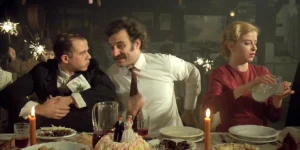
We open at a raucous farewell party for the crew of U-96 in a French port. Sailors drink heavily, brawl, and perform the rituals of men who know they may not return. A young war correspondent, Werner, watches from the edges, quietly absorbing everything.
We meet the Captain, a veteran U-boat commander who carries visible contempt for the Nazi leadership but remains utterly devoted to his crew. He is weary before the mission even begins. That weariness is not weakness; it is the most honest thing in the room.
Into the Atlantic: The Hunt Begins
U-96 sets out into the North Atlantic on a patrol mission. Long stretches of nothing dominate the early voyage: boredom, claustrophobia, and the peculiar intimacy that forms when men share a space the size of a school bus. Petersen refuses to rush this section, and the patience pays off enormously.
Werner observes the crew as individuals. There is the baby-faced Werner the cadet, a young officer trying to prove himself. There is the Chief Engineer (Der Leitende Ingenieur, or “Der LI”), the mechanical heart of the boat. These men become distinct human beings before any torpedo is fired, which is a deliberate and smart structural choice.
First Contact: The Convoy Attack
U-96 spots a British convoy and moves to attack. Petersen films the torpedo run with almost surgical restraint: the Captain’s eye at the periscope, quiet commands, the soft thud of a launch. Two ships are struck. One burns slowly while survivors float in the water, and the Captain orders U-96 to leave them.
That decision sits in the film like a stone. Nobody celebrates loudly. The crew watches the burning wreckage from a distance, and the silence is louder than any score could be. Werner writes in his notebook with a face that tells you he expected something different from war.
The Storm
A catastrophic Atlantic storm batters the submarine on the surface. This sequence is among the greatest things Petersen ever put on film. Men are thrown against walls, vomit, bleed, and laugh with the kind of hysterical relief that comes from surviving something that should have killed them.
After the storm, the boat sits damaged in heavier seas. Supplies are spoiling. The men grow beards, their skin turns pale and slick, and the already tight quarters feel somehow smaller. This is the film’s way of compressing time: not through a title card, but through faces.
The Pursuit and Depth Charge Attack
U-96 is spotted by a British destroyer and subjected to a prolonged depth charge attack. This sequence runs for an excruciating stretch of screen time, and every second of it counts. The crew sits in absolute silence while charges detonate around them, each blast rattling the hull and extinguishing lights.
Gauges spin. Pipes burst. Men grip whatever is bolted down and stare at the ceiling. The Captain stays grimly calm, issuing low commands, and Jürgen Prochnow’s performance in this sequence is the best single stretch of acting in the film. He never shouts. He sweats and calculates and does not flinch.
Gibraltar and the Impossible Dive
Orders come through sending U-96 to the Mediterranean via the Strait of Gibraltar. Every experienced man on the boat knows this is a suicide mission: the strait is heavily patrolled and shallow. The Captain’s disgust at the order is evident, but he obeys.
British warships spot U-96 in the strait. The submarine dives far past its rated depth to escape, the hull screaming and leaking under the pressure. Bolts shoot across the cabin. Men cling to anything and pray in silence. The boat sinks below 280 meters, well past its structural limit, and somehow holds.
By some engineering miracle and sheer will, Der LI manages to pump enough water to halt the descent. The boat crawls to the bottom of the strait and sits there, half-destroyed, until the pursuers move on. Then the crew slowly, methodically, begins to repair everything that broke.
The Long Repair
This section of the film is quiet and almost procedural. Men fix pipes, replace seals, and coax the engines back to life. It takes days. The oxygen depletes. Men lie still to conserve air, some praying, some staring blankly at nothing.
When the engines finally catch and the boat begins to rise, the crew erupts. Grown men cry. The Captain allows himself a single brief smile. It is one of the most genuinely earned emotional moments I have seen in any war film, and it works precisely because Petersen made us wait for it.

Movie Ending
U-96 limps back to La Rochelle. The crew has been through hell, survived the impossible, and they return to port looking like men who aged ten years in a few months. Flags are flying. Music plays. A small crowd gathers on the dock to welcome them home.
Werner is there, and the Captain is there, and for a few minutes the film lets you breathe. It feels like it might actually end with something resembling relief. Petersen sets this up deliberately so that what follows lands with maximum devastation.
Allied aircraft arrive without warning and bomb the harbor. U-96 is strafed and sunk at the dock. Men who survived the Atlantic, the depth charges, and the impossible dive through Gibraltar die on dry land, within sight of safety. The Captain staggers out, bleeding, watches his boat slip beneath the surface, and collapses.
He dies on the dock. Werner survives, left standing among the wreckage and the bodies. The irony is the point: the submarine that could not be killed by the ocean gets destroyed in port, on a clear day, without a fight. Petersen is not making a subtle argument about futility. He is making a blunt one, and the bluntness is correct.
Audiences most often ask whether the ending is based on a real event. The film is not a documentary reconstruction of a single patrol, but the destruction of returning U-boats by Allied air raids did happen historically. The ending reflects a documented reality of the U-boat war rather than a purely dramatic invention.
Are There Post-Credits Scenes?
There are no post-credits scenes. Das Boot ends as it should: with silence, wreckage, and no consolation prize.
Type of Movie
Das Boot is a war drama, specifically a submarine thriller. Its tone is relentlessly realistic and deeply anti-romantic about combat. Long sections function more as psychological drama than action film.
There are genuine thriller sequences, but the dominant register is one of dread and endurance. It shares more emotional DNA with survival films than with traditional war pictures that frame combat as heroic spectacle.
Cast
- Jürgen Prochnow – The Captain (Der Alte)
- Herbert Grönemeyer – Lieutenant Werner, the war correspondent
- Klaus Wennemann – Chief Engineer (Der Leitende Ingenieur / Der LI)
- Hubertus Bengsch – First Watch Officer (1WO)
- Martin Semmelrogge – Second Watch Officer (2WO)
- Bernd Tauber – Chief Quartermaster (Kriechbaum)
- Erwin Leder – Johann, the mechanic
- Jan Fedder – Pilgrim
- Uwe Ochsenknecht – Chief Bosun’s Mate (Bootsmaat)
Film Music and Composer
Klaus Doldinger composed the score for Das Boot. Doldinger was already well known in Germany as a jazz musician and composer before this film. His work here leans away from orchestral bombast and toward something more mechanical and ambient.
The main theme is built on a relentless, engine-like pulse that mirrors the submarine’s own rhythms. It does not swell triumphantly; it throbs. The music reinforces confinement rather than escape, which is exactly the right instinct for this material.
Doldinger’s score became one of the most recognized in German cinema. It was reused and rearranged for later versions of the film, including the extended television cut.

Filming Locations
Most of the interior submarine sequences were shot at Bavaria Studios in Munich, where a full-scale replica of a Type VIIC U-boat interior was constructed. The set was built to exact historical dimensions, which meant cameras and crew had almost no room to maneuver.
Petersen used specially developed camera mounts and wide-angle lenses to capture the space without cheating the geography. You always know where you are in the boat, which matters enormously for the tension sequences. That spatial clarity is a real directorial achievement in a setting designed to disorient.
Some exterior shots of the submarine on the surface were filmed using a real submarine, as well as purpose-built models for certain sequences. The La Rochelle harbor scenes were shot at actual locations in France.
Awards and Nominations
Das Boot received six Academy Award nominations in 1983, including Best Director for Petersen and Best Cinematography for Jost Vacano. It won none of those six Oscars, which remains one of the more puzzling decisions in the Academy’s history.
The film won multiple German Film Awards (Deutscher Filmpreis), and Vacano’s handheld cinematography was widely recognized as exceptional. For a foreign-language film to receive six Oscar nominations was itself a significant acknowledgment of the film’s impact.
Behind the Scenes Insights
- The entire cast underwent months of preparation together before filming, living and working in close proximity to build genuine camaraderie and physical familiarity.
- Jost Vacano, the director of photography, operated the camera himself for almost all interior shots, crawling through the set in real time with the actors.
- The interior submarine set was built on hydraulic mounts so it could physically tilt and shake during action sequences, forcing the actors to react to real movement.
- Filming took nearly a year to complete, an unusually long production schedule driven by the complexity of the set and the number of intricate sequences.
- Several cast members, including Jürgen Prochnow, have described the shoot as genuinely physically exhausting and psychologically draining due to the confined conditions.
- Petersen chose to cast the crew with mostly unknown or stage actors rather than established film stars, specifically to avoid audience members arriving with preconceptions about any performer.
- The film was originally produced as a television miniseries and then cut into a theatrical release. A longer director’s cut and an even longer restoration have since been released.
Inspirations and References
The film adapts Lothar-Günther Buchheim’s 1973 novel Das Boot. Buchheim served as a war correspondent assigned to a U-boat patrol during World War II, and the novel draws directly from his personal experiences aboard U-96.
Buchheim’s account was one of the first major German literary works to portray the ordinary men of the Wehrmacht and Kriegsmarine as human beings rather than either monsters or heroes. That moral nuance carries directly into Petersen’s film.
Petersen has cited the documentary texture of Buchheim’s writing as a central influence on his visual approach. The goal was to make the audience feel present rather than spectating.
Alternate Endings and Deleted Scenes
Because Das Boot originated as a longer television production, there is a substantial amount of additional footage beyond what appears in the theatrical cut. The original German television version runs considerably longer and includes extended character scenes that deepen several crew members who appear only briefly in the theatrical version.
A Director’s Cut released in 1997 runs approximately 209 minutes and restores a significant amount of this footage. It is widely considered the preferred version of the film by critics and by Petersen himself.
There is no alternate ending in any version. All cuts of the film conclude with the same harbor bombing sequence and the Captain’s death.
Book Adaptations and Differences
The film adapts Buchheim’s novel fairly closely in its broad strokes but compresses and restructures some material for dramatic pacing. The novel is more episodic and spends more time inside Werner’s internal observations than the film can accommodate.
Buchheim himself was famously unhappy with the adaptation. He felt the film softened or romanticized certain elements and did not fully convey his anti-war message. Petersen and Buchheim had a public falling-out over the film that lasted for years.
From a purely structural standpoint, the film actually sharpens several sequences, particularly the depth charge attack and the Gibraltar dive. Those scenes are more viscerally effective on screen than on the page, which is not something you can say about every novel adaptation.

Memorable Scenes and Quotes
Key Scenes
- The opening party in La Rochelle: A rowdy, slightly desperate celebration where the camera lingers on faces that already look haunted, even before the mission begins.
- The first depth charge attack: Crew members pressed against walls in total silence while detonations walk closer and closer across the hull.
- The storm sequence: Men thrown bodily across the boat, the horizon gone, survival reduced to hanging on with both hands.
- The Gibraltar dive: The hull screaming under pressure, bolts popping loose, water spraying through cracks, and the Captain’s voice staying completely level while everything fails around him.
- The repair sequence on the ocean floor: Quiet, almost meditative work in near-darkness, with depleted oxygen making every movement slow and heavy.
- The return to port and the bombing: The whiplash from relief to catastrophe, compressed into minutes, with no dramatic warning.
Iconic Quotes
- “We either win or we die.” (The Captain, conveying the brutal arithmetic of submarine warfare)
- “When you’re at sea for months and you finally see a woman…” (The 2WO, part of the crew’s dark humor about isolation)
- The Captain’s recurring observation about the men above in command positions who have never been on a boat: a contempt for bureaucratic leadership expressed in a few flat, precise words.
Easter Eggs and Hidden Details
- The Bing Crosby song “It’s a Long Way to Tipperary” plays at various points in the film, a piece of Allied music enjoyed by German sailors, quietly underscoring the absurdity of who is fighting whom.
- Petersen deliberately dressed the crew in gradually dirtier, more degraded uniforms as filming progressed, so that even in scenes shot out of sequence, the physical deterioration of the men reads consistently on screen.
- Several of the instruments and dials visible in the submarine set are real period equipment sourced from naval archives, not replicas. Close viewers can read accurate period markings on the gauges.
- The Chief Engineer’s rosary beads appear in a number of scenes where he is handling equipment or preparing for dangerous maneuvers, a subtle and consistent character detail that never gets called out in dialogue.
- The flag flying at the dock during the return to port is historically accurate to the period and the specific insignia of the Kriegsmarine, a detail the production team researched carefully.
Trivia
- Jost Vacano strapped the camera to his body to shoot the interior sequences, developing a technique for moving through the narrow tube of the set that involved sliding, crouching, and turning sideways.
- The film was one of the most expensive German film productions ever made at the time of its release.
- Almost the entire cast had to learn basic submarine operations and crew terminology before filming, so their physical movements around the set would look authentic.
- Herbert Grönemeyer, who plays Werner, went on to become one of the most successful pop musicians in Germany; Das Boot was one of his first major screen roles.
- The film took years to secure international distribution, partly because American distributors were uncertain about releasing a film that asked audiences to sympathize with German soldiers.
- Petersen has said in interviews that he deliberately avoided casting anyone who looked conventionally heroic, wanting faces that read as ordinary and tired rather than cinematic.
- The theatrical cut removes a significant subplot involving Werner’s relationship with a woman in France, which appears in longer versions and adds context to his emotional journey.
- Das Boot is one of a small number of foreign-language films to receive six Oscar nominations in a single year.
Why Watch?
Watch it for Jost Vacano’s camera work alone: a handheld lens threading through actual-scale corridors, sharing every flinch and stumble with the actors in real time. No film has put you inside a submarine this convincingly, before or since. Prochnow’s Captain is one of cinema’s great portraits of command without romance, and the harbor bombing ending hits harder precisely because Petersen spent two hours making you believe survival was possible.
Director’s Other Movies
- The NeverEnding Story (1984)
- Enemy Mine (1985)
- In the Line of Fire (1993)
- Outbreak (1995)
- Air Force One (1997)
- The Perfect Storm (2000)
- Troy (2004)
- Poseidon (2006)
Recommended Films for Fans
- Run Silent, Run Deep (1958)
- The Hunt for Red October (1990)
- Crimson Tide (1995)
- U-571 (2000)
- The Desert Fox: The Story of Rommel (1951)
- Dunkirk (2017)
- Fury (2014)
- White Tiger (2012)
- Apocalypse Now (1979)
- Stalingrad (1993)