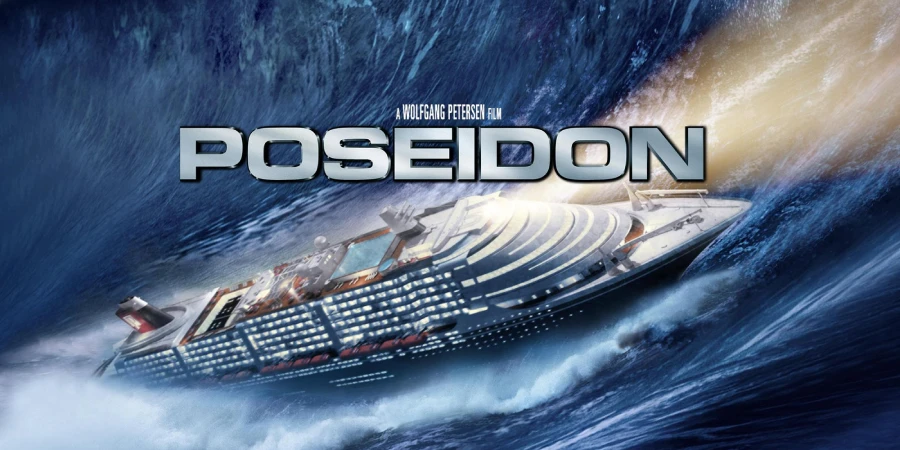

Wolfgang Petersen took a already-filmed disaster premise, stripped out the original’s philosophical fat, and replaced it with a lean, wet, claustrophobic race against drowning. Poseidon (2006) gives you a capsized luxury cruise ship, a handful of survivors with questionable survival instincts, and roughly ninety minutes of corridor-flooding tension. Nobody wins an Oscar here, but Petersen knows exactly what he is selling, and he delivers it without apology.
Detailed Summary
New Year’s Eve on the Open Atlantic
A massive luxury ocean liner, the Poseidon, cuts across the North Atlantic on New Year’s Eve. Passengers are celebrating, the ballroom is packed, and the ship’s captain announces the new year to applause and confetti. Nobody aboard suspects this is the last normal moment any of them will have.
We meet our core group quickly. Robert Ramsey, a former New York City mayor, travels with his daughter Jennifer and her fiancé Christian. Lone gambler Dylan Johns sits at the card tables. Maggie James travels with her young son Conor. A stowaway named Elena is also aboard.
The Rogue Wave Hits
Without warning, a massive rogue wave strikes the Poseidon broadside. The ship rolls completely, flipping upside down. Ballroom chandeliers plunge into the crowd. People slam into ceilings that are now floors. The sequence lasts only minutes but Petersen shoots it with brutal efficiency, furniture becoming projectiles and water rushing in from every direction.
Hundreds of passengers and crew die immediately. A pocket of survivors gathers in what was the ballroom ceiling, now a precarious floor. The ship’s staff urges everyone to stay put and wait for rescue. Most comply. Dylan refuses.
Dylan’s Decision and the Splinter Group
Dylan Johns decides he will not wait to drown. He heads for the hull, planning to climb up through the inverted ship to the propeller shaft and cut an exit to open water. Robert Ramsey joins him, refusing to trust the official plan with Jennifer’s life.
A small group forms around them: Maggie and Conor, Christian, Elena, and a man named Richard Nelson, a closeted gay architect who has just been rejected by his partner aboard the ship. Each of them carries a personal reason to survive. The group leaves the ballroom as water continues rising below.
Climbing Through a Capsized Ship
What follows is a series of escalating obstacles. Every corridor the group enters is either flooded, on fire, structurally collapsing, or all three at once. Petersen stages these set pieces with mechanical precision, each one removing another option and compressing the survivors into tighter and tighter spaces.
Nelson proves unexpectedly useful here. His knowledge of ship architecture helps the group navigate inverted hallways and service shafts. He reads structural details that others miss, which gives the character genuine weight beyond his emotional subplot.
Sacrifices Along the Way
Characters start dying. Lucky Larry, a flamboyant gambler who joined the group early, drowns in a flooded passage when he panics. His death shocks the audience partly because the film positions him as comic relief before pulling the rug out.
Richard Nelson makes the film’s most genuinely affecting sacrifice. Trapped in a flooding chamber, he holds open a valve so the others can pass through, drowning in the process. Nelson volunteers calmly, without melodrama. Actor Richard Dreyfuss plays the moment with quiet exhaustion rather than theatrical grief, and it works because of that restraint.
Robert Ramsey also sacrifices himself. He dives into submerged machinery to kick free a jammed propeller shaft, creating the escape route the group needs. He does not surface. Josh Lucas’s Dylan watches him go, and the film holds just long enough on that moment to let it register.

Movie Ending
Dylan leads the surviving group through the propeller shaft to the hull of the inverted ship. They breach the hull from the inside using emergency flares and explosive decompression. When the hull finally opens, survivors spill into the open ocean as the Poseidon groans and begins to sink completely.
Jennifer, Christian, Maggie, Conor, Dylan, and Elena are all in the water. Rescue helicopters appear on the horizon. The Poseidon sinks beneath the surface in a final wide shot, taking everything and everyone who did not make it out.
Jennifer grieves her father openly in the water, holding Christian. The film does not cut away from her crying to offer a cheap upbeat button. That choice earns a small amount of credit in a movie that generally avoids sentiment.
Audiences most often ask whether Robert Ramsey had any chance of survival. He does not. Petersen makes that clear visually: the machinery closes around him and the water fills the chamber. There is no ambiguity, and the film does not backpedal. His death is the price of everyone else getting out.
Some viewers also question why more people from the ballroom did not follow Dylan’s group. A large crowd stayed behind waiting for rescue. We never see what happens to them directly, but the ship sinking confirms their fate. Petersen wisely avoids showing that mass death explicitly, which keeps the film from tipping into exploitation.
Are There Post-Credits Scenes?
Poseidon has no post-credits scene. When the film ends, it ends. There is no stinger, no sequel tease, and no extra footage buried in the credits.
Type of Movie
Poseidon is a disaster survival thriller. Its tone is tense and propulsive, with almost no comedy after the wave hits. Petersen pitches the film at a relentless pace, prioritizing physical jeopardy over character depth.
It shares DNA with the disaster film genre that dominated the 1970s, but strips away the ensemble melodrama of that era. This is a leaner, more action-oriented machine than its predecessor The Poseidon Adventure (1972).
Cast
- Josh Lucas – Dylan Johns
- Kurt Russell – Robert Ramsey
- Emmy Rossum – Jennifer Ramsey
- Richard Dreyfuss – Richard Nelson
- Jacinda Barrett – Maggie James
- Mike Vogel – Christian
- Mia Maestro – Elena
- Jimmy Bennett – Conor James
- Kevin Dillon – Lucky Larry
- Andre Braugher – Captain Bradford
Film Music and Composer
Klaus Badelt composed the score for Poseidon. Badelt is best known for his work on Pirates of the Caribbean: The Curse of the Black Pearl (2003), where he co-composed alongside Hans Zimmer’s Remote Control team. His style leans heavily on orchestral momentum.
For Poseidon, Badelt keeps the music functional rather than memorable. Strings surge during the wave sequence. Quieter underscore accompanies the sacrifice scenes. No single theme lodges in the memory after the film ends, which is arguably the score’s biggest weakness: a survival film this physical deserves music with more distinct personality.

Filming Locations
Principal photography took place primarily on massive sets built at Warner Bros. Studios in Burbank, California. The production constructed enormous water tanks to simulate the flooded, inverted corridors of the ship. Practical water work formed the backbone of most set pieces.
Shooting on purpose-built studio sets rather than a real vessel gave Petersen complete control over water levels, lighting rigs, and structural collapses. That control shows: the flooding sequences feel genuinely dangerous precisely because the filmmakers could fine-tune exactly how fast water rises in each shot.
Some exterior ocean footage used digital augmentation, but the claustrophobic interior of the film is almost entirely a physical studio construction. That physical reality is one reason the film holds up better than many of its CGI-heavy contemporaries.
Awards and Nominations
Poseidon received an Academy Award nomination for Best Visual Effects at the 79th Academy Awards. It did not win.
Behind the Scenes Insights
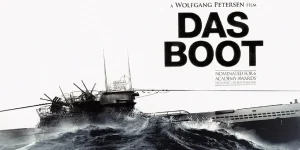
- Director Wolfgang Petersen previously helmed Das Boot (1981), a film set almost entirely in a submarine. His experience shooting claustrophobic, water-adjacent environments under pressure directly informed how he staged Poseidon‘s flooding sequences.
- Actors performed a significant amount of the underwater and flooding work themselves. Cast members trained extensively in water survival and breath-holding techniques before production began.
- Kurt Russell reportedly found the physical demands of the shoot among the most grueling of his career, particularly the extended underwater sequences.
- Production designers built the ship’s interior sets to be modular, allowing crews to reconfigure and partially flood sections repeatedly for different angles without rebuilding from scratch.
- The rogue wave sequence involved a combination of large-scale practical water rigs and digital effects, but Petersen insisted on keeping as much physical water on set as possible to force genuine reactions from the cast.
- Richard Dreyfuss’s casting was something of a nod to his history with water-set cinema, given his starring role in Jaws (1975).
Inspirations and References
Poseidon is a direct remake of The Poseidon Adventure (1972), which was itself based on Paul Gallico’s 1969 novel of the same name. Petersen’s version strips the story back to its survival mechanics and largely jettisons the original film’s religious allegory.
Gallico’s novel drew loosely on the real physics of ship capsizing and disaster psychology, imagining how a group of mismatched strangers might self-organize when official authority fails. That core premise survives into the 2006 film even if the thematic depth does not.
Petersen also drew on his own work with Das Boot and The Perfect Storm (2000), both of which deal with human beings trapped inside machines that water is trying to consume. His personal filmography is essentially a long meditation on drowning.
Alternate Endings and Deleted Scenes
No officially released alternate ending for Poseidon exists in the public domain. Petersen and Warner Bros. did not release a significant extended cut or director’s cut with substantially different material.
Some scenes showing secondary characters in the ballroom waiting group were trimmed in editing. Their presence would have added emotional weight to the sinking finale, but the cuts tighten pacing. Whether that trade-off was correct is debatable: a brief return to the ballroom crowd before the ship sinks might have made the ending hit harder.
Book Adaptations and Differences
Poseidon (2006) traces back to Paul Gallico’s 1969 novel The Poseidon Adventure. It is, however, a remake of the 1972 film rather than a fresh adaptation of the book. The differences between the novel and the 2006 film are therefore substantial.
Gallico’s novel centers on Reverend Frank Scott, a controversial clergyman whose crisis of faith drives the narrative. That religious dimension disappears entirely in Petersen’s version. Dylan Johns is a loner gambler, not a man wrestling with God.
Character names and relationships shift considerably across all three versions. Petersen’s film borrows the premise and setting from Gallico but reconstructs the characters from scratch to fit a more secular, action-forward framework.


Memorable Scenes and Quotes
Key Scenes
- The rogue wave impact: Shot from inside the ballroom, the wave hits and the camera rotates with the ship. People become debris. Confetti from the New Year’s celebration still floats in the air as the ceiling becomes the floor. The contrast is genuinely unsettling.
- Nelson’s sacrifice: Richard Dreyfuss holds a flooding valve open with his body while the group swims through. He looks at the water rising around his chest, then his neck, with no theatrical screaming. Just a man choosing to drown so others move forward.
- Robert Ramsey’s final dive: Kurt Russell drops into black, churning water to free a propeller shaft. The camera stays above the surface while he disappears below. When he does not come back up, the film commits to that absence completely.
- Lucky Larry’s death: The film plants Larry as a joke character and then drowns him without ceremony. It is the moment audiences realize Petersen is not playing favorites and anyone can go.
- Hull breach: Survivors use flares to heat and weaken the hull from inside. When it finally gives and ocean light pours in, the shot earns its release because the film made you wait for it.
Iconic Quotes
- “I’m not gonna sit here and wait to die.” – Dylan Johns, establishing his entire worldview in one sentence and setting the survival plot in motion.
- “You don’t know anything about me.” – Dylan, to Robert Ramsey, during one of their early clashes over who leads the group.
Easter Eggs and Hidden Details
- Richard Dreyfuss’s casting carries a winking quality given his role in Jaws (1975): the man once terrorized by water returns to die in it, though this time voluntarily and heroically.
- Wolfgang Petersen directed the original Das Boot and later The Perfect Storm, making Poseidon a kind of unofficial third chapter in his water-and-claustrophobia filmography. Alert viewers can see stylistic echoes from both earlier films in how he frames narrow corridors and rising water.
- The ballroom set is constructed so that its decorations mirror the film’s theme: a large circular ceiling piece, when the ship flips, becomes a floor medallion that survivors stand on. The geometry of the set quietly signals the inversion before it happens.
- Several background passengers in the ballroom wear costumes that evoke the 1970s disaster film era, a subtle visual nod to the film’s own genre history.
Trivia
- Wolfgang Petersen’s production of Poseidon used some of the largest water tanks ever constructed for a Hollywood film at that time.
- Josh Lucas performed most of his own swimming and diving work throughout the production.
- Kurt Russell was in his mid-fifties during filming and performed demanding physical sequences without doubling for the majority of the shoot.
- The film runs approximately 98 minutes, making it one of the shorter major studio disaster films of its era. Petersen cut hard to keep momentum.
- Emmy Rossum had previously starred in The Day After Tomorrow (2004), another large-scale disaster film, before joining this production.
- Petersen deliberately avoided giving Dylan Johns a detailed backstory, keeping him as a near-archetypal survivor figure rather than layering in sentimentality.
- Warner Bros. marketed the film heavily on the strength of its visual effects and practical water work rather than its cast, an unusual choice given the presence of Kurt Russell and Richard Dreyfuss.
Why Watch?
Richard Dreyfuss drowning himself quietly, without a speech, is worth the price of admission alone. Petersen builds a film that respects its audience enough to kill likable characters and not walk it back. For a studio disaster film from 2006, that level of commitment to consequence is rarer than it should be.
Director’s Other Movies
- Das Boot (1981)
- The NeverEnding Story (1984)
- Enemy Mine (1985)
- In the Line of Fire (1993)
- Outbreak (1995)
- Air Force One (1997)
- The Perfect Storm (2000)
- Troy (2004)
Recommended Films for Fans
- The Poseidon Adventure (1972)
- The Perfect Storm (2000)
- Das Boot (1981)
- Titanic (1997)
- The Day After Tomorrow (2004)
- Cliffhanger (1993)
- Alive (1993)
- Dante’s Peak (1997)