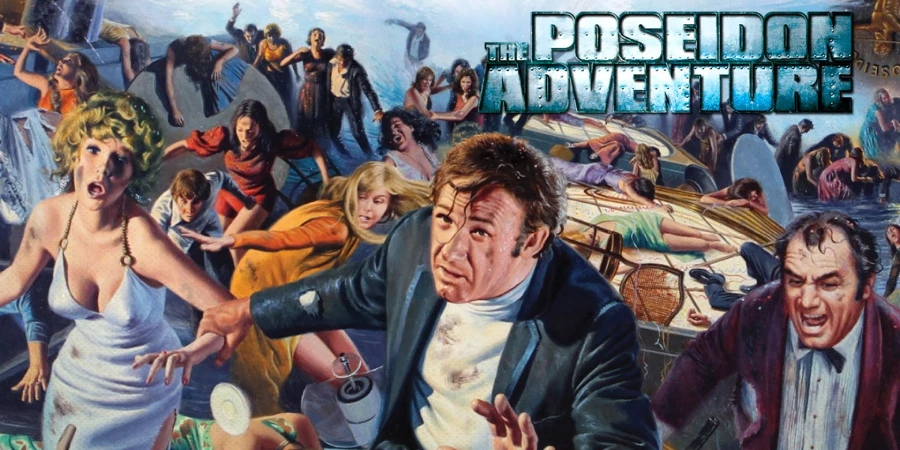

A luxury ocean liner flips upside down on New Year’s Eve, and the survivors have to climb up toward the hull to escape. That single premise, executed with sweaty, brutal commitment, made The Poseidon Adventure one of the biggest films of 1972 and kicked off an entire decade of disaster cinema. Gene Hackman plays a priest who argues with God while scaling a Christmas tree, and somehow that sentence undersells it.
Detailed Summary
Setting Sail: New Year’s Eve Aboard the S.S. Poseidon
The film opens on the S.S. Poseidon, a massive ocean liner making what its owners intend to be its final commercial voyage before being sold for scrap. Cost-cutting has left the ship dangerously under-ballasted, a detail the captain protests loudly and the company representative dismisses just as loudly.
Passengers fill the ballroom for a New Year’s Eve celebration. We meet the core group quickly: Reverend Frank Scott (Gene Hackman), a rebellious minister who believes God helps those who help themselves; Detective Mike Rogo (Ernest Borgnine) and his wife Linda (Stella Stevens), a former prostitute whose past Rogo barely tolerates discussing; James Martin (Red Buttons), a shy bachelor haberdasher; and Belle Rosen (Shelley Winters), a retired swimmer traveling with her husband Manny (Jack Albertson).
Rounding out the group are young siblings Robin and Susan Shelby, their grandparents, lounge singer Nonnie Parry (Carol Lynley), and a waiter named Acres (Roddy McDowall).
The Wave Hits: Disaster Strikes at Midnight
A massive underwater earthquake generates a giant wave. It strikes the ship broadside just after midnight, and the Poseidon rolls completely over. The ballroom sequence is genuinely harrowing: tables fly, the Christmas tree crashes, people smash into walls and ceiling fixtures as gravity reverses itself in seconds.
When the chaos settles, the ship is upside down. Most of the passengers in the ballroom are dead or dying. A ship’s officer arrives and tells the survivors to stay put and wait for rescue, insisting that help will come from below, meaning the hull, which is now pointing upward and above the waterline.
Scott Takes Charge: The Climb Begins
Reverend Scott disagrees loudly. He argues that waiting means drowning as the ship slowly floods from the bottom, now the top. He urges anyone willing to follow him to climb up through the ship toward the hull.
Most survivors choose to stay with the officer. Scott, Rogo, Linda, Martin, Belle and Manny, the Shelby siblings, Nonnie, and Acres form the group that follows him. A small group that stays behind dies almost immediately when a flooding surge sweeps through the ballroom, a brutal payoff that proves Scott right within minutes of the argument.
Scott leads the group up the ship’s Christmas tree as their first ladder, a visually strange and weirdly moving image. From there they push deeper into the ship’s interior, climbing through maintenance shafts and cargo holds, always moving toward what was once the floor and is now their ceiling.
Deaths Along the Way: The Group Shrinks
Acres dies early, falling during the tree climb. His death is quick and rattles Nonnie, who was romantically interested in him.
Belle Rosen becomes one of the film’s most memorable figures in this stretch. She reveals she was once a competitive swimmer, which pays off dramatically when the group must swim through a flooded corridor. Belle dives in and guides them through, but the physical effort costs her everything. She suffers a heart attack and dies in her husband’s arms shortly after, and Shelley Winters earns every second of that scene.
Manny Rosen, devastated by Belle’s death, loses his will to continue. He keeps moving anyway, which is somehow sadder than if he had simply given up.
Tension Within the Group
Rogo and Scott clash repeatedly. Rogo is a blunt, street-level pragmatist who resents Scott’s almost aggressive faith-in-action philosophy. Their arguments give the film its dramatic spine, and Borgnine plays Rogo’s frustration with real heat.
Linda Rogo’s past becomes an unexpected dramatic element. Rogo’s discomfort with it surfaces under pressure, and Stella Stevens plays Linda as someone who has made peace with who she is far more than her husband has. Her death, when it comes, lands harder because of how clearly she had earned her own dignity in the story.

Movie Ending
Scott leads the survivors to the engine room area near the hull. They find a steam valve blocking their path, and the heat and pressure make it impassable. Scott, furious and grief-stricken after Linda Rogo dies trying to cross the structure, begins shouting at God in one of Gene Hackman’s best raw moments on film.
He screams, essentially, that God keeps taking the good people and leaving the useless ones alive, and then he grabs the valve wheel himself and turns it. He falls into the scalding water below and dies. It is a stunning choice for a film built around a minister protagonist.
Scott’s death reads as a deliberate theological statement by the screenplay. He does not survive because he was right about God. He survives long enough to save the others because he was willing to act, and then the film lets him die anyway. That refusal to give the preacher a triumphant exit is the single most interesting decision the film makes.
Rogo takes command of the remaining group, including himself, Martin, Nonnie, the Shelby kids, and the grieving Manny Rosen. They bang on the hull. Rescue workers hear them and cut through from the outside. Rogo guides everyone out through the opening.
Manny Rosen’s exit is heartbreaking in a quiet way. He climbs out last, alone, with nothing waiting for him. Martin and Nonnie hold hands, suggesting something fragile and hopeful. Rogo, who spent the whole film being the most abrasive person in every room, ends up as the one who gets everyone out alive.
Are There Post-Credits Scenes?
No. The Poseidon Adventure has no post-credits scene of any kind. When it ends, it ends. This was 1972, and Marvel was not yet a cinematic force requiring audiences to sit through five minutes of credits for a thirty-second tease.
Type of Movie
This is a disaster film and survival thriller with strong ensemble drama elements. Its tone sits in an interesting place: earnest enough to take its character deaths seriously, but propulsive enough to keep the action moving at a sharp pace.
There is also a layer of theological drama running underneath everything, courtesy of Scott’s ongoing argument with a God he clearly still believes in. It is not a faith film in the comfortable sense. It asks harder questions than it answers.
Cast
- Gene Hackman – Reverend Frank Scott
- Ernest Borgnine – Detective Mike Rogo
- Red Buttons – James Martin
- Carol Lynley – Nonnie Parry
- Roddy McDowall – Acres
- Stella Stevens – Linda Rogo
- Shelley Winters – Belle Rosen
- Jack Albertson – Manny Rosen
- Leslie Nielsen – Captain Harrison
- Arthur O’Connell – Chaplain John
- Eric Shea – Robin Shelby
- Pamela Sue Martin – Susan Shelby
- John Crawford – Mr. Linarcos
Film Music and Composer
John Williams composed the score, and it is a fascinating artifact of a career that was about to explode. Williams uses swelling orchestral arrangements that amplify the physical chaos without ever tipping into parody.
The standout musical moment is not actually Williams. “The Morning After”, written by Al Kasha and Joel Hirschhorn, became a genuine pop hit and won the Academy Award for Best Original Song. Maureen McGovern performed it, and it plays over the film with an almost cruel irony given how many people do not make it to morning.
Williams builds tension throughout the survival sequences with propulsive rhythmic passages that were an early preview of the instincts he would later deploy in Jaws and Star Wars. His work here is one of the most underrated elements of the film.

Filming Locations
Principal photography took place on soundstages at 20th Century Fox studios in Los Angeles. The production built enormous sets designed to be used upside down, which created genuinely disorienting visual geography for audiences used to conventional interiors.
Exterior ship shots used a real vessel. Shooting on controlled studio sets gave director Ronald Neame and his team precise control over water levels, lighting rigs, and safety conditions, which mattered enormously given the physical demands placed on the cast.
The upside-down set design deserves specific credit. Walking through a ballroom where chandeliers are on the floor and tables are bolted to the ceiling creates a low-grade visual wrongness that no amount of post-production trickery could fully replicate.
Awards and Nominations
The Poseidon Adventure received eight Academy Award nominations, winning two: Best Original Song for “The Morning After” and an honorary award for Best Visual Effects presented to L.B. Abbott. Shelley Winters received a nomination for Best Supporting Actress, which she absolutely deserved.
The film also won the Golden Globe for Best Original Song. Its commercial and awards success helped legitimize the disaster film as a serious Hollywood genre rather than a B-movie novelty.
Behind the Scenes Insights
- Producer Irwin Allen was notoriously hands-on and clashed repeatedly with director Ronald Neame over control of the production, particularly during action sequences, which Allen directed himself.
- Shelley Winters trained extensively for her underwater swimming sequence and performed much of it herself. She was in her early fifties at the time and committed fully to the physical demands.
- Gene Hackman was not the first choice for Reverend Scott. Multiple actors passed on the role before Hackman took it. His casting turned out to be the single best decision made during pre-production.
- The enormous ballroom set was constructed on a gimbal system that allowed it to rotate, creating the capsizing effect practically rather than through optical tricks.
- Roddy McDowall was cast largely due to his friendship with producer Irwin Allen, though his character’s early death meant limited screen time.
- The production faced serious safety challenges with large volumes of water on set, and several cast members sustained minor injuries during the flood sequences.
- Leslie Nielsen plays the ship’s captain almost entirely in the pre-disaster sequences. At the time, he was primarily a dramatic actor, years before his comic reinvention in Airplane!
Inspirations and References
The film adapts Paul Gallico’s 1969 novel of the same name. Gallico based his premise on a real concern among naval architects about the stability of large vessels, and on the general principle that catastrophe tends to reward those who act over those who wait.
Producer Irwin Allen had already been exploring large-scale physical disaster in television movies. He saw Gallico’s novel as a perfect vehicle for what would become his signature formula: ensemble cast, one catastrophic event, escalating survival scenarios.
Thematically, the film draws loosely on the Book of Exodus structure, a reluctant leader guiding a fractious group toward escape while people die along the way. Whether that parallel is intentional or convenient depends on how generously you read the screenplay.
Alternate Endings and Deleted Scenes
No well-documented alternate ending exists for the original 1972 release. Scott’s death was apparently part of the screenplay from fairly early in development and was not a late-stage change or studio compromise.
A television broadcast version of the film included additional footage that extended certain character scenes, particularly for Nonnie and the Shelby siblings. These scenes do not meaningfully alter the plot but flesh out the quieter moments between action beats.
Book Adaptations and Differences
Paul Gallico’s novel predates the film and differs in several notable ways. The novel’s Reverend Scott is a younger man, and his theological conflicts read slightly differently on the page than Hackman plays them on screen. Hackman’s version feels more worn-in, more genuinely angry.
Belle Rosen’s background as a swimmer is present in the novel and carries over faithfully. Gallico was interested in the idea that physical abilities cultivated decades earlier could become life-saving under the right circumstances, which the film honors completely.
Some secondary characters in the novel are condensed or eliminated in the screenplay adaptation. The film tightens the ensemble to a manageable size, which sharpens the emotional impact of each death.
Memorable Scenes and Quotes
Key Scenes
- The capsizing sequence: The ballroom tips from festive chaos into full vertical drop in under two minutes. People slide across tables, crash into Christmas tree ornaments, and vanish under rushing water. It still works.
- Climbing the Christmas tree: Scott leads the group up the decorated tree like a surreal fire escape. The visual is absurd and completely committed, and somehow both of those things are true at once.
- Belle’s underwater swim: Shelley Winters strips down and dives into a flooded corridor, pulling herself hand-over-hand in a long underwater shot. Her face when she surfaces, exhausted and briefly proud of herself, is the best single beat in the film.
- Scott’s death at the steam valve: Hackman screams at the ceiling, grabs the burning wheel, and falls. The camera does not look away. It is violent, purposeful, and oddly dignified.
- The final escape: Rogo shepherding the survivors out through the cut hull while rescue workers pull them into daylight. After ninety minutes of darkness and water, the light feels genuinely earned.
Iconic Quotes
- “You God-damn bastard! Why don’t You help us? What is the point? What is the point of this? What is the point? Is it so You can laugh at us? Watch us struggle? What are You? What are You?” – Reverend Scott
- “In the water I’m a very skinny lady.” – Belle Rosen
- “You’re a fake! A hypocrite! Your God-given strength is a load of crap!” – Detective Rogo to Scott
- “Maybe God wants us to fight. Maybe He wants us to reach that engine room on our own.” – Reverend Scott
Easter Eggs and Hidden Details
- The name Poseidon is the Greek god of the sea and earthquakes, both of which directly cause the disaster. Naming a ship after the entity responsible for its destruction is either irony or hubris, and the film quietly lets that sit there.
- During the ballroom celebration before the wave hits, careful viewers can spot the ship already listing slightly in some shots, foreshadowing the instability the captain had warned about.
- The song “The Morning After” plays diegetically at the New Year’s party before the disaster, making it both a celebratory song and, in hindsight, a survival prayer. That double meaning was intentional.
- Robin Shelby’s extensive knowledge of ship layouts, which becomes plot-critical, is established early in a brief scene where he reads a ship’s schematic. Most viewers forget the setup by the time the payoff arrives.
- The upside-down sets include details like drained wine glasses still sitting on what is now the ceiling, small textural touches that reward attention.
Trivia
- The Poseidon Adventure was one of the highest-grossing films of 1972 and helped establish the disaster film as a commercially dominant genre throughout the decade.
- Shelley Winters kept the swimsuit she wore for her underwater sequence as a personal memento.
- John Williams composed the score before his career-defining run that included Jaws, Close Encounters of the Third Kind, and Star Wars. Hearing this score knowing what came after is a strange pleasure.
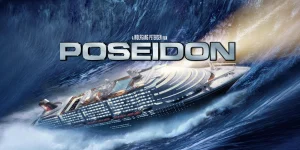
- A remake titled Poseidon was released in 2006, directed by Wolfgang Petersen. It generated far less affection than the original.
- Ernest Borgnine and Stella Stevens reportedly did not get along particularly well on set, which may have added some authentic edge to their on-screen friction.
- The film was shot in a relatively short production window given the complexity of its sets and water effects.
- Gene Hackman has since spoken about finding the physical production difficult and somewhat unpleasant to work on, though his performance shows none of that.
- Irwin Allen went on to produce The Towering Inferno in 1974, further cementing his reputation as the king of disaster cinema.
Why Watch?
Watch it for Gene Hackman screaming at God while burning his hands on a steam valve: that image alone justifies the runtime. Shelley Winters’ swimming sequence is a master class in using a character’s entire history to make one physical act devastating. No CGI in any modern blockbuster has matched what a practical water-filled set and a committed cast of actors did here.
Director’s Other Movies
- Tunes of Glory (1960)
- The Prime of Miss Jean Brodie (1969)
- The Odessa File (1974)
- Meteor (1979)
- First Monday in October (1981)
Recommended Films for Fans
- The Towering Inferno (1974)
- Airport (1970)
- Earthquake (1974)
- The Hindenburg (1975)
- Jaws (1975)
- Titanic (1997)
- Poseidon (2006)