
Six men sailed out of Gloucester, Massachusetts in the fall of 1991 and never came back. The Perfect Storm (2000) refuses to give audiences the comfort of a rescue, and that refusal is what makes it worth talking about. Director Wolfgang Petersen built a disaster film around a guaranteed tragedy, daring viewers to watch anyway. What results is a film that earns its grimness through character work before the ocean swallows everything whole.
Detailed Summary
Life in Gloucester and the Crew of the Andrea Gail
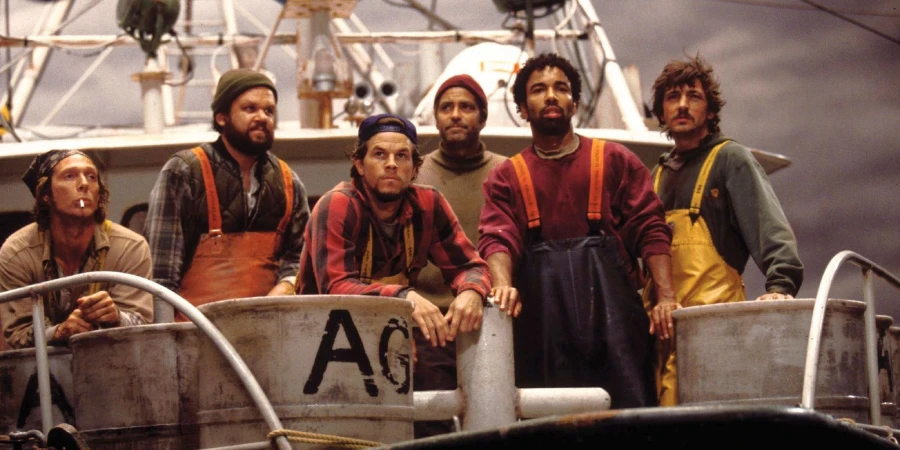
We open in Gloucester, Massachusetts, a tight-knit fishing community where commercial swordfishing is both livelihood and identity. Captain Billy Tyne, played by George Clooney, has had a bad season. He is restless, proud, and quietly desperate to prove himself again.
Tyne recruits a crew for one more run on the sword boat Andrea Gail. Among them: Bobby Shatford, played by Mark Wahlberg, who leaves behind his girlfriend Christina Cotter, played by Diane Lane. The film spends real time in Gloucester’s bars and docks, letting us feel the texture of these men’s lives before the sea claims them.
Pushing Further Out: The Flemish Cap Run
After disappointing catches closer to shore, Tyne makes the call to push far out to the Flemish Cap, an area beyond normal fishing grounds. It is an ambitious, risky decision that the crew debates but ultimately accepts. They want the money, and Tyne wants vindication.
Out at the Cap, the fishing is extraordinary. They pull in a massive haul of swordfish, filling the hold beyond expectations. Here is where the film’s dramatic trap closes: their ice machine breaks down, meaning the fish will spoil unless they race back to Gloucester immediately.
Three Storms Converging
Back on shore, a meteorologist tracks three separate weather systems colliding over the North Atlantic. A nor’easter, the remnants of Hurricane Grace, and a high-pressure system from Canada are merging into something with no modern precedent. Forecasters warn that this convergence will produce a storm of extraordinary violence.
Tyne receives weather reports aboard the Andrea Gail and faces an impossible choice. He can wait out the storm and lose the catch, or run through it and risk everything. He chooses to run through. Most of the crew trusts him; some don’t ask too many questions.
The Rescue of the Mistral
While the Andrea Gail plows toward disaster, the film cuts to a parallel storyline involving a sailing vessel called the Mistral. This pleasure boat, crewed by inexperienced sailors, gets caught in the same storm system. A Coast Guard helicopter crew launches a daring rescue mission despite brutal conditions.
This rescue sequence is exciting filmmaking. The helicopter runs low on fuel, the crew hoists survivors from churning water, and the chopper ultimately goes down. The Coast Guard airmen survive by bailing out into the sea and getting rescued by a boat. It functions as a counterweight to the main story, giving audiences a survival narrative inside a film defined by its refusal to offer one for the main characters.
The Andrea Gail Meets the Storm
Wolfgang Petersen throws everything at the screen during the storm sequences. Walls of water rise higher than the ship’s mast, and the Andrea Gail climbs each wave like it is scaling a mountain. The sound design deserves particular credit here: the groaning of steel, the shriek of wind, and the percussion of water hitting the hull create something physically oppressive.
One by one, systems on the boat fail. Communication goes dark. The crew battles flooding, equipment malfunctions, and sheer exhaustion. George Clooney’s Tyne, for all his confidence, gets quieter as conditions worsen. There’s a scene where he simply grips the wheel and stares forward, jaw set, and says nothing; it is one of the film’s best acting moments because it shows a man running out of answers.
Movie Ending
Tyne pushes the Andrea Gail up the face of an enormous rogue wave, engines screaming, the boat nearly vertical. For a moment it seems like the ship might crest it. It doesn’t. The wave breaks over the hull, and the Andrea Gail rolls and sinks into the North Atlantic. All six men die.
No rescue comes. No last-minute reprieve appears. Petersen commits fully to the real historical outcome, and that commitment is what separates this film from standard disaster-movie formula. Audiences who came for George Clooney to save the day left the theater with something heavier.
Back in Gloucester, Christina Cotter stands on the shore. Diane Lane delivers her grief without melodrama, standing in wind and silence as she processes that Bobby is not coming back. The community gathers, and we see names read aloud at a memorial, the film’s quiet insistence that these were real people.
A brief coda shows a vision of Bobby and Christina together on a sunlit beach, serene and impossible. It reads as Christina’s imagined farewell rather than any supernatural claim. Some critics found it sentimental; personally, I think it earns its moment because the film has been so ruthlessly unsentimental for the previous two hours.
What audiences most often ask: did anyone from the Andrea Gail survive? No. All six crew members perished. Their bodies were never recovered. The film honors that fact completely.
Are There Post-Credits Scenes?
The Perfect Storm has no post-credits scenes. Once the memorial ends and the credits roll, the film is finished. There is nothing extra waiting for you. The story says everything it needs to say before the screen goes dark.
Type of Movie
This is a survival disaster drama based on true events. Its tone is heavy and realistic rather than action-adventure. At its bones, it is a working-class tragedy about men who gambled their lives for a paycheck and lost.
Expect grief, not triumph. Expect spectacle in service of sorrow. This is not a film that pulls punches or pivots into comfortable resolution.
Cast
- George Clooney – Captain Billy Tyne
- Mark Wahlberg – Bobby Shatford
- Diane Lane – Christina Cotter
- John C. Reilly – Dale “Murph” Murphy
- William Fichtner – David Sullivan
- Allen Payne – Alfred Pierre
- John Hawkes – Mike Moran
- Bob Gunton – Alexander McAnally (the meteorologist)
- Cherry Jones – Coast Guard Commander Lola Hanson
- Michael Ironside – Bob Brown (boat owner)
- Mary Elizabeth Mastrantonio – Linda Greenlaw
Film Music and Composer
James Horner composed the score. Horner was one of Hollywood’s most experienced composers for large-scale dramatic films, having previously scored Titanic and Apollo 13, both of which share thematic DNA with this film.
His work on The Perfect Storm leans into swelling orchestral waves, quite literally matching the visual grammar of rising water. The score avoids being triumphant where the story refuses to be. It underscores grief rather than heroism, which is the right call.
Celine Dion contributed a song for the film’s promotional campaign. Horner’s main thematic material, however, carries the film’s emotional core throughout its runtime.


Filming Locations
Principal photography took place in Gloucester, Massachusetts, the actual hometown of the Andrea Gail crew. Filming in the real location gives the film a documentary texture in its early scenes. You can feel the specificity of a real fishing port rather than a backlot approximation.
Extensive water work and storm sequences were shot on massive water tank facilities in studio, with a full-scale replica of the Andrea Gail built for physical interaction with wave machines and practical water effects. The scale of the tank work was significant for the era, shot before digital water fully matured as a tool.
Visual effects supplemented the practical footage heavily for the largest wave sequences. Petersen blended practical and digital work in ways that still hold up reasonably well, partly because the darkness of the storm scenes hides seams that brighter photography would expose.
Awards and Nominations
The Perfect Storm received an Academy Award nomination for Best Visual Effects, which was deserved given the ambition of the water sequences for the year 2000. It did not win the award that year. The film’s commercial performance far outpaced its awards presence, which was always going to be its legacy.
Behind the Scenes Insights
- Wolfgang Petersen’s experience directing Das Boot (1981), one of cinema’s great submarine films, made him a logical choice for a story about men trapped and dying in water.
- A full-scale replica of the Andrea Gail was constructed specifically for the production, allowing actors to physically experience conditions on an authentic-feeling vessel.
- George Clooney reportedly researched the real Billy Tyne extensively, though the historical record on Tyne’s personality is incomplete given that no survivors remained to describe him.
- The wave sequences required industrial-scale water rigs that drenched cast and crew repeatedly across grueling shooting days.
- Mary Elizabeth Mastrantonio’s character, Linda Greenlaw, was a real person; Greenlaw was actually the captain of a sister vessel to the Andrea Gail and survived the storm.
- Some families of the real crew members had complicated feelings about the film’s dramatization, particularly regarding characterizations of men who could not speak for themselves.
- Petersen and cinematographer John Seale studied real North Atlantic storm footage to calibrate the visual texture of the wave sequences.
Inspirations and References
Sebastian Junger’s nonfiction book The Perfect Storm: A True Story of Men Against the Sea, published in 1997, served as the direct source material. Junger spent years reporting on the event, interviewing fishermen, meteorologists, and families. His book reconstructed events aboard the Andrea Gail by inference, since no survivors existed to describe the final hours.
Junger was transparent about the speculative nature of the boat’s final moments. Screenwriter Bill Wittliff worked from that framework, dramatizing what could plausibly have occurred based on the storm data and the crew’s known behavior patterns.
The film also draws on a long tradition of maritime tragedy narratives, from Melville’s work through to countless real-world fishing community stories along the New England coast.
Alternate Endings and Deleted Scenes
No officially released alternate ending exists for The Perfect Storm. Given that the real event’s outcome was fixed and publicly known, any version of an alternate ending would have required entirely rewriting history, which Petersen and Wittliff chose not to do.
Some deleted and extended scenes have circulated in home video releases, primarily expanding character moments in Gloucester before the voyage. These additions flesh out the Bobby and Christina relationship and deepen the community atmosphere, but none fundamentally alter the film’s arc. The theatrical cut made the right call trimming them; the film needs to move toward the sea without overstaying its land-based first act.
Book Adaptations and Differences
Junger’s book is significantly more documentary in approach than the film. It interweaves the Andrea Gail story with detailed meteorological science, the history of Gloucester’s fishing industry, and the broader context of commercial fishing danger. The film necessarily dramatizes and compresses.
Junger’s book is notably careful about what it claims to know. It presents speculative reconstructions as speculative. Wittliff’s screenplay commits to dramatic certainty that the book deliberately avoids, which is a reasonable trade-off for cinema but worth acknowledging.
Linda Greenlaw has a larger and more factually documented presence in the book than in the film. Her radio contact with Tyne before the storm represents one of the few real data points about the crew’s state of mind, and Junger gives that material considerable weight.


Memorable Scenes and Quotes
Key Scenes
- The Flemish Cap haul: The crew pulling in a massive catch, faces lit with relief and excitement, knowing they have finally hit it big. It is the film’s happiest moment, which makes everything after it darker by contrast.
- Billy at the wheel in silence: As conditions become unsurvivable, Clooney grips the helm, stares ahead, and says nothing. His stillness communicates more than any speech could.
- The helicopter rescue sequence: Frantic, chaotic, and technically impressive. The Coast Guard crew hoisting survivors from fifty-foot swells while the chopper burns through its last fuel is the film’s most purely cinematic action sequence.
- The final wave: The Andrea Gail attempting to climb a rogue wave and failing. Shot from a distance at first, then close, the camera captures the boat going nearly vertical before the water breaks over it.
- Christina on the shore: Diane Lane standing in wind, alone with the knowledge that Bobby is gone. Her face does everything. No monologue required.
- The Gloucester memorial: Names read aloud to a gathered community. It shifts the film’s register from spectacle to elegy without any warning, and it lands hard.
Iconic Quotes
- “She’s coming on, boys. She’s coming on strong.” Billy Tyne, watching the storm build on radar, underestimating what is about to happen.
- “I’m a sword boat captain. What do I do if I can’t fish?” Tyne, early in the film, establishing his entire identity and the trap it sets for him.
- “You’re the best damn swordfishing captain there is.” Spoken to Tyne as encouragement, it doubles as an epitaph by the film’s end.
Easter Eggs and Hidden Details
- Sharp-eyed viewers can spot details in the Gloucester harbor scenes that reflect the real port’s layout and working conditions, rather than a generically dressed set. The production team worked to preserve authentic dock textures.
- The meteorological maps and tracking graphics used in the film were modeled on real weather service displays from the era, giving the forecasting scenes a grounded visual accuracy.
- Several background characters in Gloucester scenes were actual Gloucester residents, lending faces and body language that no casting call could replicate.
- The fish haul sequence was staged with practical swordfish prop bodies as well as some real fish, creating a sensory authenticity that enhances the weight of what the crew is risking their lives for.
- Linda Greenlaw’s character references radio contact with the Andrea Gail, a direct nod to Junger’s documented account of the real final communications between the two vessels.
Trivia
- Sebastian Junger’s book spent months on bestseller lists before production began, giving the film a built-in audience already familiar with the tragedy.
- The real Andrea Gail disappeared on October 28, 1991, and no wreckage from the vessel was ever conclusively identified.
- Wolfgang Petersen directed Das Boot nearly twenty years before this film, making him arguably the most experienced director alive at depicting men dying inside vessels at sea.
- John C. Reilly’s character Murph has a subplot involving his estranged family that the film uses to humanize the crew beyond their professional identities.
- Diane Lane’s role as Christina is largely a creation of the screenplay. Her character exists to give the audience an emotional anchor on shore while the film spends most of its time at sea.
- George Clooney has spoken about the challenge of playing a character whose real inner life is entirely unknown, since no one who sailed with Billy Tyne survived to describe him.
- James Horner’s experience scoring ocean-disaster films was so established by this point that one critic joked he had his own standing reservation at the North Atlantic.
- Petersen reportedly pushed hard for a faithful ending rather than a studio-compromised rescue scenario. Warner Bros. accepted the tragic conclusion, a decision that respected both history and the audience.
Why Watch?
Watch it for Clooney’s performance in the film’s final act, specifically the scene where he stops talking and just holds the wheel while the ocean decides his fate. Petersen builds two hours of working-class specificity precisely so that silence means something. This is a disaster film that makes you feel the loss rather than just witness the spectacle.
Director’s Other Movies
- Das Boot (1981)
- Enemy Mine (1985)
- In the Line of Fire (1993)
- Outbreak (1995)
- Air Force One (1997)
- Troy (2004)
- Poseidon (2006)
Recommended Films for Fans
- Das Boot (1981)
- Titanic (1997)
- Deepwater Horizon (2016)
- All Is Lost (2013)
- The Finest Hours (2016)
- Alive (1993)
- Master and Commander: The Far Side of the World (2003)