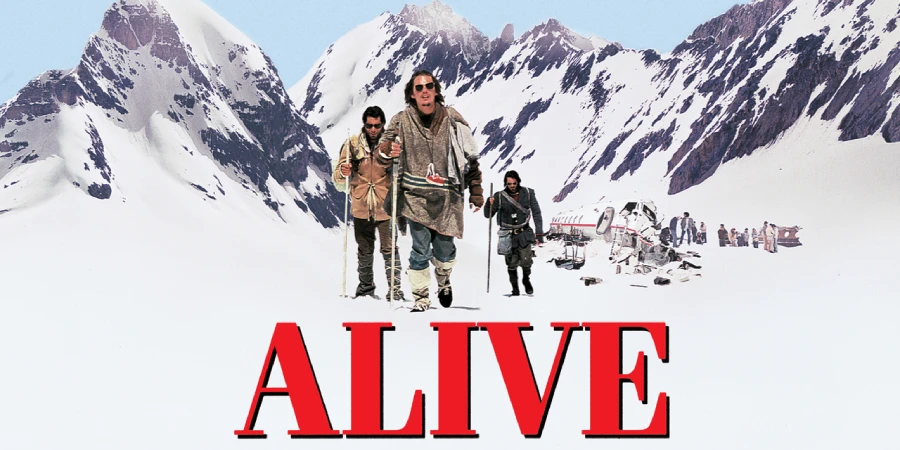

Eating your dead teammates is not something most survival films dare to show honestly, and Alive (1993) does not blink. Frank Marshall’s film follows the survivors of the 1972 Andes plane crash with unflinching commitment, refusing to soften the central act of cannibalism that kept sixteen people breathing for seventy-two days. What makes it land harder than expected is how thoroughly it frames that act as a moral, spiritual, and physical reckoning rather than a cheap shock. This one earns its grimness.
Detailed Summary
The Crash
A Uruguayan Air Force plane carrying the Old Christians rugby team departs for Santiago, Chile in October 1972. Poor weather forces the pilot to navigate through the Andes instead of waiting for clearer skies, and that decision costs everyone aboard dearly. Turbulence shreds the fuselage, the tail section breaks off, and the plane skids across a glacier before stopping.
Survivors crawl from the wreckage into brutal cold and thin air. Roughly thirty people survive the initial impact, but several are badly injured. Nando Parrado (Ethan Hawke) is among the unconscious, believed by some to be dead.
Early Survival Attempts
Roberto Canessa (Josh Hamilton) and others improvise medical care from almost nothing. They pack snow against wounds and use seat cushions for insulation. Food runs out within days.
A radio salvaged from the wreckage picks up a broadcast announcing that the official search has been called off. That moment hits the group like a second crash. Rescue is no longer coming.
The Decision to Eat the Dead
Carlitos Paez (Bruce Ramsay) voices what everyone is avoiding. With no food, no rescue, and temperatures dropping every night, eating the flesh of those who died becomes the only option. The film stages this conversation quietly, without melodrama, which makes it more disturbing than any visceral close-up would.
Nando pushes hardest for the decision. He frames it in practical terms: the dead would want the living to survive. Roberto resists longest, then accepts. One by one, the group makes the same terrible choice.
The Avalanche
Just when the group establishes a fragile routine, an avalanche buries the wreckage. Several more survivors die in their sleep, suffocated under snow inside the fuselage. The sequence is claustrophobic and genuinely terrifying, shot from inside the cramped metal shell as white snow pours through every gap.
Nando loses his sister Susana early in the ordeal, and here he loses more companions. Grief accumulates faster than hope.
Failed Expedition West
A small group attempts to hike west toward Chile, believing the coast is close. They underestimate the Andes completely. The cold and altitude defeat them, and they return exhausted and demoralized. The film does not glamorize the attempt; these men stumble back looking smaller than when they left.
Nando and Roberto’s Final Trek
Nando refuses to accept death on the mountain. He and Roberto pack the remaining food, wrap themselves in layers cut from the plane seats, and head west on foot across the glacier. Their trek lasts ten days. No helicopter, no radio, no map worth trusting.
Ethan Hawke carries these final sequences almost entirely on physical performance. He looks genuinely wrecked: hollow-faced, slow-moving, eyes fixed somewhere past the horizon. It is the best sustained work in the film.
They eventually descend low enough to find a river, following it until they spot a Chilean farmer named Sergio Catalán across the water. Nando screams his story across the rushing river. Catalán passes a note and a pen on a stone. Nando writes back. Help finally arrives.
Movie Ending
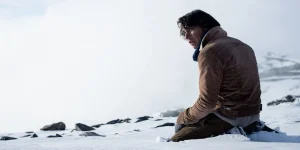
Helicopters reach the crash site and evacuate the remaining survivors in two trips. Sixteen people come off that mountain alive, out of forty-five who boarded the original flight. When the rescue story breaks publicly and journalists reveal how the survivors ate human flesh, the reaction in Uruguay splits between horror and awe.
Nando addresses this directly in the film’s closing narration. He reframes the act not as transgression but as communion, drawing on his Catholic faith to describe eating the flesh of friends as a kind of last gift freely given. The film earns this spiritual reading because it spent two hours making you feel the full weight of every small decision that led there.
What the ending does best is refuse catharsis on easy terms. The survivors return home gaunt and changed, and the film does not cut to warm reunions scored with swelling music. It lingers in ambiguity. Survival came at a price nobody outside that mountain can fully measure, and the final frames make sure you feel that.
Are There Post-Credits Scenes?
Alive has no post-credits scene of any kind. Text cards appear before the credits summarizing what became of the key survivors in real life, which is worth reading. Once those cards finish, the film is done.
Type of Movie
Alive is a survival drama with strong elements of biographical filmmaking. Its tone sits closer to documentary realism than adventure spectacle, though it has genuine moments of tension that rival thriller cinema. It is serious, bleak, and occasionally brutal, with a spiritual undercurrent that keeps it from being purely nihilistic.
Cast
- Ethan Hawke – Nando Parrado
- Josh Hamilton – Roberto Canessa
- Bruce Ramsay – Carlitos Paez
- John Haymes Newton – Antonio Balbi
- David Kriegel – Fito Strauch
- Kevin Breznahan – Roy Harley
- Sam Behrens – Gustavo Zerbino
- Illeana Douglas – Susana Parrado
- Jack Noseworthy – Bobby Francois
- Christian Meoli – Eduardo Strauch
Film Music and Composer
Nestor Almendros was the original cinematographer attached to the project, but the composer credit belongs to James Newton Howard. Howard’s score leans heavily on sparse strings and low brass, avoiding heroic swells in favor of cold, sustained tones that mirror the landscape. It is one of the more restrained survival film scores of its era, which suits the material perfectly.
There is no bombastic rescue theme, no sentimental piano motif ladled over the grief scenes. Howard trusts silence as much as music, and the film benefits enormously from that discipline.

Filming Locations
Principal photography took place in the Canadian Rockies, specifically around the Purcell Mountains in British Columbia. The production also shot portions in the Andes mountains in South America to capture authentic geography for establishing shots.
Choosing the Canadian Rockies was a practical necessity: the actual crash site in the Andes is at extreme altitude and genuinely dangerous to work in for extended periods. The Canadian locations provided the same brutal white-on-white visual palette without killing the crew.
That palette matters enormously to the film’s mood. Every frame of the mountain sequences feels isolated and monochromatic, all grey rock and blinding white snow, which amplifies the psychological confinement of the survivors’ situation.
Awards and Nominations
Alive did not receive major awards recognition despite its subject matter and strong central performances. It earned some technical praise for its production design and location photography but did not factor into the major Oscar conversations of 1993.
Behind the Scenes Insights
- Several of the real survivors of the 1972 crash visited the set and consulted with the production on factual details.
- Director Frank Marshall had the cast undergo physical training to understand what sustained cold and deprivation do to the human body.
- Ethan Hawke lost significant weight for the role and has spoken about the psychological difficulty of embodying Nando Parrado, a man who was still alive and could watch the finished film.
- The avalanche sequence inside the fuselage required a highly controlled practical set build, as filming on location during an actual avalanche-risk period was not an option.
- Screenwriter John Patrick Shanley adapted the script from Piers Paul Read’s book, working to preserve the moral complexity of the cannibalism question rather than sanitizing it for mainstream audiences.
- The production faced the challenge of depicting frozen corpses without the film becoming exploitative, a line the filmmakers worked carefully to walk.
Inspirations and References
The film adapts Piers Paul Read’s 1974 non-fiction book Alive: The Story of the Andes Survivors almost directly. Read’s book was itself drawn from extensive interviews with the survivors and stands as one of the most thorough accounts of the disaster.
Nando Parrado later wrote his own memoir, Miracle in the Andes, published in 2006, which covers the same events from a deeply personal first-person perspective. Reading it alongside the film reveals how much of Parrado’s inner voice the screenplay actually captures.
The Catholic faith of the survivors, and specifically the framing of cannibalism as a form of communion, came directly from how the survivors themselves articulated their choices. The filmmakers did not impose that spiritual reading; they inherited it from the real people.
Alternate Endings and Deleted Scenes
No officially released alternate ending or significant deleted scene package exists for Alive. The film arrived on home video without an extended cut or supplemental materials of that kind.
Given the subject matter, it seems plausible that scenes depicting the cannibalism more graphically were considered and cut to avoid an NC-17 rating, but no confirmed account of such cuts exists in the public record.
Book Adaptations and Differences
The film draws directly from Piers Paul Read’s Alive: The Story of the Andes Survivors. Read’s book covers a wider range of individual survivors in more depth than the film can manage in its runtime, giving significant attention to figures who become background characters on screen.
The book also spends more time on the internal religious debates among the survivors about whether cannibalism was permissible. The film compresses these debates into a handful of scenes, which makes the decision feel faster than it apparently was in reality.
One notable structural difference: the book details the politics and tensions within the survivor group with much more granularity. On screen, the ensemble dynamics are smoothed over to keep Nando and Roberto as the clear protagonists, which sharpens narrative focus but loses some of the group’s complexity.


Memorable Scenes and Quotes
Key Scenes
- The plane crash sequence: Shot with jarring cuts and practical chaos, the tail section shearing off and bodies flying through the cabin is still wrenching. No CGI safety net existed yet; Marshall shot it as practically as the budget allowed.
- The radio announcement: When survivors hear that the search has been called off, the camera holds on faces rather than cutting away. Nobody cries loudly. That silence is more devastating than any outburst.
- The first act of cannibalism: Staged with extreme restraint, a character cutting meat in close-up while others watch, then turn away, then force themselves to look back. No score. No dialogue. Just the sound of wind.
- The avalanche inside the fuselage: Shot from inside with walls of snow pressing in, this sequence is where the film’s production design earns every penny. It feels genuinely suffocating.
- Nando reaching the Chilean farmer: Two men screaming across a roaring river, communicating by note on a rock, with the weight of seventy-two days behind every word. Hawke plays it without vanity: shaking, barely standing, weeping without performed emotion.
Iconic Quotes
- “We are not eating them. We are eating the body. The spirit has left.” – a survivor rationalizing the decision within a Catholic framework
- “I have no more tears. I have cried them all.” – Nando Parrado
- Nando’s closing narration about the dead giving their bodies so the living could survive, framing the act explicitly as a final act of friendship
Easter Eggs and Hidden Details
- Several crowd extras in the film’s opening airport scene were actual relatives of 1972 crash victims, placed there by the production with the family members’ knowledge and consent.
- The rugby jerseys worn by the cast in early scenes were made to match the Old Christians Club’s actual colors and design from the 1972 season.
- A small Uruguayan flag is visible inside the fuselage throughout the mountain sequences, planted there by a survivor early in the ordeal and maintained as a symbol of identity. Blink and you miss it in most shots.
- The food tins visible in early post-crash scenes are authentic period-appropriate packaging rather than generic props, a small production design detail that grounds the period setting.
Trivia
- Ethan Hawke has described his preparation for the role as one of the most physically and morally demanding experiences of his early career.
- The real Nando Parrado became a successful businessman and motivational speaker after the crash and has remained publicly open about the events on the mountain.
- Frank Marshall is better known as a producer than a director; his producing credits include the Indiana Jones films and the Back to the Future trilogy. Alive represents one of his most ambitious directorial efforts.
- John Patrick Shanley, who wrote the screenplay, had previously won an Academy Award for his Moonstruck screenplay in 1988.
- The film was released in January 1993, a notoriously difficult release window for award-season consideration, which may partly explain its absence from major awards lists.
- Despite mixed initial reviews from some critics who found it too reverential, the film has grown in reputation over the decades as a serious and honest treatment of an extraordinary true story.
- A Spanish-language Uruguayan film covering the same events, titled La sociedad de la nieve, directed by J.A. Bayona, was released by Netflix in 2023 and received widespread critical praise and significant awards attention.
Why Watch?
Ethan Hawke’s physical commitment in the final trek sequences alone justifies the runtime. He does not perform desperation; he inhabits it, and watching him drag himself across that glacier makes the whole impossible story feel true. Marshall’s decision to stage the cannibalism scenes with silence rather than score or dialogue is the bravest craft choice in the film, and it works exactly as intended.
Director’s Other Movies
- Arachnophobia (1990)
- Congo (1995)
Recommended Films for Fans
- La sociedad de la nieve (2023)
- Into the Wild (2007)
- 127 Hours (2010)
- The Grey (2011)
- Touching the Void (2003)
- Cast Away (2000)
- Everest (2015)