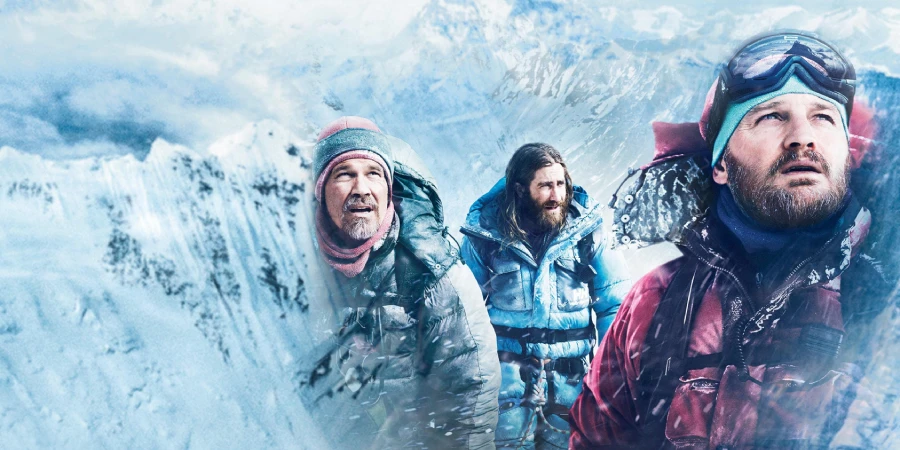

Nine people walked into a storm on May 10, 1996, and only a handful came back down alive. Baltasar Kormákur’s Everest (2015) reconstructs that catastrophe with a sprawling ensemble cast and a physical commitment to the cold that you can practically feel through the screen. It is a survival film that refuses to let you cheer, because it already knows how the story ends.
Detailed Summary
Assembling the Expedition
Rob Hall, played by Jason Clarke, runs Adventure Consultants, a commercial guiding company that takes paying clients to the summit of Everest. He is methodical, warm, and genuinely believes he can get anyone up and down safely. His confidence reads less like arrogance and more like hard-earned professionalism, which makes what follows hurt even more.
Among his clients are Beck Weathers (Josh Brolin), a Texas pathologist with something to prove, Doug Hansen (John Hawkes), a mailman on his second attempt at the summit, and journalist Jon Krakauer (Michael Kelly), along for the story. Scott Fischer (Jake Gyllenhaal) leads a rival guiding outfit called Mountain Madness, and his loose, freewheeling style contrasts sharply with Hall’s careful operation.
The Crowded Mountain
One of the film’s sharpest observations is how commercialization has turned Everest into a traffic jam at altitude. Multiple expeditions compete for the same fixed ropes and weather windows. Hall brokers an uneasy cooperation agreement with Fischer’s team and others, but the fragile coordination is already straining before anyone reaches the summit.
Base camp life gets fleshed out with enough character detail to make the later deaths land properly. We see Hall’s video calls to his pregnant wife Jan Arnold (Keira Knightley) back in New Zealand. We see Beck’s casual bravado and the quiet desperation underneath Doug’s determination. Kormákur is smart to spend time here, because the mountain is going to strip all of this away very quickly.
Summit Day Begins
May 10, 1996 starts with a delayed departure from Camp IV. A key piece of equipment, a rope section near the Hillary Step, is not fixed ahead of time, and the guides have to sort it out on the fly. Precious hours evaporate. Rob Hall’s own turnaround rule, designed to keep everyone safe, starts to feel like a promise the mountain will not honor.
Beck Weathers reveals a medical complication: his vision deteriorates badly at altitude due to a prior radial keratotomy surgery. Hall tells him to wait at a fixed point while the rest push on. Beck agrees, which is both the decision that later saves his life and the decision that nearly kills him.
The Summit Push
Several clients make the top, including Doug Hansen, who is visibly exhausted. Hall makes a decision that the film frames as a fatal act of compassion: he stays with Doug on the descent instead of retreating ahead of the incoming storm. Doug cannot move properly. Hall will not leave him.
Scott Fischer, meanwhile, is in worse physical shape than anyone around him realizes. He has been pushing through illness, likely exacerbated by fatigue and altitude sickness. By the time the storm hits, Fischer is barely coherent and cannot descend under his own power. His Sherpa guide Anatoli Boukreev makes the controversial decision to descend ahead of the clients, a choice the film handles carefully without fully condemning him.
The Storm Hits
What Kormákur does with the storm sequence deserves direct acknowledgment as the film’s single best stretch of filmmaking. Visibility drops to near zero in minutes. Climbers scatter. The sound design layers shrieking wind over muffled radio calls and labored breathing until the chaos feels genuinely disorienting. You lose track of who is where, and that spatial confusion is intentional.
Beck is left exposed on the South Col for hours. He lies down in the snow, and rescuers who find him pronounce him essentially dead. His body temperature has crashed, and frostbite has claimed his hands. Against every reasonable expectation, Beck regains consciousness and walks into Camp IV on his own. It is one of the most extraordinary things in the film, and it actually happened.
Rob Hall on the Ridge
Rob Hall survives the summit night but is stranded near the South Summit with Doug, who dies sometime during the night. Hall gets through to base camp by radio. The expedition’s doctor, Caroline Mackenzie, relays calls between Hall and his wife Jan, who is in New Zealand. Jan, a doctor herself, understands exactly what the signs mean. She stays composed anyway.
Their conversation is the emotional core of the film. Hall and Jan discuss their unborn daughter, and Jan asks him to name her. Hall suggests Sarah. He promises to come home. Jan tells him she loves him. A rescue attempt reaches the South Summit but cannot get to Hall’s position. He dies on the mountain.

Movie Ending
Rob Hall never comes down. That is the blunt, awful conclusion the film earns rather than dramatizes. His last radio contact with Jan ends with him slipping into unconsciousness in the cold, having named their daughter and said goodbye. Kormákur does not show Hall die on screen explicitly, which is the right call. The camera holds on Jan’s face instead, and Clarke’s voice performance over the radio in that scene is quietly devastating.
Beck Weathers, written off for dead by the rescue teams, walks into camp on his own. He later requires helicopter evacuation, loses his nose and both hands to frostbite, and survives. Scott Fischer is found dead on the mountain. Doug Hansen’s body is never recovered. Of the clients and guides on Hall’s team, the losses are severe.
A title card confirms the fates of the real survivors and names those who died. Jan gave birth to their daughter Sarah alone. Beck returned to Texas and resumed a version of his life. Boukreev died in an avalanche in the Himalayas the following year.
What the ending refuses to do is assign clean blame. The film resists the urge to make Hall a reckless hero or a negligent guide. His flaw, if it is one, is loyalty. He would not leave Doug. That choice cost him his life, and the film lets that fact sit without editorializing.
Are There Post-Credits Scenes?
Everest contains no post-credits scenes. After the title cards and dedications, the film ends. Sitting through the credits gives you the score and nothing else, which feels appropriate given the subject matter.
Type of Movie
Everest is a survival drama based on a true disaster. Its tone is sober, procedural in the best sense, and increasingly harrowing as the second half unfolds. It shares DNA with disaster films but resists their usual appetite for spectacle-driven catharsis.
There is no villain, no last-minute rescue twist, and no triumphant score swell. It plays more like a documentary reconstructed with movie stars, which is both its greatest strength and the quality that occasionally makes it feel emotionally restrained.
Cast
- Jason Clarke – Rob Hall
- Josh Brolin – Beck Weathers
- Jake Gyllenhaal – Scott Fischer
- John Hawkes – Doug Hansen
- Michael Kelly – Jon Krakauer
- Keira Knightley – Jan Arnold
- Emily Watson – Caroline Mackenzie
- Robin Wright – Peach Weathers
- Sam Worthington – Guy Cotter
- Naoko Mori – Yasuko Namba
Film Music and Composer
Dario Marianelli composed the score. He is best known for his work on Atonement and Pride and Prejudice, both of which earned him significant recognition. His sensibility tends toward the lyrical and restrained, which suits Everest well.
The score avoids swelling heroics. Marianelli leans on sparse orchestration and low, sustained strings that suggest cold and vast emptiness rather than adventure. During the storm sequences, the music recedes almost entirely, letting the sound design carry the weight instead. That discipline is the score’s smartest quality.

Filming Locations
Production used a combination of real location work and studio shooting. Some base camp scenes were filmed at the Khumbu Glacier in Nepal, giving the film authentic visual texture in its lower-altitude sequences. Cinematographer Salvatore Totino captured the scale of the Himalayan landscape in ways a studio set simply could not replicate.
Higher-altitude sequences were shot in the Italian Alps, specifically around the Dolomites, which provided dramatic terrain without the logistical nightmare of filming above 8,000 meters. Interiors and controlled storm sequences were handled at Cinecittà Studios in Rome, where large-scale wind and weather rigs were constructed.
The film also shot material in Iceland for certain icy landscape shots. That combination of real mountain footage and controlled studio work gives Everest a visual coherence that keeps the geography legible even when the story deliberately disorients you.
Awards and Nominations
Everest received recognition primarily for its technical achievements. It earned nominations in sound and visual effects categories at various awards bodies, which accurately reflects where the film’s craft concentrated its energy.
It was not a major awards-season contender, which is fair. The screenplay is functional rather than dazzling, and the ensemble structure makes it difficult for any single performance to build the kind of sustained momentum awards voters tend to reward.
Behind the Scenes Insights
- Baltasar Kormákur conducted extensive research with survivors of the 1996 disaster before writing began, consulting with Beck Weathers directly.
- Jason Clarke and other cast members trained extensively in alpine conditions to prepare for physically demanding sequences.
- Keira Knightley and Robin Wright filmed their scenes largely in studios, never on location, yet their performances are among the most emotionally precise in the film.
- The production built massive wind machines capable of generating near-whiteout conditions on set, used during the storm sequences at Cinecittà.
- Shooting at real altitude, even for base camp scenes, affected the crew physically. Altitude sickness was a genuine on-set concern in Nepal.
- Kormákur has spoken about the ethical pressure of dramatizing an event in which real people died, and the consultations with surviving families shaped how certain characters were handled.
Inspirations and References
The film draws primarily from Jon Krakauer‘s bestselling account Into Thin Air, published in 1997, which Krakauer wrote as a firsthand witness to the disaster. His book became one of the most widely read pieces of adventure journalism ever published.
Beck Weathers also wrote a memoir, Left for Dead, which covers his experience and survival in detail. Both books informed the screenplay, though their perspectives occasionally conflict, reflecting the disputed nature of certain events on that climb.
Anatoli Boukreev’s own account, The Climb, offered a counterpoint to Krakauer’s version of events, particularly regarding Boukreev’s decision to descend ahead of clients. The film threads a careful line between these competing narratives.
Alternate Endings and Deleted Scenes
No officially released alternate endings or significant deleted scenes have been made publicly available for Everest. Given the film’s basis in documented history, there was limited room to invent alternative outcomes.
Some behind-the-scenes materials suggest additional character scenes were trimmed to keep the pacing tight, but no extended cut has been released. What exists in the theatrical version is, as far as public record shows, the definitive version of the film.
Book Adaptations and Differences
The film adapts events covered in both Into Thin Air and Left for Dead, but it is not a direct adaptation of either book. Krakauer himself has expressed reservations about how his character and perspective are represented in the film.
One notable structural difference is how much weight the screenplay gives to Beck Weathers relative to Rob Hall. In Into Thin Air, Krakauer’s own experience and observations are central. The film distributes focus more democratically across the ensemble, which dilutes some of the book’s first-person urgency.
Scott Fischer is treated with more sympathy in the film than some accounts suggest his behavior warranted. His physical decline is framed as heroic suffering rather than reckless self-neglect, a choice that feels generous but probably makes for a more watchable film.
Memorable Scenes and Quotes
Key Scenes
- Rob and Jan’s final radio call: Clarke speaks in a thin, exhausted voice, and Knightley keeps her composure by fractions, her jaw tightening around each word. It is devastating precisely because both characters refuse to collapse.
- Beck walking into Camp IV: Shot wide, so you see this small orange figure lurching through white nothing, and for a moment you do not believe it is a person at all.
- The storm hits the summit group: Climbers disappear into white noise within seconds. The editing becomes deliberately fragmented. Kormákur makes you feel the confusion rather than just observe it.
- Doug Hansen on the summit: John Hawkes plays the exhaustion with such specific physical detail, hunched and glassy-eyed, that the joy of reaching the top and the doom already in his body occupy the same frame.
- The base camp dinner scene: A rare moment of warmth and humor before everything fractures, it does the essential work of making you like these people before the film takes them apart.
Iconic Quotes
- “Human beings simply aren’t built for the Death Zone.” – Rob Hall
- “Why do we even climb this mountain?” – a recurring question the film refuses to answer tidily
Easter Eggs and Hidden Details
- Several pieces of kit and equipment visible at base camp are period-accurate to 1996 gear rather than contemporary mountaineering equipment, a deliberate choice by the costume and props departments.
- Jon Krakauer is kept deliberately in the background during several summit-day sequences, a subtle nod to the limitations and gaps in his own firsthand account.
- The flags and national markers visible at base camp reflect the actual multinational composition of expeditions on the mountain that spring.
- Beck’s sunglasses, which he removes at a key moment revealing his deteriorating vision, are a specific period-accurate model consistent with what climbers used in the mid-1990s.
Trivia
- Everest opened the Venice Film Festival in 2015, premiering in competition there before its wide release.
- Baltasar Kormákur is Icelandic, a background that likely informed his comfort directing in extreme cold and hostile natural environments.
- Jake Gyllenhaal’s casting as Scott Fischer generates an interesting tension: his charisma makes Fischer magnetic on screen, even as the character’s recklessness becomes apparent.
- The film was released in IMAX, and several sequences were specifically composed with the IMAX frame in mind.
- Jason Clarke prepared for the role partly by studying Hall’s recorded interviews and video footage from the actual expedition.
- Beck Weathers has spoken publicly about the film and called the reconstruction of his experience largely accurate to how he remembers it.
Why Watch?
Watch it for Jason Clarke’s performance in that final radio call sequence, a scene where he holds an entire film’s worth of grief in a voice going quiet by degrees. Keira Knightley matches him beat for beat from a different continent. No summit shot in the film hits harder than two people saying goodbye across a crackling connection.
Director’s Other Movies
- 101 Reykjavik (2000)
- Jar City (2006)
- Contraband (2012)
- 2 Guns (2013)
- Adrift (2018)
Recommended Films for Fans
- Into Thin Air: Death on Everest (1997)
- Touching the Void (2003)
- The Impossible (2012)
- 127 Hours (2010)
- Alive (1993)
- Free Solo (2018)
- The Revenant (2015)