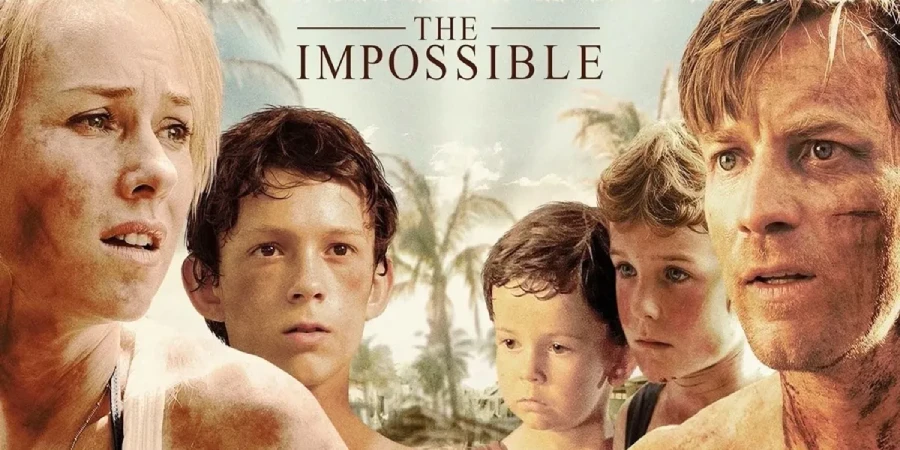

A wall of black water thirty feet tall swallows a family whole, and director J.A. Bayona shoots it without a single cut for what feels like an eternity. The Impossible (2012) is not a disaster film in the usual sense; it is a survival film built on one of the most brutal pieces of real-world luck in recent memory. Naomi Watts earned every award nomination she received for this one. Ewan McGregor made grown adults weep with a single phone call.
Detailed Summary
The Bennet Family Arrives in Thailand
Henry and Maria Bennet, along with their three sons Lucas, Thomas, and Simon, check into a luxury resort in Khao Lak, Thailand, for Christmas 2004. Life looks comfortable and uncomplicated. Henry works a demanding corporate job, and the family clearly needs this break.
Bayona establishes the resort’s beauty with a deliberate, almost cruel patience. Palm trees sway. Kids splash. The audience knows exactly what is coming, and that dread makes every sun-drenched frame feel like borrowed time.
The Wave Hits
On December 26, 2004, the Indian Ocean tsunami strikes without warning. Maria and Lucas are at the pool when the wave arrives. Bayona drops all music, strips back the sound design to a low rumble, and then unleashes chaos.
Maria gets slammed through submerged trees and debris. She tumbles, spins, and loses all sense of up and down. A gash in her thigh is immediately visible, and it will plague the rest of the film. This sequence is genuinely harrowing to watch; Naomi Watts performed much of it herself.
Maria and Lucas Survive Together
Maria surfaces, bleeding and disoriented, and eventually finds Lucas. They cling to each other as the water carries them through wreckage. Lucas, played by Tom Holland in a career-launching performance, shifts from frightened child to reluctant protector almost in real time.
Maria spots a small boy named Daniel lost in the flood. She insists they take him with them despite her worsening injuries. It is one of the film’s most quietly important choices; her compassion costs her physical effort she can barely spare.
Maria Collapses and Reaches a Hospital
Local villagers pull Maria and Lucas to safety and eventually get them to a makeshift hospital. Maria’s leg wound is severe. Watts conveys the physical deterioration of a woman burning through her last reserves with almost no dialogue.
Lucas steps up in a way that feels completely earned rather than scripted. He helps other patients, reunites lost children with parents, and keeps himself together by keeping busy. Holland plays this as a boy discovering something about himself mid-catastrophe.
Henry Searches for His Family
Henry survives with Thomas and Simon at the resort. He leaves the boys with other survivors and sets out to find Maria and Lucas. Ewan McGregor plays Henry’s barely-contained panic with admirable restraint for most of this section.
Henry eventually makes a satellite phone call to his parents back home to ask them to transfer money for medical care. He breaks down completely on the call, voice cracking, hands shaking, unable to speak for a long beat. It is one of the most quietly devastating scenes in the film, and McGregor absolutely earns it.
The Family Searches Across Hospitals
Chaos reigns across every medical facility. Lists of survivors are incomplete. Bodies are misidentified. Henry wanders from hospital to hospital clutching a piece of paper with names on it. Bayona shoots these corridors with a documentary roughness that makes the bureaucratic nightmare feel suffocating.
Thomas and Simon are almost separated from Henry when a relief bus takes them to an inland shelter. Henry makes a gut-punch decision and sends them on the bus while he continues searching, promising he will find them again. Watching a father choose between his injured wife and his two small boys is genuinely uncomfortable viewing.

Movie Ending
Maria goes into surgery at the overwhelmed hospital. Her condition is critical; the internal injuries go beyond the visible wound on her leg. Lucas roams the hospital corridors helping reunite lost patients with family members, and in doing so he spots his father Henry searching among the cots and gurneys.
Father and son find each other. Henry locates Thomas and Simon at the shelter. Bayona stages the full reunion slowly and without musical fanfare until the moment actually lands, which makes the emotional release feel earned rather than manufactured. You feel the weight of what this family survived.
Maria survives surgery. She is flown by helicopter to a better-equipped hospital for continued care. Henry and all three boys ride in the helicopter alongside her. As the aircraft lifts above the devastated coastline, the camera looks down at the scale of the destruction for the first time from a distance. It reframes everything. What felt personal for two hours suddenly connects to hundreds of thousands of other stories happening simultaneously across that flooded landscape.
Bayona closes on the family intact but visibly shattered. Lucas stares out the helicopter window. Henry grips Maria’s hand. Nobody smiles. The film refuses to let the reunion function as a simple happy ending, which is the right call. Survival is not the same as recovery, and Bayona is honest enough to leave that tension unresolved.
Are There Post-Credits Scenes?
The Impossible has no post-credits scenes. Stay if you need a moment to collect yourself, but nothing extra is waiting for you.
Type of Movie
The Impossible is a disaster survival drama with strong elements of a family film. The tone is unflinching and emotionally intense throughout. Bayona never softens the physical horror of the tsunami or the grinding suffering of the aftermath.
This is not an action film. Pace is measured and deliberate. Grief and endurance drive the narrative far more than any external plot mechanics.
Cast
- Naomi Watts – Maria Bennet
- Ewan McGregor – Henry Bennet
- Tom Holland – Lucas Bennet
- Samuel Joslin – Thomas Bennet
- Oaklee Pendergast – Simon Bennet
- Geraldine Chaplin – Older Woman
Film Music and Composer
Fernando Velázquez composed the score. He is a Spanish composer with a strong background in horror and thriller cinema, having worked closely with Bayona on The Orphanage (2007).
Velázquez keeps the music restrained for long stretches, letting ambient sound and silence do heavy lifting. When strings finally swell during the reunion sequence, the contrast makes the emotional impact hit harder. It is a disciplined score that trusts the material.

Filming Locations
Production shot primarily in Thailand, close to the actual affected regions, which gives the film an undeniable physical authenticity. Crews also filmed at a water park in Spain, specifically in Alicante, to recreate the tsunami wave sequences in controlled conditions.
Shooting in Thailand carries obvious thematic weight. Standing in locations where real victims lost their lives creates a gravity that no studio backlot could replicate. Bayona has spoken about feeling that responsibility acutely throughout production.
Awards and Nominations
Naomi Watts received an Academy Award nomination for Best Actress for her performance. She also picked up nominations from BAFTA and the Golden Globes in the same category.
Tom Holland received a BAFTA nomination for Outstanding British Newcomer. Fernando Velázquez’s score earned recognition on the awards circuit as well. The film did not win the major prizes it was nominated for, which remains one of the more baffling outcomes of the 2013 awards season.
Behind the Scenes Insights
- Naomi Watts performed a significant amount of the water work herself, sustaining physical bruising throughout the shoot.
- Tom Holland was cast after Bayona saw footage of his stage work in Billy Elliot the Musical in London.
- Bayona and his crew consulted extensively with Maria Belon, the real survivor whose family inspired the film, throughout production.
- The wave sequence required months of preparation and used a combination of practical water tanks and visual effects to achieve its ferocious realism.
- Ewan McGregor reportedly found the phone call scene so emotionally draining that he needed extended recovery time between takes.
- Many of the hospital extras in the film were actual tsunami survivors from the region, which Bayona considered both a profound responsibility and a gift to the film’s authenticity.
Inspirations and References
The film is based directly on the true survival story of Maria Belon and her family, who were vacationing in Khao Lak, Thailand, when the 2004 Indian Ocean tsunami struck on December 26. The disaster killed over 200,000 people across multiple countries.
Maria Belon served as a producer and close consultant on the project. Screenwriter Sergio G. Sanchez worked with her testimony to reconstruct events. Sanchez had previously written The Orphanage, which cemented his working relationship with Bayona.
Alternate Endings and Deleted Scenes
No officially released alternate ending exists for The Impossible. Bayona has not publicly discussed major structural alternatives that were shot and discarded.
Some scenes depicting the broader community of survivors appear to have been trimmed in editing based on descriptions from cast and crew interviews, but no deleted scenes were included in major home video releases.
Book Adaptations and Differences
The Impossible is not based on a book. It draws from first-person testimony and interviews rather than any published literary source. Maria Belon later wrote about her experiences, but the film preceded that published work.
Memorable Scenes and Quotes
Key Scenes
- The wave sequence: Maria and Lucas get pulled under simultaneously. Bayona holds the camera underwater as debris slams past, the sound design reducing to a muffled roar. No score. Just water.
- The leg wound revelation: Maria pulls back her sarong on the raft of palm fronds to reveal a gaping wound with visible tissue. Watts does not scream. She just breathes and stares. It is more disturbing than any scream would have been.
- Henry’s phone call: McGregor crouches near a road, satellite phone to his ear, and his voice simply disintegrates mid-sentence when he tries to tell his parents he cannot find his family. The camera stays close on his face the entire time.
- Lucas reuniting families in the hospital: Lucas moves from bed to bed with a notebook, calling out names, matching lost children with searching parents. Holland plays this scene with a red-eyed exhaustion that feels completely real.
- The helicopter liftoff: As the aircraft rises above the coast, the landscape below shifts from personal to planetary. Quiet, wide shot. No dialogue.
Iconic Quotes
- “I thought I had lost you.” – Henry to Maria, during their reunion
- “You did good today. I want you to know that.” – Maria to Lucas, at the hospital
Easter Eggs and Hidden Details
- The small boy Daniel, whom Maria insists they rescue from the floodwaters, is based on a real child the actual Belon family helped during the disaster.
- Bayona includes a brief shot of a Christmas ornament floating in the receding floodwater, a quiet visual callback to the holiday setting that frames how completely the celebration was destroyed.
- Several background figures in the hospital scenes are wearing clothing that subtly mirrors the colors worn by the Bennet family, a visual choice that reinforces how many identical stories surrounded theirs.
- The film opens with a shot of clouds viewed from above during the flight to Thailand. Bayona returns to a high aerial perspective at the very end, closing the visual frame of the story.
Trivia
- The Impossible was Tom Holland’s feature film debut. His performance here was what eventually brought him to Marvel’s attention for Spider-Man.
- The real family the film is based on is Spanish, not British. Producers cast English-speaking actors to broaden the film’s international commercial reach, a decision that drew some criticism.
- Bayona and Watts reportedly watched footage of the actual 2004 tsunami together as preparation, a process Watts described as deeply disturbing.
- Naomi Watts lost significant weight during production to physically embody Maria’s deteriorating condition across the timeline of the film.
- The film’s Spanish title is Lo imposible, and it was a major commercial and critical success in Spain before its wider international release.
- Geraldine Chaplin, who plays the older woman who comforts Lucas, is the daughter of Charlie Chaplin.
Why Watch?
Watch this film for Tom Holland’s performance alone. He carries entire scenes at age sixteen with a physical and emotional specificity that most adult actors never achieve. Naomi Watts’s performance is the one that got the awards attention, and it deserves every word of praise it received, but Holland is the film’s beating heart.
Director’s Other Movies
- The Orphanage (2007)
- A Monster Calls (2016)
- Jurassic World: Fallen Kingdom (2018)
- Society of the Snow (2023)
Recommended Films for Fans
- United 93 (2006)
- 127 Hours (2010)
- Beasts of the Southern Wild (2012)
- A Monster Calls (2016)
- Deepwater Horizon (2016)
- Society of the Snow (2023)