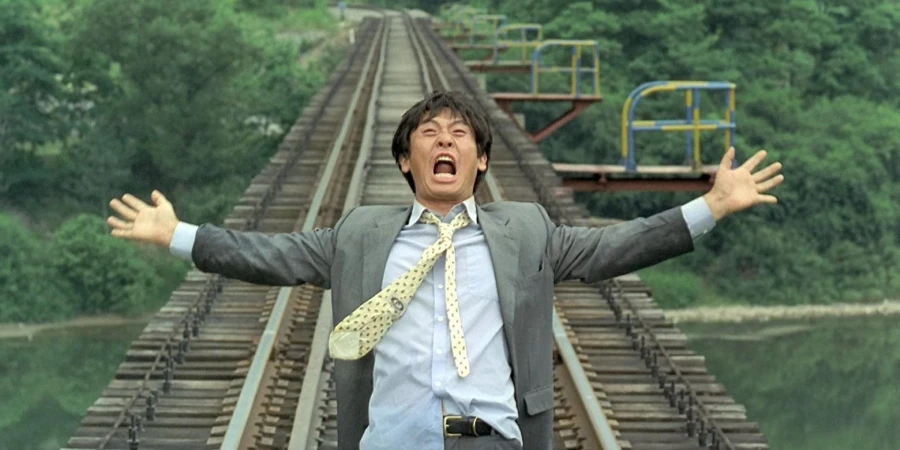
A man stands at a river’s edge, arms stretched wide, screaming at an oncoming train. That image, held for an unbearable few seconds before Peppermint Candy cuts to its title card, tells you everything and nothing at the same time. Director Lee Chang-dong then rewinds twenty years of one man’s life, pulling apart every choice, every wound, every moment of ordinary cruelty that delivered him to that riverbank. This is not a comfortable film, and it was never meant to be.
Detailed Summary
The Picnic: 1999
A group of middle-aged friends gather for a reunion picnic beside a stream. A disheveled, clearly distressed man named Yongho crashes the party, drunk and barely coherent.
He climbs onto a rail bridge above them, faces the oncoming train, and shouts that he wants to go back. Then the train hits him. That is where the film begins, and that is also, structurally, where it ends.
On a Spring Day, 1999
Rewinding three days before his death, the film shows Yongho selling off his photography equipment. He confronts his ex-wife Hongja at her new home and destroys her front gate with his car, sobbing and raging simultaneously.
He is a broken man with no money, no marriage, and no reason to continue. Lee Chang-dong films his degradation without pity and without melodrama, which makes it worse somehow.
The Camera, 1994
Five years earlier, Yongho runs a small business and keeps a gun he found at work. A young woman named Sunim tracks him down; she is his first love from his military service days, now dying from illness.
She returns his old camera, the one he used before life ground him down. Yongho barely reacts. His numbness here is genuinely painful to watch, because we sense what that camera once meant.
Memories, 1987
Yongho is now a detective, and this segment shows him at his most overtly monstrous. He beats and tortures a political suspect with clinical efficiency during the intense period of state repression in South Korea.
His partner is more hesitant, but Yongho has already learned to detach. Lee Chang-dong makes no attempt to soften this. Yongho is a torturer, and the film forces you to keep that fact in mind as you continue to understand him.
An Outing, 1984
A company picnic shows Yongho meeting Hongja, the woman he will eventually marry. He still carries warmth here, still laughs. There is a version of him that could have been content.
He runs into Sunim briefly, and the encounter is charged with grief. She is the ghost the film keeps returning to.
The Army, 1980
Young Yongho serves as a soldier during the Gwangju Uprising. In the chaos and darkness, he accidentally shoots a young civilian girl.
He cradles her body and weeps. This moment is the axis of everything. Every subsequent act of cruelty, every withdrawal from tenderness, every destroyed relationship traces back to this one night and this one irreversible mistake.
The First Picnic, 1979
The final segment takes us to the very beginning. A young, gentle Yongho attends a picnic with factory workers at the same riverside location where the film opened.
He meets Sunim for the first time. She offers him a peppermint candy. He is shy, curious, completely unmarked by what is coming. Lee Chang-dong holds on his face for a long moment, and the effect is devastating, because we know everything that face will carry.

Movie Ending
Yongho stands on the bridge again, arms out, facing the train. But now, having walked backward through his entire life, the audience understands every gram of weight behind that scream. He shouts that he wants to go back, and this time it is not a cry of despair alone; it is a cry that contains an entire lifetime of regret.
The film cuts to the young Yongho at the 1979 picnic. Sunim looks at him. He is smiling. Lee Chang-dong does not let that image console you, because you cannot unknow what comes next.
What audiences often debate is whether the film offers any hope. It does not, exactly. What it offers instead is comprehension. Yongho is not a monster delivered from nowhere; he is a specific product of specific historical violence. South Korea’s authoritarian period shaped him just as surely as his own choices did.
That refusal to let either the individual or the system entirely off the hook is the film’s sharpest and most demanding quality. You leave understanding Yongho completely while forgiving him not at all.
Are There Post-Credits Scenes?
Peppermint Candy has no post-credits scenes. Once the final image of the young Yongho at the picnic fades, the film is over. No coda, no extra material.
Type of Movie
Peppermint Candy is a drama with strong elements of tragedy and political cinema. Its structure is experimental: a reverse chronology that functions less as a gimmick and more as a formal argument about fate and causality.
The tone is relentless and austere. Lee Chang-dong refuses sentimentality at every turn, even when the material practically begs for it.
Cast
- Sol Kyung-gu – Yongho
- Moon So-ri – Sunim
- Kim Yeo-jin – Hongja
Film Music and Composer
The score for Peppermint Candy was composed by Yoon Do-hyun and Jin Won Kim. It is spare and restrained, relying more on ambient sound and silence than on traditional dramatic scoring. That restraint is a deliberate choice that serves the film well.

Filming Locations
Principal photography took place in South Korea, with the recurring riverside location serving as the film’s symbolic anchor. Shooting the first and last scenes at the same physical place gives the reverse structure a grounded, geographic reality.
The factory environments and military settings were chosen specifically to evoke the texture of South Korean working-class and institutional life across the late 1970s and 1980s. These are not glamorized locations. They look exactly as worn and functional as the lives being depicted.
Awards and Nominations
Peppermint Candy earned Sol Kyung-gu significant recognition in South Korea, including a Grand Bell Award for Best Actor. The film competed at the Cannes Film Festival in the Un Certain Regard section.
It is widely credited with establishing Lee Chang-dong as a major voice in world cinema, drawing substantial critical attention internationally at the time of its release.
Behind the Scenes Insights
- Lee Chang-dong wrote the script with the explicit intention of using the reverse chronological structure as a political statement: you cannot understand a person’s collapse without tracing the social forces that produced it.
- Sol Kyung-gu had to perform an enormous emotional and physical range, playing the same character across roughly two decades of fictional time within a single production.
- Lee Chang-dong was already an established novelist before turning to film, and his literary sensibility heavily shaped how character psychology functions in the screenplay.
- The Gwangju Uprising sequence was a deliberate engagement with a subject that remained politically sensitive in South Korea at the time of production.
Inspirations and References
Lee Chang-dong drew directly on the political history of South Korea, particularly the Gwangju Uprising of 1980 and the state repression that defined the authoritarian period. That history is not backdrop; it is causality.
The reverse chronology has drawn comparisons to Harold Pinter’s play Betrayal and to Irreversible by Gaspar Noe, though Peppermint Candy predates the latter. Lee Chang-dong has cited his own novelistic background as the most direct structural influence.
Alternate Endings and Deleted Scenes
No alternate endings or significant deleted scenes from Peppermint Candy have been publicly documented or released. The film appears to have reached screens largely as Lee Chang-dong intended.
Book Adaptations and Differences
Peppermint Candy is an original screenplay written by Lee Chang-dong. It is not based on a novel or any other pre-existing text.



Memorable Scenes and Quotes
Key Scenes
- Yongho standing on the bridge with arms outstretched, screaming at the oncoming train as the film opens.
- The torture sequence in 1987, in which Yongho beats a political prisoner with methodical detachment while his partner hesitates.
- Yongho cradling the body of the civilian girl he accidentally shot during the Gwangju Uprising, weeping in the dark.
- Sunim returning Yongho’s old camera in 1994, and Yongho receiving it with near-total emotional vacancy.
- The 1979 picnic scene, with young Yongho accepting a peppermint candy from Sunim for the first time, his face completely open.
Iconic Quotes
- “I want to go back!” (Yongho on the bridge, the line that opens and haunts the entire film)
Easter Eggs and Hidden Details
- The peppermint candy that gives the film its title appears in the very first scene (1979) and represents Yongho’s original self before corruption. Its absence throughout the middle segments is deliberate and pointed.
- Yongho’s camera functions as a recurring symbol: his early passion for photography represents curiosity and openness, and its sale in 1999 signals total self-erasure.
- The same riverside location at the film’s opening and closing creates a visual loop that reinforces the structural argument: this man’s end was always embedded in his beginning.
- The train, which kills Yongho at the start, appears in the final 1979 scene passing in the distance, functioning as a quiet visual premonition.
Trivia
- This was Lee Chang-dong’s second feature film as director.
- Moon So-ri, who plays Sunim, would later become one of the most celebrated actresses in South Korean cinema and went on to collaborate again with Lee Chang-dong in Oasis (2002).
- The film’s reverse structure requires the audience to hold the ending in mind from the very first frame, which is precisely why Lee Chang-dong places the death at the beginning rather than saving it.
- Sol Kyung-gu‘s performance required him to shoot the chronologically earliest material while already knowing the full arc of the character’s destruction, a significant psychological challenge for an actor.
- Lee Chang-dong’s background as a novelist made him unusually attentive to the way narrative structure itself carries meaning, separate from dialogue or imagery.
Why Watch?
Sol Kyung-gu gives one of the most demanding lead performances in South Korean cinema, aging and collapsing a man across twenty years with almost no vanity and zero sentimentality. Watch specifically for the 1979 picnic scene: his face in that final shot, knowing what you now know, makes the whole film click into place with an almost physical force. No other structural trick in recent memory works quite as hard as this one does.
Director’s Other Movies
- Green Fish (1997)
- Oasis (2002)
- Secret Sunshine (2007)
- Poetry (2010)
- Burning (2018)
Recommended Films for Fans
- Oldboy (2003)
- Secret Sunshine (2007)
- Oasis (2002)
- A Bittersweet Life (2005)
- Mother (2009)
- Irreversible (2002)
- Burning (2018)