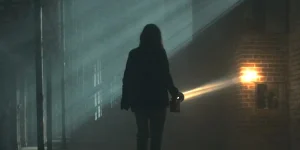
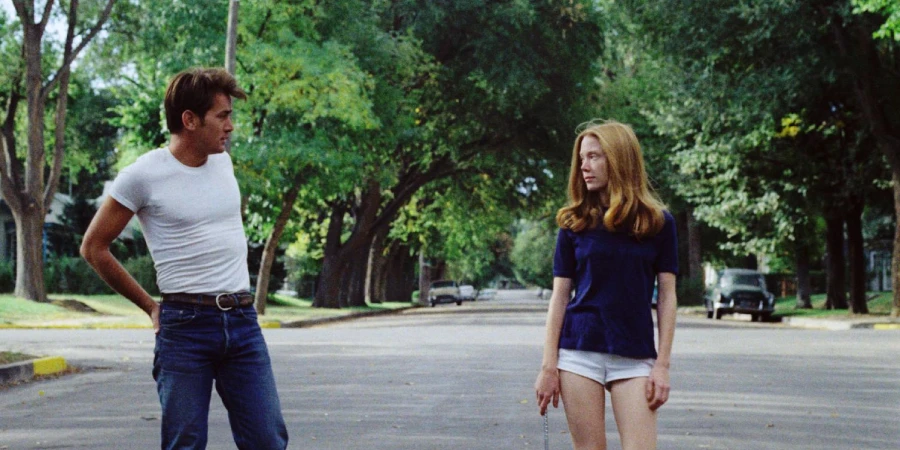
Kit Carruthers shoots Holly Sargis’s father dead in the living room, and neither of them seems particularly bothered about it. That casual brutality, delivered in broad daylight with a rifle and almost no dramatic buildup, sets the entire moral temperature of Terrence Malick’s debut feature. Badlands (1973) follows two teenagers drifting across the American heartland, leaving corpses behind them, narrated by a girl who sounds like she is describing a mildly interesting summer vacation. Sissy Spacek’s flat, dreamy voiceover is the film’s most disturbing trick.
Table of Contents
Detailed Summary
Holly and Kit Meet in Fort Dupree
Holly Sargis is fifteen years old, baton-twirling in her front yard in a small South Dakota town. Kit Carruthers is ten years her senior, a garbage collector who looks like James Dean and knows it. Their courtship is awkward, low-key, and slightly absurd, conducted with the seriousness of people who have learned romance from movie magazines.
Holly’s father disapproves immediately and kills her dog as punishment for seeing Kit. Rather than accepting the verdict, Kit shoots the father in the kitchen. Holly watches, narrates the moment with almost no affect, and helps Kit burn the house down.
Life in the Woods
Kit and Holly retreat into the woods outside town, where Kit builds an elaborate treehouse camp. This stretch of the film has a strange, pastoral sweetness to it. They fish, they dance to Nat King Cole’s “A Blossom Fell” on a portable record player, and Holly narrates it all as if filing a report on someone else’s life.
Kit builds booby traps around the perimeter. He is playing a fantasy, part survivalist, part outlaw celebrity. Holly begins to detach emotionally even here, practicing her lessons by correspondence while Kit prepares for the inevitable siege.
The Killings Continue
A bounty hunter and two friends eventually find them. Kit kills all three. He does it efficiently, without rage, and the film does not linger on grief. Holly watches and records it in her diary.
They hit the road across the Badlands of South Dakota and Montana. Kit adds more victims along the way, including a wealthy man named Cato’s acquaintance and a rich couple whose house Kit and Holly briefly occupy. Holly grows colder and more disengaged with each stop. She tries to run from Kit at one point, which he ignores almost entirely.
The Rich Man’s House
Kit and Holly hole up in a spectacular mansion belonging to a wealthy man. Kit locks a servant couple in a storm cellar. He and Holly wander through rooms full of fine things, and Holly records a message about her feelings into a dictaphone, speaking to an imaginary future audience with the earnestness of a teenager.
This sequence is where Malick sharpens his theme most precisely. These two young people are performing a version of life they have absorbed from popular culture, and the performance is running out of material. Kit shoots the rich man’s friend. They leave.
Across the Badlands
Driving through the vast, empty landscape of Montana, the couple begins to separate psychologically. Kit remains energized by the notoriety he imagines he is accumulating. Holly tells him flatly that she is not in love with him anymore. Kit receives this with puzzling calm.
He builds a cairn of personal objects as a time capsule for future fans. He is already rehearsing his own legend. Holly sits nearby, unimpressed, watching him with the same detached curiosity she has shown everything else.
Movie Ending
Kit’s fantasy finally meets its limit in the wide open sky above the badlands. When National Guard aircraft begin tracking them, he drives out to an empty stretch of road and stops the car. He piles rocks into a small monument, leaves behind a comb, a lighter, and other trinkets, and surrenders to the authorities with a movie-star grin.
He charms the arresting officers almost immediately. Guards trade items with him. He is funny, relaxed, generous with his attention, and the lawmen are visibly starstruck. Kit has always wanted to be famous, and in the moment of capture he finally gets a version of it.
Holly cooperates with investigators. She is found not guilty by reason of youth and coercion, and she eventually marries her court-appointed attorney’s son. Her final narration delivers this information with the same breezy detachment she has used throughout, as if she is wrapping up a book report.
Kit is executed, though the film does not show the moment. What matters is Holly’s voice describing it from a comfortable future. She feels no obvious guilt. She has processed everything and moved on, which is arguably more disturbing than anything Kit did with a rifle.
Malick refuses to deliver judgment on either character. There is no moment where the score swells in condemnation, no scene where Holly weeps in recognition of what happened. Her final line about flying over the badlands in a small plane with her new husband has an almost serene quality. The film simply stops. That refusal to moralize is the most provocative thing about it.
Are There Post-Credits Scenes?
Badlands has no post-credits scenes. Malick ends the film cleanly. There is nothing after the credits begin.
Type of Movie
Badlands is a crime film built on a road-movie skeleton, but it functions more like a meditation on American mythology than a thriller. It sits alongside a small group of films sometimes called “lovers-on-the-run” pictures, though it strips away the romance and the urgency that usually power that genre.
The tone is cool, dry, and faintly surreal. Malick never lets the violence become cathartic or exciting. This is not exploitation; it is something closer to anthropology.
Cast
- Martin Sheen – Kit Carruthers
- Sissy Spacek – Holly Sargis
- Warren Oates – Holly’s Father
- Ramon Bieri – Cato
- Alan Vint – Deputy
Film Music and Composer
The score for Badlands is one of its most quietly brilliant elements. Carl Orff’s “Musica Poetica” plays over key sequences, giving the film an eerie, childlike lilt that perfectly mirrors Holly’s narration. The choice is inspired: Orff wrote educational music for children, and Malick deploys it over murder scenes.
George Tipton contributed additional music. Nat King Cole’s “A Blossom Fell” appears diegetically, playing from that portable record player during the treehouse idyll. That sequence is, without question, the most romantically effective moment in the film, precisely because it is about to be destroyed.

Filming Locations
Despite the South Dakota and Montana settings established in the story, much of Badlands was shot in Colorado and other locations that could approximate the flat, sparse landscape Malick needed. The landscape is not merely backdrop; it functions as a character in itself.
Those enormous skies and empty plains reinforce the film’s central idea: these two people are operating in a moral and physical void. Nobody is watching. The land does not care what they do. Malick’s camera lingers on grass, sky, and dust with as much attention as it gives the actors.
Awards and Nominations
Badlands was not a major awards contender on its initial release, though it screened at the New York Film Festival in 1973 to strong critical attention. Over the decades, its reputation has grown considerably, and it now appears on numerous critical lists celebrating American cinema of the 1970s.
Behind the Scenes Insights
- Terrence Malick was a former philosophy student and Rhodes Scholar who had worked as a journalist before turning to film. Badlands was his directorial debut.
- Malick and Spacek were involved romantically during production, a fact that may have contributed to the film’s strange intimacy between director and subject.
- Martin Sheen reportedly drew on James Dean’s mannerisms consciously, since Kit himself is imitating Dean. The performance operates on two levels of imitation simultaneously.
- Malick wrote the script, directed, and was deeply involved in the editing, establishing the obsessive, hands-on approach that would define his career.
- Spacek was in her early twenties when she played fifteen-year-old Holly, and her physical stillness in many scenes was a deliberate choice she developed herself.
- The production was low-budget and relatively small, which gave Malick unusual freedom to shoot long takes of landscape without studio interference.
Inspirations and References
The film draws directly from the real-life killing spree of Charles Starkweather and his girlfriend Caril Ann Fugate, who murdered eleven people across Nebraska and Wyoming in 1957 and 1958. Starkweather was nineteen; Fugate was fourteen. Malick transplants the events to South Dakota and changes names, but the outline is unmistakable.
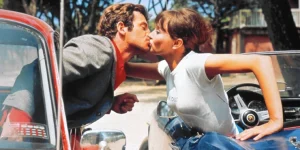
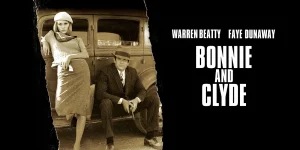
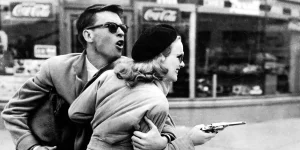
Malick was also clearly influenced by Jean-Luc Godard’s Breathless and Arthur Penn’s Bonnie and Clyde, both of which glamorize criminal couples in ways Malick deliberately undercuts. Where Penn gives you excitement, Malick gives you boredom and grass.
Holly’s voiceover owes a debt to literary models. Malick studied philosophy at Harvard and Oxford, and the narration has a detached, almost phenomenological quality that feels more like a short story than conventional film narration.
Alternate Endings and Deleted Scenes
No widely documented alternate ending or significant deleted scenes from Badlands have been confirmed in public record. Malick is famously private about his process, and no official supplementary materials have surfaced to document cut content.
Book Adaptations and Differences
Badlands is not based on a book. Terrence Malick wrote the original screenplay himself, drawing on the Starkweather-Fugate case and his own creative instincts. No novelization of the film has become notable.

Memorable Scenes and Quotes
Key Scenes
- The record player in the woods: Kit and Holly dance slowly to “A Blossom Fell” in their forest camp, the warm crackle of the recording filling the silent trees. It is the film’s most tender moment, and Malick frames them at a slight distance, as if the camera is also a little unsure about intruding.
- The father’s shooting: Kit lifts the rifle in the kitchen with almost no buildup. Warren Oates barely has time to register what is happening. The speed of it is what makes the scene so effective; there is no music, no slow motion, just a man falling.
- Kit’s surrender: Sheen grins at the arresting officers and starts trading personal possessions with them like a man at a county fair. It is darkly comic, deeply strange, and the single best scene in the film for understanding Kit as a character.
- The dictaphone recording: Holly speaks into the wealthy man’s dictaphone, recording her thoughts for posterity in the same flat tone she uses for everything. Spacek plays it with utter seriousness, and the comedy and horror of it arrive at the same moment.
- Building the cairn: Kit stacks rocks and buries trinkets on an empty Montana road. The sky is huge above him. He works with the careful attention of a man who believes history is watching, and nobody is watching at all.
Iconic Quotes
- “Little did I realize that what began in the alleys and back ways of this quiet town would end in the Badlands of Montana.” (Holly, opening narration)
- “I could always work up some feelings, but I couldn’t always tell if they were the right ones.” (Holly)
- “Somebody later told me that Kit was the most trigger-happy person they’d ever encountered in their life.” (Holly, narration)
Easter Eggs and Hidden Details
- Kit’s physical resemblance to James Dean is not accidental; the film uses it to comment on how pop culture icons get absorbed into real violence. Kit has modeled himself on a movie star, and the film implicates the star-making machine itself.
- Holly’s baton-twirling in the opening scene establishes her as someone performing for an absent audience. Every scene she narrates has the same quality: she is always performing for someone who is not there.
- The music cues, particularly the Orff pieces, recur at moments of violence and at moments of innocence almost interchangeably. Malick gives them equal weight, which quietly destabilizes the viewer’s moral compass.
- The treehouse camp Kit builds echoes childhood fantasy, specifically the kind of fort a ten-year-old constructs. Kit is emotionally frozen at a much younger age than his body suggests, and the set design makes that argument visually.
- Holly’s final marriage to her attorney’s son mirrors the film’s opening domestic arrangement almost exactly. She has traded one father-approved home for another, and she sounds entirely content about it.
Trivia
- Terrence Malick did not release another film until Days of Heaven in 1978, five years after Badlands.
- Martin Sheen was 29 during filming and playing a character in his mid-twenties. His physicality in the role, all coiled restlessness and sudden stillness, came partly from watching archival footage of Starkweather.
- Sissy Spacek’s performance here predates her star-making role in Carrie by three years. Many critics who saw Badlands first consider Holly her more technically demanding role.
- The film’s working title during early production was simply Montana, reflecting Malick’s original geographic focus.
- Malick’s screenplay was admired in Hollywood before production began and helped establish his reputation as a serious writer-director before the film even screened publicly.
- Warren Oates, who plays Holly’s father, was one of the most respected character actors of the era, and his casting gives the brief role an unexpected gravity.
Why Watch?
Martin Sheen’s performance in the surrender scene alone justifies the price of admission: he plays Kit’s sudden celebrity with such genuine delight that you laugh before you remember you are watching a mass murderer. Sissy Spacek’s narration is even better, a perfectly calibrated emotional flatline that makes the violence feel stranger than any gore could. These two performances, operating in completely different registers, create a discomfort no conventional crime film can match.
Director’s Other Movies
- Days of Heaven (1978)
- The Thin Red Line (1998)
- The New World (2005)
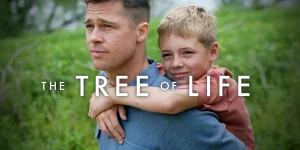
- The Tree of Life (2011)
- To the Wonder (2012)
- Knight of Cups (2015)
- Song to Song (2017)
- A Hidden Life (2019)
Recommended Films for Fans
- Bonnie and Clyde (1967)
- Breathless (1960)
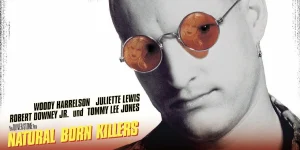
- Natural Born Killers (1994)
- Thelma & Louise (1991)
- Terrence Malick’s Days of Heaven (1978)
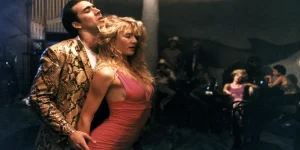
- Wild at Heart (1990)
- True Romance (1993)
- Monster (2003)