
Watch the scene in Jaws (1975) where Chief Brody sits on the beach and suddenly spots a shark attack in the water. His face freezes. The camera rushes backward while the lens simultaneously zooms in, and the world behind him seems to collapse inward like a tunnel. Steven Spielberg did not invent that effect, but he burned it into popular memory. Alfred Hitchcock used it years earlier in Vertigo (1958), which is why most people call it the Vertigo effect. The technical name is the dolly zoom, and it remains one of the few camera tricks in film history that creates a genuinely disorienting physical sensation in the viewer. Here is how it actually works, and who has used it best.
What a Dolly Zoom Actually Does to the Image
A dolly zoom works by moving the camera in one direction while adjusting the lens focal length in the opposite direction at the same rate. You dolly the camera back while zooming in, or you push the camera forward while zooming out. Either way, the subject in the foreground stays roughly the same size in the frame.
What changes is the background. When you zoom in while pulling back, the background appears to rush forward, compressing space. When you push in while zooming out, the background seems to fall away. Both versions create a sense that the space around the subject is behaving wrong, bending in a way our eyes know is impossible.
That wrongness is the whole point. The technique does not just look strange. It makes the viewer feel spatially unmoored, which is exactly what directors reach for when a character is experiencing shock, dread, or a sudden loss of psychological grip.
Why It Feels Different From a Simple Zoom or Dolly Move
A plain zoom does not move the camera. It just changes magnification, flattening the image and making it feel slightly removed from reality. A straight dolly move keeps focal length constant, so perspective shifts naturally as the camera travels through space.
The dolly zoom combines both actions in a way that cancels out the expected result. Your eye senses the camera moving, but the subject refuses to change size the way it should. That contradiction hits somewhere below conscious thought. It registers as wrong before you can name it.


Hitchcock and Herrmann Built the Original Version Together
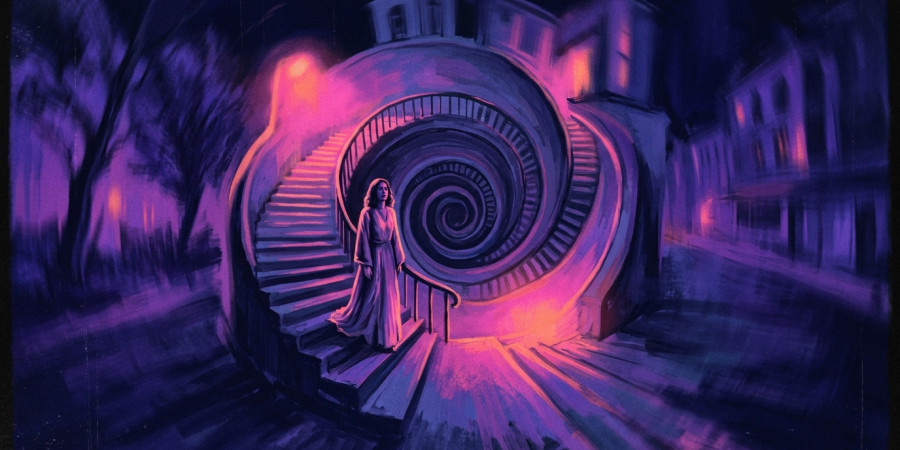
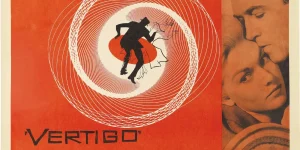
Saul Bass designed the title sequence for Vertigo, but the dolly zoom inside the film was a collaboration between Hitchcock and his director of photography, Robert Burks. Hitchcock wanted a visual representation of Scottie Ferguson’s fear of heights, something that put the audience inside the phobia rather than just watching it.
Burks and his team built a miniature staircase and shot it from above with the combined dolly-and-zoom technique. Paired with Bernard Herrmann‘s spiraling string score, the result lands as one of the most precisely engineered moments of unease in all of cinema. Every element earns its place.
What makes Hitchcock’s version still feel definitive is the restraint. He used it sparingly. That staircase sequence hits so hard partly because the film does not dilute it with repetition.
Spielberg Took It to a Wider Audience
When Spielberg used the dolly zoom on Roy Scheider‘s face in Jaws, he was working with cinematographer Bill Butler. The setup is a single cut: Brody is handing out sandwiches on the beach, half-relaxed, when he sees blood in the water. The world caves in around him in about two seconds of screen time.
It works better here than in almost any other film because the motivation is so simple. Pure shock. There is no need to intellectualize it. You see what Brody sees, and then you see what his nervous system does with that information.
Spielberg’s instinct was to let the cut do the work before and after the effect. He does not linger. The dolly zoom hits and then the film moves. That pacing decision makes the effect feel like a real physiological response rather than a directorial flourish.
Five Directors Who Have Used the Dolly Zoom Well (and One Who Overdid It)
Beyond Hitchcock and Spielberg, a number of directors have found real uses for the technique in very different contexts:
- Brian De Palma in Carrie (1976): uses a slow, creeping version as Carrie accepts the invitation to prom, turning what should be a happy moment into something quietly wrong.
- Peter Jackson in The Lord of the Rings: The Fellowship of the Ring (2001): applies it to Frodo when Gandalf warns him about the Ring, collapsing the Shire lane around him to signal that his safe world is already ending.
- Robert Zemeckis in Goodfellas (1990): credit actually goes to director Martin Scorsese and cinematographer Michael Ballhaus, who use a subtle version on Henry Hill as he begins to unravel under paranoia, tightening the diner scene around him.
- Tobe Hooper in Poltergeist (1982): stretches the hallway using the technique to make a familiar domestic space feel infinite and wrong.
- Paul Thomas Anderson in Boogie Nights (1997): uses a brief version during Dirk Diggler’s psychological collapse, making it feel less like a camera trick and more like a memory misfiring.
The one director who genuinely overdid it is Tony Scott. His later work used the dolly zoom almost as a default nervous-energy setting, stripping it of any specific emotional meaning. When every tense moment gets the same treatment, the effect stops meaning anything.
What Separates a Purposeful Dolly Zoom From a Showy One
The technique earns its place when three conditions are met:
- The character’s psychological state justifies spatial distortion (shock, dissociation, mounting dread).
- The shot is not held too long. Most effective dolly zooms land in under four seconds.
- The surrounding edit gives the effect room to breathe. A cut before and after tells the audience this moment is different.
When any of those conditions are missing, the dolly zoom reads as decoration. It looks like a director showing off, which is the worst thing a camera technique can do.
Modern Cinematographers Keeping the Technique Honest
Roger Deakins has spoken about his preference for motivated camera movement, and the dolly zoom fits that philosophy when used correctly. His work does not rely on it, but that restraint is part of what makes it effective when other cinematographers deploy it well.
Linus Sandgren‘s work on La La Land (2016) includes a version during Sebastian’s audition sequence that is almost imperceptible at normal viewing speed. It quietly registers as emotional instability without calling attention to itself. That is probably the most sophisticated use of the dolly zoom in recent memory: present enough to do its job, invisible enough not to break the spell.
Digital cameras have made the mechanics easier. You can program a lens to zoom at a precise rate while a dolly or slider controls the camera move. But the craft decision, knowing when to use it and when to leave the shot alone, is exactly the same as it was in 1958.
What the Vertigo Effect Has Never Stopped Doing Right
Most camera innovations age quickly. Rack focus felt fresh in the 1970s and now reads as a film school exercise. The slow-motion crash shot looked new in the 1990s and became a shorthand for lazy action editing. The dolly zoom has not aged in the same way, and I think the reason is that it is not really a stylistic trick. It is a direct simulation of a specific mental state.
Dread and shock do not feel like other emotions. They feel spatial. They feel like the ground moving, like walls closing in, like the room getting longer. No other camera technique captures that as directly.
My honest opinion: Spielberg’s Jaws version remains the best single use of the effect in any film, not because it is the most technically sophisticated, but because the emotional trigger is the cleanest. Brody sees a child die. His world contracts. Two seconds of dolly zoom says everything a monologue could not. That economy of expression is what good filmmaking actually looks like.