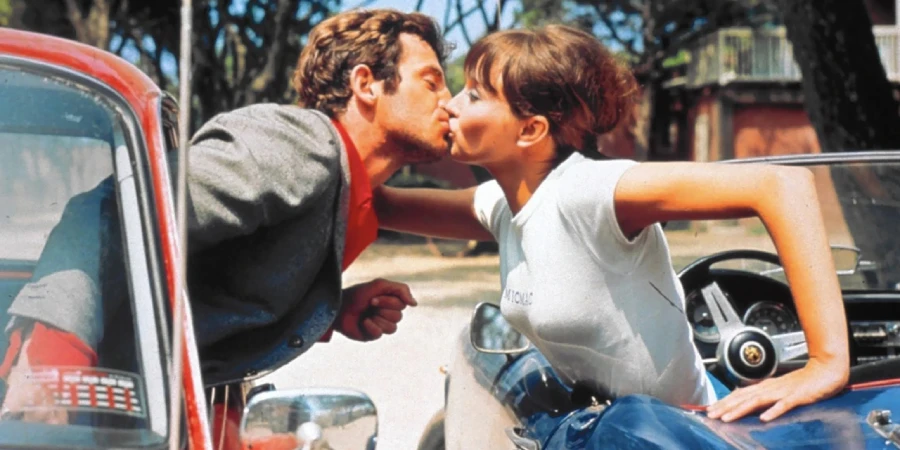

Jean-Luc Godard blew up the road movie, the crime thriller, and the love story all at once with Pierrot le Fou, then scattered the pieces in primary colors across the French Riviera. Ferdinand Griffon abandons his bourgeois life, hits the road with the beguiling Marianne Renoir, and ends up painting his face blue before detonating himself on a clifftop. It is a film about freedom, boredom, and the impossible gap between two people who desperately want to connect. Godard treats cinema itself as the subject, and that gambit makes Pierrot le Fou one of the most audacious films ever made.
Detailed Summary
Ferdinand’s Suffocating Bourgeois Life
Ferdinand Griffon, played by Jean-Paul Belmondo, opens the film reading Elie Faure’s art history book in a bathtub. He narrates to the audience directly, already signaling that this story will refuse to stay inside conventional boundaries. His marriage is loveless, his social world is hollow, and a party at his in-laws’ confirms every suspicion he has about modern life.
At that party, guests speak almost entirely in advertising slogans. Godard stages the sequence as a savage comedy, with characters literally reciting commercial copy to each other as conversation. Ferdinand watches it all with barely concealed contempt.
Marianne Reappears and Everything Changes
Ferdinand reconnects with Marianne Renoir, played by Anna Karina, who is babysitting at his in-laws’ home. She is his former girlfriend, and the spark between them reignites instantly. He stays the night, and in the morning their world has already turned violent.
A dead man lies in Marianne’s apartment, connected to some murky arms-dealing operation she is entangled in. Without much deliberation, Ferdinand and Marianne grab cash and flee Paris together. Their escape feels simultaneously thrilling and completely absurd.
The Road South and the Performance of Freedom
The couple drives south toward the Mediterranean, abandoning cars, stealing money, and improvising their survival. Godard shoots their journey in blazing color, with the landscape itself functioning as a kind of emotional barometer. Freedom, however, turns out to be a performance rather than a genuine state.
Ferdinand wants to read, write, and reflect. Marianne wants action, movement, and sensation. Their incompatibility surfaces almost immediately, and the film frames this tension as something almost philosophical rather than simply romantic. Consequently, every moment of happiness carries an undertow of futility.
Life on the Island and Growing Restlessness
For a period, Ferdinand and Marianne live a quasi-idyllic existence near the coast, fishing and reading and playing. Ferdinand writes in a diary and addresses the audience directly, musing on art, life, and the impossibility of contentment. Marianne grows visibly bored.
Godard intercuts their island life with sudden bursts of genre pastiche, including a Vietnam War skit performed for tourists in exchange for cash. The tonal lurches are entirely deliberate. Moreover, they reinforce the film’s core argument that genre itself is a kind of trap.
Marianne’s Betrayal and the Arms-Dealing Plot
Marianne eventually contacts her brother Fred, who is actually her lover and is deeply involved in gunrunning. She lies to Ferdinand about Fred’s identity throughout their journey. Ferdinand slowly pieces together the deception, but his attachment to Marianne keeps him from fully confronting it.
Fred and his associates pursue the couple, and violence erupts in short, almost casual bursts. Godard refuses to glamorize the gunplay; instead, he shoots it with the same matter-of-fact flatness he applies to everything else. In contrast to Hollywood crime films, danger here feels mundane rather than exciting.
Ferdinand Discovers the Full Extent of the Lies
Ferdinand ultimately learns that Marianne has been manipulating him from the very beginning, using him partly as cover and partly out of genuine but confused feeling. She leaves him to return to Fred. Ferdinand, heartbroken and adrift, tracks them down.
He finds Marianne and Fred together. In a moment of sudden, almost dreamlike violence, he shoots them both. The act carries no triumphant weight; it feels more like a man sleepwalking through the last page of a story he no longer believes in.
Movie Ending
After killing Marianne and Fred, Ferdinand paints his face blue and wraps sticks of dynamite around his head. He lights the fuse with a kind of weary resignation, as if suicide is simply the logical final sentence of a paragraph he has been writing all film. Then, in a flash of panic, he tries to pull the fuse out.
He fails. The explosion kills him, and the film cuts to a wide shot of the sea and the sky, serene and indifferent. Godard lets the landscape absorb the violence without ceremony. The final image belongs to nature, not to Ferdinand.
Most audiences rightly ask whether Godard intends this as tragedy, absurdist comedy, or something in between. The answer, characteristically, is all three simultaneously. Ferdinand’s death completes the film’s argument that the romantic ideal of total freedom leads not to liberation but to self-annihilation.
Notably, the film’s last words are drawn from Arthur Rimbaud: “Elle est retrouvee. Quoi? L’Eternite.” (“It is found again. What? Eternity.”) This literary coda reframes Ferdinand’s destruction as a kind of terrible transcendence. Godard leaves the viewer uncertain whether to mourn or shrug, which is precisely the point.
Are There Post-Credits Scenes?
Pierrot le Fou contains no post-credits scenes. The film ends with the ocean, Rimbaud’s words, and silence. No additional footage follows the credits.
Type of Movie
Pierrot le Fou resists easy genre classification, which is part of its identity. At its core, it is a New Wave road movie wrapped around a crime thriller wrapped around a doomed romance. Godard also folds in elements of political satire and self-reflexive meta-cinema.
In terms of tone, the film oscillates between melancholy, dark comedy, lyrical beauty, and sudden violence. Viewers expecting a straightforward narrative will find it disorienting. On the other hand, those open to cinema as a poetic medium will find it endlessly rewarding.
Cast
- Jean-Paul Belmondo – Ferdinand Griffon (Pierrot)
- Anna Karina – Marianne Renoir
- Dirk Sanders – Fred, Marianne’s lover
- Raymond Devos – Man on the pier
- Graziella Galvani – Ferdinand’s wife
- Samuel Fuller – Himself (cameo at the party)
- Jean-Pierre Leaud – Young man (brief appearance)
Film Music and Composer
Antoine Duhamel composed the score for Pierrot le Fou. His music swings between jaunty, almost cartoonish melodies and passages of genuine romantic ache. That tonal range mirrors the film’s own refusal to settle into a single emotional register.
Anna Karina also sings “Ma Ligne de Chance” within the film, a delicate and melancholy number that functions as a kind of interior monologue for Marianne. Furthermore, the score uses silence strategically, letting landscape sounds take over where music might have provided easy emotional guidance. Duhamel went on to become one of France’s most respected film composers.
Filming Locations
Godard shot Pierrot le Fou primarily in Paris and along the French Riviera, particularly around the coastline near Toulon and the Ile de Porquerolles. The Mediterranean setting is not mere backdrop; it represents Ferdinand’s fantasy of escape, warmth, and a life stripped of bourgeois clutter.
However, paradise turns sour the longer the characters inhabit it. Godard uses the beautiful coastal landscape to undercut Ferdinand’s romanticism, making the eventual tragedy feel even more devastating against that luminous scenery. The color photography by Raoul Coutard transforms these real locations into something almost painterly.
Awards and Nominations
Pierrot le Fou competed for the Golden Lion at the Venice Film Festival in 1965. It did not win the top prize, but its presence at Venice cemented its status as a major work of European cinema. Over the decades, critical reassessment has placed it among the essential films of the French New Wave.
Behind the Scenes Insights
- Godard reportedly wrote the script day by day, handing pages to the cast each morning on set, with no one knowing how the story would end.
- Jean-Paul Belmondo has said the experience felt more like a happening than a conventional film shoot, with Godard constantly changing dialogue and direction.
- American director Samuel Fuller appears at the party scene and delivers his famous line defining cinema as “a battleground: love, hate, action, violence, death.” Godard essentially handed Fuller a microphone to articulate the film’s own manifesto.
- Anna Karina and Godard were in the final, painful stages of their marriage during production. That real emotional tension bleeds directly into the film’s portrait of two people who cannot reach each other.
- Raoul Coutard, the cinematographer, used available light extensively, which gives many scenes a raw, immediate quality that studio lighting could never have produced.
- The film’s title refers to the classic French commedia dell’arte character Pierrot, the sad clown, which maps directly onto Ferdinand’s self-image as a doomed romantic.
Inspirations and References
Godard based the film loosely on Obsession, a novel by Lionel White. White was an American crime writer, and Godard borrowed the basic scaffold of a man who flees his life with a dangerous woman before stripping out almost everything that made it a conventional thriller.
Beyond White, Godard saturates the film with literary and artistic references. Arthur Rimbaud, Louis-Ferdinand Celine, and Velazquez all surface in Ferdinand’s narration and reading material. In addition, the film engages directly with American pop culture and cinema, treating both as objects of fascination and critique simultaneously.
Alternate Endings and Deleted Scenes
No widely documented alternate ending exists for Pierrot le Fou. Given Godard’s day-by-day scripting approach, the production was fluid, but no specific deleted scenes have entered the public record with verified detail. The ending as released appears to be the ending Godard arrived at organically through the shoot.
Book Adaptations and Differences
Pierrot le Fou draws loosely from Lionel White’s novel Obsession. However, calling it an adaptation in any traditional sense would be misleading. Godard used the novel as a launching pad rather than a blueprint.
White’s source material is a tighter, more conventional crime narrative. Godard discarded the plot mechanics and kept only the emotional premise of a man entrapped by a woman and by his own desires. As a result, the two works share a family resemblance but feel like entirely different artistic projects.
Memorable Scenes and Quotes
Key Scenes
- The cocktail party where guests speak entirely in advertising language, one of Godard’s sharpest satirical sequences.
- Samuel Fuller’s cameo, where he defines cinema as a battleground in a single electrifying speech.
- Marianne singing “Ma Ligne de Chance” directly to the camera, a moment of pure, fragile intimacy.
- Ferdinand and Marianne performing their Vietnam War tourist skit for a crowd, comedy and horror collapsed into one absurd scene.
- Ferdinand painting his face blue and wrapping himself in dynamite, one of cinema’s most haunting final images.
- The ocean shot after the explosion, the sea indifferent and vast, absorbing Ferdinand’s death without comment.
Iconic Quotes
- “You speak to me with words, and I look at you with feelings.” (Marianne to Ferdinand, cutting to the heart of their incompatibility)
- “Cinema is like a battleground: love, hate, action, violence, death. In one word: emotion.” (Samuel Fuller at the party)
- “I don’t know how to live… but I know that I live.” (Ferdinand, in one of his diary entries)
- “Elle est retrouvee. Quoi? L’Eternite.” (The film’s closing words, drawn from Rimbaud)
Easter Eggs and Hidden Details
- The name Marianne is the symbolic name of the French Republic, and some critics read her character as Godard’s ambivalent portrait of France itself.
- Ferdinand insists on calling himself Ferdinand throughout the film, while everyone else calls him Pierrot. This name tension encapsulates his struggle to define his own identity against others’ projections.
- The primary movie colors (red, blue, yellow) that saturate the film’s visual design reference Mondrian’s geometric paintings, linking Ferdinand’s inner life to a world of pure, irreconcilable forms.
- Godard includes direct addresses to the camera at irregular intervals, breaking the fourth wall in a way that implicates the audience in Ferdinand’s self-destruction.
- The book Ferdinand reads at the opening, Elie Faure’s History of Art, resurfaces throughout the film as a kind of talisman, contrasting intellectual order with the chaos of lived experience.
- Several background details in the Paris apartment scenes include comic strip panels and pop art imagery, anticipating and engaging with the broader pop art movement of the 1960s.
Trivia
- Godard originally wanted to shoot the film in black and white, but producer Georges de Beauregard insisted on color. The Eastmancolor cinematography ultimately became one of the film’s defining qualities.
- Belmondo reportedly found some of Godard’s methods frustrating but delivered one of his most nuanced and physically committed performances as a result.
- Anna Karina’s role as Marianne was one of the last major collaborations between her and Godard, both professionally and personally.
- The film’s title was a compromise; Godard preferred simply Ferdinand, reflecting his sympathy with the character’s insistence on his own name over the nickname Pierrot.
- Godard referenced over a dozen painters, writers, and directors within the film’s dialogue, essentially constructing a portable syllabus of his artistic influences.
- Despite its experimental nature, the film performed respectably at the French box office, demonstrating that Godard’s New Wave provocations had found a genuine audience.
Why Watch?
Pierrot le Fou is essential viewing for anyone who wants to understand what cinema can do when it refuses all its own rules. Belmondo and Karina generate a chemistry that is genuinely painful to watch as it disintegrates. Furthermore, Godard’s visual invention here remains startling nearly sixty years later. Few films feel this alive and this heartbroken at the same time.
Director’s Other Movies
- Breathless (1960)
- Vivre sa Vie (1962)
- Contempt (1963)
- Band of Outsiders (1964)
- Alphaville (1965)
- Masculin Feminin (1966)
- Weekend (1967)
- Tout va Bien (1972)
- Every Man for Himself (1980)
- Goodbye to Language (2014)