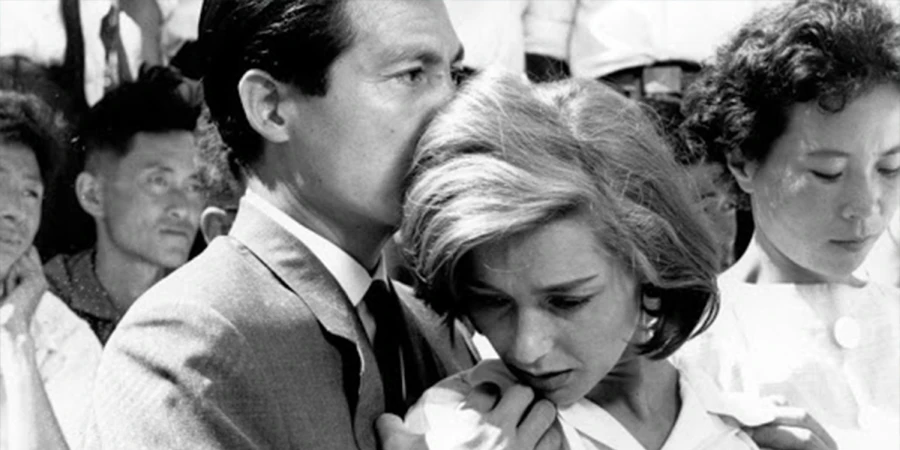

Memory is a lie we tell ourselves, and Hiroshima Mon Amour knows it. Alain Resnais opened his debut feature with images of atomic devastation intercut with two lovers’ entwined bodies, a pairing so audacious it still unsettles audiences today. This 1959 French New Wave landmark asks whether personal grief and collective trauma can ever truly be understood by an outsider, and it refuses to answer neatly. It is, without exaggeration, one of cinema’s most intellectually daring films.
Detailed Summary
The Opening: Bodies and Ruins
Resnais opens with a sequence that deliberately disorients. We see two bodies in close embrace, their skin dusted with what appears to be ash or dew, while a voiceover exchange begins between the two unnamed lovers.
A French woman insists she has seen everything in Hiroshima: the museum, the hospital, the reconstructed ruins. Her Japanese lover flatly contradicts her at every turn, repeating, “You saw nothing in Hiroshima.” This dialectic immediately establishes the film’s central tension between personal testimony and the limits of understanding.
The Lovers Meet in Hiroshima
We learn that Elle (She), a French actress, has come to Hiroshima to film a peace movie. Lui (He), a Japanese architect, is her lover for the duration of her stay. Their affair is casual in origin but quickly becomes something more complicated.
Lui is married, and Elle is due to return to Paris the following day. However, a single night together unravels something deeply buried inside her. Their intimacy triggers her memory in ways neither of them anticipated.
Elle’s Wartime Memory Surfaces
As Elle and Lui talk through the night, she begins to share a story she has apparently never fully told anyone. During the German occupation of France, she had fallen in love with a young German soldier in her hometown of Nevers.
Their relationship was passionate and genuine, at least from her perspective. Consequently, when France was liberated in 1944, the community branded her a collaborator. Her German lover was shot and killed by French resistance fighters on the very day of liberation.
The Punishment in Nevers
Elle’s family, consumed by shame, locked her in their cellar. She spent weeks there, descending into grief and what she later describes as near-madness. Her fingernails bled from clawing at the walls in anguish.
In time, her mental state stabilized enough for her family to release her. She left Nevers for Paris on the night Hiroshima was bombed, a coincidence the film treats as a profound, haunting parallel. Meanwhile, her German lover’s face began to fade from her memory, a loss she mourns alongside his death.
Forgetting as Betrayal
Elle describes the horror of forgetting not as relief but as a second death. She had promised herself she would never forget him, yet memory eroded anyway. This process mirrors the broader cultural forgetting she accuses Hiroshima itself of risking.
Lui listens with growing intensity. He begins to see that she is not simply recounting history; she is reliving it, and she is, in some unconscious way, projecting the dead German soldier’s face onto him. The dynamic between them shifts from romantic to something stranger and more desperate.
The Night Stretches On
They move through Hiroshima together: a café, the streets, a station. Elle alternates between the present moment and her memories of Nevers. Resnais cuts between the two time periods fluidly, refusing clean boundaries between past and present.
Lui urges her to stay. She resists, then wavers. Her internal conflict externalizes itself in fragmented, poetic speech. In addition, the film uses her psychological unraveling to suggest that trauma, whether personal or collective, resists containment.

Movie Ending
In the final stretch, Elle walks alone through Hiroshima at night, unable to sleep and unable to leave. She enters a bar and sits in silence. A Japanese man begins to watch her, and for a moment the film hints at another potential connection, but nothing comes of it.
Lui follows her, finding her at a second café in the early hours of the morning. Their reunion is quiet and exhausted. He calls her “Hiroshima,” and she calls him “Nevers.” These are not terms of affection in any conventional sense; they are the names of the places that defined their respective wounds.
This exchange is the film’s most significant moment. By naming each other after cities rather than people, they acknowledge something painful and precise: they are not truly seeing each other as individuals. Each represents, for the other, an irretrievable loss. Furthermore, both names carry the weight of mass death and personal devastation simultaneously.
No resolution arrives. Elle does not stay, and Lui does not stop her. The film ends on her face, and on the word “Nevers,” echoing. Resnais refuses the audience any catharsis. Instead, the ending insists that memory is cyclical, that wounds reopen, and that forgetting is both inevitable and devastating.
What audiences most often question is whether Elle ultimately stays or leaves. Resnais deliberately withholds that answer. The ambiguity is not a flaw; it is the whole point. She is caught between two cities, two men, two moments in time, and the film leaves her suspended there, which is exactly where grief tends to live.
Are There Post-Credits Scenes?
There are no post-credits scenes in Hiroshima Mon Amour. The film ends without any additional footage following its closing moments. Given the film’s meditative tone, such a device would be entirely out of place.
Type of Movie
Hiroshima Mon Amour belongs to the French New Wave movement and operates primarily as a romantic drama with strong elements of experimental cinema. Its tone is melancholic, cerebral, and quietly devastating.
In contrast to conventional romance films, it uses its love story as a structural framework for exploring trauma, memory, and historical guilt. Critics have also categorized it as an early example of essay film, given its philosophical voiceover and non-linear editing.
Cast
- Emmanuelle Riva – Elle (the French actress)
- Eiji Okada – Lui (the Japanese architect)
Film Music and Composer
The score for Hiroshima Mon Amour was composed by Giovanni Fusco and Georges Delerue, two composers whose contributions complement rather than compete with each other. Fusco provided the more austere, sparse musical passages, while Delerue contributed warmer, more lyrical cues.
Fusco had previously collaborated with Michelangelo Antonioni, giving him a strong background in music that supports psychological tension without overwhelming it. Delerue would later become one of French cinema’s most celebrated composers. Together, their work on this film feels restrained and perfectly calibrated to Resnais’s editing rhythms.
Filming Locations
Principal photography took place in Hiroshima, Japan, and in Nevers, France. These two locations are not interchangeable backdrops; they are thematically essential to everything the film argues.
Hiroshima carries the weight of the atomic bombing of 1945, making every street and building a site of collective trauma. Nevers, a quiet provincial French town, represents personal, intimate suffering, the kind of wound that goes unrecorded by history. Shooting on location in both cities gave the film an authenticity and a geographic specificity that a studio production could never replicate.
Awards and Nominations
Hiroshima Mon Amour received a nomination for the Palme d’Or at the 1959 Cannes Film Festival, though it did not win. Marguerite Duras received a nomination for the Academy Award for Best Original Screenplay, one of the rare early instances of a French-language film script earning that recognition. The film’s script nomination at the Oscars was a significant acknowledgment of its literary quality.
Behind the Scenes Insights
- Alain Resnais had previously directed documentary shorts, and his background in that form heavily influenced his use of archival footage and location shooting in Hiroshima.
- Screenwriter Marguerite Duras initially had no experience writing for film; Resnais sought her out specifically because he wanted a literary writer, not a conventional screenwriter.
- Emmanuelle Riva was relatively unknown at the time of filming; her performance here launched her career and remains one of the finest in French cinema.
- Resnais and Duras held extensive conversations about memory and time before a single word of the script was written, treating the project as a philosophical collaboration from the outset.
- The opening sequence, featuring the lovers’ entwined bodies dusted with glittering particles, required careful choreography to achieve its disturbing visual link between sensuality and atomic fallout.
- Eiji Okada learned his French dialogue phonetically, as he spoke little French at the time; this adds an unintended layer of linguistic estrangement to his performance that actually suits the film’s themes.
Inspirations and References
Resnais drew directly on the documented history of the atomic bombing of Hiroshima in August 1945. He incorporated genuine archival materials and references to the Hiroshima Peace Memorial Museum into the film’s opening act.
The story of French women shaved and publicly humiliated for relationships with German soldiers during the occupation is historically documented. Duras drew on that specific cultural shame for Elle’s backstory. In addition, Duras’s own wartime experiences in occupied France informed the emotional texture of the screenplay, though the film is not autobiographical in a strict sense.
Philosophically, the film engages with ideas associated with Henri Bergson and later Gilles Deleuze regarding time and memory, though these were not explicit textual sources so much as intellectual currents circulating in mid-century French thought.
Alternate Endings and Deleted Scenes
No widely documented alternate endings or significant deleted scenes from Hiroshima Mon Amour exist in the public record. Resnais was a meticulous filmmaker, and the film’s structure reflects a very deliberate authorial vision rather than a process of heavy revision in post-production.
Duras’s original screenplay was published as a book, and comparing it to the finished film reveals minor differences in dialogue and emphasis, but no major structural divergences. The ambiguous ending appears in the screenplay itself, confirming it was always intentional rather than the result of cuts.
Book Adaptations and Differences
Hiroshima Mon Amour is not based on a pre-existing novel. Marguerite Duras wrote the screenplay directly for the film. However, Duras subsequently published the screenplay as a literary text, blurring the line between cinema and literature in a way that suited her broader artistic practice.
Reading the published screenplay reveals how much of the film’s power originates in Duras’s writing rather than in purely cinematic choices. Nonetheless, Resnais’s editing and visual decisions transform the text into something neither purely literary nor purely filmic.

Memorable Scenes and Quotes
Key Scenes
- The opening sequence intercutting the lovers’ bodies with documentary footage and images of Hiroshima’s destruction, setting up the film’s central argument in purely visual terms.
- Elle describing her German lover’s death and her own breakdown in the cellar at Nevers, delivered in fragmented, almost hallucinatory dialogue.
- The moment Elle looks at Lui’s sleeping hand and suddenly sees, in her memory, her dying German lover’s hand twitching in the street.
- Elle and Lui sitting in the early-morning café while she oscillates between present and past, with Resnais cutting between Hiroshima and Nevers without warning.
- The final exchange in which they call each other “Hiroshima” and “Nevers,” collapsing identity into geography and trauma.
Iconic Quotes
- “Tu n’as rien vu a Hiroshima.” (“You saw nothing in Hiroshima.”) Lui’s repeated refusal of Elle’s testimony, opening the film’s philosophical argument.
- “Like you, I struggled with all my might against forgetting. Like you, I forgot.” Elle articulating the paradox at the heart of the film.
- “Nevers… Ne-vers in France.” The final words, placing the weight of the entire film onto a single place name.
- “I met you. I remember you. This city was made to the size of love.” A line that captures the film’s fusion of personal and collective memory.
Easter Eggs and Hidden Details
- The glittering particles on the lovers’ bodies in the opening sequence visually echo both sweat and ash, linking erotic life to death by atomic fire without a single word of explanation.
- Resnais films Hiroshima’s rebuilt streets as clean and modern, a visual argument that physical reconstruction can mask historical trauma rather than heal it.
- Elle’s repeated use of present tense when describing past events subtly signals that her trauma has never actually receded into the past for her.
- Lui’s profession as an architect carries quiet symbolic weight: he is someone who rebuilds structures, paralleling Hiroshima’s own postwar reconstruction, yet he cannot rebuild Elle’s fractured memory.
- The film’s peace-movie-within-a-movie device allows Resnais to comment obliquely on the politics of representing atrocity through art, a self-reflexive gesture embedded early in the narrative.
Trivia
- Hiroshima Mon Amour was Alain Resnais‘s first feature-length fiction film, after a career spent making short documentaries.
- The film is widely cited as one of the founding texts of the French New Wave, alongside works by Godard and Truffaut, despite Resnais himself being somewhat outside that specific group.
- Marguerite Duras initially declined Resnais’s invitation to write the script, feeling unqualified to address Hiroshima; Resnais persuaded her by arguing that her outsider perspective was precisely the point.
- The film’s running time is approximately 90 minutes, unusually compact given the density of its ideas and the breadth of historical material it engages.
- Resnais screened documentary footage of Hiroshima’s aftermath extensively before and during production to ensure that his fictional treatment engaged seriously with the historical reality.
- Several French critics initially resisted the film, finding its juxtaposition of personal love story and atomic catastrophe inappropriate; international reception was considerably more enthusiastic.
Why Watch?
Hiroshima Mon Amour does something almost no other film attempts: it holds personal grief and historical catastrophe in the same frame without diminishing either. Resnais and Duras created a work that rewards repeated viewing precisely because it refuses easy answers. For anyone serious about cinema, this is essential.
Director’s Other Movies
- Last Year at Marienbad (1961)
- Muriel, or the Time of a Return (1963)
- The War Is Over (1966)
- Stavisky (1974)
- Providence (1977)
- My American Uncle (1980)
- Life Is a Bed of Roses (1983)
- Mélo (1986)
- Same Old Song (1997)
- Wild Grass (2009)
- You Ain’t Seen Nothin’ Yet (2012)
Recommended Films for Fans
- Last Year at Marienbad (1961)
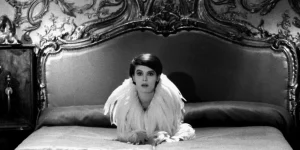
- Breathless (1960)
- The 400 Blows (1959)
- Cleo from 5 to 7 (1962)
- Eternal Sunshine of the Spotless Mind (2004)
- In the Mood for Love (2000)
- The Lovers on the Bridge (1991)
- La Jetée (1962)