
Some films tell stories. Last Year at Marienbad dismantles the very idea of storytelling and dares you to reassemble it yourself. Released in 1961 and directed by Alain Resnais, this French masterwork follows a nameless man who insists he met a woman at a grand baroque hotel the previous year, a claim she denies with total conviction. It is hypnotic, maddening, and unlike anything else in cinema history.
Detailed Summary
The Opening: A Palace of Corridors and Voices
A man’s voice drifts over images of an ornate, sprawling hotel. Ceilings, moldings, corridors, and frozen guests fill the frame while the narration loops obsessively over the same descriptions. Nothing moves with purpose, and yet everything feels charged with urgency.
We are introduced to a world that operates outside normal time. Guests stand rigid in formal attire, posing like wax figures in a museum. Moreover, the camera glides through the hotel with a ghostly, mechanical smoothness that immediately unsettles the viewer.
X Encounters A: The Central Confrontation
A man, identified in credits only as X, approaches a woman identified as A. He speaks to her with quiet intensity, claiming they met at this very hotel the previous year and made a promise together. She listens, but she does not remember him, or at least she insists she does not.
X refuses to accept her denial. He describes their meetings in precise, poetic detail: a garden, a balcony, a bedroom. However, as he narrates these memories, the images we see contradict each other, shift, and reset.
The Game of Nim and the Figure of M
A third character enters the picture: M, a composed, authoritative man who appears to be A’s husband or companion. M plays a matchstick game called Nim repeatedly throughout the film, always winning. X attempts to beat him and always loses.
Nim functions as a metaphor for control within the film. M controls the space around A with quiet dominance. In contrast, X’s repeated failure at the game mirrors his inability to fully reclaim A from her present existence.
Shifting Memories and Competing Realities
X continues pressing A with his version of their shared past. His narration conjures images that appear on screen, but the images keep changing. In one version of a memory, A wears white; in another, she wears black. Rooms rearrange themselves between cuts.
A begins to show cracks in her composure. She seems disturbed, even frightened. Consequently, the viewer starts questioning whether X is a persistent lover, a stalker, a manipulator, or simply a man constructing a fiction to seduce her.
The Bedroom Scene and the Question of Assault
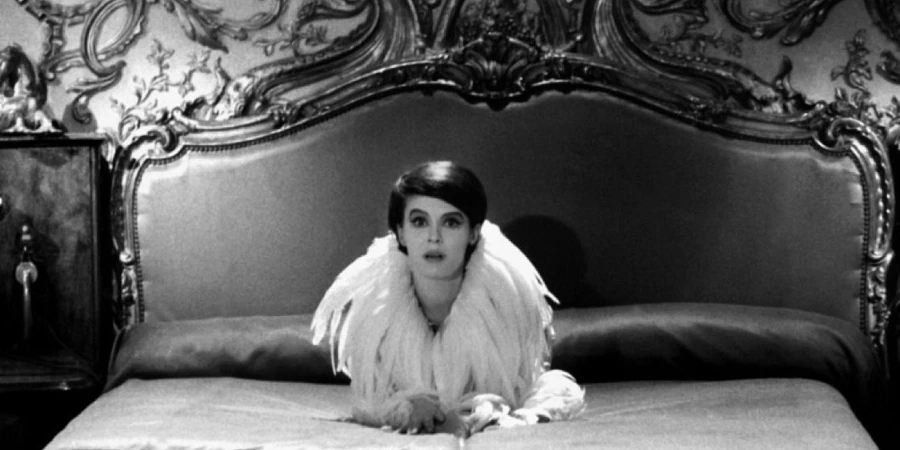
One of the film’s most disturbing sequences presents a possible sexual assault. X’s narration describes entering A’s room, and the images that follow show her prone on a bed, arms outstretched, while X looms over her. The scene flickers and recurs with variations, never settling into a single definitive version.
Resnais and screenwriter Alain Robbe-Grillet built deliberate ambiguity into this moment. It may represent something X did, something he imagined, or something A remembers differently. As a result, the sequence sits at the film’s moral and psychological center.
A’s Growing Uncertainty
As the film progresses, A begins to waver. She no longer dismisses X with the same cool certainty. Small gestures, glances, and hesitations suggest that something buried inside her is responding to his words. Whether she is remembering or simply surrendering to his narrative remains unclear.
M, meanwhile, watches everything with an unreadable expression. His calm presence feels less like obliviousness and more like a calculated act of containment. Furthermore, his continued victories at Nim reinforce the sense that he holds power over both X and A.
Movie Ending
X finally persuades A to leave with him. She agrees, or perhaps she simply stops resisting. The two walk together into the darkness of the hotel’s vast garden, and X’s narration declares that he is taking her away from Marienbad at last.
However, this apparent resolution offers no real closure. The final images show the garden at night, shrouded in darkness, with X and A moving toward an uncertain destination. Nothing confirms that any of what we witnessed actually happened in any linear or factual sense.
M watches them go, or perhaps he does not. The film’s final moments are as spatially and temporally unstable as everything that came before. Ultimately, the ending functions less as a conclusion and more as a release valve, after 90 minutes of mounting pressure, the film simply lets go.
What audiences find most puzzling is whether A truly did meet X at Marienbad the previous year. Robbe-Grillet stated that she did not, and that X’s entire account is a persuasion strategy, a story he constructs to make her believe in a shared past that never existed. Resnais, on the other hand, believed the meeting genuinely occurred. This disagreement between the two creators was intentional and fundamental to the film’s design.
In the end, the question of truth is beside the point. X’s narrative wins. A leaves. Whether that constitutes a love story, a coercion, or a dream is entirely up to the viewer.
Are There Post-Credits Scenes?
Last Year at Marienbad contains no post-credits scenes. Credits roll in silence, and there is nothing additional to wait for. Given the film’s deliberate rejection of conventional narrative structure, a post-credits scene would frankly feel absurd.
Type of Movie
This film sits firmly within the French New Wave movement, though it pushes further into avant-garde territory than most of its contemporaries. Its genre is best described as art-house drama with strong psychological and surrealist elements. Tone-wise, it is cold, hypnotic, and deeply unsettling, luxurious in its imagery while emotionally glacial in its delivery.
Some critics classify it as a mystery, since it withholds a definitive answer to its central question. Others read it as a meditation on memory and desire. In practice, it resists all single-genre labels with considerable success.
Cast
- Delphine Seyrig – A (the Woman)
- Giorgio Albertazzi – X (the Narrator/Man)
- Sacha Pitoeff – M (the Companion/Husband)
Film Music and Composer
Francis Seyrig composed the film’s score. His music alternates between grand, swelling organ passages and sparse, eerie silences, matching the film’s oscillation between opulence and dread. Notably, the organ work gives the hotel sequences a cathedral-like solemnity.
The score never tries to guide the viewer’s emotions in a conventional way. Instead, it reinforces the film’s sense of temporal dislocation. Certain musical phrases repeat and loop in ways that parallel the repetitive structure of the screenplay itself.



Filming Locations
Principal photography took place at several real baroque palaces in Germany, most prominently Nymphenburg Palace and Schleissheim Palace near Munich, as well as the gardens of Amalienburg. Some interior sequences were shot at other grand European estates. The productions designers enhanced these locations with carefully controlled lighting and staging.
Choosing real baroque palaces was essential to the film’s atmosphere. These buildings carry centuries of accumulated formality and grandeur, and their rigid architectural symmetry mirrors the film’s obsession with repetition and control. Additionally, their actual gardens feature geometric layouts that make the strange shadow effects in the film even more pronounced.
One of the film’s most discussed visual details involves those gardens: the human figures cast shadows while the trees and hedges do not. This detail adds to the film’s dreamlike unreality and could only be achieved with careful on-location staging at the right time of day.
Awards and Nominations
Last Year at Marienbad won the Golden Lion at the Venice Film Festival in 1961, one of cinema’s most prestigious honors. It also received a BAFTA nomination for Best Film and generated significant awards attention across Europe upon its release.
Its critical reputation has grown substantially over the decades. Many major critical polls consistently rank it among the greatest films ever made.
Behind the Scenes Insights
- Director Alain Resnais and screenwriter Alain Robbe-Grillet disagreed fundamentally about the film’s meaning: Robbe-Grillet believed X invented the past entirely, while Resnais believed the past encounter genuinely happened. Both men accepted this disagreement as a feature, not a flaw.
- Delphine Seyrig had trained at the Actors Studio in New York before this role, and her performance style, interior and physically precise, brought an unusual tension between emotional depth and surface blankness.
- Resnais shot the film in a highly controlled, choreographed manner, with actors frequently required to move and stop on exact marks to maintain the geometric compositions he wanted.
- The screenplay by Robbe-Grillet was almost entirely adhered to, which was unusual for Resnais, who had previously collaborated more loosely with writers including Marguerite Duras on Hiroshima mon amour.
- Shooting inside real baroque palaces created practical difficulties: lighting equipment had to be rigged without damaging historic interiors, and sound recording posed significant challenges in the vast, reverberant spaces.
- The film’s budget was relatively modest by international standards, yet its visual ambition required extraordinarily meticulous planning and long shooting days.
Inspirations and References
Robbe-Grillet drew on his own literary work as a nouveau roman (New Novel) writer, a French literary movement that rejected conventional plot and character psychology in favor of objective, surface-level description. His novel La Jalousie shares the film’s obsession with repeated, slightly-varying descriptions of the same events and spaces.
Some scholars point to connections with Jorge Luis Borges, whose labyrinths and infinite regressions of time and memory feel spiritually close to the film’s world. However, no direct textual influence has been confirmed by Robbe-Grillet himself, so this remains a thematic parallel rather than a documented source.
The broader context of French existentialism and post-war European anxiety about memory and identity also shaped the film’s concerns. Resnais had previously confronted traumatic collective memory in Night and Fog and Hiroshima mon amour, and Last Year at Marienbad extends that preoccupation into a more abstract, dreamlike register.
Alternate Endings and Deleted Scenes
No alternate ending for Last Year at Marienbad has been officially documented or released. Given Robbe-Grillet’s extremely precise screenplay, and the close adherence to that script during production, significant cut or alternate material appears to have been minimal.
There are no widely known deleted scenes that have entered public discussion or academic scholarship. For a film built on repetition and fragmentation, the editing process was itself a form of authorship, meaning very little usable footage likely existed outside what Resnais intended to use.
Book Adaptations and Differences
Last Year at Marienbad is not based on a pre-existing novel. Robbe-Grillet wrote the screenplay as an original work, which he subsequently published as a ciné-roman (film-novel), a hybrid text that included photographs from the film alongside the complete script.
In that published form, the work functions as both a literary object and a film document. Interestingly, the ciné-roman version gives readers the same experience as the film: a text that refuses to resolve its central ambiguity, even when you can reread passages at your own pace.


Memorable Scenes and Quotes
Key Scenes
- The opening tracking shot through the hotel corridors: a slow, relentless glide through baroque architecture while the narrator’s voice loops obsessively, establishing the film’s hypnotic register from the very first frames.
- X’s first approach to A: he speaks to her in close-up with quiet conviction, and she stares back with polite, unsettling blankness. Their dynamic of pursuit and denial crystallizes in seconds.
- The repeated Nim game sequences: M wins every time, and X’s mounting frustration at the game parallels his inability to fully reclaim A. The matches become a chess match by proxy.
- The shifting bedroom scene: the same moment replays with different outcomes, different costumes, and different emotional registers, making the question of what actually happened feel genuinely unanswerable.
- The garden with shadowless trees: guests stand in sunlight casting long shadows while the sculpted hedges behind them produce none. This single visual detail encapsulates the entire film’s departure from naturalistic reality.
- The final departure: X and A walk together into the dark garden as the narrator declares that he is finally taking her away. For a film that has refused resolution at every turn, this moment carries enormous weight precisely because it remains uncertain.
Iconic Quotes
- “It was as if the night threatened never to end.” (X’s narration, recurring throughout the film)
- “You are not the one I am waiting for.” (A, in one of several variations of her response to X)
- “Again, I walk on, once again, down these corridors, through these halls, these galleries, in this structure of another century.” (X, opening narration)
Easter Eggs and Hidden Details
- The shadowless trees in the garden are one of cinema’s most famous visual details; Resnais and cinematographer Sacha Vierny achieved this by careful timing and camera positioning. It was not a special effect but a deliberate, staged reality.
- The Nim game follows a real mathematical structure in which the player who goes first can always win with perfect play, making M’s consistent victories a coded signal that he controls all outcomes in the film’s world.
- A’s costumes, designed by Coco Chanel for Delphine Seyrig, change between sequences depicting supposedly the same moment, signaling to attentive viewers that the “memories” cannot all be accurate.
- Characters in the hotel frequently appear frozen mid-gesture in the background, as if time itself has stopped around X and A. This detail rewards viewers who scan the edges of wide shots carefully.
- The film’s narration occasionally contradicts itself within the same sentence, a device borrowed directly from Robbe-Grillet’s literary technique in the nouveau roman tradition.
- Several of the paintings visible on the hotel walls depict scenes of confinement or pursuit, functioning as thematic mirrors to the central relationship without ever being highlighted by the camera.
Trivia
- Coco Chanel designed Delphine Seyrig’s costumes at a time when Chanel had recently returned to fashion after a long retirement, making Seyrig one of the first major film characters to wear Chanel’s revived collections.
- Cinematographer Sacha Vierny shot the film in widescreen black-and-white, and his collaboration with Resnais continued across several major films throughout the 1960s.
- The film divided critical opinion sharply upon release: some French critics declared it a masterpiece immediately, while others found it empty and pretentious. That debate has never fully resolved.
- Giorgio Albertazzi, who played X, was an Italian actor primarily known for stage work. His non-naturalistic, almost incantatory delivery was essential to the film’s unusual vocal texture.
- Alain Resnais reportedly used the film’s editing process to create additional temporal disorientation beyond what even the script indicated, rearranging sequences in post-production.
- Last Year at Marienbad has influenced an enormous range of filmmakers and artists, with directors including Stanley Kubrick citing its atmosphere as a reference point for his own baroque horror work on The Shining.
- Robbe-Grillet went on to direct his own films as a director, applying the same anti-narrative principles he developed in this screenplay to visual work he controlled entirely himself.
Why Watch?
Few films challenge your relationship with cinema itself as productively as this one does. It refuses easy answers, yet rewards patient, attentive viewing with a visual and intellectual richness that deepens on every revisit. If you care about what film can do beyond conventional storytelling, this is simply essential viewing.
Director’s Other Movies
- Hiroshima mon amour (1959)
- Muriel, or the Time of Return (1963)
- La Guerre est finie (1966)
- Je t’aime, je t’aime (1968)
- Stavisky (1974)
- Providence (1977)
- Mon oncle d’Amerique (1980)
- Life Is a Bed of Roses (1983)
- Smoking / No Smoking (1993)
- Wild Grass (2009)
Recommended Films for Fans
- Hiroshima mon amour (1959)
- L’Avventura (1960)
- The Exterminating Angel (1962)
- 8½ (1963)
- Persona (1966)
- The Shining (1980)
- Mulholland Drive (2001)
- Inland Empire (2006)
- Caché (2005)
- Enter the Void (2009)