
Franz Jägerstätter refused to sign a piece of paper, and that refusal cost him everything. Terrence Malick‘s A Hidden Life (2019) tells the true story of an Austrian farmer who chose conscience over survival during World War II, and it does so with a visual and spiritual intensity that few films dare to attempt. This is not a war film. It is a meditation on what it means to be human when every institution around you demands that you stop being one.
Detailed Summary
Paradise in the Mountains
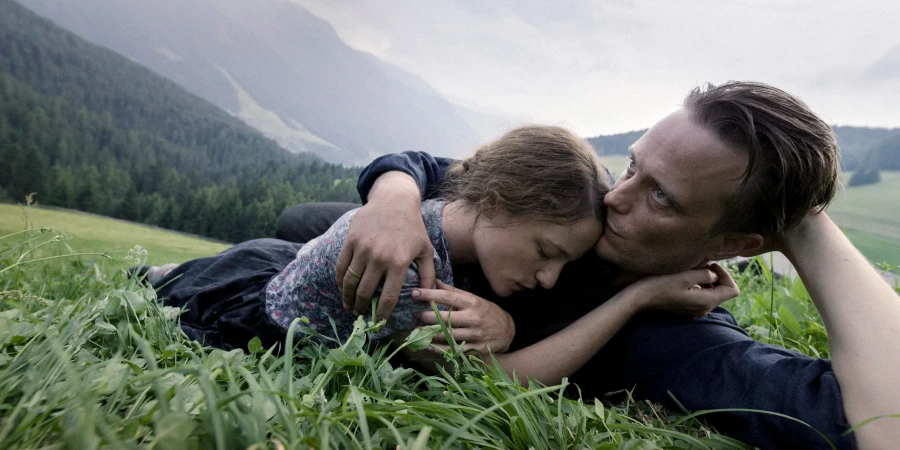
Franz Jägerstätter lives with his wife Fani and their daughters in Sankt Radegund, a small village nestled in the Austrian Alps. Life there is physically demanding but genuinely beautiful. Malick opens the film with sweeping vistas of green valleys and golden fields, establishing the farm as something close to Eden.
Franz and Fani share a deep, tender love. Their partnership is equal and grounded in faith. Meanwhile, the wider world is darkening fast, and the shadow of National Socialism stretches even into this remote mountain community.
The War Reaches Franz
Franz receives his first military training call-up and departs reluctantly, leaving Fani to manage the farm alone with help from her sister Resie. He trains but does not yet face combat. However, the experience plants a seed of moral dread that he cannot uproot.
Back home, the village begins to shift. Neighbors grow hostile. Locals who once respected Franz now view his quiet reluctance as arrogance or cowardice. In contrast, those who enthusiastically support Hitler receive social rewards and status.
The Oath and the Crisis of Conscience
Franz learns that soldiers must swear an oath of loyalty directly to Adolf Hitler. For a devout Catholic, swearing such an oath feels like a spiritual betrayal he cannot justify. He prays, reads scripture, and wrestles with the decision at length.
He seeks guidance from the Church, but priests and bishops fail him. Each clergyman, in his own way, counsels compliance. They frame submission as prudence, as service to family, as the lesser evil. Franz listens, but he cannot be persuaded.
Fani’s Suffering Begins
Fani carries an enormous burden as Franz’s decision becomes known. Villagers shun her family. Neighbors refuse to help with the harvest. Her daughters face cruelty from other children. Fani never abandons Franz, but Malick shows her grief honestly, without sentimentality.
She writes to Franz constantly throughout his imprisonment, and he writes back. These letters form the emotional spine of the film. Their words are read in voiceover, layered over images of the landscape they both love.
Arrest and Imprisonment
Franz refuses to swear the oath when called up for active service. Consequently, authorities arrest him and transfer him through a series of military prisons. He meets other prisoners, some of whom try to persuade him that his sacrifice serves no practical purpose.
A lawyer assigned to his case warns Franz bluntly: the tribunal will sentence him to death. Franz understands this. He does not waver. He simply cannot sign his name to something he believes is evil.
The Trial and Condemnation
Franz appears before a military tribunal in Berlin. Judges and officials question him, alternately mocking and cajoling. Some seem genuinely puzzled by a man who would die for a refusal that, to them, seems trivial and pointless.
The tribunal sentences Franz to death by beheading. He is transferred to Brandenburg an der Havel prison to await execution. Fani travels to Berlin to see him one final time, a reunion that Malick renders with quiet devastation.
Movie Ending
Franz spends his final days in Brandenburg prison, continuing to write letters to Fani and to reflect on his faith. A prison chaplain initially refuses to administer the sacraments because Franz is condemned as a traitor. Franz accepts this additional cruelty without rage.
Eventually, the chaplain relents and gives Franz last rites. It is a small mercy in a place stripped of mercy. Malick does not dramatize the execution itself. Instead, he holds back, letting the weight of what we know is coming press down on the viewer silently.
Franz is executed on August 9, 1943. He is 36 years old. A title card at the end of the film informs us that his cause for beatification was opened by the Catholic Church, and Pope Francis beatified him in 2007, recognizing him officially as Blessed Franz Jägerstätter.
The film closes with Malick returning to images of the Austrian mountains, the fields, and the family Franz left behind. Fani’s voiceover reflects on sacrifice and love, drawing directly from her real words. The final note is not triumph. It is something quieter and more durable: the conviction that a life lived with integrity matters, even when the world refuses to acknowledge it.
For audiences, the most pressing question is whether Franz’s death meant anything. Malick answers this obliquely. No single act of conscience stopped the war. However, the film argues, through its very existence and through the Church’s eventual recognition, that moral witness has its own kind of permanence. Franz changed nothing in 1943. He changed everything in the long view of history.
Are There Post-Credits Scenes?
A Hidden Life contains no post-credits scenes. Malick closes the film with the title cards about Franz’s beatification, and that is the intended conclusion. Audiences can leave as the credits begin without missing anything.
Type of Movie
A Hidden Life occupies the intersection of historical drama, spiritual meditation, and biographical film. Its tone is contemplative, slow-burning, and deeply serious. Malick uses the tools of art cinema, long takes, wide-angle lenses, and voiceover, to create something closer to a prayer than a conventional narrative film.
Violence is largely absent from the screen, yet the film creates an atmosphere of sustained dread. It is, notably, one of Malick’s most emotionally direct works despite its deliberate pacing.
Cast
- August Diehl – Franz Jägerstätter
- Valerie Pachner – Franziska “Fani” Jägerstätter
- Michael Nyqvist – Bishop Flieser
- Tobias Moretti – Mayor Kogler
- Karin Neuhäuser – Rosalia Jägerstätter (Franz’s mother)
- Maria Simon – Resie (Fani’s sister)
- Bruno Ganz – Judge
- Matthias Schoenaerts – Feldwebel (military officer)
- Franz Rogowski – Ernst
- Jorg Handor – Defense Lawyer
Film Music and Composer
The score for A Hidden Life draws on existing classical and sacred music rather than a single original score composed for the film. James Newton Howard contributed original music. His compositional approach complements Malick’s visual language: restrained, searching, and rooted in European classical tradition.
In addition to Howard’s work, the film incorporates pieces by composers including Johann Sebastian Bach and others from the Western sacred music canon. The music functions as another form of prayer within the film’s structure. It never overwhelms; it underlines.

Filming Locations
Production took place primarily in Austria, with filming in the actual village of Sankt Radegund am Wallersee and the surrounding Salzburg region. Using the real locations grounded the film in authentic geography. The mountains, the farmhouses, and the village streets carry a weight that studio construction could not replicate.
Additional scenes were filmed in Italy and Germany. The prison sequences required locations that conveyed institutional bleakness as a stark contrast to the alpine beauty of the opening acts. This visual contrast between freedom and confinement is central to the film’s emotional architecture.
Awards and Nominations
A Hidden Life received the Ecumenical Jury Prize at the Cannes Film Festival in 2019, where it screened in competition. Critics and award bodies praised the film widely, particularly for its cinematography and performances. However, it did not receive major nominations from mainstream American awards bodies, a pattern consistent with Malick’s recent output.
Behind the Scenes Insights
- Director Terrence Malick cast largely European actors, many of whom were not widely known to American audiences, to keep the performances feeling grounded and authentic.
- Cinematographer Jorg Widmer used wide-angle lenses and handheld camera work extensively, a technique that places viewers physically inside scenes rather than observing from a distance.
- Much of the dialogue in the film was reportedly improvised within scenes, consistent with Malick’s established practice of giving actors significant freedom on set.
- August Diehl and Valerie Pachner spent considerable time on the actual farm in Sankt Radegund, learning to perform agricultural tasks authentically before filming began.
- Michael Nyqvist, who plays the bishop, passed away in 2017. His scenes were completed before his death, making A Hidden Life one of his final film appearances.
- Malick, who rarely grants interviews, kept the production largely shielded from press attention throughout filming.
Inspirations and References
The film draws directly from the life and letters of Franz Jägerstätter, the real Austrian conscientious objector executed in 1943. His story gained wider attention through the book In Solitary Witness by sociologist Gordon Zahn, published in 1964. Zahn’s work documented how the Catholic Church hierarchy largely abandoned Jägerstätter during his trial and imprisonment.
Malick’s title comes from the closing lines of George Eliot’s novel Middlemarch, specifically the passage about those who perform good deeds unknown to the world, and how the growing good of the world depends on unhistoric acts. This thematic frame is essential to understanding what Malick is arguing throughout the film.
Philosophically, the film engages with ideas associated with Dietrich Bonhoeffer and other Christian resisters of Nazism, even without naming them directly. Furthermore, it shares spiritual DNA with the work of Carl Theodor Dreyer, particularly The Passion of Joan of Arc.
Alternate Endings and Deleted Scenes
No officially confirmed deleted scenes or alternate endings have been released for A Hidden Life. Given Malick’s working method, it is likely that substantial additional footage exists from the production. Malick consistently shoots far more material than appears in final cuts.
His previous films have sometimes received alternate edits for different markets or retrospective releases. As of now, no such alternate version of A Hidden Life has been publicly confirmed or released.
Book Adaptations and Differences
A Hidden Life is not a direct adaptation of any single book. It draws from historical records, including Franz and Fani Jägerstätter’s actual letters, and from Gordon Zahn’s biographical study. Malick wrote the screenplay himself, synthesizing historical sources rather than adapting one primary text.
Consequently, comparing the film to a source novel is not applicable here. The spirit of the story is faithful to the historical record, though Malick naturally shapes scenes and dialogue for cinematic effect.


Memorable Scenes and Quotes
Key Scenes
- The opening harvest sequence: Franz and Fani work the fields together while their daughters play nearby. This scene establishes everything the film fears losing.
- Franz confronting the village mayor: Kogler pleads with Franz to comply, mixing genuine concern with social pressure. The scene illustrates how ordinary people perpetuate systems they individually doubt.
- The prison yard conversations: Fellow prisoners challenge Franz’s logic, questioning whether a death no one will remember can mean anything. Franz listens but holds firm.
- Fani’s visit to Berlin: Franz and Fani see each other through a prison barrier in what both know is likely their final meeting. Malick films it without melodrama, which makes it devastating.
- The painter in the cathedral: An artist decorating a church tells Franz that he paints worshippers’ faces as comfortable and pleased, because that is what they want to see. He admits he lacks the courage to show them the truth. This exchange functions as a parable about art, complicity, and conscience.
- The title cards at the film’s close: Learning that Franz was beatified by Pope Francis gives the preceding three hours a retrospective resonance. It does not redeem the tragedy, but it confirms that his witness was not forgotten.
Iconic Quotes
- “I cannot do what I believe is wrong.” Franz, repeated across multiple scenes in varied forms, captures his entire moral position in a single sentence.
- “You will die. And no one will know. And it will change nothing.” A character challenging Franz during imprisonment, articulating the film’s central crisis.
- “We live in the darkest times. And people want to be consoled.” The cathedral painter, confessing his own moral compromise to Franz.
- “Our love is eternal. Nothing can change that.” Drawn from the spirit of the actual letters between Franz and Fani, this sentiment runs through their correspondence throughout the film.
Easter Eggs and Hidden Details
- Malick frames several shots so that Franz appears physically small within the vast Austrian landscape, visually reinforcing the film’s theme about the insignificance of individual resistance in the eyes of the powerful.
- The cathedral painter scene contains a visual detail: the faces in his murals are placid and uniform, a subtle commentary on how religious institutions can flatten individual conscience into communal conformity.
- Letters exchanged between Franz and Fani in the film incorporate language drawn from their actual historical correspondence. Audiences familiar with the real letters will recognize specific phrases.
- Malick frequently films characters from below, shooting upward toward faces against the sky. This compositional choice recurs in his other films but carries particular weight here, suggesting figures caught between earth and heaven.
- The village community scenes early in the film include background details showing neighbors subtly excluding Fani from communal activities, foreshadowing the full social ostracism to come.
Trivia
- A Hidden Life runs approximately 174 minutes, making it one of Malick’s shorter films in recent years by his own standards.
- The film premiered at the Cannes Film Festival in May 2019 and received a lengthy standing ovation.
- Valerie Pachner, who plays Fani, was relatively little-known internationally before this film. Her performance drew significant critical praise and expanded her profile considerably.
- Malick shot scenes at the actual Jägerstätter family farm, lending documentary-like authenticity to the domestic sequences.
- This marked Malick’s return to a more linear narrative structure after a period of highly fragmented, associative works. Many critics noted it as his most accessible film in years.
- Bruno Ganz, who plays a judge in the film, is perhaps best known internationally for playing Adolf Hitler in Downfall (2004). His appearance here, judging a man who refused to serve Hitler, carries an unmistakable ironic resonance.
- The film’s title references the closing passage of George Eliot’s Middlemarch, though Eliot is never cited within the film itself.
Why Watch?
A Hidden Life confronts a question most films avoid: what would you sacrifice to remain who you are? Malick crafts an experience that is visually overwhelming and morally bracing in equal measure. Moreover, the central performances by Diehl and Pachner are among the finest in recent cinema. Few films in the last decade have asked so much of their audience, and given so much in return.
Director’s Other Movies
- Badlands (1973)
- Days of Heaven (1978)
- The Thin Red Line (1998)
- The New World (2005)
- The Tree of Life (2011)
- To the Wonder (2012)
- Knight of Cups (2015)
- Song to Song (2017)
Recommended Films for Fans
- The Passion of Joan of Arc (1928)
- Ida (2013)
- Silence (2016)
- Downfall (2004)
- The Tree of Life (2011)
- Of Gods and Men (2010)
- Sophie Scholl: The Final Days (2005)
- First Reformed (2017)