Eight monks choose to stay. That single decision, made quietly in a cold Algerian monastery, carries the full moral and spiritual weight of Of Gods and Men, Xavier Beauvois’s devastating 2010 masterpiece. Based on a true story, the film refuses to sensationalize martyrdom; instead, it watches faith erode and rebuild itself in real time. Few films have ever made stillness feel so urgent.
Detailed Summary
A Community at Peace
Cistercian monks live alongside an Algerian Muslim village in the Atlas Mountains during the mid-1990s. Their lives follow a rhythm of prayer, agricultural work, and community service, particularly through Brother Luc’s medical clinic. This opening section establishes an almost idyllic coexistence between the monks and their neighbors.
However, the political situation outside the monastery walls is rapidly deteriorating. Algeria is in the grip of a brutal civil war between the government and Islamist armed groups. Violence creeps closer to the monks’ peaceful world with each passing day.
Violence Arrives on the Doorstep
A massacre at a nearby construction site shocks the community. Croatian workers fall victim to Islamist militants, and the monks suddenly confront the reality that their isolation offers no real protection. Fear enters the monastery for the first time.
Armed militants visit the monastery on Christmas Eve, demanding medical supplies and assistance from Brother Luc. Prior Christian de Chergé calmly refuses and quotes the Quran back at the militia leader, Ali Fayattia. This remarkable scene establishes Christian’s moral authority and his deep respect for Islam.
The Question of Departure
Algerian authorities pressure the monks to leave or accept military protection. Neither option sits well with the community. Accepting armed guards would fundamentally alter their relationship with the village they serve.
The monks begin a series of agonizing private discussions about whether to stay or go. Brother Christophe is visibly frightened and initially wants to leave. In contrast, Brother Luc seems almost serene in his willingness to accept whatever comes.
Meanwhile, Prior Christian wrestles privately with his conscience and his vocation. He writes a now-famous testament addressed to his potential future killer, demonstrating that he has already spiritually prepared for death. His colleagues do not know about this letter during the events of the film.
Votes and Fractures
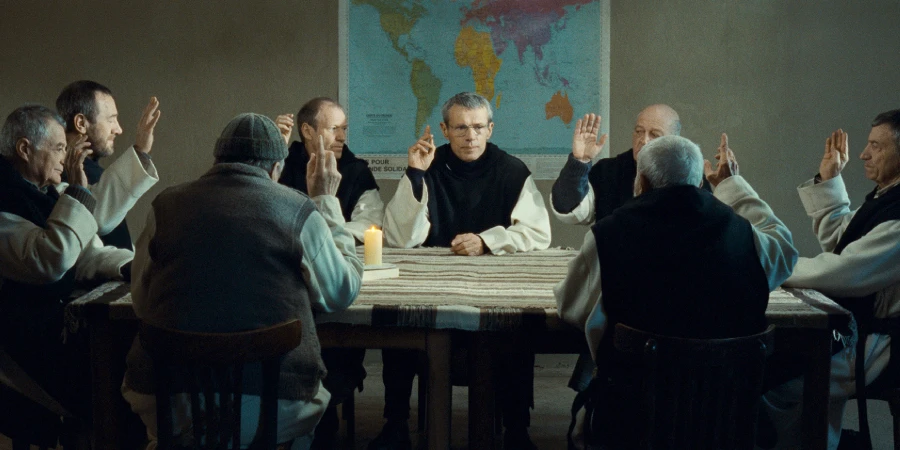
Each monk votes individually on whether to remain. Some waver; some are resolute. The democratic and deeply personal nature of this process reveals distinct personalities within the community, each man carrying his own relationship with fear and faith.
Ultimately, every monk chooses to stay. This collective decision does not feel triumphant; it feels sober and costly. Beauvois films it with almost unbearable restraint.
The Last Supper Scene
Brother Luc obtains a recording of Tchaikovsky’s Swan Lake, and the monks share wine and listen together in what functions as a cinematic last supper. Beauvois holds on each face for an extended, wordless sequence. Tears, smiles, and private farewells pass across their features without a single line of dialogue.
This scene stands as one of the most emotionally powerful moments in contemporary cinema. It does not announce itself as significant; it simply is. Audiences feel the finality without needing it explained.
Kidnapping and Disappearance
In March 1996, armed men enter the monastery at night and take seven of the nine monks. Brothers Amédée and Jean-Pierre remain behind. No violence occurs during the abduction itself, which makes the sequence eerily quiet and all the more disturbing.
The film follows the monks briefly into the mountains as they walk through snow in their white robes. This image carries an almost ghostly beauty. Then the film simply ends.
Movie Ending
Beauvois refuses to show the deaths. Seven monks disappear into the fog and snow of the Atlas Mountains, and the screen fades to black. A title card explains that the monks were found dead in May 1996; the exact circumstances of their deaths remain unknown to this day.
This choice is profoundly deliberate. Showing the executions would have transformed a meditation on faith into a thriller. By cutting away, Beauvois forces the audience to sit with uncertainty, which is precisely the condition in which the monks themselves lived and died.
Audiences often ask whether the monks knew they would be killed. Of Gods and Men suggests they did, particularly through Christian’s secret testament and the overwhelming gravity of that final shared meal. Their knowledge makes their choice to remain more extraordinary, not less.
Some viewers also wonder whether the GIA (Armed Islamic Group) or the Algerian government was responsible for the deaths. This question remains genuinely unresolved historically. Beauvois wisely refuses to assign blame, keeping the film focused on the monks’ spiritual journey rather than political attribution.
The two surviving monks, Amédée and Jean-Pierre, never appear in the film’s epilogue. Their survival is mentioned only in the closing titles. Consequently, the film’s final emotional register belongs entirely to the seven who did not return.
Are There Post-Credits Scenes?
Of Gods and Men contains no post-credits scenes whatsoever. After the closing titles and historical information, the film simply ends. Given the contemplative and solemn nature of the story, any such addition would have been deeply inappropriate.
Type of Movie
Of Gods and Men is a historical drama rooted in true events. It also functions as a spiritual film and a meditation on mortality, community, and conscience. Some critics classify it as a slow cinema work due to its deliberate pacing and emphasis on silence and ritual.
In terms of tone, the film is grave, tender, and quietly devastating. It never exploits emotion; instead, it earns every moment of feeling through patient observation. Viewers expecting conventional dramatic tension will need to adjust their expectations accordingly.
Cast
- Lambert Wilson – Brother Christian de Chergé
- Michael Lonsdale – Brother Luc
- Olivier Rabourdin – Brother Christophe
- Philippe Laudenbach – Brother Célestin
- Jacques Herlin – Brother Amédée
- Loïc Pichon – Brother Jean-Pierre
- Xavier Maly – Brother Michel
- Jean-Marie Frin – Brother Paul
- Farid Larbi – Rabiah
- Sabrina Ouazani – Aïssa
Film Music and Composer
Xavier Beauvois made an unusual and inspired decision regarding the score: he used pre-existing classical and sacred music rather than a commissioned original score. Gregorian chants feature prominently throughout, reinforcing the liturgical rhythm of the monks’ daily lives.
Tchaikovsky’s Swan Lake provides the emotional centerpiece during the film’s most celebrated scene. Its use is unexpected in an Algerian monastery setting; however, that very incongruity gives the sequence its piercing quality. Beauty arrives from an unlikely source, just as it does throughout the film.
Sacred choral works and traditional monastic music also underscore the prayer sequences. These pieces reinforce the authenticity of the monks’ daily routine. Music in this film functions less as accompaniment and more as liturgy.
Filming Locations
For security reasons, production could not film in Algeria itself. Instead, Beauvois shot the monastery sequences at the Abbaye Notre-Dame de Tamié in the French Alps in Savoie. This Cistercian monastery provided an authentic environment that closely mirrored the Tibhirine monastery in Algeria.
Exterior landscape shots were filmed in Morocco, which offered terrain similar to the Algerian Atlas Mountains. This combination of locations allowed the production to maintain visual authenticity without placing the cast and crew in danger.
Furthermore, filming within an actual working Cistercian monastery shaped the performances in unexpected ways. Actors participated in real monastic routines during production. That immersive approach gave the film its remarkable lived-in quality.
Awards and Nominations
Of Gods and Men won the Grand Prix at the 2010 Cannes Film Festival, the festival’s second-highest honor. It also represented France as its submission for the Academy Award for Best Foreign Language Film, though it did not receive a nomination.
In addition, the film won the César Award for Best Film and the César Award for Best Director for Xavier Beauvois in 2011. Lambert Wilson and Michael Lonsdale both received César nominations for their performances. Notably, Michael Lonsdale won the César for Best Supporting Actor.
Behind the Scenes Insights
- Lambert Wilson, who plays Prior Christian, learned to chant Gregorian music authentically for his role and spent time with real Cistercian monks before filming began.
- Michael Lonsdale drew on his own deep Catholic faith to portray Brother Luc, and he stated in interviews that playing the role was a profoundly personal spiritual experience for him.
- Beauvois cast non-professional actors from the local Moroccan community for smaller supporting roles, contributing to the film’s documentary-like atmosphere.
- The production team lived alongside the monks at the Abbaye Notre-Dame de Tamié during filming, attending prayer sessions and following the monastic schedule.
- Beauvois reportedly kept the set extremely quiet between takes, discouraging casual conversation so that the contemplative atmosphere could be maintained throughout the shoot.
- The filming of the Swan Lake dinner sequence was shot in a single extended take, allowing the actors’ genuine emotional reactions to accumulate naturally over time.
- Xavier Beauvois co-wrote the screenplay with Étienne Comar, drawing heavily on documented testimonies and the actual writings of Christian de Chergé.
Inspirations and References
The film draws directly from the true story of the Tibhirine monks, seven Cistercian monks from the Monastery of Our Lady of Atlas in Algeria who were kidnapped in March 1996 and found dead in May of that year. Their story became internationally known and prompted widespread debate about faith, martyrdom, and the Algerian civil war.
Christian de Chergé’s actual testament, written before his death and addressed to his potential murderer, heavily influenced the film’s characterization of the prior. This document, full of forgiveness and spiritual clarity, is one of the most remarkable texts produced by any modern religious figure.
John W. Kiser’s book The Monks of Tibhirine: Faith, Love, and Terror in Algeria served as a key research source for the screenplay. Moreover, Beauvois and Comar consulted surviving monks and people who knew the Tibhirine community personally. Their testimonies shaped the film’s intimate and specific character portraits.
Alternate Endings and Deleted Scenes
No officially released deleted scenes or alternate endings exist for Of Gods and Men. Beauvois has spoken about the film’s tight construction, and the ending’s deliberate ambiguity appears to have been central to the project from an early stage. No alternate cut has surfaced in any home release.
Book Adaptations and Differences
Of Gods and Men is not a direct adaptation of any single book. It draws on historical record, personal testimonies, and Christian de Chergé’s own writings rather than adapting one source text. Kiser’s The Monks of Tibhirine informed the research process, but the screenplay is an original work.
Consequently, comparing the film to a single literary source is not straightforward. Beauvois and Comar synthesized multiple sources into a dramatization that prioritizes spiritual and emotional truth over biographical completeness. Some individual monks receive less screen time than their documented stories might warrant.

Memorable Scenes and Quotes
Key Scenes
- Christian’s Christmas Eve confrontation with the militia leader, where he calmly quotes the Quran and refuses to hand over medical supplies or Brother Luc.
- The individual voting sequences, where each monk privately reveals his decision to stay or leave, each face telling a distinct and quietly devastating story.
- The extended Swan Lake dinner scene, where the monks share wine and silently say goodbye to one another without speaking a word.
- The haunting final image of the monks walking in single file through snow and fog into the mountains, their white habits becoming indistinct in the white landscape.
- Brother Luc treating an endless stream of patients in his clinic, demonstrating the monks’ irreplaceable role in the community’s daily life.
- Christian reading his completed testament alone, the camera holding on his face as he processes what he has committed to paper and to God.
Iconic Quotes
- “My life is not more valuable than any other. It is not less valuable either.” (Christian, on the decision to stay)
- “I’ve already given my life. It was given a long time ago.” (Brother Luc, on his apparent fearlessness in the face of death)
- “If it should happen one day that I become a victim of the terrorism which now seems ready to encompass all the foreigners living in Algeria, I would like my community, my Church, my family, to remember that my life was given to God and to this country.” (from Christian’s testament, read in voice-over)
Easter Eggs and Hidden Details
- The monks’ robes shift subtly in appearance across the film, moving from bright white at the start to a slightly more worn and muted look by the final scenes, suggesting the psychological toll of their situation without any dialogue acknowledging it.
- Background details in the medical clinic scenes show prescriptions and medicine bottles typical of the mid-1990s, grounding the film precisely in its historical period.
- During the opening prayer sequences, the chants used are authentic to the Cistercian liturgical tradition, not generic sacred music composed for the film, a detail that rewards viewers familiar with monastic music.
- Christian’s bookshelf, visible in several scenes, contains texts on Islamic theology alongside Christian scriptures, quietly illustrating his genuine intellectual engagement with the religion of his neighbors.
- The snow in the final sequence appears to intensify slightly as the monks walk further from the camera, a subtle visual effect that accelerates their disappearance into the landscape.
Trivia
- Of Gods and Men became one of the highest-grossing French films of 2010 in France, an extraordinary commercial achievement for a slow, dialogue-driven drama about monks.
- Xavier Beauvois himself is not a practicing Catholic, which makes his deeply empathetic portrayal of monastic faith all the more striking to critics and religious communities alike.
- Lambert Wilson, primarily known before this film for action and mainstream roles including his appearance in The Matrix Reloaded, cited this as the most challenging and meaningful work of his career.
- Michael Lonsdale was already in his late seventies during production, and his natural frailty added an additional layer of poignancy to Brother Luc’s calm acceptance of mortality.
- The real Monastery of Our Lady of Atlas in Tibhirine, Algeria, still operates today under a small community of monks, decades after the 1996 tragedy.
- Pope John Paul II cited the Tibhirine monks as martyrs, and their beatification process within the Catholic Church advanced significantly in subsequent years after the film’s release.
- France’s selection of the film as its Oscar submission generated significant media attention and renewed public interest in the Tibhirine story among French audiences.
Why Watch?
Of Gods and Men offers something genuinely rare in cinema: a portrait of courage that contains no action sequences, no villains in close-up, and no redemptive Hollywood finale. Its power comes entirely from character, faith, and the agonizing weight of a free choice. Few films demand and reward patience in equal measure so completely.
Director’s Other Movies
- Nord (1991)
- Don’t Forget You’re Going to Die (1995)
- The Count of Monte Cristo (1998) – tv series
- Le Petit Lieutenant (2005)
- The Price of Fame (2014)