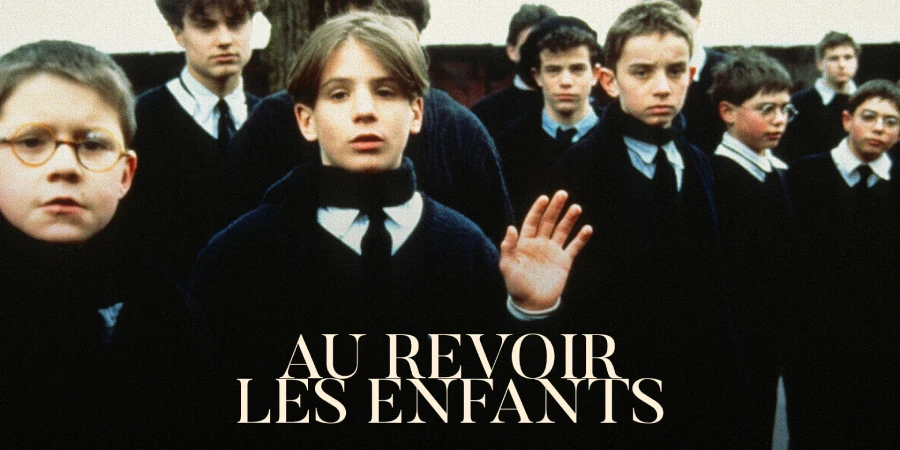

Louis Malle’s Au revoir les enfants hits you like a punch to the chest, and it never apologizes for it. Based directly on one of the most painful memories of Malle’s own childhood, this 1987 film follows two boys at a French boarding school during the Nazi occupation, building a fragile friendship that ends with one of cinema’s most devastating final moments. It is quiet, precise, and utterly merciless. Few films about childhood carry this much weight.
Detailed Summary
Julien Returns to School
It is January 1944, and twelve-year-old Julien Quentin returns to his Catholic boarding school in rural France after the Christmas holidays. He clings to his mother at the station, embarrassed by his own emotion, while the shadow of wartime occupation hangs over everything. Rationing, cold dormitories, and German soldiers in the background define the daily texture of life.
Julien is bright, a little arrogant, and socially confident among his peers. He reads voraciously, competes fiercely at games, and occupies a comfortable position in the school’s social order. His world, in other words, feels secure enough, at least for now.
Jean Bonnet Arrives
A new boy, Jean Bonnet, joins the school mid-term. He is reserved, intellectually gifted, and notably unwilling to talk about his family. Julien immediately senses something different about Jean, though he cannot name it. Other boys bully Jean, drawn to the mystery and slight otherness he projects.
Julien and Jean slowly gravitate toward each other, drawn together by their shared love of reading and music. However, this friendship develops with friction; Julien can be cruel one moment and generous the next. Their dynamic feels recognizably real, messy in the way that actual childhood friendships often are.
The Secret Revealed
Julien gradually pieces together the truth. Jean Bonnet is not Jean Bonnet at all; his real name is Jean Kippelstein, and he is Jewish. Father Jean, the school’s headmaster, is hiding Jean and at least two other Jewish boys among the student population, providing them with false identities to protect them from deportation.
Julien discovers this partly by accident, noticing Jean’s prayer book and then his circumcision during a bath. He processes this information with a child’s incomplete moral vocabulary. He does not fully grasp the danger, but he understands that keeping the secret matters enormously.
A Deepening Friendship
As weeks pass, Julien and Jean develop a genuine bond. A key moment arrives when the two boys get lost in the forest during a scavenger hunt and spend a tense, cold evening together before being found. This shared vulnerability strips away Julien’s pretension and Jean’s guardedness.
Meanwhile, the school’s kitchen helper, Joseph, runs a small black market operation, selling food and goods to students. Father Jean eventually discovers this and dismisses Joseph from the school. Joseph is humiliated and furious. That dismissal will have catastrophic consequences.
Ordinary Life Under Occupation
Malle is careful to show that life at the school is not purely dramatic. Boys play, argue, and study. A scene at a local restaurant is particularly telling: German officers attempt to eject a Jewish man from the restaurant, and the French patrons intervene, a small act of decency in a landscape of collaboration and fear.
Father Jean’s lectures reference the moral responsibilities of ordinary people under oppression. These are not subtle hints; they are direct. The film trusts its audience to connect the classroom ethics to the moral stakes unfolding in real time.


Movie Ending
On a January morning, the Gestapo arrives at the school. Officers stride into a classroom where Julien sits alongside Jean. In a moment that has haunted Louis Malle for decades, Julien instinctively glances toward Jean before he can stop himself. That glance, whether it actually betrayed Jean or simply coincided with the Gestapo already knowing, is something Malle admitted he could never resolve with certainty in his own memory.
The Gestapo officers identify Jean and the other hidden Jewish boys. Father Jean is also arrested. Students and teachers line the courtyard as the arrested boys are led away. Jean turns and looks back at Julien; his expression carries no accusation, only a quiet, unbearable farewell.
Father Jean pauses and addresses the boys gathered in the courtyard: “Au revoir, les enfants.” It is a simple goodbye, but it carries the full weight of what everyone understands and cannot say aloud. Joseph’s earlier betrayal, his act of revenge against the school that fired him, almost certainly triggered the Gestapo’s visit.
A closing title card delivers the film’s final blow. Jean and the two other Jewish boys died at Auschwitz. Father Jean died at the Mauthausen concentration camp. Malle’s voice, in narration, states that more than forty years have passed and he has never stopped thinking about that morning. The film ends not with catharsis but with guilt, memory, and an open wound that time refuses to close.
Are There Post-Credits Scenes?
Au revoir les enfants contains no post-credits scenes of any kind. After the title cards deliver their devastating historical postscript, the film simply ends. There is nothing to wait for; the silence is entirely intentional.
Type of Movie
This is a historical drama rooted in autobiographical memory, set during the German occupation of France. Its tone is restrained and naturalistic, favoring observation over melodrama. Some critics also classify it as a coming-of-age film, though it strips that genre of any comfort or easy growth narrative.
Emotionally, it operates in a register of quiet dread. Malle builds tension not through conventional thriller mechanics but through the accumulation of small, ordinary details that make the final catastrophe feel both inevitable and unbearable.
Cast
- Gaspard Manesse – Julien Quentin
- Raphael Fejto – Jean Bonnet (Jean Kippelstein)
- Francine Racette – Madame Quentin, Julien’s mother
- Stanislas Carre de Malberg – Francois Quentin, Julien’s older brother
- Philippe Morier-Genoud – Father Jean
- Francois Berleand – Father Michel
- Peter Fitz – Muller, the Gestapo officer
- Francois Negret – Joseph
Film Music and Composer
Schubert’s piano music plays a central role in the film’s emotional architecture. Jean performs Schubert at the school, and those scenes are among the most quietly powerful in the entire film. Malle did not commission an original dramatic score; instead, he let classical music and ambient sound carry the emotional weight.
In addition to Schubert, Saint-Saens appears on the soundtrack. The deliberate restraint in the music mirrors Malle’s overall directorial philosophy: nothing is overstated, and the audience must lean in rather than be told how to feel.


Filming Locations
Principal photography took place at the Petit College d’Avon, near Fontainebleau in France. This is the actual school where the real events occurred, making the location choice both historically significant and personally charged for Malle. Shooting on the real site gave the film an undeniable authenticity.
Fontainebleau’s winter landscape, cold, grey, and forested, contributes enormously to the film’s atmosphere. The forest sequence, where Julien and Jean get lost, used the actual woods surrounding the school. Consequently, the setting functions almost as a character in itself.
Awards and Nominations
Au revoir les enfants won the Golden Lion at the Venice Film Festival in 1987, one of cinema’s most prestigious prizes. It also received a nomination for the Academy Award for Best Foreign Language Film and won multiple Cesar Awards, including Best Film and Best Director for Louis Malle.
Furthermore, the film received widespread critical recognition across Europe and North America, cementing its status as one of the defining European films of the 1980s.
Behind the Scenes Insights
- Louis Malle carried the memory of the real events for nearly forty years before he felt ready to make this film. He described it as the most personal project of his career.
- Malle cast non-professional child actors in the lead roles, choosing Gaspard Manesse and Raphael Fejto specifically for their naturalistic presence rather than formal training.
- Both boys were coached carefully but allowed to improvise within scenes, giving their interactions an unscripted, genuine quality.
- Malle kept the full nature of the story from the child cast initially, revealing details gradually to preserve authentic emotional reactions on camera.
- Shooting took place in sequence, which helped the young actors build their relationship organically rather than jumping between scenes.
- Francine Racette, who plays Julien’s mother, is Malle’s real-life partner, adding another layer of personal investment to the production.
Inspirations and References
Louis Malle based the film directly on his own childhood experience at the Petit College d’Avon. The real boy he befriended, Hans-Helmut Michel, was one of three Jewish children hidden by the school’s headmaster, Father Jacques de Jesus. Father Jacques was later recognized as Righteous Among the Nations by Yad Vashem.
Malle read extensively about the occupation period and consulted historical records to ensure the film’s depiction of daily life under German occupation remained accurate. However, the emotional core of the film comes entirely from personal memory rather than research.
Alternate Endings and Deleted Scenes
No alternate endings or significant deleted scenes from Au revoir les enfants have been formally documented or released. Malle was characteristically precise in his editing, and the film as released reflects his complete artistic vision. No extended cuts or substantially different versions are known to exist.
Book Adaptations and Differences
Au revoir les enfants is not based on a book. Louis Malle wrote the original screenplay himself, drawing on personal memory. Malle did later publish the screenplay in written form, but the film came first and serves as the primary work.


Memorable Scenes and Quotes
Key Scenes
- Julien and Jean lost in the Fontainebleau forest at dusk, vulnerable and finally honest with each other.
- Jean playing Schubert on the school piano, with the other boys gradually falling silent to listen.
- The restaurant scene, where French patrons defend an elderly Jewish man against German officers attempting to remove him.
- The Gestapo’s arrival in the classroom, and Julien’s fateful involuntary glance toward Jean.
- Father Jean pausing in the courtyard and saying goodbye to his students as he is led away.
- The closing title cards, delivered in near silence, naming where each boy and Father Jean died.
Iconic Quotes
- “Au revoir, les enfants.” Father Jean’s farewell to his students in the courtyard.
- Malle’s closing narration: “I will remember every second of that January morning until the day I die.”
- Julien, after Jean reveals his real name: a silence that functions more powerfully than any spoken line.
Easter Eggs and Hidden Details
- Father Jean in the film closely mirrors the real Father Jacques in speech patterns and mannerisms, based on accounts Malle gathered from former students who knew him.
- Books visible in Jean’s possession include titles that would have been considered subversive or dangerous under the occupation, a detail most viewers miss on first viewing.
- Joseph’s black market dealings are shown before his dismissal with deliberate specificity, so attentive viewers understand his motive for betrayal long before the climax.
- The scarf Julien’s mother wraps around him at the opening station scene reappears later in the film, a subtle visual thread connecting family warmth to the film’s colder second half.
- Sounds of distant air raids and radio broadcasts in the background establish the war’s proximity without ever directly depicting combat.
Trivia
- Malle was approximately twelve years old, the same age as Julien, when the real events took place in 1944.
- The real Father Jacques de Jesus survived the concentration camps initially but died shortly after liberation, in 1945, from the effects of his imprisonment.
- Au revoir les enfants was selected as France’s official submission to the Academy Awards in the Foreign Language Film category for 1988.
- Gaspard Manesse, who played Julien, largely stepped away from acting after this film, making his performance here all the more singular.
- Malle reportedly wept during certain takes, particularly during the final courtyard sequence, and had to step away from the monitor.
- Critics frequently cite this film alongside The 400 Blows and Zero for Conduct when discussing the great French films about childhood.
Why Watch?
Au revoir les enfants is essential viewing because it refuses to make tragedy comfortable or distant. Louis Malle turns personal guilt into universal moral reckoning, using two boys and a school to ask what ordinary people owe each other under impossible circumstances. Notably, its restraint makes it more devastating than any film that shouts. It stays with you for years.
Director’s Other Movies
- Elevator to the Gallows (1958)
- The Lovers (1958)
- Zazie dans le Metro (1960)
- Murmur of the Heart (1971)
- Lacombe, Lucien (1974)
- Atlantic City (1980)
- My Dinner with Andre (1981)
- Damage (1992)
- Vanya on 42nd Street (1994)
Recommended Films for Fans
- The 400 Blows (1959)
- Lacombe, Lucien (1974)
- Europa Europa (1990)
- The White Ribbon (2009)
- Mephisto (1981)
- The Boy in the Striped Pajamas (2008)
- Forbidden Games (1952)
- Son of Saul (2015)
- Zero for Conduct (1933)