
Emir Kusturica does not make quiet films. Life Is a Miracle arrives in a storm of chickens, accordions, war-torn grief, and absurd tenderness, and it refuses to let go until it has wrung every last emotion out of you. Set against the backdrop of the Bosnian War, this Serbian epic follows a man whose life collapses and then, improbably, blooms again. It is ridiculous, heartbreaking, and completely alive.
Detailed Summary
Luka Arrives in the Balkans with Big Dreams
Luka, a Serbian railway engineer played by Slavko Stimac, relocates with his family to a small village in the mountains of Bosnia. He carries enormous enthusiasm for a new railway construction project, convinced it will transform the region. His optimism immediately clashes with the chaotic, indifferent energy of everyone around him.
His wife, Jadranka, grows increasingly restless and disconnected from the moment they arrive. Meanwhile, his son Milos shows genuine promise as a footballer, which gives Luka a second source of pride. These two threads, the railway and the son, are what the first act carefully builds before pulling them both away.
The War Begins and Everything Fractures
As the Yugoslav Wars escalate, the construction project stalls and the village transforms into something unrecognizable. Jadranka, already unstable and emotionally adrift, eventually abandons her family and runs off with a Hungarian officer. Her departure devastates Luka but does not entirely surprise the audience, given how visibly she had been unraveling.
Milos, on the verge of a promising football career, gets conscripted into the Serbian army. Luka watches helplessly as his son marches off to a war that feels both abstract and catastrophically real. In contrast to Luka’s warm absurdity, the war carries a cold, grinding indifference that Kusturica refuses to glamorize.
Sabaha Enters the Picture
A young Bosniak Muslim woman named Sabaha arrives as a prisoner of war and ends up placed under Luka’s care. She is frightened, grieving, and completely out of place in his chaotic household. Luka, equally lost and lonely, is supposed to hold her as a potential exchange for a Serbian prisoner, which happens to be his own son Milos.
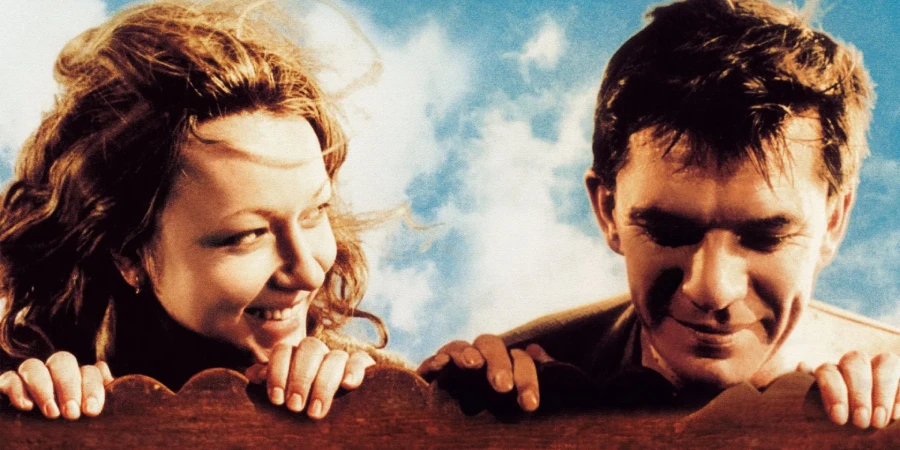
However, proximity and shared grief do what they always do. Luka and Sabaha begin to fall in love despite the absurdity and the horror of the situation surrounding them. Kusturica frames their growing bond with the same anarchic warmth he applies to everything else, making it feel earned rather than forced.
Love in the Time of Chaos
Their relationship deepens as Luka’s world continues to fragment. His loyal donkey, his raucous neighbors, and his crumbling railway project all serve as a kind of darkly comic Greek chorus. Kusturica layers in constant noise, animals, music, and slapstick precisely to emphasize the stubborn persistence of ordinary life during wartime.
Sabaha and Luka share moments of genuine sweetness that feel almost stolen from a different, kinder film. She confides in him, he protects her, and together they build something fragile and real. Notably, this romance does not sanitize the political reality; both characters understand their love is dangerous and complicated by the war around them.
The Prisoner Exchange and Its Consequences
Arrangements move forward for Sabaha to be exchanged for Milos. Luka faces an impossible choice between his son and the woman he loves. Kusturica does not make this clean or comfortable; the emotional weight of the exchange saturates every scene leading up to it.
When Milos finally returns, he is physically intact but emotionally damaged by what he has seen. Luka’s joy at his son’s return gets immediately complicated by the absence of Sabaha, who has been taken away in the exchange. Consequently, the reunion feels bittersweet rather than triumphant.

Movie Ending
Luka cannot simply accept losing Sabaha. He pursues her, crossing into territory that the war has made treacherous and absurd in equal measure. Kusturica stages this final pursuit as something between a fairy tale and a desperate act of love, complete with the film’s characteristic mix of chaos and beauty.
Sabaha and Luka find each other again. Their reunion carries the weight of everything the film has built: war, loss, separation, and the stubborn refusal of love to follow the rules imposed on it. Milos, meanwhile, processes his own trauma and begins to look forward rather than backward, which gives the ending a sense of generational continuation.
Jadranka resurfaces in the final stretch, now clearly broken by her own choices. Her return is not triumphant; it is pathetic in the classical sense, a once-vibrant woman hollowed out by bad decisions. Kusturica uses her reappearance to underscore what Luka and Sabaha have built together, by contrast.
The film closes on an image of improbable, defiant happiness. Life, Kusturica insists, does not stop for war or grief or political catastrophe. Therefore, the title functions as both an observation and a declaration: existence itself is the miracle, and it keeps insisting on continuing regardless of what humans do to each other.
Are There Post-Credits Scenes?
Life Is a Miracle contains no post-credits scenes. Kusturica ends the film proper and leaves the audience with the final images and music rather than any additional footage. You can safely leave when the credits roll.
Type of Movie
Life Is a Miracle is a romantic drama with very strong elements of dark comedy and war film. Its tone is deliberately inconsistent in the best possible way, shifting from slapstick to genuine tragedy without warning. Kusturica operates in a register that defies easy genre labeling, much like his earlier work.
Audiences expecting a straightforward war romance will find something far more anarchic and surreal. In contrast to polished Hollywood wartime love stories, this film leans into disorder, noise, and the absurd. That contrast is precisely where its emotional power lives.
Cast
- Slavko Stimac – Luka
- Natasa Solak – Sabaha
- Vesna Trivalic – Jadranka
- Vuk Kostic – Milos
- Aleksandar Bercek – Veljo
Film Music and Composer
Emir Kusturica himself composed and performed music for the film alongside his band, The No Smoking Orchestra. Their sound blends Serbian folk traditions with punk energy, brass band chaos, and raw emotionalism. Music in a Kusturica film is never background noise; it actively participates in the storytelling.
The score pulses through every major scene, amplifying the emotional swings between comedy and grief. Brass instruments carry much of the dramatic weight, which is characteristic of Kusturica’s broader musical identity. For instance, celebratory scenes explode with trumpet-heavy arrangements that feel simultaneously joyful and slightly unhinged.
Filming Locations
Principal photography took place in Serbia, with Kusturica shooting on location in the rugged Balkan countryside. The mountainous terrain is not merely a backdrop; it becomes a visual metaphor for the isolating, difficult terrain of the characters’ emotional lives. Kusturica built an actual village set for production, which he later transformed into the tourist village of Drvengrad (also known as Mecavnik).
Drvengrad still exists today as a functioning cultural village and continues to attract visitors. Shooting in this environment gave the film an authenticity that studio work could not have replicated. Furthermore, the railway construction sequences benefited enormously from using real landscape rather than constructed sets.
Awards and Nominations
Life Is a Miracle competed in the main competition at the Cannes Film Festival in 2004, which represents one of cinema’s most prestigious platforms. However, the film did not take home the Palme d’Or or major Cannes prizes that year.
Kusturica’s reputation ensured the film received serious critical attention globally, and it performed well at various European festivals. Nonetheless, its major awards footprint remained modest compared to some of his earlier celebrated works.
Behind the Scenes Insights
- Kusturica constructed an entire village set for the film, which he subsequently converted into the real inhabited settlement of Drvengrad.
- The director cast non-professional actors alongside trained performers to maintain a sense of authentic, unpolished energy on screen.
- Animals feature prominently throughout the film, and Kusturica reportedly insisted on using live animals extensively rather than relying on effects or trained animal actors in controlled settings.
- The No Smoking Orchestra performed live on set during certain scenes, which influenced the energy and pacing of those sequences.
- Kusturica has spoken about the film as a deeply personal response to the trauma of the Yugoslav Wars and his own complicated national identity during that period.
Inspirations and References
Kusturica drew directly from the experience of the Yugoslav Wars of the 1990s, channeling collective Balkan trauma into a story about individual survival and love. His own background as a Sarajevo-born Bosnian Serb gave him an intimate, conflicted perspective on the war’s human cost. The film does not take clean political sides, which reflects Kusturica’s genuine ambivalence about the conflict.
Thematically, the film echoes the tradition of magical realism in Eastern European cinema and literature. Directors like Fellini and writers like Gabriel Garcia Marquez cast a visible influence over Kusturica’s sensibility. Similarly, his own earlier films, particularly Underground (1995), share the same appetite for grand emotional excess set against political catastrophe.
Alternate Endings and Deleted Scenes
No officially documented alternate endings or deleted scenes from Life Is a Miracle have entered wide public circulation. Kusturica has not released extended cuts or behind-the-scenes materials that reveal substantially different versions of the film. As a result, what audiences saw on release appears to represent Kusturica’s complete and intended vision.
Book Adaptations and Differences
Life Is a Miracle is not based on a book or pre-existing literary source. Kusturica developed the story as an original screenplay. No comparative literary analysis therefore applies here.

Memorable Scenes and Quotes
Key Scenes
- Luka’s exuberant arrival in the village, surrounded by chaos, animals, and his own infectious enthusiasm, sets the film’s anarchic tone immediately.
- Jadranka’s public breakdown, performed with frightening intensity by Vesna Trivalic, signals the irreversible fracturing of Luka’s original life.
- The scene where Luka and Sabaha share a quiet moment of connection amid the surrounding war noise is one of the film’s most emotionally precise sequences.
- The prisoner exchange sequence, where Sabaha departs and Milos returns, delivers the film’s most gut-wrenching emotional payload.
- Luka’s final pursuit of Sabaha, half desperate and half fairy tale, crystallizes everything the film argues about love’s stubborn persistence.
Iconic Quotes
- “Life is a miracle” appears in various forms throughout the film, functioning as both irony and genuine affirmation depending on the context.
- Luka’s declarations of love to Sabaha carry a blunt, unpoetic directness that makes them unexpectedly moving.
Easter Eggs and Hidden Details
- The railway project that Luka works on mirrors the broader futility of trying to impose order on a landscape, and a society, actively resisting it.
- Animals throughout the film frequently behave in ways that comment on human action, a recurring Kusturica device that rewards attentive viewers.
- Musical motifs associated with specific characters recur subtly during scenes where those characters are absent but emotionally present, linking sound to memory.
- The village set’s deliberately theatrical quality, slightly too colorful and slightly too loud, consistently signals that Kusturica is operating in heightened reality rather than strict naturalism.
Trivia
- Kusturica transformed the film’s purpose-built village set into Drvengrad, a real cultural and artistic community in Serbia that continues to host events and tourists.
- At roughly 154 minutes, the film is one of Kusturica’s longer works, which reflects his preference for epic emotional canvases over tight narratives.
- The No Smoking Orchestra, Kusturica’s band, released a soundtrack album connected to the film that found its own audience beyond the movie itself.
- Kusturica has described this film as among his most personal, partly because it engages directly with the war that defined the region of his birth.
- Life Is a Miracle was Serbia and Montenegro’s submission for consideration for the Academy Award for Best Foreign Language Film, though it did not receive a nomination.
Why Watch?
Few filmmakers treat chaos as lovingly as Kusturica does here. This film makes you laugh, ache, and marvel, sometimes within the same minute. Moreover, its argument that love survives catastrophe lands with genuine force because Kusturica earns it through two hours of honest emotional labor, not sentiment.
Director’s Other Movies
- Do You Remember Dolly Bell? (1981)
- When Father Was Away on Business (1985)
- Time of the Gypsies (1988)
- Arizona Dream (1993)
- Underground (1995)
- Black Cat, White Cat (1998)
- Promise Me This (2007)
- On the Milky Road (2016)
Recommended Films for Fans
- Underground (1995)
- Black Cat, White Cat (1998)
- Time of the Gypsies (1988)
- No Man’s Land (2001)
- Before the Rain (1994)
- Amelie (2001)
- The Lives of Others (2006)