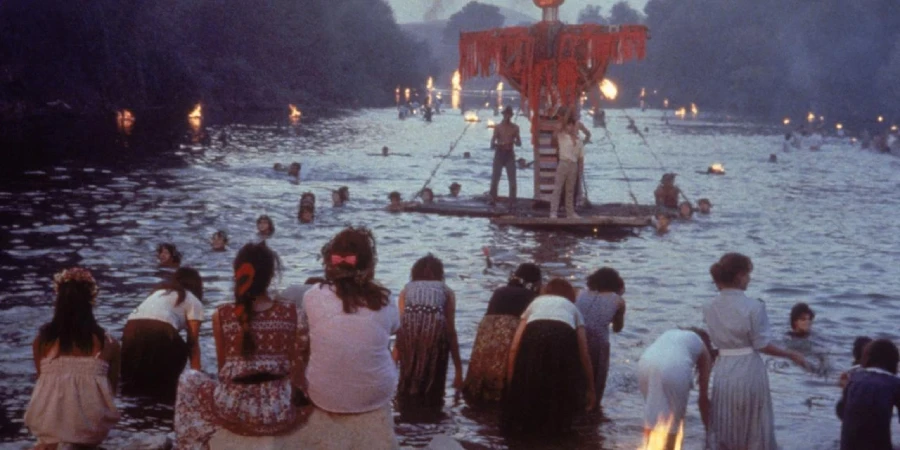

A young Romani boy with telekinetic powers gets swallowed whole by a criminal underworld, and Time of the Gypsies never lets you look away. Director Emir Kusturica crafted one of cinema’s most hypnotic fever dreams in 1988, blending magical realism with brutal social critique. This film does not flinch. It earns every tear and every gut punch it delivers.
Detailed Summary
Perhan’s World in the Village
We meet Perhan, a teenage Romani boy living in a poor Yugoslav village with his grandmother, Baba Sita, and his younger sister, Danira. Perhan possesses a quiet, mysterious telekinetic ability, which he uses for small tricks and private amusement. His world is humble but alive with color, music, and communal energy.
Perhan is deeply in love with Azra, a girl from his community. Her mother, however, disapproves of him entirely, viewing Perhan as too poor and too rootless. This rejection becomes one of the emotional engines driving the entire story forward.
Ahmed and the Promise of Italy
A local crime figure named Ahmed arrives and offers to take Danira to Slovenia for medical treatment for her damaged leg. Baba Sita reluctantly agrees, but Ahmed also persuades her to let Perhan accompany him. Perhan sees this as his chance to earn money and prove himself worthy of Azra.
Ahmed is charming on the surface but corrupt underneath. He runs a child-trafficking and begging operation in Italy, exploiting Romani children for profit. Perhan, naive and desperate, does not yet understand what he has walked into.
Life in Ahmed’s Criminal Network
Once in Italy, Perhan witnesses the full machinery of Ahmed’s operation. Children beg on the streets, and Ahmed collects every coin they earn. Meanwhile, Danira disappears from the picture, and Ahmed keeps stalling whenever Perhan asks about her whereabouts.
Perhan gradually rises within Ahmed’s network. He proves useful, resourceful, and willing to do what it takes. Consequently, Ahmed grooms him as a lieutenant rather than treating him as a simple laborer.
Perhan’s telekinetic powers surface occasionally throughout this section, used in small, almost incidental ways. Kusturica keeps the magical realism low-key here, making it feel like a natural part of this world rather than a spectacle.
Azra, Pregnancy, and Betrayal
Azra eventually joins Perhan in Italy after he sends word and money back home. For a brief period, their relationship blooms, and Azra becomes pregnant with Perhan’s child. This represents the first real happiness Perhan has experienced since leaving the village.
However, Ahmed betrays Perhan in the most personal way possible. He sleeps with Azra, and she gives birth to a son. Perhan is devastated, unsure whether the child is his or Ahmed’s. This uncertainty destroys him emotionally and sets the tragic finale in motion.
Azra’s Death and the Baby
Azra dies during or shortly after childbirth, a loss that strips Perhan of his last remaining reason to stay within Ahmed’s world peacefully. He names the boy and raises him, but grief and rage continue to simmer. In addition, he never fully resolves his doubt about the child’s paternity.
Perhan becomes harder, colder, and more dangerous. He builds his own small criminal operation, mirroring Ahmed’s methods. Kusturica draws a direct line between victimization and the perpetuation of exploitation.
Return to the Village and Confrontation
Perhan eventually returns home, now a man with money and a reputation. He discovers that Danira, his sister, sold herself into a forced marriage as a direct result of the poverty and desperation his absence created. This revelation hits him like a physical blow.
Everything Perhan sacrificed and everything he became achieves nothing for his family. His grandmother still lives in poverty. His sister’s life has been damaged. Furthermore, the wealth he brings carries the stain of Ahmed’s criminal world.
Movie Ending
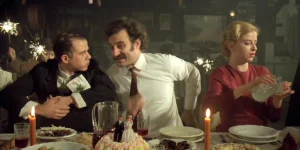
Perhan tracks down Ahmed at a lavish wedding celebration, one of those sprawling, chaotic, joyful Romani feasts that Kusturica films with such affectionate excess. He approaches Ahmed calmly, almost serenely. Then he stabs him.
Ahmed’s wife, who has her own grievances and loyalties in play, immediately shoots Perhan in retaliation. Perhan dies at the wedding, surrounded by music and chaos, holding his infant son. It is a devastating image, a man destroyed by the system he tried to beat at its own game.
In contrast to the violence of his death, the film closes on Perhan’s son. Years later, the boy has grown up and appears to be repeating his father’s trajectory, already drawn into petty crime and street life. Notably, the cycle does not break. Kusturica refuses to offer a redemptive exit.
This ending is the film’s most discussed element because it confirms what Kusturica argued throughout: structural poverty and exploitation reproduce themselves across generations. Perhan’s telekinetic gift, his capacity for something extraordinary, gets consumed entirely by circumstance. His death is not a dramatic climax so much as a quiet, inevitable conclusion.
The son spitting into the camera in the final shot directly implicates the audience. We watched. We did nothing. Kusturica makes sure we feel that.
Are There Post-Credits Scenes?
Time of the Gypsies contains no post-credits scenes. The film ends on that final, confrontational image, and Kusturica has no interest in softening the blow with additional footage.
Type of Movie
This film occupies a rare genre space: magical realist drama with strong elements of crime, coming-of-age tragedy, and social commentary. Its tone shifts fluidly between warmth and horror, between celebration and grief. Kusturica never lets either register dominate for too long.
In terms of mood, it resembles a folk tale that refuses to grant its protagonist a happy ending. Think Fellini filtered through the specific textures of Yugoslav Romani culture.
Cast
- Davor Dujmovic – Perhan
- Bora Todorovic – Ahmed
- Ljubica Adzovic – Baba Sita (Grandmother)
- Sinolicka Trpkova – Azra
- Husnija Hasimovic – Merdzan
Film Music and Composer
Goran Bregovic composed the score, and his contribution to the film’s identity cannot be overstated. Bregovic drew heavily from traditional Romani and Balkan brass music, creating a sound that feels simultaneously ancient and urgent. His work here essentially launched his international career as a composer.
Notable tracks weave together tupan drums, zurna, and accordion, instruments deeply embedded in Romani musical tradition. The music functions as a character in its own right, swelling during moments of joy and turning mournful when the story demands it. Moreover, Bregovic’s score became one of the most celebrated elements of the film’s overall reception.


Filming Locations
Principal photography took place in Yugoslavia, specifically in Romani settlements in the region that is now part of North Macedonia and surrounding areas. These locations were not dressed sets; they reflected genuine living conditions. Kusturica insisted on authenticity over comfort.
Scenes set in Italy were filmed on location as well, capturing the actual streets where Romani communities worked and survived. For instance, the contrast between the warm, village-based sequences and the cold Italian urban exteriors reinforces the film’s thematic argument about displacement and exploitation.
Awards and Nominations
Kusturica won the Best Director prize at the Cannes Film Festival in 1989 for this film, one of the most significant honors in world cinema. Time of the Gypsies also received Yugoslavia’s submission consideration for international attention during that period.
The Cannes recognition elevated both the film and Kusturica’s international profile significantly. Consequently, it remains one of the most decorated Yugoslav productions of its era.
Behind the Scenes Insights
- Kusturica cast non-professional actors from actual Romani communities for many supporting roles, prioritizing authenticity over polish.
- Davor Dujmovic, who played Perhan, was relatively unknown before the film and delivered a performance of remarkable emotional depth for a young actor.
- Kusturica spent considerable time living with and observing Romani communities before and during production to inform his portrayal of their culture.
- The telekinetic sequences required careful practical staging; the production used simple wire rigs and in-camera techniques rather than elaborate visual effects.
- Goran Bregovic recorded much of the score with actual Romani musicians, some of whom also appear on screen in the film’s many celebratory scenes.
- The wedding and celebration sequences were partially improvised, with Kusturica allowing genuine community energy to shape the footage.
Inspirations and References
Kusturica drew from his direct observations of Yugoslav Romani life and from journalistic reporting on the exploitation of Romani children in Western Europe. The child-trafficking element reflected real criminal networks documented in that period. He did not adapt a specific source text.
Thematically, the film engages with a long tradition of Eastern European magical realism, echoing writers like Ivo Andric in its use of folk elements to illuminate social reality. On the other hand, Kusturica’s visual language owes something to Fellini’s carnivalesque style, particularly in the wedding and crowd sequences.
Alternate Endings and Deleted Scenes
No officially documented alternate endings or significant deleted scenes have entered the public record for Time of the Gypsies. Kusturica has not released or discussed a substantially different cut of the film in interviews or retrospectives that have been widely reported.
Book Adaptations and Differences
Time of the Gypsies is not based on a book or any pre-existing literary source. Kusturica developed the story as an original screenplay, informed by research and observation rather than by adapting another work.


Memorable Scenes and Quotes
Key Scenes
- Perhan making a spoon float through the air for Azra, a small act of wonder that captures the film’s magical realist heart.
- The arrival in Italy and Perhan’s first glimpse of Ahmed’s begging operation, where innocence visibly drains from his face.
- The sprawling wedding sequence early in the film, a raucous, joyful explosion of music and dance that establishes the cultural world Perhan will lose.
- Perhan discovering the truth about Azra and Ahmed, a scene played with restrained devastation rather than melodrama.
- The final confrontation at the wedding and Perhan’s death, bookending the film with another celebration turned to violence.
- The closing shot of Perhan’s son spitting directly into the camera, implicating every viewer in the cycle being depicted.
Iconic Quotes
- “You think money will make you a man. Money makes you a servant to money.” (Baba Sita to Perhan, paraphrased from the film’s dialogue)
- Perhan’s repeated insistence that he will return rich, a promise the film systematically dismantles.
Easter Eggs and Hidden Details
- The floating objects in Perhan’s telekinetic sequences often mirror his emotional state; objects rise when he feels hope and fall or shatter when he loses it.
- Kusturica frames Perhan’s village with warm, golden light throughout, a visual shorthand for the innocence he progressively abandons.
- Ahmed’s wardrobe grows increasingly elaborate as the film progresses, a subtle visual commentary on wealth built on exploitation.
- Several of the musicians visible in the wedding and celebration scenes are real Romani performers, not extras or actors.
- The turkey that appears periodically near Perhan functions as an almost totemic presence, a recurring absurdist element that Kusturica uses to punctuate tonal shifts.
Trivia
- Much of the film’s dialogue was performed in the Romani language, making it one of the very few major films to use Romani as its primary spoken language.
- Kusturica reportedly described the project as deeply personal, connecting it to his broader interest in marginalized communities within Yugoslavia.
- Davor Dujmovic, who gave such a defining performance as Perhan, tragically died in 1999 at a young age.
- The film runs approximately two and a half hours, yet its pacing rarely feels slow because Kusturica fills every frame with visual incident.
- Goran Bregovic went on to collaborate with Kusturica again on Underground (1995), cementing one of the most productive director-composer partnerships in European cinema.
- The production was a Yugoslav-British-Italian co-production, which helped secure the budget necessary for the Italy-based sequences.
Why Watch?
Time of the Gypsies offers something genuinely rare: a film that is simultaneously a visual feast and a moral reckoning. Kusturica presents Romani culture with specificity and love rather than condescension. Moreover, Bregovic’s score and Dujmovic’s performance together create an emotional experience that stays with you long after the credits roll.
Director’s Other Movies
- Do You Remember Dolly Bell? (1981)
- When Father Was Away on Business (1985)
- Arizona Dream (1993)
- Underground (1995)
- Black Cat, White Cat (1998)
- Life Is a Miracle (2004)
- Promise Me This (2007)
Recommended Films for Fans
- Underground (1995)
- Black Cat, White Cat (1998)
- Latcho Drom (1993)
- Gadjo Dilo (1997)
- Landscape in the Mist (1988)
- Pixote (1980)
- City of God (2002)