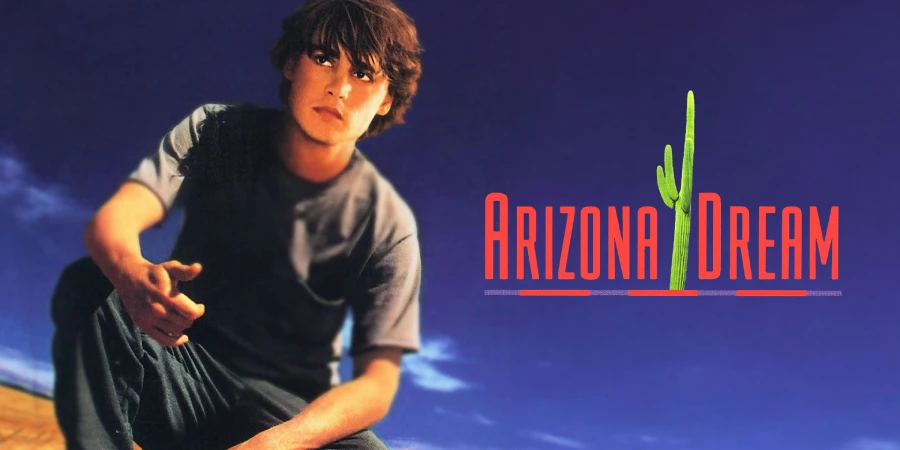

Few films dare to open with a man dreaming about an Eskimo fishing through ice and then spend the next two hours refusing to explain themselves. Arizona Dream is that film. Directed by Emir Kusturica and largely forgotten on its release, it remains one of the most bizarre, beautiful, and emotionally gutting American films of the 1990s. It rewards patience and punishes anyone expecting a tidy narrative.
Detailed Summary
Axel and the Fish
We meet Axel Blackmar, played by Johnny Depp, working as a fish-counter for the Department of Fish and Game in New York. He counts fish. That is genuinely his job, and he loves it. His dreamlife, however, is far richer; he repeatedly envisions an Eskimo riding across frozen tundra, a sequence that Kusturica uses as a kind of spiritual compass throughout the film.
Axel’s friend Paul, played by Vincent Gallo, drags him to Tucson, Arizona, to attend the wedding of Axel’s uncle, Leo Sweetie, played by Jerry Lewis. Leo runs a Cadillac dealership and wants Axel to join the family business. Axel resists, but he stays.
Leo and the Cadillac Dream
Leo Sweetie is not a villain, but he is a gravitational force. He sells cars with the fervor of a preacher, and Jerry Lewis plays him with surprising warmth and melancholy. Leo genuinely believes in the American Dream, in cars, in progress, and in keeping his family close.
Paul, meanwhile, throws himself into the dealership with absurd enthusiasm. He wants to be an actor and rehearses scenes obsessively. In contrast, Axel drifts through Tucson like a tourist in his own life, unable to commit to anything.
Elaine and the Flying Machine
Everything shifts when Axel meets Elaine Stalker, played by Faye Dunaway. She is older, eccentric, and consumed by a single obsession: she wants to build a flying machine and take to the sky. Her property is littered with failed contraptions and half-finished dreams.
Axel falls hard for Elaine. Their relationship is intense and strange, built more on shared restlessness than on genuine compatibility. Elaine’s stepdaughter, Grace, played by Lili Taylor, also lives on the property, and she immediately complicates everything.
Grace and the Turtle
Grace is suicidal, darkly funny, and utterly magnetic. She attempts suicide repeatedly throughout the film, always failing, always with a kind of theatrical resignation. Her attempts feel less like cries for help and more like arguments with existence itself.
Axel becomes entangled with Grace even while pursuing Elaine. Grace keeps a pet turtle that she adores, and this turtle becomes a quiet symbol of slow, stubborn survival. Moreover, Grace’s relationship with death and her persistent failure to achieve it gives the film much of its dark comedic energy.
Paul’s Audition Obsession
Paul’s subplot runs parallel to Axel’s romantic chaos. He rehearses for an imaginary acting career with manic dedication. His favorite role involves performing scenes from films he loves, particularly a monologue connected to The Deer Hunter. Vincent Gallo plays Paul as a man whose dreams are both ridiculous and genuinely heartbreaking.
Paul also develops feelings for Grace, which adds another layer of tension to the group dynamic. His love for her is sincere, however clumsy, and it eventually becomes the emotional spine of the film’s final act.
The Flying Machine Failures
Elaine’s various flying machines dominate the middle section of the film. Axel helps her build them, repair them, and ultimately watch them fail. Each attempt is staged as both spectacle and metaphor; these contraptions represent the desire to escape gravity, to escape Arizona, to escape the self.
One sequence involves a genuinely airborne attempt that ends in a crash. Kusturica films it with the tone of a fairy tale gone wrong. Consequently, the crashes accumulate into a portrait of beautiful, stubborn futility.
The Emotional Unraveling
As Axel grows closer to both women simultaneously, the household becomes a pressure cooker. Elaine grows more erratic. Grace oscillates between warmth and darkness. Axel cannot choose, cannot leave, and cannot fully commit to either woman or to any version of his own future.
Leo, back at the dealership, grows increasingly worried about Axel. He represents stability, family, and the life Axel refuses to accept. Their scenes together carry a quiet sadness that offsets the wilder surrealism happening at Elaine’s property.
Movie Ending
Grace succeeds. After multiple failed attempts throughout the film, she dies by suicide, using a gun. Her death is sudden and devastating, arriving without the theatrical framing of her earlier attempts. Kusturica refuses to aestheticize it. The loss lands with full weight, and it shatters the strange equilibrium that the household had maintained.
Axel is destroyed by Grace’s death. Elaine, in response, retreats further into herself. Their relationship, already fragile, cannot survive the grief. Axel ultimately leaves both Elaine and the life he had been building, or half-building, in Arizona.
Paul, however, carries the emotional resolution. His love for Grace was genuine, and he mourns her with a sincerity that surprises everyone, including the audience. His grief is the film’s most honest moment.
In the final sequence, Axel returns to his fish. He is back in New York, back counting, back dreaming. The Eskimo appears one final time, and Axel imagines himself as the man on the ice. He has not transformed into someone new; he has simply survived and returned to the thing he loved before Arizona complicated everything.
The ending refuses catharsis. There is no redemption arc, no lesson neatly delivered. Instead, Kusturica suggests that some people are not meant for the American Dream, for ambition, for roots, for Cadillacs. Some people are simply meant to count fish and dream about frozen landscapes. Notably, the film frames this not as failure but as a kind of quiet, melancholy freedom.
Are There Post-Credits Scenes?
Arizona Dream contains no post-credits scenes. Once the film ends, it ends completely. Given the film’s dreamlike structure, a post-credits addition would feel jarringly out of place anyway.
Type of Movie
Arizona Dream occupies a rare and stubborn genre space. It is part surrealist drama, part dark comedy, and part romantic tragedy. No single label fits cleanly.
In tone, the film swings between lyrical beauty and deadpan absurdism, sometimes within the same scene. Furthermore, it carries the DNA of European art cinema transplanted awkwardly and deliberately into an American setting, which is precisely the point.
Cast
- Johnny Depp – Axel Blackmar
- Jerry Lewis – Leo Sweetie
- Faye Dunaway – Elaine Stalker
- Lili Taylor – Grace Stalker
- Vincent Gallo – Paul Leger
Film Music and Composer
Goran Bregovic composed the score, drawing on the Balkan musical tradition he had built with Kusturica on earlier collaborations. His music is boisterous, melancholic, and distinctly un-American, which makes it a perfect tonal counterpoint to the Arizona setting.
However, the film’s most iconic musical moment belongs to Iggy Pop, whose song In the Death Car plays at a key emotional juncture. It is a haunting, slow-burning track that perfectly captures the film’s mixture of beauty and dread. In addition, the score incorporates passages that feel like Balkan folk music drifting through the American desert, creating a persistent sense of cultural dislocation.

Filming Locations
Principal photography took place in Arizona, specifically in and around Tucson, as well as in New York for the opening sequences. Kusturica chose real Arizona landscapes rather than studio constructions, and the desert vistas carry genuine heat and strangeness.
The choice of Tucson matters thematically. It is a city associated with the American Southwest, with space and sprawl and the particular version of the American Dream that involves open roads and big cars. Placing European characters and European emotional logic inside that landscape creates the film’s central tension.
New York, by contrast, is shown as cramped and aquatic. Axel’s fish-counting world feels almost underwater. The visual contrast between the two settings reinforces the film’s core question about where a person truly belongs.
Awards and Nominations
Arizona Dream won the Silver Bear at the Berlin International Film Festival in 1993. This recognition validated the film’s artistic ambitions, even as it struggled commercially, particularly in the United States.
Behind the Scenes Insights
- Kusturica shot the film in English, his second language, which added to the deliberate sense of cultural displacement he wanted on screen.
- Jerry Lewis’s casting was considered a bold and unconventional choice; however, his performance is one of the film’s most grounded and affecting elements.
- The production was notably difficult, with the film running significantly over schedule and budget.
- Kusturica has described the film as his attempt to capture his personal impression of America rather than a realistic portrait of it.
- Faye Dunaway and Lili Taylor reportedly brought significant creative input to their characters, particularly in the more emotionally volatile scenes.
- The flying machine sequences required extensive practical construction and multiple takes to achieve the combination of comedy and pathos Kusturica wanted.
Inspirations and References
Kusturica drew heavily on his outsider perspective on American culture. Having consumed American cinema voraciously as a young filmmaker in Yugoslavia, he constructed Arizona Dream as a kind of fever dream assembled from those influences rather than from lived American experience.
The Deer Hunter appears directly within the film, with Paul performing monologues connected to it. This is not accidental; the film engages consciously with the mythology of American masculinity and its discontents. Similarly, the Eskimo dream sequences reflect Kusturica’s interest in indigenous mythology and the idea of a pre-modern spiritual life buried beneath contemporary American restlessness.
Chekhov’s influence is also frequently cited in discussion of the film. The structure of characters trapped together, suffocating politely, and the use of symbolic objects like the flying machine and the turtle, all carry a distinctly Chekhovian texture.
Alternate Endings and Deleted Scenes
Arizona Dream exists in two significantly different cuts. The version released in Europe runs approximately 142 minutes, while the American release was cut to around 119 minutes. The shorter cut removes character development and several surrealist sequences that Kusturica considered essential.
Kusturica has expressed strong preference for the longer European cut and has criticized the shortened American version as a distortion of his intentions. Consequently, most serious viewers seek out the full-length version, which restores much of the film’s dreamlike rhythm and emotional depth.
Book Adaptations and Differences
Arizona Dream is not based on a book. Kusturica developed the story with screenwriter David Atkins, and the script is an original work. No source novel or short story exists for comparison.

Memorable Scenes and Quotes
Key Scenes
- The opening Eskimo dream sequence, which establishes the film’s surrealist register immediately and without apology.
- Elaine’s first flying machine attempt, staged with a mixture of genuine hope and inevitable disaster.
- Paul performing his acting audition monologue with total, unselfconscious commitment in front of an indifferent audience.
- Grace’s repeated suicide attempts, each more darkly comedic than the last, until the final one that is neither comedic nor survivable.
- Axel and Elaine dancing together inside the house, a moment of genuine tenderness before everything collapses.
- The final return to New York, with Axel back among his fish and the Eskimo appearing one last time on the ice.
Iconic Quotes
- “A fish is not an animal. A fish is a fish.” (Axel, establishing his philosophy of life with complete sincerity.)
- “I have failed at everything I’ve ever tried.” (Grace, delivered with the casual tone of someone reporting the weather.)
- “You have to dream something before you can have it.” (Leo, speaking to Axel about ambition and the Cadillac life.)
Easter Eggs and Hidden Details
- The turtle Grace keeps as a pet visually echoes the slow, persistent survival motif that runs through the entire film; it outlasts almost everything else in the story.
- Kusturica populates background scenes at the Cadillac dealership with visual details that parody American consumer culture, including oversized American flags and aggressively cheerful signage.
- The recurring Eskimo figure is dressed and lit in ways that mirror Axel’s own clothing palette, suggesting the Eskimo is a projection of Axel’s ideal self rather than an external vision.
- Paul’s acting rehearsals reference multiple American film genres, functioning as a compressed tribute to Hollywood history buried inside a film that deliberately resists Hollywood structure.
- The flying machines Elaine builds become progressively more elaborate, but each one is fundamentally flawed in the same way, which mirrors her emotional inability to truly escape her circumstances.
Trivia
- This was Kusturica’s first English-language feature film.
- Johnny Depp took the role partly due to his admiration for Kusturica’s earlier work, particularly Time of the Gypsies.
- Jerry Lewis considered this one of his most meaningful dramatic roles and spoke warmly about working with Kusturica.
- The film received a very limited American theatrical release and was largely unavailable in the United States for years after its initial release.
- Goran Bregovic’s score was released as a standalone album and gained its own following independent of the film.
- Vincent Gallo and Lili Taylor were both relatively early in their careers at the time of filming, and both deliver performances that stand among their finest work.
- Kusturica filmed additional footage not used in either cut, meaning the full scope of the production material remains larger than any publicly available version.
Why Watch?
Arizona Dream is the rare film that genuinely does not resemble anything else. Its surrealism is earned rather than decorative, its performances are extraordinary across the board, and its willingness to sit with grief rather than resolve it makes it feel bracingly honest. For anyone tired of films that explain themselves, this one is a gift.
Director’s Other Movies
- Do You Remember Dolly Bell? (1981)
- When Father Was Away on Business (1985)
- Time of the Gypsies (1988)
- Underground (1995)
- Black Cat, White Cat (1998)
- Life Is a Miracle (2004)
- Promise Me This (2007)
- On the Milky Road (2016)