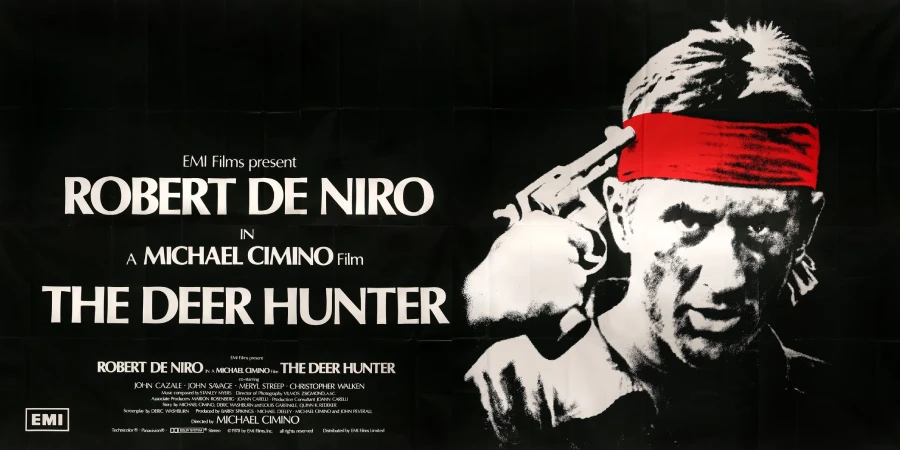

Few films dare to stare into the soul of American masculinity and come back with something this devastating. The Deer Hunter runs nearly three hours, and every minute earns its place. Director Michael Cimino crafted a portrait of friendship, trauma, and irreversible loss that still hits like a body blow. This is one of the most uncompromising films Hollywood ever produced.
Detailed Summary
A Wedding, a Town, and a Way of Life
The film opens in Clairton, Pennsylvania, a working-class steel town populated by Ukrainian-American steelworkers. We meet Michael, Nick, and Steven, three close friends preparing for two major events: Steven’s wedding and their imminent deployment to Vietnam.
The wedding sequence runs for nearly an hour. Cimino uses that time deliberately, immersing the audience in the warmth, ritual, and community that the war will soon shatter.
Meanwhile, undercurrents of tension already simmer. Nick asks Michael to bring him home if anything ever happens to him overseas. That quiet request becomes one of the film’s most important threads.
The Hunt Before the Storm
Before shipping out, Michael leads his friends on a deer hunting trip in the Pennsylvania mountains. For Michael, hunting is almost spiritual. He believes in taking a deer with a single shot, a philosophy that reflects his rigid sense of honor and control.
His friend Stan arrives unprepared and irresponsible, and Michael confronts him sharply. This scene quietly establishes Michael as a man who demands discipline, in himself and in others. That discipline will be brutally tested in Vietnam.
Vietnam and the Russian Roulette Nightmare
The film cuts abruptly to Vietnam with almost no transition. Michael, Nick, and Steven find themselves captured by Viet Cong soldiers and held in a cage submerged in a river. Their captors force them to play Russian roulette while soldiers gamble on the outcome.
This sequence is one of the most viscerally terrifying in cinema history. Cimino uses the game as a metaphor for the randomness of death in war. Survival becomes purely a matter of chance.
Michael seizes a moment of brutal ingenuity. He convinces the guards to load three bullets instead of one, then uses the increased odds to turn the gun on their captors. The three friends escape, but the psychological damage runs deep and permanent.
Separation and Survival
After their escape, the friends scatter. Steven lands in a military hospital, having lost both legs and an arm. Nick, psychologically destroyed, disappears into the underworld of Saigon, where he falls into a cycle of professional Russian roulette games for money.
Michael, in contrast, returns home. He receives a hero’s welcome that he cannot emotionally accept. He sits outside the party held in his honor, unable to walk through the door.
His relationship with Linda, Nick’s girlfriend, quietly deepens. Both of them grieve in parallel, and their bond carries enormous unspoken weight throughout the second half of the film.
Michael Returns to Vietnam
Michael goes back to Vietnam, partly to find Nick and partly to bring Steven home from the hospital. He locates Steven first, convincing him to return to Clairton. Steven reveals that someone has been sending him cash from Saigon. Michael realizes immediately who it is.
He traces Nick to a clandestine gambling den. Nick, hollow-eyed and barely recognizable, sits across from a stranger playing roulette for a crowd of gamblers. He shows no recognition of Michael at first.
Michael sits down across from him and tries to reach him through the game itself. He pleads with Nick, invoking memories of the mountains and the deer hunt. For a brief moment, something flickers behind Nick’s eyes.
Movie Ending
Nick pulls the trigger during their roulette game and the gun fires. He dies instantly, a faint smile crossing his face in the moment before death, suggesting he may have briefly recognized Michael and chosen his fate. It is one of cinema’s most agonizing finales.
Michael brings Nick’s body home to Clairton. The group gathers for the funeral, fractured and diminished. Steven has returned, legless, to his wife. Angela, who had been emotionally absent for most of the film, shows up. The community tries to hold itself together.
After the funeral, the surviving friends gather at a bar. Someone begins quietly singing “God Bless America.” One by one, the others join in. It is not triumphant. It is mournful, confused, and deeply ambiguous.
Cimino refuses to tell the audience how to feel. The song functions simultaneously as an expression of love for country and a lament for everything that country cost these people. Many critics and viewers have debated its meaning for decades, and that ambiguity is entirely intentional.
Ultimately, the film asks whether survival itself is enough. Michael brought his friends home, or tried to. But the versions of them that returned bear little resemblance to the men who left.
Are There Post-Credits Scenes?
The Deer Hunter contains no post-credits scenes. The film ends with the funeral gathering and the “God Bless America” singalong, and the credits roll in silence. No additional footage follows.
Type of Movie
The Deer Hunter occupies the war drama genre, though it spends as much time outside of combat as inside it. Cimino structures the film in three distinct acts, each with its own emotional register. Consequently, the tonal range is enormous, moving from warmth and celebration to pure horror and finally to muted grief.
In contrast to action-driven war films, this one focuses relentlessly on psychological aftermath. Its pace is slow and deliberate. That patience is a feature, not a flaw.
Cast
- Robert De Niro – Michael Vronsky
- Christopher Walken – Nick Chevotarevich
- John Savage – Steven Pushkov
- Meryl Streep – Linda
- John Cazale – Stan
- George Dzundza – John Welsh
- Chuck Aspegren – Axel
Film Music and Composer
Stanley Myers composed the score for The Deer Hunter. His most famous contribution is “Cavatina,” a piece originally written for guitar that became one of the most recognizable film themes of the era. Classical guitarist John Williams (not the Star Wars composer, but the British guitarist of the same name) performed it for the film.
“Cavatina” perfectly captures the film’s emotional core: something beautiful haunted by inevitable loss. Its gentle, melancholic melody appears during quieter moments and lingers long after the credits roll.
Myers had a distinguished career in European film and television. However, “Cavatina” remains his most celebrated work by a significant margin.


Filming Locations
Production used Clairton, Pennsylvania as the primary stand-in for the fictional steel town, lending the film an authentic working-class texture that a studio set could never replicate. The steel mills, cramped bars, and modest homes ground the story in lived reality.
The wedding sequence was filmed partly in Cleveland, Ohio, using a real Ukrainian Orthodox church. That choice adds genuine cultural and religious specificity to the ceremony.
For the Vietnam sequences, the production filmed in Thailand, which provided convincing jungle and river environments. The river cage scenes, in particular, were shot in conditions that reportedly pushed cast and crew to their limits.
Awards and Nominations
The Deer Hunter won five Academy Awards at the 1979 ceremony, including Best Picture, Best Director for Michael Cimino, and Best Supporting Actor for Christopher Walken. John Savage, Meryl Streep, and the film’s editing also received nominations.
Moreover, the film won the BAFTA Award for Best Film and earned widespread critical recognition as one of the defining American films of its decade. Its awards sweep was not without controversy, as Coming Home competed in several of the same categories that year.
Behind the Scenes Insights
- John Cazale, who played Stan, was terminally ill with cancer during production. Robert De Niro helped secure his casting by agreeing to personally cover insurance costs if the studio refused. Cazale died shortly after filming wrapped.
- Cimino ran significantly over budget and schedule during production, foreshadowing the catastrophic excess that would later define Heaven’s Gate.
- Meryl Streep and John Cazale were a real-life couple at the time. Their relationship gave their scenes together an additional layer of genuine emotional texture.
- De Niro spent extensive time with steelworkers in Pennsylvania to prepare for his role, immersing himself in the community’s rhythms and speech patterns.
- The Russian roulette scenes required intense psychological preparation from the cast. Walken has spoken about how demanding and disturbing those sequences were to film.
- Cimino reportedly shot enormous amounts of footage and edited the film down from a much longer cut, particularly the wedding sequence.
Inspirations and References
The Deer Hunter drew on the broader cultural trauma of the Vietnam War, which was still raw and largely unprocessed when the film released in 1978. Cimino and his co-writers tapped into the specific experience of working-class Americans who bore a disproportionate burden of military service during that conflict.
The film references Ukrainian-American immigrant culture with some specificity, grounding its characters in an ethnic community rarely seen on screen. However, several Ukrainian-American organizations criticized the film for inaccuracies in its cultural depictions.
The Russian roulette sequences were controversial because historians found no credible evidence that the Viet Cong ever used the game as a torture method. Cimino defended the device as symbolic rather than documentary. For instance, it functions as a metaphor for the arbitrary nature of survival in combat rather than a literal historical claim.
Alternate Endings and Deleted Scenes
No officially released alternate ending exists for The Deer Hunter. Cimino cut substantial footage from the wedding sequence during editing, and that material has not been made publicly available in any home release version.
Some extended cuts of individual scenes reportedly exist in archival form, but no major alternate version of the film has ever received a commercial release. What audiences see is Cimino’s intended final cut.
Book Adaptations and Differences
The Deer Hunter is not based on a book. The screenplay originated from a story by Louis Garfinkle and Quinn K. Redeker, which Cimino and Deric Washburn developed into the final script. Novelizations of films were common in the era, but no source novel preceded this production.
Memorable Scenes and Quotes
Key Scenes
- The extended wedding sequence in Clairton, which establishes the community and friendship at the heart of the film with almost documentary patience.
- Michael’s pre-war deer hunt, where he kills a deer with a single shot and the group’s camaraderie feels both joyful and already tinged with melancholy.
- The first Russian roulette sequence in the Viet Cong prison, widely considered one of the most terrifying scenes in American cinema.
- Michael sitting outside his own homecoming party, unable to enter, conveying PTSD without a single word of dialogue.
- The final roulette game in Saigon, where Nick dies across the table from Michael just as recognition seems to flicker back into his eyes.
- The closing “God Bless America” singalong, which functions as both elegy and unanswered question about patriotism and loss.
Iconic Quotes
- “This is this. This ain’t something else. This is this.” (Michael, during the deer hunt, articulating his philosophy of presence and singularity)
- “One shot is what it’s all about. A deer has to be taken with one shot.” (Michael, establishing his personal code early in the film)
- “Okay, Nick?” (Michael’s desperate plea across the roulette table in Saigon, one of De Niro’s most heartbreaking moments)
- “God bless America.” (Sung collectively at the end, carrying far more weight than the words alone suggest)
Easter Eggs and Hidden Details
- The green beret who briefly appears at the wedding and seems emotionally closed off foreshadows what the three friends will become after their own combat experience.
- Michael’s insistence on one shot during hunting mirrors the Russian roulette sequences, where a single bullet determines everything. The thematic parallel is deliberate and precise.
- Nick wears his hunting jacket in an early Vietnam scene, a visual callback connecting his pre-war identity to his deteriorating self.
- The bar where the friends gather is named John’s Bar, and it recurs throughout the film as a touchstone of normalcy that gradually feels more and more distant.
- During the wedding, a brief moment shows Linda and Nick exchanging a look that already suggests strain in their relationship, before the war even begins.
Trivia
- The Deer Hunter was the first Vietnam War film to win the Academy Award for Best Picture.
- Robert De Niro turned down the role of Michael Corleone in The Godfather Part II at one point during the period when this film was in development, though he ultimately appeared in that sequel.
- John Cazale appeared in only five feature films during his career, and every single one received a Best Picture nomination. The Deer Hunter was his fifth and final film.
- Christopher Walken’s Best Supporting Actor Oscar was his first Academy Award win. His performance as Nick is frequently cited as one of the finest in that category’s history.
- The film’s runtime of approximately 183 minutes made it one of the longest Best Picture winners up to that point.
- Cimino was relatively unknown before this film. Its success gave him the creative freedom that led directly, and disastrously, to Heaven’s Gate.
- The Russian roulette scenes so disturbed some audiences at early screenings that several people reportedly left the theater.
Why Watch?
The Deer Hunter offers something increasingly rare: a film that trusts its audience with silence, ambiguity, and slow-burning devastation. Its performances, particularly from De Niro and Walken, set a benchmark few war films have matched. Moreover, it captures a specific American community with a tenderness that makes every subsequent loss feel genuinely personal. This is cinema at its most uncompromising.
Director’s Other Movies
- Thunderbolt and Lightfoot (1974)
- Heaven’s Gate (1980)
- Year of the Dragon (1985)
- The Sicilian (1987)
- Desperate Hours (1990)
- The Sunchaser (1996)
Recommended Films for Fans
- Apocalypse Now (1979)
- Coming Home (1978)
- Platoon (1986)
- Full Metal Jacket (1987)
- Born on the Fourth of July (1989)
- Out of the Furnace (2013)
- Casualties of War (1989)
- The Best Years of Our Lives (1946)