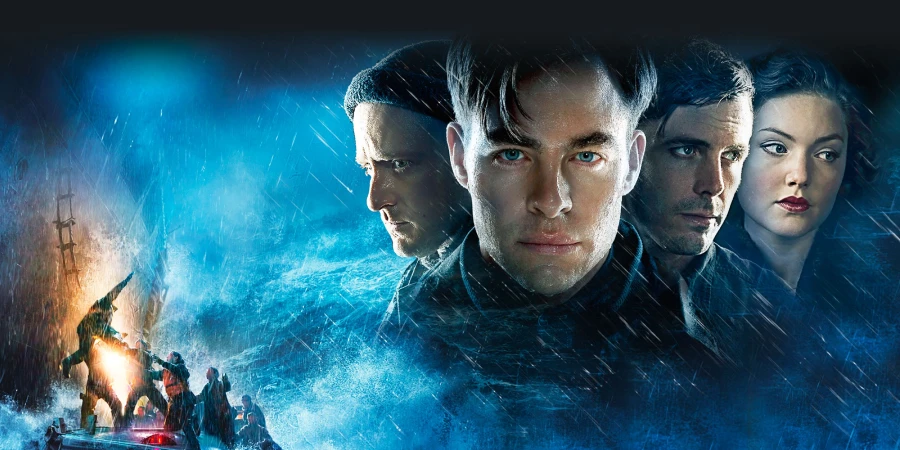

Thirty-two men stranded on a sinking tanker, a Coast Guard cutter half the size it should be, and a nor’easter that would have turned any rational sailor back to shore. The Finest Hours (2016) tells the true story of the 1952 rescue of the SS Pendleton, and it earns its tension not through invention but through sheer, documented fact.
Director Craig Gillespie leans hard into the claustrophobic horror of both the storm and the small-town social pressures bearing down on his hero. What results is a film that works better than most people gave it credit for at the time.
Detailed Summary
Bernie Webber and the Weight of Rockport
Bernie Webber (Chris Pine) lives in Chatham, Massachusetts, a Coast Guard boatswain’s mate who carries a quiet, almost painful humility. He asks permission from his superior before dating Miriam (Holliday Grainger), a detail the film uses to establish both the rigid social codes of 1952 and Bernie’s instinct to defer to authority. That deference will be tested in every way imaginable before the film ends.
Miriam is sharp, direct, and unafraid of the town’s gossip. She accepts Bernie’s awkward courtship with warmth, and their relationship gives the film its emotional anchor before the storm arrives.
The Pendleton Splits in Two
A brutal nor’easter hammers the New England coast on February 18, 1952. SS Pendleton, a T2 tanker, fractures amidships in catastrophic seas off Cape Cod. This is one of the film’s most viscerally effective sequences: steel groaning, the hull tearing open, water flooding the lower decks in seconds. The men on the stern section have no radio contact with shore.
Engineer Ray Sybert (Casey Affleck) emerges as the de facto leader on the stranded stern. He is not the ship’s official officer, and some crewmen resist his authority immediately. Affleck plays Sybert as a man who communicates through action rather than speech, muttering calculations and issuing instructions with minimal eye contact.
Sybert Takes Command Below Decks
Sybert assesses the flooding with frightening calm. He orders the crew to redistribute ballast by manipulating the ship’s tanks, an improvised solution designed to keep the stern section afloat long enough for rescue. Most of the crew falls in line, though a faction led by Tiny Myers (John Magaro) pushes back, preferring to trust the ship’s lifeboats over Sybert’s calculations.
This conflict is the film’s smartest structural choice. It mirrors Bernie’s own struggle on the water: both men must convince frightened people to trust an unconventional plan against every survival instinct.
The Coast Guard Receives the Call
Chief Daniel Cluff (Eric Bana) receives the distress signal and orders a rescue mission. He assigns Bernie to command a 36-foot motor lifeboat, the CG-36500, into seas running 60-plus feet. Bernie’s reputation carries a shadow: a previous failed rescue has left the town skeptical of him. Cluff’s order, framed as a command rather than a request, strips Bernie of any legitimate exit.
Miriam hears about the mission and tries to stop it, driving to the station and confronting Cluff directly. He turns her away. Her desperation in that scene feels real precisely because Grainger never plays it as hysteria; she plays it as someone doing math and not liking the answer.
Bernie Crosses the Bar
Bernie recruits a small crew: Richard Livesey (Ben Foster), Ervin Maske (Kyle Gallner), and Andrew Fitzgerald (Abraham Benrubi). Crossing the outer bar at Chatham in those conditions destroys the boat’s compass. This is a devastating plot point. Bernie must navigate by memory, by feel, and by the faint glow of the Pendleton’s lights on the horizon.
Foster is the best thing in every scene he appears in here. His Livesey is steady, sardonic, and loyal without being sentimental, and Foster communicates all of that in glances rather than dialogue.
The Voyage Out
Waves swamp the CG-36500 repeatedly. Fitzgerald is nearly swept overboard. Gillespie shoots these sequences with cameras mounted close to the waterline, putting the audience inside the chaos rather than observing it from a safe distance. It is genuinely unpleasant in the best way: cold, loud, and disorienting.
Bernie keeps the boat pointed into the waves by instinct and stubbornness. He barely speaks during these stretches, and Pine communicates the character’s internal state entirely through his grip on the wheel and the set of his jaw.
Sybert’s Plan Holds, Barely
Back on the Pendleton, Sybert’s ballast manipulation keeps the stern section from capsizing, but the ship is slowly sinking. Tiny and his faction briefly overpower the situation and attempt to lower a lifeboat. It is immediately destroyed by the sea. This moment, brutal and quick, ends the debate. Sybert’s authority is never challenged again.
Affleck plays Sybert’s reaction to the lifeboat disaster with deliberate blankness. No “I told you so,” no visible relief, just a return to work. It is one of the more quietly effective character beats in the film.
Contact and the Impossible Rescue
Bernie’s crew finally reaches the Pendleton. What greets them is a 70-foot wall of steel rising out of the ocean, with 32 men clinging to the stern section above it. Getting the survivors into the 36-foot lifeboat without capsizing either vessel is a technical nightmare. Bernie holds the CG-36500 against the ship’s side and orders the survivors to jump, one by one, into the churning water below.
Thirty-two men need to board a boat built for 12. Some jump well. Some fall badly. The crew hauls them in by hand, soaking and panicked. The sequence does not glamorize the rescue; it shows it as exhausting, physically brutal work with no guarantee of success at any point.


Movie Ending
Bernie loads all 32 survivors aboard the CG-36500, a number that defies the boat’s design capacity and, frankly, basic physics. One man, George “Tiny” Myers, refuses to jump and goes down with the Pendleton. He is the rescue’s only fatality. Bernie does not dramatize this loss with a monologue; the film simply lets it sit there, unresolved and quiet, which is the right call.
Getting back to shore presents its own crisis. Chatham bar is impassable in those seas without the compass, and Bernie navigates blind toward a coastline he cannot see. Miriam, who has driven to the shore and gathered the townspeople, lines the beach with car headlights to create a visible target. It is a simple, wordless solution, and it works.
Bernie brings the CG-36500 through the bar and beaches the boat safely. Thirty-two men walk ashore. The Chatham crowd, which has been radioing warnings that the mission was suicidal, goes completely silent when they realize what just happened. Bernie and Miriam find each other in the crowd.
A brief text epilogue confirms the real-world outcome: Bernie and Miriam married shortly after. Bernie received the Gold Lifesaving Medal. The rescue became one of the most celebrated in Coast Guard history. Sybert and the surviving crew of the Pendleton received recognition for keeping the stern afloat long enough for rescue to succeed.
What the ending gets right is restraint. No swelling speech about heroism. No villain defeated. Just a man who did a thing that could not be done, because no one explicitly told him he could refuse.
Are There Post-Credits Scenes?
The Finest Hours has no post-credits scenes. Stay if you want to read the text cards about the real people, but nothing narrative follows the credits. You can leave when the card about Bernie and Miriam appears.
Type of Movie
The Finest Hours is a historical survival drama with strong disaster-thriller mechanics. Its tone is earnest and unsentimental, which feels slightly out of step with modern blockbuster rhythms but aligns well with the true story it serves. Think less Deepwater Horizon and more Captain Phillips: procedural, grounded, and interested in competence under pressure.
There is a romance subplot, but it never tips into melodrama. Gillespie keeps the emotional register low and lets the circumstances do the heavy lifting.
Cast
- Chris Pine – Bernie Webber
- Casey Affleck – Ray Sybert
- Holliday Grainger – Miriam Webber
- Ben Foster – Richard Livesey
- Eric Bana – Daniel Cluff
- Kyle Gallner – Ervin Maske
- John Magaro – Tiny Myers
- Abraham Benrubi – Andrew Fitzgerald
Film Music and Composer
Carter Burwell composed the score. He is best known for his long collaboration with the Coen Brothers, covering films like Fargo, No Country for Old Men, and Blood Simple. His approach here is restrained and textural, using low strings and sparse piano motifs to underline dread rather than manufacture excitement.
The score wisely refuses to tell the audience how to feel during the rescue sequences. Burwell pulls back when the action is loudest, letting the sound design carry those moments. That choice gives the music more power when it does arrive.


Filming Locations
Production shot extensively in Quincy, Massachusetts, which doubled for various coastal settings. Some sequences used a large water tank to simulate the open ocean conditions. The production built physical sets that could be flooded and tilted to replicate the Pendleton’s deteriorating interior.
Chatham itself appears in establishing shots and some exteriors. Using real Massachusetts coastline grounds the film visually: the architecture, the light, and the landscape carry a period credibility that no studio backlot could replicate.
Awards and Nominations
The Finest Hours received a nomination for Best Visual Effects at the Academy Awards. It did not convert that nomination into a win. The film’s effects work is genuinely good, particularly the practical water sequences combined with digital wave augmentation, making the nomination well deserved even if the competition that year was steep.
Behind the Scenes Insights
- Chris Pine trained extensively with the U.S. Coast Guard to prepare for the role, learning small boat handling and storm navigation techniques.
- Many of the water sequences used real water rigs with the actors present, rather than relying purely on CGI environments.
- Casey Affleck developed Sybert’s physical mannerisms independently, choosing to make him someone who communicates primarily through body language and task-focus rather than speech.
- The production consulted with surviving crew members and family of the real men involved to maintain historical accuracy in key details.
- Director Craig Gillespie pushed for practical effects wherever possible, arguing that actors respond more authentically when actually cold and wet.
- Holliday Grainger, a British actress, worked with a dialect coach to nail Miriam’s Massachusetts accent, which is one of those performance details audiences rarely notice when it works.
Inspirations and References
The film adapts the 2009 nonfiction book The Finest Hours: The True Story of the U.S. Coast Guard’s Most Daring Sea Rescue by Michael J. Tougias and Casey Sherman. Their research drew on Coast Guard records, survivor interviews, and local newspaper archives from 1952.
The real rescue on February 18, 1952 involved not one but two T2 tanker disasters simultaneously. The SS Fort Mercer also broke apart that same night. The film focuses on the Pendleton rescue specifically, leaving the Fort Mercer story largely in the background.
Alternate Endings and Deleted Scenes
No officially released alternate endings or significant deleted scene packages have surfaced for The Finest Hours. The home video release did not include an extended cut or substantial bonus footage beyond behind-the-scenes material.
Given the film’s straightforward narrative structure, an alternate ending would have required rewriting history, which the production clearly had no interest in doing.
Book Adaptations and Differences
The Tougias and Sherman book covers both the Pendleton and Fort Mercer disasters in roughly equal detail. Screenwriters Scott Silver, Paul Tamasy, and Eric Johnson narrowed the focus to the Pendleton specifically, a smart compression that tightens the film’s dramatic unity.
Miriam’s role is more prominent in the film than in the source material. The book treats her presence on the night of the rescue as a brief detail; the screenplay builds her into a full parallel narrative. This is one of the film’s better inventions: it gives the audience a shore-based perspective that keeps emotional stakes visible even when the camera is stuck on a sinking tanker.
Some crew dynamics on the Pendleton are dramatized and compressed. The book is more granular about the technical steps Sybert took; the film streamlines those into a single readable conflict between his authority and Tiny’s fear.


Memorable Scenes and Quotes
Key Scenes
- The Pendleton fractures: Steel rivets pop like gunshots, the hull tears open in a single brutal cut, and the camera drops below the waterline as the bow section vanishes into the dark.
- Bernie crosses the bar: The compass needle spins uselessly as a wave crashes over the bow, and Pine grips the wheel with both hands, jaw locked, steering purely from memory.
- Tiny’s lifeboat attempt: A single davit lowers the boat into the water and the sea smashes it to splinters before a single man can board. No dialogue. No score. Just the sound of it.
- Miriam lines the beach with headlights: She walks car to car, asking strangers to turn their lights toward the water, and the shot from Bernie’s perspective shows a faint glow materializing out of absolute darkness.
- The survivors board the CG-36500: Foster’s Livesey hauls a man aboard by his collar with one arm while keeping his own footing on a deck that is constantly moving. Nobody in the scene is performing courage; they are just working.
Iconic Quotes
- “You go out there, you go out there and you do your job.” Bernie Webber, quietly, before crossing the bar.
- “We go out. We don’t have to come back.” A variation of the real Coast Guard standing order, delivered without inflection, which makes it more frightening than any dramatic reading would.
Easter Eggs and Hidden Details
- Period-accurate Coast Guard uniforms were sourced and replicated with input from Coast Guard historians; rank insignia visible on screen matches 1952 specifications.
- The CG-36500 motor lifeboat used in the film is a faithful replica of the actual vessel, which still exists and is preserved at the Chatham Fish Pier as a landmark.
- Background radio chatter in the station scenes briefly references the SS Fort Mercer, the other tanker that broke apart the same night, a nod to audiences who know the full historical context.
- Miriam’s dress in the final beach scene matches the color palette of the Coast Guard uniform Bernie wears, a visual choice that reads as deliberate rather than accidental.
Trivia
- The real Bernie Webber was alive when production began but passed away in 2009 before the film entered development at Disney.
- Casey Sherman, one of the book’s co-authors, is the nephew of Miriam Webber, which is why the book treats her perspective with particular care.
- The actual CG-36500 survived the rescue in 1952 and was later found beached and abandoned before being restored by volunteers.
- Chris Pine wore prosthetic ears to better resemble photographs of the real Bernie Webber.
- Two separate tank facilities were used during production to simulate different sea states, from the relatively controlled waters near shore to the open-ocean sequences.
- The film was shot partially during winter months in Massachusetts, meaning some of the actors’ visible discomfort in exterior scenes is entirely genuine.
Why Watch?
Ben Foster delivers one of his most efficient performances in a decade, and most people who saw this film in 2016 walked out talking about Pine and Affleck. Foster’s Livesey is the one to watch: every glance at Bernie carries a full sentence worth of loyalty and quiet calculation. This film makes a compelling case for what procedural restraint can do when a director trusts the facts over spectacle.
Director’s Other Movies
- Lars and the Real Girl (2007)
- Fright Night (2011)
- I, Tonya (2017)
- Cruella (2021)