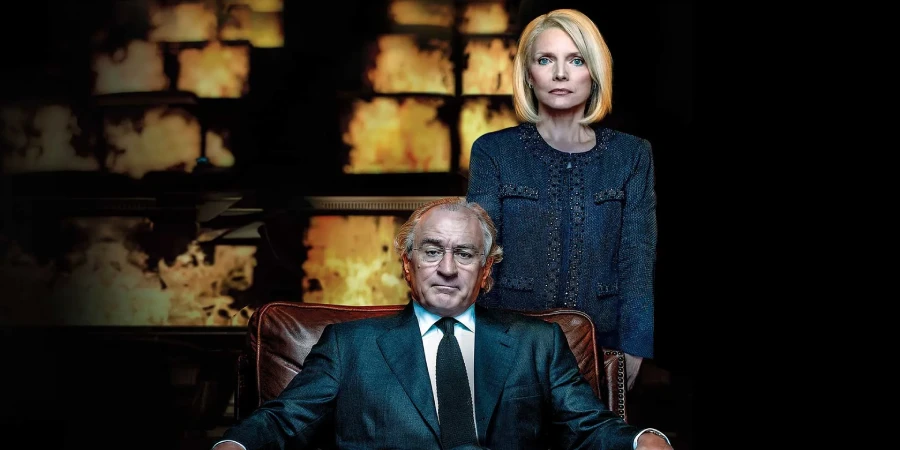

Bernie Madoff did not just steal money; he stole futures, trust, and entire families. The Wizard of Lies drops you inside the wreckage of the largest Ponzi scheme in history, refusing to let you look away. Robert De Niro plays Madoff with a chilling stillness that makes the monster feel uncomfortably human. HBO’s film asks a question more disturbing than how he did it: who knew?
Detailed Summary
The Arrest That Shook Wall Street
The film opens in December 2008, when Bernard Madoff confesses to his sons, Mark and Andrew, that his investment firm is a massive fraud. He tells them everything is “one big lie.” His sons, horrified, call a lawyer and report him to authorities.
Federal agents arrest Bernie the next morning at his Manhattan apartment. He offers no resistance. That quiet surrender sets the tone for De Niro’s entire performance: controlled, calculating, almost serene.
The Ponzi Machine Revealed
Through a series of interviews between Bernie and journalist Diana Henriques (who plays herself), the film peels back the mechanics of the fraud. Bernie ran a split-strike conversion strategy that existed only on paper. In reality, client money simply sat in a Chase bank account, untouched and uninvested.
New client deposits covered withdrawals from older clients. For decades, nobody looked closely enough to notice. Moreover, Bernie’s legitimate market-making business gave him a veneer of credibility that kept regulators off his back.
Ruth’s Impossible Position
Ruth Madoff, played by Michelle Pfeiffer, becomes one of the film’s most compelling focal points. She insists, repeatedly and desperately, that she had no knowledge of the fraud. Her husband’s world crumbled around her, and she lost nearly everything alongside his victims.
However, the film resists painting Ruth as simply innocent. Small moments of willful blindness accumulate. She enjoyed a lavish lifestyle funded by stolen money, and the film asks whether comfort can function as complicity.
The Sons Under the Microscope
Mark and Andrew Madoff, played by Alessandro Nivola and Nathan Darrow respectively, maintained they knew nothing about the fraud. Their father’s confession blindsided them completely, or so they claimed. The film presents their shock as genuine while allowing the audience to sit with the ambiguity.
Mark struggled most visibly under public scrutiny and relentless civil litigation. His reputation was destroyed despite no criminal charges being filed against him. Consequently, the psychological toll on both sons becomes a major emotional thread running through the second half of the film.
Victims and the Human Cost
Henriques conducts interviews with real victims, and their testimony hits like a series of body blows. Retirees lost life savings. Charities dissolved overnight. Families who trusted Bernie for generations found themselves with nothing.
Bernie, in his prison interviews, displays a troubling detachment from this devastation. He speaks of victims with a clinical distance that reads less like remorse and more like a man reviewing a business decision that went sideways.
The Family Falls Apart
Bernie’s relationship with Ruth deteriorates painfully on screen. She attempts suicide alongside Bernie on Christmas Eve 2008, and both survive. That scene carries enormous weight; it shows two people trapped in a catastrophe of their own making, with nowhere left to turn.
Ruth eventually distances herself from Bernie publicly and moves out of their shared life. She loses virtually all her assets in civil settlements. In contrast, Bernie remains in federal custody, insulated from the full social wreckage his family endures in real time.

Movie Ending
Mark Madoff takes his own life on December 11, 2010, exactly two years after his father’s arrest. He hangs himself in his Manhattan apartment while his infant son sleeps nearby. It is the film’s most devastating moment, and director Barry Levinson presents it without melodrama, which makes it land even harder.
Bernie, informed of Mark’s death while in prison, shows a reaction that is difficult to read. De Niro plays the scene with his characteristic restraint, and that restraint is the point. We cannot tell whether Bernie feels grief, guilt, or something else entirely.
Andrew Madoff, meanwhile, battles cancer throughout the film’s timeline. He dies in 2014, and the film acknowledges this through title cards at the close. Both sons were, in a very real sense, casualties of their father’s crime, even without criminal convictions of their own.
Ruth ends up largely alone, estranged from the few family members still living. She settles in a modest rental far removed from the Manhattan penthouse world she once inhabited. The film’s final beat reinforces its central argument: Bernie Madoff did not just destroy his victims; he destroyed his own family with equal thoroughness.
Closing title cards inform the audience that Bernie received a 150-year federal prison sentence. He maintained, even from prison, that his sons were innocent of any involvement. The film ends not with justice feeling satisfying, but with loss feeling total and irreversible.
Are There Post-Credits Scenes?
No, The Wizard of Lies does not include any post-credits scenes. As an HBO television film, it closes with standard credits following the final title cards. You can safely turn it off when the credits roll.
Type of Movie
This is a biographical drama with strong elements of crime and tragedy. The tone is sober, restrained, and relentlessly grim. Levinson never allows the film to slip into thriller territory; he keeps it grounded in the mundane horror of real consequences.
In addition, the film functions partly as a character study, using the Henriques interview framework to probe Bernie’s psychology. It is deliberately paced, prioritizing emotional and moral weight over plot mechanics.
Cast
- Robert De Niro – Bernard “Bernie” Madoff
- Michelle Pfeiffer – Ruth Madoff
- Alessandro Nivola – Mark Madoff
- Nathan Darrow – Andrew Madoff
- Kristen Connolly – Stephanie Madoff
- Hank Azaria – Frank DiPascali
- Diana Henriques – Herself
Film Music and Composer
Jeff Beal composed the score for The Wizard of Lies. Beal is known for his work on prestige television, including House of Cards, and he brings a similarly cold, precise sensibility to this project. His score avoids dramatic swells, favoring sparse, unsettling textures that mirror Bernie’s emotional flatness.
The music rarely calls attention to itself, which is a deliberate choice. Beal uses minimalist orchestration to create an atmosphere of unease rather than conventional dramatic tension. The result serves the film’s tonal restraint perfectly.



Filming Locations
The Wizard of Lies filmed primarily in New York City, grounding the story in the actual geography of Madoff’s world. Manhattan’s Upper East Side settings reinforce the insular, privileged bubble in which Bernie operated for decades. Familiar city backdrops give the film an authenticity that studio sets could not replicate.
Some sequences also filmed in Connecticut, reflecting the suburban reality of the Madoff family’s extended circle. Shooting on location rather than recreating these environments keeps the film’s feet firmly planted in the real world.
Awards and Nominations
The Wizard of Lies earned significant awards recognition upon its 2017 HBO debut. Robert De Niro received a Golden Globe nomination for Best Actor in a Limited Series or Motion Picture Made for Television. Michelle Pfeiffer similarly received nominations from multiple awards bodies for her performance as Ruth.
The film itself received Emmy attention, including nominations for Outstanding Television Movie. Pfeiffer won a Screen Actors Guild Award as part of the cast ensemble recognition, which highlighted the strength of the performances across the board.
Behind the Scenes Insights
- Diana Henriques, who authored the book the film is based on and plays herself on screen, actually conducted real interviews with Bernie Madoff in prison, which gave the interview scenes an unusual layer of authenticity.
- Barry Levinson researched the Madoff case extensively before production, consulting court documents and victim testimonies to ensure accuracy in the financial details depicted.
- Michelle Pfeiffer has spoken about the difficulty of humanizing Ruth without excusing her, describing it as one of the more morally complex roles she had taken on.
- Robert De Niro reportedly avoided playing Bernie as a cartoonish villain, choosing instead to find the ordinariness within the man, which he felt was more terrifying than any theatrical villainy.
- The suicide attempt scene between De Niro and Pfeiffer required careful choreography and emotional preparation; both actors have noted it as one of the most demanding scenes in the production.
Inspirations and References
The film draws directly from The Wizard of Lies: Bernie Madoff and the Death of Trust, the nonfiction book by Diana Henriques, published in 2011. Henriques spent years investigating the fraud and conducted exclusive prison interviews with Madoff himself. Her book remains the most authoritative account of the scheme’s mechanics and human fallout.
The title itself references the contrast between Madoff’s carefully constructed image and the hollow reality beneath it. Furthermore, the film echoes broader cultural anxieties about financial trust that intensified after the 2008 global economic crisis, placing Madoff’s story within a wider context of institutional failure.
Alternate Endings and Deleted Scenes
No officially confirmed alternate endings or significant deleted scenes have been publicly documented for The Wizard of Lies. HBO has not released an extended cut or supplementary footage. Given the film’s status as a made-for-television production, its final cut appears to align closely with Levinson’s intended vision.
Book Adaptations and Differences
The Wizard of Lies adapts Henriques’s book of the same name, but the film necessarily compresses and dramatizes material that the book covers in exhaustive financial detail. Henriques’s text devotes considerable space to the regulatory failures at the SEC that allowed Madoff to operate unchallenged for so long. The film touches on this but does not pursue it with the same depth.
Notably, the screenplay focuses more heavily on the Madoff family dynamic than the book does. This shift in emphasis gives the film its emotional core while potentially softening the systemic critique that Henriques builds so carefully in her reporting.
Memorable Scenes and Quotes
Key Scenes
- Bernie confessing to his sons in their family apartment, watching their expressions shift from confusion to horror in real time
- Ruth and Bernie’s Christmas Eve suicide attempt, presented with devastating quietness
- Bernie’s prison interview with Henriques, where he describes his victims with disturbing detachment
- Mark’s suicide, rendered without sensationalism but with full emotional weight
- Ruth confronting Bernie in prison, asking him directly whether he ever loved her or whether everything between them was also a performance
Iconic Quotes
- “It’s all just one big lie.” (Bernie to his sons, delivering the confession that starts everything unraveling)
- “I never thought it would end this way.” (Bernie in his prison interview, a line that reveals more about his detachment than any direct admission)
- “What kind of person does that to people who trusted him?” (Ruth, in a moment of grief that doubles as self-interrogation)
Easter Eggs and Hidden Details
- Diana Henriques appearing as herself creates a subtle meta-layer: the journalist who exposed Madoff’s story is literally present within the dramatization of that same story, blurring the line between document and drama.
- Several background details in the Madoff apartment scenes reflect the actual furnishings and aesthetic documented in real photographs of the property, adding visual authenticity.
- The film deliberately shows Bernie’s legitimate trading floor as genuinely busy and functional, underlining that his fraud operation and real business ran on entirely separate floors, a fact many people found surprising after his arrest.
- Costume choices for Ruth shift subtly across the film’s timeline, moving from polished and expensive to muted and understated as her circumstances deteriorate.
Trivia
- Diana Henriques is the only journalist known to have conducted a formal on-camera interview with Bernie Madoff after his imprisonment, and those real interactions directly informed her portrayal in the film.
- Barry Levinson is best known for theatrical films, making The Wizard of Lies a notable entry in his later career pivot toward prestige television.
- Michelle Pfeiffer’s portrayal of Ruth Madoff marked one of her most prominent screen appearances in several years, drawing significant critical attention back to her work.
- The film premiered on HBO in May 2017 and drew strong viewership numbers for the network, benefiting from sustained public interest in the Madoff case.
- Bernie Madoff died in federal prison in April 2021, after the film’s release, which gave the movie renewed attention as audiences revisited his story following the news.
- Hank Azaria’s portrayal of Frank DiPascali, Madoff’s key accomplice, was praised for capturing the pressured loyalty of someone trapped inside a crime they helped sustain.
Why Watch?
Few films about financial crime manage to be this emotionally suffocating without resorting to cheap thrills. De Niro and Pfeiffer deliver career-caliber work, grounding an almost unbelievable true story in raw, uncomfortable humanity. For anyone who wants to understand how ordinary-seeming people commit extraordinary harm, this film is essential viewing.
Director’s Other Movies
- Diner (1982)
- The Natural (1984)
- Good Morning, Vietnam (1987)
- Rain Man (1988)
- Bugsy (1991)
- Wag the Dog (1997)
- Sphere (1998)
- Bandits (2001)
Recommended Films for Fans
- The Big Short (2015)
- Margin Call (2011)
- Too Big to Fail (2011)
- Enron: The Smartest Guys in the Room (2005)
- Catch Me If You Can (2002)
- Wall Street (1987)
- Molly’s Game (2017)