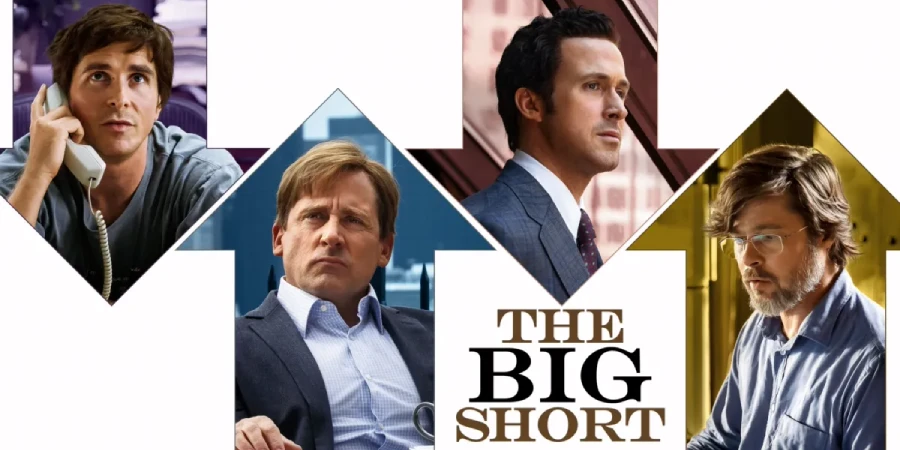

Greed transforms into a systemic disaster when a few social outcasts notice the global economy is built on a lie. Adam McKay turns a dry financial crisis into a fast-paced, snarky heist movie where the stakes are millions of homeless families. The Big Short proves that while everyone else was partying, the smart money was betting on the world to burn.
Detailed Summary
Scion Capital Sees the Crack
Dr. Michael Burry realizes the housing market rests on a foundation of bad loans. He discovers thousands of subprime mortgages are bundled into top-rated bonds despite their high risk of default. Consequently, he approaches major banks to create a credit default swap. This financial instrument allows him to bet against the housing market. Banks eagerly take his money because they believe the real estate market is invincible.
The Discarded Wrong Number
Jared Vennett, a slick Deutsche Bank trader, accidentally hears about Burry’s massive bet. He understands Burry’s logic and decides to sell the same idea to other investors. Mark Baum, a cynical hedge fund manager, receives Vennett’s pitch after a crossed phone call. Baum and his team travel to Florida to investigate the actual state of the housing market. They find entire neighborhoods abandoned even though the banks still report high profits.
Brownfield Capital Seeks Maturity
Young investors Jamie Shipley and Charlie Geller find Vennett’s prospectus in a lobby. They see the potential for massive returns but lack the capital to play in the big leagues. Eventually, they recruit Ben Rickert, a retired trader with a deep distrust of the financial system. Rickert helps them navigate the complexities of international banking. Meanwhile, they discover the regulators are completely blind to the impending collapse.
Movie Ending
Panic strikes the financial world as the housing market finally crumbles. Banks begin to fail, yet they refuse to devalue the bonds immediately to protect their own positions. Mark Baum realizes the entire system is fraudulent and corrupt. He waits until the last possible second to sell his swaps. This delay ensures he maximizes his profit while witnessing the destruction of the global economy.
Michael Burry closes his fund after earning his investors billions of dollars. He receives no praise for his foresight and instead faces scrutiny from the FBI. Jamie and Charlie walk away with millions but lose their innocence regarding how the world functions. They see the banks receive massive bailouts while ordinary citizens lose their homes and jobs. Only one banker goes to jail for the entire catastrophe.
Are There Post-Credits Scenes?
No post-credits scenes appear in this film. The story concludes with sobering text updates about the aftermath of the 2008 crisis. These updates remind viewers that the financial industry continues to create similar risky products today.
Type of Movie
This film is a biographical comedy-drama with a highly satirical tone. It utilizes breaking the fourth wall to explain complex financial concepts directly to the audience. Such creative choices turn a grim historical event into a sharp, energetic cinematic experience.
Cast
- Christian Bale – Michael Burry
- Steve Carell – Mark Baum
- Ryan Gosling – Jared Vennett
- Brad Pitt – Ben Rickert
- John Magaro – Charlie Geller
- Finn Wittrock – Jamie Shipley
- Hamish Linklater – Porter Collins
- Rafe Spall – Danny Moses
- Jeremy Strong – Vinny Daniel
- Marisa Tomei – Cynthia Baum
Film Music and Composer
Nicholas Britell composed the score for this production. His music blends orchestral elements with modern beats to evoke the frantic energy of the trading floor. Specifically, the soundtrack uses a variety of licensed rock and hip-hop tracks to ground the film in the mid-2000s era. This eclectic mix highlights the chaotic nature of the financial bubble.

Filming Locations
The production filmed primarily in New Orleans to take advantage of tax incentives despite the New York setting. Sets recreate the sterile environments of investment banks and the sun-drenched, empty streets of Florida. These locations emphasize the contrast between the wealthy traders and the struggling homeowners. Every office space feels lived-in and cluttered with the stress of the era.
Awards and Nominations
The film received five Academy Award nominations and won Best Adapted Screenplay. Additionally, it earned several Golden Globe nominations and won the Producers Guild of America Award for Best Theatrical Motion Picture.
Behind the Scenes Insights
- Christian Bale wore the actual clothes of the real Michael Burry during filming.
- Adam McKay encouraged the actors to improvise their dialogue to create a more naturalistic feel.
- Director Adam McKay suffered a heart attack shortly after finishing the film, which he partially credited to the stress of the project.
- The celebrity cameos, like Margot Robbie in a bathtub, were written to make boring financial jargon more engaging for the viewers.
Inspirations and References
The film is based on the 2010 book The Big Short: Inside the Doomsday Machine by Michael Lewis. Lewis interviewed the real-life investors who bet against the housing bubble. Their unconventional stories provided the foundation for the screenplay’s unique structure. Furthermore, the movie references the 1987 market crash as a precursor to the 2008 disaster.
Alternate Endings and Deleted Scenes
The theatrical version remains very close to the finished script. Consequently, there are no widely released alternate endings. Deleted scenes mostly include longer financial explanations and extra banter between Mark Baum’s team members. These cuts helped maintain the film’s brisk and relentless pace.
Book Adaptations and Differences
Adam McKay’s adaptation remains remarkably faithful to the core facts of Michael Lewis’s book. However, the film changes some names to offer the actors more creative freedom. For instance, the character Mark Baum is based on Steve Eisman. Similarly, Jared Vennett represents the real-life Greg Lippmann.
Memorable Scenes and Quotes
Key Scenes
- Margot Robbie explains subprime mortgages while drinking champagne in a bathtub.
- The Florida trip where Mark Baum discovers a stripper owns five houses with no income.
- Michael Burry blasts heavy metal in his office while the market remains irrational.
- Ben Rickert yells at Jamie and Charlie for celebrating a bet that signifies people will lose their homes.
Iconic Quotes
- “Truth is like poetry. And most people fucking hate poetry.”
- “I’m standing in front of a burning house and I’m offering you fire insurance.”
- “We live in an era of fraud.”
- “Tell me the difference between stupid and illegal and I’ll have my wife’s brother arrested.”
Easter Eggs and Hidden Details
- The real Michael Burry makes a brief cameo appearance during the office scenes at Scion Capital.
- Many background televisions play actual news footage from 2007 and 2008 to maintain historical accuracy.
- The font used for the title cards matches the style of mid-2000s financial reports.
- Subtle visual cues show the decay of the housing market, such as dying lawns in suburban neighborhoods.
Trivia
- Christian Bale learned to play the double-bass drums in just two weeks for his role.
- Ryan Gosling’s character frequently wears a wig to better resemble his real-life counterpart.
- The film shot in many real office buildings in New Orleans to save on set construction costs.
- Anthony Bourdain used a fish stew metaphor to explain collateralized debt obligations.
Why Watch?
This movie makes complex economics feel like a high-stakes thriller. It balances hilarious satire with a devastating critique of modern capitalism. Ultimately, you will finish the film feeling both entertained and rightfully angry at the world’s financial leaders.
Director’s Other Movies
- Anchorman: The Legend of Ron Burgundy (2004)
- Step Brothers (2008)
- The Other Guys (2010)
- Vice (2018)
- Don’t Look Up (2021)