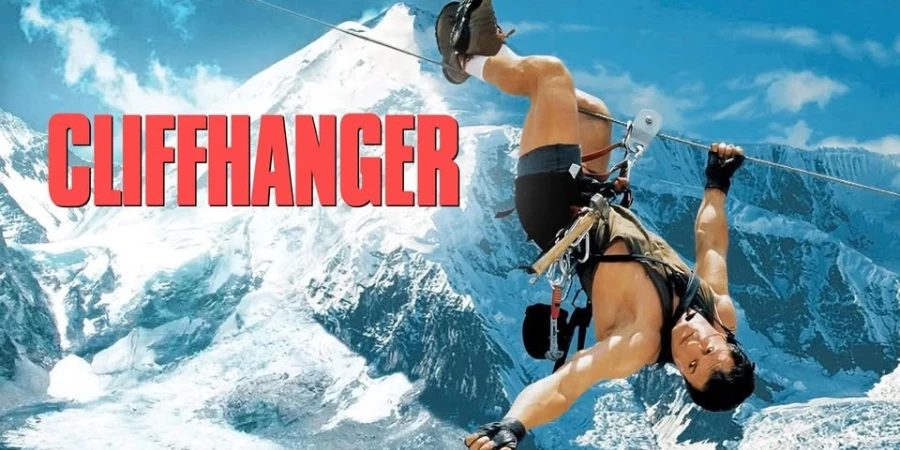

Sylvester Stallone hanging off a mountain by one hand, watching a woman plummet to her death in the opening minutes, sets the tone for everything Cliffhanger delivers: relentless, vertiginous, unapologetic action cinema at its most visceral. Director Renny Harlin took a deceptively simple premise and turned it into one of the defining blockbusters of the early nineties. This film earns its reputation through sheer physical spectacle, a genuinely nasty villain, and a lead performance that reminded audiences Stallone still had plenty of fuel left in the tank.
Detailed Summary
The Opening Tragedy on the Mountain
Gabe Walker (Sylvester Stallone) works as a Rocky Mountain Rescue ranger alongside his best friend Hal Tucker (Michael Rooker) and Hal’s girlfriend Sarah (Michelle Joyner). During a routine rescue on a high ridge, Sarah’s harness clip fails while Gabe attempts to transfer her across a rope line. He cannot hold her grip, and she falls to her death far below.
This sequence is genuinely harrowing. Harlin shoots it without music for long stretches, letting the wind and Sarah’s screaming do the work. The tragedy immediately establishes Gabe’s central psychological wound: survivor’s guilt and a crisis of nerve.
Eight Months Later: Gabe Returns
Eight months after Sarah’s death, Gabe returns to the mountains to collect his belongings and say goodbye to his girlfriend Jessie Deighan (Janine Turner). Hal blames Gabe bitterly for Sarah’s death and their friendship has fractured completely. Gabe plans to leave the Rockies for good and take Jessie with him, but events overtake that plan almost immediately.
The Heist in the Sky
Meanwhile, a criminal mastermind named Eric Qualen (John Lithgow) executes a mid-air heist aboard a US Treasury plane. His crew, posing as federal agents, intercepts three cases containing a total of $100 million in uncirculated bills. During the transfer between aircraft, turbulence causes all three cases to eject and scatter across the Colorado Rockies.
Qualen’s gang survives a crash landing in the mountains. However, they need local guides to find the scattered cases before the weather kills them. They intercept a distress signal and lure Gabe and Hal into a trap.
Gabe and Hal Walk Into the Trap
Responding to what they believe is a genuine distress call, Gabe and Hal fly into the mountains by helicopter. Qualen’s crew captures both men almost immediately. Qualen’s plan is straightforward: force the rangers to guide them to each money case using the emergency locator signals.
Gabe manages to escape during the confusion of the first case retrieval. Consequently, Qualen keeps Hal as a hostage to ensure Gabe keeps cooperating. This dynamic drives the middle section of the film, with Gabe stalking the gang while simultaneously being blackmailed into helping them.
Picking Off the Gang One by One
Gabe reunites with Jessie, who escaped her own capture attempt. Together they work to recover the cases while neutralizing Qualen’s crew. Harlin stages a series of impressive set pieces across ice caves, frozen cliffs, and narrow mountain passes.
Gabe kills several gang members through increasingly inventive means. One villain meets his end via a stalactite; another falls during a brutal fistfight on a cliff face. Each confrontation chips away at Qualen’s resources and patience.
In addition, a corrupt Treasury agent named Richard Travers (Rex Linn), who was the inside man on the heist, operates within the group. His presence connects the criminal operation to institutional betrayal, giving the plot a small but effective political edge.
Hal’s Arc: From Victim to Participant
Hal’s captivity is not passive. Over the course of the film, Hal shifts from resentful prisoner to reluctant survivor. His hatred of Gabe never fully dissolves, but survival instinct gradually overrides his bitterness.
Qualen’s lieutenant Kristel (Caroline Goodall) develops a complicated dynamic with Hal. She is ruthless but not entirely without conscience, which makes her marginally more interesting than the film’s more cartoonish heavies. Nonetheless, she remains loyal to Qualen until she no longer can be.

Movie Ending
Qualen secures the final case and boards a helicopter, taking Hal and Jessie hostage as insurance for his escape. Gabe, refusing to let the situation end on Qualen’s terms, stows away on the underside of the helicopter as it lifts off from the mountainside. This is pure Stallone spectacle: one man clinging to a helicopter skid over a thousand-foot drop, inching his way toward a reckoning.
Gabe climbs aboard and a brutal close-quarters fight erupts inside and around the aircraft. Meanwhile, Hal breaks free from his restraints and takes control of the situation on board, helping to neutralize the remaining threat. The helicopter crashes onto a rocky outcrop at the mountain’s edge.
Qualen survives the initial crash and confronts Gabe for a final showdown on the wreckage. Gabe sends Qualen plummeting off the cliff by destroying the landing gear he is clinging to, and Qualen falls screaming to his death far below. It is a deliberate visual echo of Sarah’s death in the opening, closing the film’s emotional loop with satisfying symmetry.
Hal and Gabe reconcile on the mountainside. Hal finally acknowledges that Sarah’s death was not Gabe’s fault, releasing both men from the guilt and blame that had defined their estrangement. Jessie survives unharmed, and the three of them face the climb down together, battered but alive.
For audiences, the ending works because it resolves both plotlines simultaneously. The physical threat and the emotional wound get addressed in the same sequence of events. Moreover, Stallone’s physicality throughout the finale feels genuinely earned rather than effortlessly superhuman, which gives the resolution real stakes.
Are There Post-Credits Scenes?
Cliffhanger contains no post-credits scenes. Once Qualen falls and the survivors regroup, the film ends cleanly. You can leave when the credits roll.
Type of Movie
Cliffhanger is a action thriller with strong elements of survival cinema. Its tone sits firmly in the high-octane blockbuster tradition of early-nineties Hollywood. Harlin keeps the pacing aggressive throughout, with very little downtime between set pieces.
On the other hand, the film does invest briefly in emotional drama through the opening tragedy and Gabe’s guilt arc. That emotional undercurrent prevents it from becoming purely mechanical. The overall experience is tense, physically exhilarating, and occasionally darkly funny thanks to Lithgow’s gleefully theatrical villain performance.
Cast
- Sylvester Stallone – Gabe Walker
- John Lithgow – Eric Qualen
- Michael Rooker – Hal Tucker
- Janine Turner – Jessie Deighan
- Rex Linn – Richard Travers
- Caroline Goodall – Kristel
- Leon – Kynette
- Craig Fairbrass – Delmar
- Michelle Joyner – Sarah
Film Music and Composer
Trevor Jones composed the score for Cliffhanger. Jones brought his signature orchestral sweep to the project, filling the mountain sequences with wide, heroic brass arrangements that complement Harlin’s visual grandeur. His work here ranks among his most commercially successful output.
The main theme is muscular and ascending, mirroring the film’s literal and figurative upward momentum. Jones understood that mountain-set action cinema demands music that feels physically large. Furthermore, his score avoids being generic, incorporating more texture and tension than a typical blockbuster of the period might receive.


Filming Locations
Production shot extensively in the Dolomites in northern Italy, specifically around the town of Cortina d’Ampezzo. These locations provided the spectacular vertical rock faces and snowy peaks the story required. In contrast to studio-bound productions of the era, Harlin committed to real altitude shooting wherever feasible.
Some additional filming took place in Colorado, lending authenticity to the American Rocky Mountain setting the script established. Stallone and the stunt team performed many sequences at genuine elevation, which gives the film a physicality that CGI-heavy productions often lack. The Dolomites, in particular, provided backdrops so dramatic they function almost as a character themselves.
Awards and Nominations
Cliffhanger received an Academy Award nomination for Best Sound and nominations in sound editing and visual effects categories. It did not win in any of those categories. For a pure action film of its era, that level of recognition from the Academy reflects the genuine technical achievement the production represented.
Behind the Scenes Insights
- Stallone performed a significant number of his own stunts, including sequences at real altitude in the Dolomites, adding authentic physical risk to the production.
- Renny Harlin conducted extensive pre-production research into mountain rescue operations to give the ranger characters procedural credibility.
- John Lithgow reportedly based elements of Qualen’s theatrical menace on classic stage villain archetypes, deliberately pushing the character toward operatic territory.
- The opening sequence, involving the harness failure and Sarah’s fall, required meticulous stunt coordination and multiple shooting days to achieve the right emotional and visual impact.
- Wolfgang Güllich, one of the world’s foremost rock climbers at the time, performed the extraordinary free-climbing sequence seen in the opening titles. Tragically, Güllich died in a car accident shortly after filming completed.
- The production faced severe weather conditions in the Dolomites, which caused significant scheduling disruptions but also provided authentically brutal atmospheric footage.
- Harlin and Stallone had previously worked together, which gave them an established shorthand that reportedly accelerated on-set decision-making considerably.
Inspirations and References
Cliffhanger drew from the tradition of survival action thrillers that placed ordinary heroes in extraordinary physical environments. The heist-gone-wrong structure borrows loosely from classic crime cinema, while the mountain rescue backdrop gave the familiar formula a fresh physical texture.
Screenwriter Michael France developed the story alongside Stallone, and both drew on the inherent drama of real mountain rescue scenarios. Specifically, the psychological trauma of losing someone you tried to save gives the film a more grounded emotional core than most of its genre peers. The film does not derive from a pre-existing novel or specific true story.
Alternate Endings and Deleted Scenes
No widely documented alternate ending exists for Cliffhanger in the public record. Some trimmed action footage exists from the editing process, as is standard for large-scale productions of this scope. However, no significant deleted scenes have entered mainstream discussion or appeared prominently in home video releases.
Book Adaptations and Differences
Cliffhanger is an original screenplay, not an adaptation of a novel or any other pre-existing source material. A novelization of the film was published to coincide with its theatrical release, which is a standard practice for major blockbusters of that era. In that case, the book follows the film rather than the other way around.


Memorable Scenes and Quotes
Key Scenes
- Sarah’s harness fails and she falls to her death as Gabe loses his grip in the devastating opening sequence.
- Qualen’s gang executes the mid-air heist between two aircraft, scattering the money cases across the Rockies.
- Gabe battles Kynette (Leon) in an ice cave, a brutal and claustrophobic fight sequence that stands out for its raw physicality.
- Gabe hangs from the helicopter skid over a sheer drop as Qualen attempts his escape, the film’s most visually iconic image.
- Qualen plunges off the cliff, mirroring Sarah’s fatal fall and closing the film’s emotional arc.
- Hal and Gabe reconcile on the mountainside wreckage, the film’s quietly powerful emotional conclusion.
Iconic Quotes
- “You’re the best, Walker. Too bad you have to die.” – Qualen, delivering Lithgow’s brand of silky theatrical menace.
- “Didn’t anyone ever tell you not to play with guns?” – Gabe, dispatching a villain with characteristically blunt Stallone cool.
- “Good morning, Mr. Tucker. I’ll be your captor today.” – Qualen, introducing himself to Hal with absurd, chilling politeness.
Easter Eggs and Hidden Details
- The opening free-climbing sequence, performed by Wolfgang Güllich, features genuinely unprotected climbing moves that no stunt performer could safely replicate; sharp-eyed viewers can tell the difference between Güllich’s sequences and the stunt work that follows.
- Qualen’s very British villainy, delivered by American actor Lithgow, plays as a subtle nod to the Hollywood convention of casting European or British-accented actors as antagonists in action films of this era.
- Several background shots in the Dolomites capture natural rock formations that dwarf the human figures, a deliberate compositional choice by Harlin to reinforce the theme of human vulnerability against nature.
- The color palette shifts noticeably colder and more desaturated during sequences where Gabe faces his lowest emotional points, a visual storytelling technique that rewards attentive viewing.
Trivia
- Cliffhanger grossed over $250 million worldwide against a production budget estimated around $65 million, making it a major commercial success.
- Stallone reportedly trained intensively for months to achieve the physical conditioning required for the shirtless and climbing sequences filmed in genuinely cold conditions.
- Renny Harlin, a Finnish director, had already established his Hollywood action credentials with Die Hard 2 (1990) before taking on this project.
- John Lithgow’s Qualen is frequently cited by critics as one of the most entertainingly theatrical villains in nineties action cinema.
- Wolfgang Güllich, who performed the opening titles climbing sequence, was considered one of the greatest technical rock climbers in history at the time of filming.
- The film helped revitalize Stallone’s box office standing after a string of commercial disappointments in the early nineties.
- Filming at altitude in the Dolomites created genuine physical hardship for cast and crew, with some sequences shot at elevations that caused breathing difficulties.
Why Watch?
Cliffhanger delivers exactly what it promises: breathtaking locations, relentless physical action, and a villain so enjoyably theatrical that every scene Lithgow owns becomes an event. Stallone brings real conviction to a role that demands both muscle and genuine emotional vulnerability. For fans of practical, location-shot action cinema, this film remains a benchmark of the form.
Director’s Other Movies
- A Nightmare on Elm Street 4: The Dream Master (1988)
- Die Hard 2 (1990)
- The Long Kiss Goodnight (1996)
- Deep Blue Sea (1999)
- Driven (2001)
Recommended Films for Fans
- Die Hard (1988)
- The Fugitive (1993)
- Assassins (1995)
- Vertical Limit (2000)
- Demolition Man (1993)
- Speed (1994)
- Rambo: First Blood (1982)