Imagine being fully conscious, locked inside a paralyzed body, with only one blinking eye connecting you to the world. The Diving Bell and the Butterfly forces audiences to live that reality alongside Jean-Dominique Bauby, the former editor of Elle France who communicated an entire memoir by blinking. Director Julian Schnabel turned that premise into one of the most visually inventive films of the 21st century. This is a film that rewires how you think about freedom, language, and what it means to be alive.
Detailed Summary
Waking Up Inside the Diving Bell
The film opens entirely from Jean-Dominique Bauby’s point of view. We see blurred, disorienting visuals as Jean-Do (played by Mathieu Amalric) regains consciousness in a hospital, hearing voices but unable to respond. For a sustained and genuinely uncomfortable stretch, the audience inhabits his locked-in perspective.
Doctors quickly explain his condition: a massive stroke has caused locked-in syndrome, leaving him with full cognitive function but almost no motor ability. His only reliable movement is blinking his left eye. Consequently, the camera itself becomes his imprisoned gaze.
Learning to Communicate
Speech therapist Henriette Durand (played by Marie-Josee Croze) introduces Jean-Do to a painstaking communication system. An assistant reads aloud a frequency-ordered French alphabet; Jean-Do blinks when he hears the letter he wants. Letter by letter, word by word, he begins to speak again.
His first full message is bitterly funny: he blinks out “I want death.” However, this dark humor quickly gives way to something more complex as Jean-Do decides, stubbornly, to keep living and keep working. He still has a memoir contract with a publisher, and he intends to honor it.
The World of Memory and Imagination
Schnabel structures large portions of the film as internal escapes. Jean-Do mentally travels to ski slopes, past love affairs, and vivid sensory memories that his body can no longer access. These sequences use warm, fluid cinematography that contrasts sharply with the cold, clinical hospital footage.
Meanwhile, his literary imagination runs wild. He voices interior monologues about Empress Eugenie, a 19th-century French figure, and reimagines himself as a man trapped inside a diving bell, sinking under the weight of his paralysis. In contrast, his butterfly represents the soaring freedom of the mind.
Relationships Strained and Sustained
His ex-partner and the mother of his children, Celine (played by Emmanuelle Seigner), visits regularly and navigates her grief with raw, visible effort. She loves him, resents the situation, and still functions as his primary emotional anchor. Their dynamic carries enormous, unspoken weight.
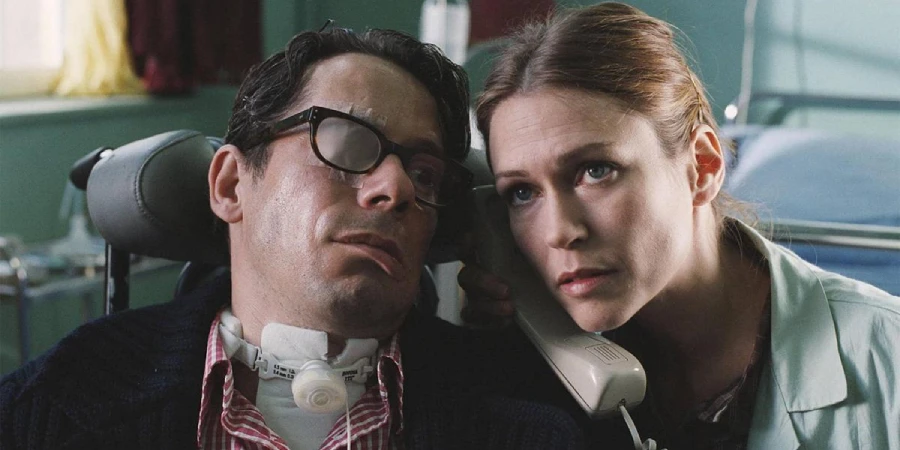
A particularly devastating scene involves a phone call. Jean-Do’s girlfriend at the time of his stroke cannot bring herself to speak with him directly, so Celine must relay the conversation, absorbing the awkward cruelty of the situation with heartbreaking composure.
Jean-Do’s Father and the Mirror of Mortality
Papinou, Jean-Do’s elderly father (played by Max von Sydow), appears in one of the film’s most emotionally loaded sequences. Now housebound himself, Papinou cannot travel to see his son. They communicate by telephone, and Papinou weeps openly, aware that he may never see Jean-Do in person again.
This scene reframes the film’s central metaphor. Both father and son are, in their own way, locked inside bodies that have failed them. Max von Sydow delivers his few minutes of screen time with devastating simplicity.
Writing the Memoir
Publisher’s assistant Claude Mendibil (played by Anne Consigny) becomes Jean-Do’s primary creative collaborator. She visits him daily at the hospital in Berck-sur-Mer, transcribing his blinked letters with extraordinary patience. Over many months, she captures his entire memoir this way.
The writing process itself becomes a form of triumph. Each session is exhausting and slow, yet Jean-Do produces vivid, literary prose that surprises everyone around him. His mind, however constrained, remains fierce and creative.
Movie Ending
Jean-Do completes his memoir, Le Scaphandre et le Papillon, dictated entirely through eye-blinks over roughly ten months. His book goes to print, and he lives just long enough to know it exists in the world. Within days of publication, he develops pneumonia and dies at the age of 44.
Schnabel presents the final moments with restraint rather than melodrama. We do not see a prolonged death scene. Instead, the film closes with text informing us of the facts: the book published, the death following swiftly, the memoir becoming an international bestseller.
What makes this ending resonate so forcefully is its refusal to sentimentalize. Jean-Do did not miraculously recover. He did not receive a farewell filled with cinematic closure. He simply finished the thing he set out to finish, and then he was gone. That blunt honesty honors both the real man and the audience.
The final image returns, briefly, to the butterfly imagery that threads through the film. It functions less as a consolation and more as a quiet acknowledgment: his mind flew even when his body could not. For viewers, the ending lands as both devastating and, strangely, affirming.
Are There Post-Credits Scenes?
The Diving Bell and the Butterfly contains no post-credits scenes. The film ends with on-screen text about Bauby’s death and his book’s legacy, and then it is simply over. No additional footage follows.
Type of Movie
This film occupies the intersection of biographical drama and experimental art cinema. Its tone blends grief, dark humor, and transcendence in a way that defies easy categorization. It feels literary rather than conventional, closer to a prose poem than a standard biopic.
Schnabel uses the film’s formal qualities, especially its subjective camera, as emotional tools rather than gimmicks. In addition, the film functions as a meditation on memory and creativity, which gives it a philosophical depth that lingers long after viewing.
Cast
- Mathieu Amalric – Jean-Dominique Bauby
- Emmanuelle Seigner – Celine Desmoulins
- Marie-Josee Croze – Henriette Durand
- Anne Consigny – Claude Mendibil
- Max von Sydow – Papinou (Jean-Do’s father)
- Patrick Chesnais – Dr. Lepage
- Marina Hands – Josephine
- Olatz Lopez Garmendia – Nurse Sandra
Film Music and Composer
Paul Cantelon composed the film’s score, and his work here ranks among the most quietly affecting soundtracks of its era. His compositions lean on piano and sparse orchestration, creating a fragile, floating quality that mirrors Jean-Do’s interior world. The music never overwhelms; it drifts beneath the images like breath.
Schnabel also incorporated pre-existing songs into the soundtrack, including tracks that reflect Jean-Do’s eclectic, cultured sensibility. The combination of original score and carefully chosen source music gives the film a rich, layered sonic texture. Cantelon later earned wider recognition, but this score remains a career highlight.


Filming Locations
Principal photography took place at the Hospital Maritime de Berck-sur-Mer in northern France, the actual facility where Bauby spent his final months. Shooting on location added immediate authenticity; the building’s corridors, light, and atmosphere reflect the real environment Jean-Do inhabited.
The French coastline around Berck-sur-Mer also features prominently, providing a stark, windswept backdrop that amplifies the film’s emotional register. Furthermore, Paris appears in flashback sequences, representing the vibrant, fashionable life Jean-Do lived before his stroke. The contrast between these two worlds is central to the film’s power.
Awards and Nominations
The Diving Bell and the Butterfly earned Julian Schnabel the Best Director award at the Cannes Film Festival in 2007, a significant recognition that announced the film as a major artistic achievement. It received four Academy Award nominations, including Best Director and Best Adapted Screenplay, though it did not win in any category.
Notably, the film won the Golden Globe for Best Foreign Language Film and received nominations across numerous critics’ circles worldwide. Its awards season presence confirmed its status as one of the most admired films of that year.
Behind the Scenes Insights
- Mathieu Amalric spent extended time researching locked-in syndrome, including visiting patients with the condition, to understand the physical and psychological reality of Bauby’s experience.
- Cinematographer Janusz Kaminski, best known for his long collaboration with Steven Spielberg, shot the film with techniques that physically simulated a single blinking eye, including a device that partially obscured the lens to mimic eyelid movement.
- Julian Schnabel, primarily known as a painter and visual artist before his filmmaking career, approached the project with an emphasis on sensory experience over conventional narrative structure.
- Much of the subjective, first-person footage required unconventional rigging and camera placement, with the crew working closely to ensure the perspective felt genuine rather than artificially stylized.
- Amalric wore prosthetics and contorted his body physically throughout filming to convey Jean-Do’s paralysis, a demanding process that required significant endurance on set.
Inspirations and References
The film directly adapts Jean-Dominique Bauby’s memoir of the same name, published in 1997. Bauby wrote the entire book by blinking, working with a transcriptionist who used the frequency-ordered French alphabet system depicted in the film. His death came two days after the book’s publication.
Schnabel has cited his own experience as a visual artist as a key inspiration for the film’s formal approach. He treated each frame as a canvas, building meaning through composition and color rather than relying purely on dialogue or plot momentum.
Alternate Endings and Deleted Scenes
No officially confirmed alternate endings or significant deleted scenes have been publicly documented for this film. Schnabel’s approach to the project was deliberate and highly controlled, and no major cut content has entered public discussion through press materials or home releases.
Book Adaptations and Differences
Bauby’s original memoir, also titled Le Scaphandre et le Papillon, is short, impressionistic, and non-linear. It reads more as a collection of lyrical essays than a conventional autobiography. Schnabel’s film preserves that fragmentary, non-linear quality, which makes it one of the more faithful literary adaptations in recent memory.
However, the film necessarily adds visual and dramatic context that the book, by its nature, could not provide. Scenes depicting Bauby’s relationships, his hospital routines, and his father’s phone call expand on material that exists more obliquely in the source text. Screenwriter Ronald Harwood shaped these additions with sensitivity to Bauby’s voice.
Memorable Scenes and Quotes
Key Scenes
- The opening sequence, shot entirely from Jean-Do’s blurred perspective as he regains consciousness, immediately establishes the film’s immersive formal strategy.
- Henriette teaching Jean-Do the blinking alphabet, culminating in his sardonic first message about wanting death, balances tragedy and dark comedy in a single exchange.
- Papinou’s phone call scene, with Max von Sydow weeping alone in his apartment, stands as one of the most quietly devastating moments in the film.
- The relay phone call through Celine, where Jean-Do’s girlfriend speaks to him through his ex-partner, exposes painful emotional complexity without a single moment of melodrama.
- Jean-Do’s vivid memory of feeding oysters on a beach, a sensory flashback that arrives as pure joy against the hospital’s bleakness.
Iconic Quotes
- “I decided to stop pitying myself. Other than my eye, two things aren’t paralyzed: my imagination and my memory.”
- “My diving bell becomes less oppressive, and my mind takes flight like a butterfly.”
- “You can visit the woman you love, relive forgotten memories, and feel the rush of wings that carry you to the other side.”
Easter Eggs and Hidden Details
- Schnabel embeds subtle visual echoes of Bauby’s professional life as a fashion editor throughout the film; clothing, color, and composition in flashback scenes reflect the aesthetic world of Elle magazine.
- The butterfly motif appears not only in dialogue and the title but in small visual details throughout the film, including brief glimpses in background imagery during outdoor sequences.
- Janusz Kaminski’s use of lens flares and diffused light in the flashback sequences visually distinguishes memory from present reality in a way that rewards attentive viewers who track the film’s shifting temporal registers.
- The frequency-ordered alphabet used in the film, known as Partner-Assisted Scanning, is the actual system used with Bauby, and the film presents it accurately, including the specific letter order that was standard practice in French speech therapy at the time.
Trivia
- Jean-Dominique Bauby dictated his entire memoir through an estimated 200,000 blinks, according to accounts from those who worked with him.
- Julian Schnabel was not the first director attached to the project; the film spent years in development before Schnabel came aboard and reshaped the approach entirely.
- Mathieu Amalric’s performance required him to keep one eye taped shut for extended filming periods, creating genuine physical discomfort that reportedly informed his portrayal.
- Ronald Harwood, who wrote the screenplay, previously won an Academy Award for his adaptation of The Pianist (2002).
- The film was a French-American co-production, which qualified it for both domestic and foreign language categories in various awards competitions worldwide.
- Bauby’s book was translated into dozens of languages and became an international bestseller, a success he never witnessed given his death two days after publication.
Why Watch?
The Diving Bell and the Butterfly accomplishes something rare: it makes you feel physical imprisonment while simultaneously liberating your senses. Schnabel’s formal daring never tips into pretension because the emotional core stays brutally honest throughout. Moreover, performances from Amalric, Seigner, and Von Sydow anchor every experimental flourish in genuine human feeling. Few films demand so little of your body while asking so much of your heart.
Director’s Other Movies
- Basquiat (1996)
- Before Night Falls (2000)
- Lou Reed’s Berlin (2007)
- Miral (2010)
- At Eternity’s Gate (2018)