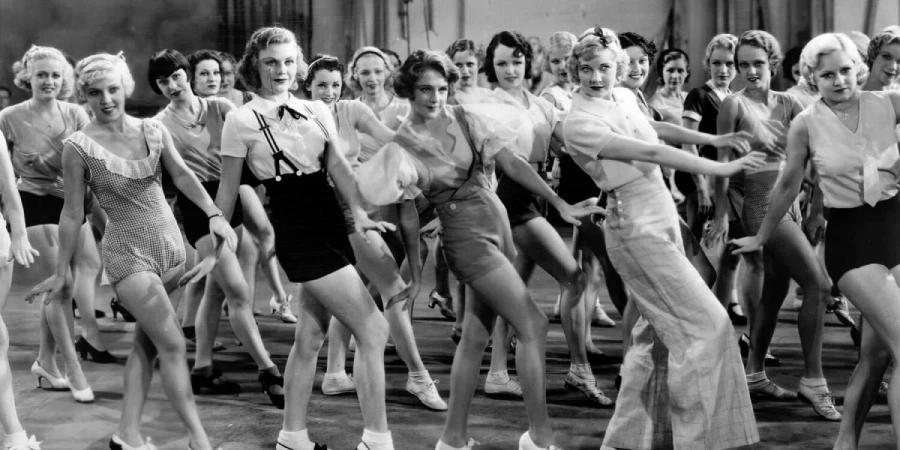

42nd Street is more than just a musical; it is the blueprint. This 1933 film didn’t just entertain audiences during the Great Depression, it single-handedly revitalized a genre. Furthermore, it established the definitive backstage story of the plucky understudy who gets her one big shot at stardom.
Detailed Summary
The Great Director’s Last Shot
The story kicks off with news that legendary Broadway director Julian Marsh is staging a new musical, Pretty Lady. However, Marsh is a broken man. He lost his fortune in the 1929 stock market crash and his doctor warns that another demanding show could kill him. Ignoring the risks, Marsh pushes forward, seeing this show as his only chance to regain financial security and cement his legacy.
Abner Dillon, a wealthy and lecherous “sugar daddy,” is funding the production. He only agrees to back the show on the condition that his girlfriend, the aging and notoriously difficult star Dorothy Brock, gets the leading role. Marsh reluctantly agrees, fully aware that Dorothy’s best days are long behind her.
Chorus Girl Tryouts
Meanwhile, aspiring performers flood the theater for auditions. A fresh-faced and naive dancer from Allentown, Pennsylvania, Peggy Sawyer, arrives just moments too late. She literally bumps into the show’s charming juvenile lead, Billy Lawlor, who is immediately taken with her talent and innocence.
Billy tries to help Peggy get a spot, but the dance director, Andy Lee, dismisses her. Dejected, Peggy begins to leave. Interestingly, she forgets her purse and returns to the theater, where she is spotted by Marsh, who needs an extra girl for a number and hires her on the spot after seeing her dance.
Star Trouble with Dorothy Brock
Rehearsals for Pretty Lady are brutal and tense. Dorothy struggles with the dance numbers and constantly clashes with the crew. Her primary focus is not the show, but her secret relationship with her old vaudeville partner, the penniless but handsome Pat Denning.
Abner Dillon is intensely jealous and suspicious of Dorothy. Consequently, Marsh must constantly run interference to keep his financial backer happy. He eventually has some hired thugs intimidate Pat, convincing him to leave town to prevent Dorothy from being distracted and jeopardizing the show.
From Understudy to the Spotlight
During the final dress rehearsal in Philadelphia, Dorothy gets into an argument with Peggy. She falls and breaks her ankle, rendering her unable to perform. With the show set to open in mere hours and Dillon ready to pull his money, everyone panics. The cast, however, convinces Marsh that the talented Peggy can take over the role.
Marsh finds Peggy on a train, ready to head home. In a legendary cinematic moment, he delivers an intense, desperate plea. He tells her she has to go out on stage a “youngster” but “come back a star.” Exhausted but determined, Peggy agrees to take on the monumental task of learning the entire leading role in just five hours.



Movie Ending
Under Julian Marsh’s relentless coaching, Peggy Sawyer endures a grueling, non-stop rehearsal. He drills every line, song, and dance step into her until she is on the verge of collapse. The fate of the entire company, and Marsh’s own future, rests squarely on her inexperienced shoulders.
On opening night, Peggy is a nervous wreck. Just before the curtain rises, Dorothy Brock hobbles into her dressing room. In a surprising turn, Dorothy shows her grace, wishing Peggy luck and giving her crucial advice on how to perform her songs. She admits her own career is over and now wants to see Peggy succeed, paving the way for her to finally be with Pat Denning.
Peggy, buoyed by this support, takes the stage. She is an absolute sensation. The film showcases a series of dazzling, kaleidoscopic musical numbers choreographed by Busby Berkeley, including “Shuffle Off to Buffalo” and the iconic title number, “42nd Street.” The show is a smash hit, and Peggy Sawyer becomes an overnight star.
In the final scene, as the audience roars for Sawyer, Julian Marsh stands anonymously in the shadows of the alley exit. Overhearing patrons praise Peggy as the star, he slumps against the wall, utterly spent but victorious. His gamble paid off, but he remains the forgotten architect of her success, a cigarette his only companion.
Are There Post-Credits Scenes?
No, there are no post-credits scenes in 42nd Street. Post-credits scenes were not a common practice in Hollywood during the 1930s.
Type of Movie
42nd Street is the quintessential backstage musical. It blends drama with spectacular song-and-dance numbers to create a new subgenre. As a pre-Code film, it also features frank dialogue and risqué humor that would be censored just a year later with the enforcement of the Hays Code. Overall, its tone is a mix of gritty realism and Depression-era optimism, celebrating the “show must go on” spirit.
Cast
- Warner Baxter – Julian Marsh
- Bebe Daniels – Dorothy Brock
- George Brent – Pat Denning
- Ruby Keeler – Peggy Sawyer
- Guy Kibbee – Abner Dillon
- Dick Powell – Billy Lawlor
- Ginger Rogers – Ann “Anytime Annie” Lowell
- Una Merkel – Lorraine Fleming
Film Music and Composer
The film’s unforgettable music was composed by Harry Warren with lyrics by Al Dubin. This duo became one of the most successful songwriting teams in Hollywood history. Their work defines the sound of the early Warner Bros. musicals.
Notable tracks include the title song “42nd Street,” the romantic ballad “You’re Getting to Be a Habit with Me,” and the comically suggestive “Shuffle Off to Buffalo.” The music is inseparable from the groundbreaking choreography of Busby Berkeley, whose geometric formations and ambitious camera work turned these songs into cinematic spectacles.



Filming Locations
42nd Street was filmed almost entirely at the Warner Bros. Burbank Studios in California. The sets were designed to meticulously recreate the backstage environment of a Broadway theater, from cramped dressing rooms to massive, complex stages. The title itself refers to the heart of New York’s theater district, making the setting a symbolic representation of Broadway dreams and struggles.
Awards and Nominations
42nd Street received two Academy Award nominations at the 6th Academy Awards. Specifically, it was nominated for Best Picture and Best Sound Recording. Although it did not win in either category, the nomination for Best Picture solidified its status as a critical and cultural landmark.
Behind the Scenes Insights
- Busby Berkeley was hired only as a choreographer but his visionary staging of the musical numbers ended up defining the film’s visual style. He used overhead shots, complex patterns of dancers, and innovative camera movements that were revolutionary for the time.
- Actress Ruby Keeler was a talented tap dancer but was relatively new to acting, making her performance as the naive Peggy Sawyer feel authentic. This was her major film debut, launching her to stardom.
- The film’s enormous success is widely credited with saving Warner Bros. from bankruptcy during the height of the Great Depression.
- Warner Baxter, who played the ailing Julian Marsh, was reportedly suffering from a nervous breakdown and severe arthritis during production, adding a layer of realism to his portrayal of the exhausted director.
Inspirations and References
The film is based on the 1932 novel of the same name by Bradford Ropes, a former chorus boy. His book drew heavily on his own experiences working in vaudeville and Broadway productions. It offered a cynical and gritty look at the backstage world.
Alternate Endings and Deleted Scenes
There are no known major alternate endings or significantly deleted scenes from 42nd Street. The final cut released in 1933 is the definitive version of the film. Some pre-Code dialogue and situations were toned down from the source novel, but this was a creative choice made during screenwriting, not a result of cut footage.
Book Adaptations and Differences
While 42nd Street is an adaptation of Bradford Ropes’ novel, the film significantly softens the book’s much darker and more cynical tone. The novel was far more explicit, even for the pre-Code era. For instance, in the book, Billy Lawlor is a gay man, and Julian Marsh’s relationship with Peggy has predatory undertones.
The film adaptation transformed the story into a more hopeful, aspirational narrative. It shifted the focus from scandalous exposé to an uplifting underdog tale, which resonated powerfully with Depression-era audiences. Dorothy Brock’s character is also more sympathetic in the film, evolving from a washed-up diva to a graceful and wise veteran.



Memorable Scenes and Quotes
Key Scenes
- Peggy’s Audition: After being rejected, Peggy leaves her purse behind and returns to dance for Julian Marsh, landing a spot in the chorus through a mix of luck and talent.
- Julian Marsh’s Speech: Marsh’s raw, desperate monologue to Peggy (“You’re going out a youngster, but you’ve got to come back a star!”) is one of the most famous speeches in film history.
- “Shuffle Off to Buffalo”: This iconic Busby Berkeley number takes place on a train car set that splits apart to reveal various sleeper compartments, blending comedy with incredible visual design.
- The “42nd Street” Finale: The climactic title number is a cinematic tour de force, portraying a gritty but vibrant story of life on Broadway through dance, elaborate sets, and hundreds of performers.
Iconic Quotes
- “Sawyer, you’re going out a youngster, but you’ve got to come back a star!” – Julian Marsh
- “It must be tough on you, being a star. All that temperament and no chance to show it.” – Ann Lowell
- “Keep your feet on the ground and your head on your shoulders, and you’ll be a big star.” – Dorothy Brock
Easter Eggs and Hidden Details
- Future superstar Ginger Rogers plays the supporting role of Ann “Anytime Annie” Lowell, showcasing the sharp, witty persona that would make her famous.
- During the title number, a shot shows a newspaper headline about a “Broadway Butterfly” being murdered. This is a direct reference to the real-life unsolved murder of an actress named Dot King in 1923, a story well-known to audiences at the time.
- The grueling rehearsals depicted on screen were often just as intense in real life. Busby Berkeley was a notorious perfectionist who pushed his dancers to their physical limits to achieve his vision.
Trivia
- The film’s budget was an estimated $439,000, a considerable sum during the Depression. It went on to gross over $2.25 million, making it a massive financial success.
- The term “Busby Berkeley number” was coined because of the unique, large-scale kaleidoscopic musical sequences he created for this film and others that followed.
- Both Ruby Keeler and Dick Powell, who play the romantic leads, were paired together in six more Warner Bros. musicals due to their immense popularity as an on-screen couple.
Why Watch?
Watch 42nd Street to see the birth of the modern movie musical. Its timeless underdog story, dazzling production numbers, and gritty pre-Code dialogue make it as entertaining today as it was in 1933. It is pure cinematic joy and historical dynamite.
Director’s Other Movies
- Footlight Parade (1933)
- Marked Woman (1937)
- Brother Orchid (1940)
- Action in the North Atlantic (1943)
Recommended Films for Fans
- Gold Diggers of 1933 (1933)
- Footlight Parade (1933)
- Dames (1934)
- Singin’ in the Rain (1952)
- The Band Wagon (1953)