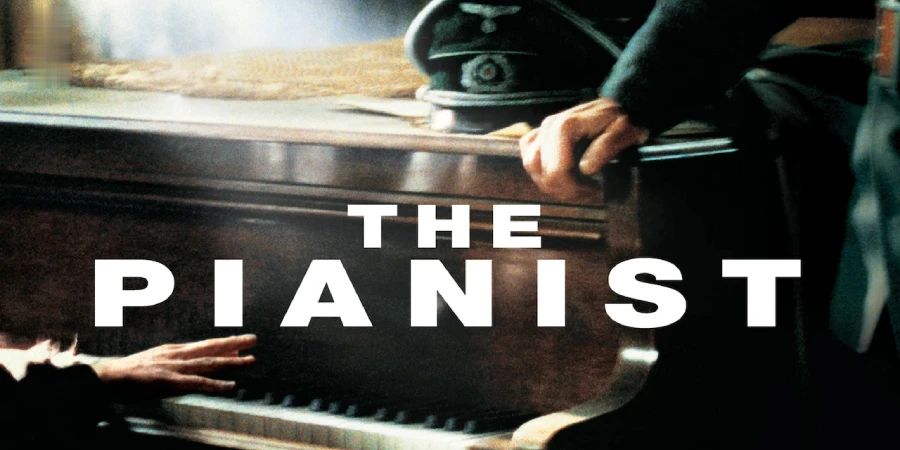

Roman Polanski’s The Pianist does not ask for your sympathy. It demands your witness. Based on the true memoir of Władysław Szpilman, a Jewish Polish pianist who survived the destruction of Warsaw and the horrors of the Nazi occupation, this film strips war down to its most unbearable human core. Polanski, himself a Holocaust survivor, brings an authenticity to the material that no amount of research alone could replicate.
Detailed Summary
Warsaw, 1939: A World About to Shatter
We first meet Szpilman playing Chopin live on Polish Radio in Warsaw as German bombs fall around the building. He refuses to stop playing until the studio is hit. This opening moment tells you everything about who Szpilman is: a man whose identity is inseparable from music.
His family lives a comfortable, cultured middle-class life in Warsaw. However, the German invasion swiftly dismantles that world. Anti-Jewish laws multiply rapidly, forcing the family to wear armbands, surrender their savings, and endure daily humiliations on the street.
The Warsaw Ghetto: Confinement and Degradation
In 1940, the Nazis force Warsaw’s Jewish population into a sealed ghetto. Szpilman and his family relocate there, cramped into a small apartment with their dignity steadily eroded. Szpilman finds work playing piano in a café inside the ghetto, earning just enough to help his family survive.
Conditions deteriorate rapidly. Starvation, disease, and random Nazi violence become the ghetto’s daily rhythm. Szpilman witnesses executions, beatings, and the slow disintegration of an entire community.
The Deportations: Losing His Family
In 1942, mass deportations to the Treblinka extermination camp begin. Szpilman and his family are assembled at the Umschlagplatz, the deportation square, waiting for the trains. A Jewish ghetto policeman, someone Szpilman knows, pulls him out of the line at the last second.
His parents, siblings, and brother are loaded onto the train without him. He never sees them again. That separation, achieved in seconds and without any grand farewell, is one of the most quietly devastating moments in modern cinema.
Surviving Inside the Ghetto Walls
Szpilman remains in the ghetto, working brutal forced labor for the Germans. He witnesses the Warsaw Ghetto Uprising of 1943, watching Jewish resistance fighters hold off Nazi forces with smuggled weapons. The Nazis ultimately crush the uprising and demolish the ghetto building by building.
Friends in the Jewish underground help Szpilman escape to the Aryan side of Warsaw before the ghetto is completely destroyed. He crosses over with forged papers and a new, false identity.
Hidden on the Aryan Side: Isolation and Fear
Polish contacts shelter Szpilman in a series of apartments on the Aryan side. His existence shrinks to four walls, whispered conversations, and constant terror of discovery. In one apartment, he is so close to a German gathering downstairs that any sound he makes could betray him.
His health deteriorates seriously. Meanwhile, Warsaw burns around him as the Warsaw Uprising of 1944 erupts, with Polish resistance fighters clashing with German forces across the city. Szpilman watches the city’s destruction from his hiding spot, helpless and alone.
Abandoned and Near Death in a Ruined City
His contacts disappear or are killed, leaving him without food or support. Szpilman scavenges through bombed-out ruins, surviving on whatever scraps he can find. He is skeletal, frostbitten, and desperately ill by the time the Germans suppress the Warsaw Uprising.
He hides in the ruins of a destroyed hospital, then finds a partially standing villa. Inside, he discovers a can of pickles, which he struggles to open with shaking, frozen hands. That scene, absurd and heartbreaking in equal measure, captures the film’s genius for finding humanity in extremity.
Movie Ending
German officer Captain Wilm Hosenfeld discovers Szpilman hiding in the villa. Instead of reporting him, Hosenfeld asks what Szpilman did before the war. When Szpilman answers that he was a pianist, Hosenfeld leads him to an upright piano in the abandoned room.
Szpilman sits and plays Chopin’s Ballade No. 1 in G minor. His fingers, cracked and stiff from months of cold and starvation, find the keys anyway. Hosenfeld listens in silence. That piece of music becomes a bridge across an otherwise unbridgeable human divide.
Hosenfeld begins bringing Szpilman food and supplies. He provides him with a German military overcoat to survive the brutal Polish winter. Consequently, Szpilman lives through the final months of the war in that attic, sustained by a German officer’s inexplicable decency.
When Soviet and Polish forces finally liberate Warsaw in January 1945, Szpilman emerges from the ruins. However, a tragic irony follows: Polish soldiers nearly shoot him because he is wearing a German coat. He survives that last, almost absurd brush with death and walks free into a devastated city.
Szpilman later tries to locate Hosenfeld to help him, learning that the Soviets have captured the officer as a prisoner of war. He never manages to secure Hosenfeld’s release. Hosenfeld dies in Soviet captivity in 1952, and that fact lands like a quiet gut-punch at the film’s close.
A title card informs us that Szpilman performed and composed in Poland for the rest of his life, dying in 2000. Furthermore, Hosenfeld was posthumously recognized as Righteous Among the Nations by Yad Vashem. The ending refuses catharsis; instead, it offers truth, which is far more powerful and far more difficult to carry.
Are There Post-Credits Scenes?
The Pianist contains no post-credits scenes whatsoever. After the closing title cards, the film simply ends. No additional footage, no hidden sequences, nothing extra follows the credits.
Type of Movie
The Pianist is a biographical historical drama and a survival film. Its tone is relentlessly sober, unsentimental, and precise. Polanski resists melodrama at every turn, presenting horror through restraint rather than spectacle.
In contrast to many Holocaust films, this one refuses to offer redemptive arcs or uplifting conclusions. It sits in the uncomfortable space between survival and loss, never fully letting the audience off the emotional hook.
Cast
- Adrien Brody – Władysław Szpilman
- Thomas Kretschmann – Captain Wilm Hosenfeld
- Frank Finlay – The Father
- Emilia Fox – Dorota
- Michal Zebrowski – Henryk
- Ed Stoppard – Henryk (credited separately as the brother)
- Julia Rayner – Regina
- Jessica Kate Meyer – Halina
- Ruth Platt – Janina
- Emilia Fox – Dorota
Film Music and Composer
Wojciech Kilar composed the original score for The Pianist. Kilar was a celebrated Polish composer with deep roots in both classical and film music, making him an ideal choice for this story. His score is spare and mournful, never overpowering the imagery.
Chopin’s music threads throughout the film as a narrative device, not merely as background. Notably, Chopin’s Ballade No. 1 in G minor serves as the emotional centerpiece of the climactic scene with Hosenfeld. Pianist Janusz Olejniczak performed all the Chopin pieces heard on screen, with Brody miming the playing convincingly after months of piano practice.
Filming Locations
Principal photography took place primarily in Germany, with key scenes shot at studios and on sets built to replicate wartime Warsaw. Production designer Allan Starski reconstructed entire Warsaw streets, including the ghetto, in extraordinary detail. The scale of that reconstruction earned significant praise from critics and historians alike.
Some filming also occurred in Warsaw, Poland itself. Using actual Warsaw locations added a layer of historical weight to the production. However, much of the city Szpilman knew no longer exists, so the reconstructed sets were absolutely essential to the film’s visual authenticity.
Awards and Nominations
The Pianist swept major international awards. At the 2003 Academy Awards, it won Best Director for Roman Polanski, Best Actor for Adrien Brody, and Best Adapted Screenplay for Ronald Harwood.
At the Cannes Film Festival, the film received the Palme d’Or, Cannes’s highest honor. In addition, it received the BAFTA Award for Best Film. Polanski notably could not collect his Oscar in person due to his ongoing legal situation in the United States.
Behind the Scenes Insights
- Adrien Brody famously gave up his apartment, car, and cell phone before filming to psychologically prepare for the role of a man stripped of everything.
- Brody lost approximately 30 pounds to physically portray Szpilman’s starvation during the film’s later scenes.
- He also practiced piano for four hours a day in preparation, reaching a level where he could credibly mime the performances on camera.
- Roman Polanski drew directly on his own childhood experience hiding from the Nazis in occupied Poland when directing the film.
- Polanski escaped the Krakow Ghetto as a child; his own mother died at Auschwitz.
- Polanski initially resisted directing the film for years because the material was too personally painful.
- Production designer Allan Starski and his team built full-scale Warsaw street reconstructions on studio lots in Germany.
- Ronald Harwood’s screenplay stayed extremely faithful to Szpilman’s memoir, a deliberate creative choice by Polanski to honor the source.
Inspirations and References
The Pianist draws directly from Władysław Szpilman’s memoir of the same name, originally published in Poland in 1946. The memoir was suppressed for political reasons and largely forgotten for decades before being republished internationally in the late 1990s. Szpilman’s son, Andrzej Szpilman, played a key role in bringing the book back into public awareness.
Polanski’s personal history also functions as an invisible layer beneath the film. His own survival as a Jewish child in Nazi-occupied Poland shaped his directorial instincts profoundly. As a result, the film carries an authority that purely academic research could never have produced.
Alternate Endings and Deleted Scenes
No well-documented alternate endings or significant deleted scenes from The Pianist have entered the public record. Polanski maintained tight creative control throughout production, and the released cut reflects his intentions closely. No extended or alternate versions of the film have been officially released.
Book Adaptations and Differences
The Pianist adapts Szpilman’s memoir, also titled The Pianist, very faithfully. Screenwriter Ronald Harwood preserved the memoir’s episodic, observational structure rather than imposing a conventional dramatic arc. The film’s emotional restraint mirrors the book’s own unsentimental prose style.
One meaningful addition in the film is a greater visual emphasis on the scale of Warsaw’s destruction. Moreover, the screenplay gives slightly more screen time to the encounter with Hosenfeld, deepening that relationship cinematically in ways that prose alone could not achieve.



Memorable Scenes and Quotes
Key Scenes
- The opening radio broadcast: Szpilman plays Chopin as bombs fall, refusing to abandon his piano until destruction forces him to stop.
- The Umschlagplatz separation: Szpilman is pulled from the deportation line while his family boards the train to Treblinka. No music plays; no words are adequate.
- The pickle tin: Szpilman struggles with frozen, trembling hands to open a can of pickles in the ruins of Warsaw, a scene of unbearable physical and emotional vulnerability.
- The Chopin performance for Hosenfeld: Szpilman plays Ballade No. 1 for the German officer in a cold, half-destroyed room; music bridges two men across a war.
- The ghetto uprising witnessed from a window: Szpilman watches Jewish fighters battle German tanks from across the wall, too far away to help, unable to look away.
- The coat incident after liberation: Polish soldiers nearly shoot the newly freed Szpilman because he is still wearing Hosenfeld’s German military overcoat.
Iconic Quotes
- “I don’t know if I am what I was.” (Szpilman reflecting on his survival and transformation)
- “Why are you complaining? You should be happy you are still alive.” (Reflecting the brutal calculus of survival in the ghetto)
- Hosenfeld, after hearing Szpilman play: “You played beautifully.” (Simple words carrying enormous weight given their context)
Easter Eggs and Hidden Details
- Polanski frames Szpilman’s hands in close-up repeatedly throughout the film, visually reinforcing that his identity as a pianist is both his greatest gift and, at times, a haunting reminder of everything he has lost.
- The choice of Chopin’s Ballade No. 1 is historically accurate to the memoir, but it also carries symbolic weight: Chopin himself was a Polish exile who never returned to his homeland.
- When Szpilman first plays piano again after his long period of hiding, he plays on an imaginary keyboard in the air, his muscle memory intact even as the world around him has collapsed.
- The film’s color palette shifts subtly as the story progresses, growing progressively colder and more desaturated as Szpilman’s world is stripped away.
- Background extras in the ghetto scenes include period-accurate details of smuggling, trade, and black market activity that mirror documented historical accounts of ghetto life.
Trivia
- Adrien Brody became, at 29, the youngest actor to win the Academy Award for Best Actor at that time.
- His now-famous impromptu kiss with presenter Halle Berry at the Oscars ceremony became one of the most-discussed moments in recent Academy Awards history.
- Polanski was not present at the Oscars to collect his Best Director award, sending a representative instead.
- Władysław Szpilman died in Warsaw in July 2000, just two years before the film’s release; he knew the project was in production.
- Captain Wilm Hosenfeld was recognized as Righteous Among the Nations by Yad Vashem in 2009, several years after the film’s release.
- The film’s budget was approximately 35 million dollars, a relatively modest sum for a production of its scope and ambition.
- Janusz Olejniczak, who performed the piano pieces on the soundtrack, is a distinguished Polish concert pianist with a long career performing Chopin.
Why Watch?
The Pianist stands among the most honest films ever made about survival, identity, and the terrifying randomness of fate. Brody’s performance is physically and emotionally extraordinary, and Polanski’s direction never manipulates where it could simply observe. For anyone willing to sit with difficulty rather than demand comfort, this film rewards that patience completely.
Director’s Other Movies
- Rosemary’s Baby (1968)
- Chinatown (1974)
- Tess (1979)
- The Ninth Gate (1999)
- The Ghost Writer (2010)
- Carnage (2011)
- Venus in Fur (2013)
- An Officer and a Spy (2019)
Recommended Films for Fans
- Schindler’s List (1993)
- Life is Beautiful (1997)
- Son of Saul (2015)
- Sophie’s Choice (1982)
- The Boy in the Striped Pajamas (2008)
- Europa Europa (1990)
- Ida (2013)
- Come and See (1985)
- Conspiracy (2001)