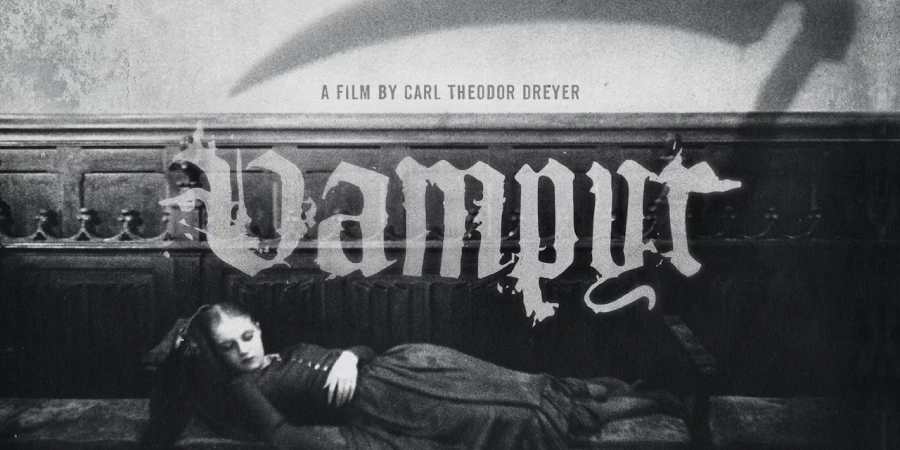

Vampyr is not a movie you simply watch; it is a film you experience. Carl Theodor Dreyer’s 1932 masterpiece floats through its narrative like a waking nightmare. It trades conventional horror scares for an oppressive, dreamlike atmosphere. Consequently, it has haunted audiences for decades with its ghostly visuals and quiet dread.
Detailed Summary
Allan Gray’s Arrival
Our protagonist, Allan Gray, is a student of the occult and supernatural. His travels lead him to the remote French village of Courtempierre. He checks into a rustic inn, seeking solitude and perhaps something more sinister.
The atmosphere is immediately unsettling. Shadows seem to have a life of their own. Something is clearly wrong in this village, a fact Dreyer communicates through ethereal, hazy visuals.
A Mysterious Package
Later that night, an elderly man mysteriously enters Gray’s locked room. Without a word, he leaves a small, wax-sealed package on the table. A note on the package reads, “To be opened upon my death.”
The man then vanishes as strangely as he appeared. Allan Gray is left confused, holding a parcel that foretells a man’s doom. This event propels him from observer to active participant in the village’s nightmare.
The Lord of the Manor
Drawn by a shadow’s strange movements, Gray leaves the inn. He follows the disembodied silhouette to a nearby castle. There, he witnesses the same elderly man from his room being shot by an unseen assailant through a window.
Gray rushes inside to help, but it is too late. He learns the dying man is the Lord of the Manor. His two daughters, Giséle and Léone, are now in grave danger with their protector gone.
The Book of Vampires
Remembering the package, Allan Gray breaks the seal. Inside is a book: an old text detailing the history and weaknesses of vampires. It tells of vampiric spirits, known as vampyrs, that can torment and control entire villages from beyond the grave.
The book becomes Gray’s guide. It explains that the local vampire, Marguerite Chopin, must be destroyed to lift the curse. This ancient text provides all the grisly, necessary instructions for her defeat.
Léone’s Affliction and the Village Doctor
Meanwhile, the Lord of the Manor’s daughter, Léone, lies sick in her bed. She is pale and weak, with two small marks on her neck. It is clear she is the vampire’s current victim, slowly being drained of life.
The village doctor arrives, a man whose sinister nature is immediately apparent. Later, Gray catches the doctor attempting to poison Léone, revealing him as an accomplice to the vampire. The doctor is in service to evil, helping the creature secure its victims.
A Fateful Blood Transfusion
To save Léone, a blood transfusion is needed. Allan Gray, a stranger, volunteers his own blood. This act further entangles him in the family’s tragic fight for survival.
However, the transfusion leaves him weak and vulnerable. During a moment of rest, he experiences a terrifying out-of-body experience. This sequence is one of the most famous in horror cinema.
Gray’s Waking Nightmare
In his dream-state, Gray’s spirit separates from his body. He watches as his own likeness is placed into a coffin. Through a small glass window in the lid, he experiences the horror of being buried alive.
He sees the faces of the doctor and Marguerite Chopin peering down at him. This surreal journey gives him a terrifying glimpse into the world of the dead. Ultimately, it strengthens his resolve to defeat the evil that plagues Courtempierre.
Movie Ending
Guided by the vampire book and the spirit of the deceased Lord of the Manor, Allan Gray and a loyal servant finally locate the grave of Marguerite Chopin. They unearth the coffin in a forgotten cemetery. Following the book’s instructions, the servant drives a large metal spike through the vampire’s heart.
Chopin’s corpse shrieks and turns to a skeleton, and her curse is instantly broken. Léone sits up in her bed, smiling and cured. The shadows and spirits plaguing the castle disappear, releasing their hold on the living.
Simultaneously, the villainous doctor attempts to escape. However, he becomes trapped inside an old flour mill. The servant activates the machinery, and the doctor is slowly buried in a mountain of white flour, suffocating in a strangely silent and poetic death.
Allan Gray and Giséle escape the castle grounds together. They emerge from a foggy forest into the bright sunlight, having survived the nightmare. Their ordeal is finally over.
Are There Post-Credits Scenes?
No, there are no post-credits scenes in Vampyr. The practice of adding scenes after the credits was not common in the 1930s. The film concludes when the credits roll.
Type of Movie
Vampyr is a supernatural horror film with strong elements of German Expressionism and French Surrealism. Its horror is not derived from jump scares or gore. Instead, the film creates a pervasive sense of dread and unease through its dreamlike, atmospheric style.
It feels like a fever dream committed to celluloid. Carl Theodor Dreyer prioritized mood and suggestion over a straightforward narrative, making it a landmark film in atmospheric horror.
Cast
- Julian West (Baron Nicolas de Gunzburg) – Allan Gray
- Maurice Schutz – The Lord of the Manor
- Rena Mandel – Giséle
- Sybille Schmitz – Léone
- Jan Hieronimko – The Village Doctor
- Henriette Gérard – Marguerite Chopin
Film Music and Composer
Wolfgang Zeller composed the haunting score for Vampyr. The music is sparse, used to heighten the eerie atmosphere rather than drive the action. Its unsettling melodies and quiet cues are instrumental to the film’s success.
As one of Dreyer’s first sound films, the use of sound is deliberate and often minimalistic. For instance, the beating heart, the cry of a dog, and the grinding gears of the mill are more prominent than dialogue, adding to the film’s disorienting effect.

Filming Locations
The film was shot entirely on location in France, which enhances its authenticity and gothic mood. The primary filming location was the village of Courtempierre, Loiret. Director Carl Dreyer specifically chose real, dilapidated buildings and castles for their natural decay.
He believed these real locations possessed a tangible sense of history and mystery that could not be replicated on a studio set. As a result, the environment becomes a character in itself, contributing immensely to the film’s ghostly realism.
Awards and Nominations
Upon its release, Vampyr was a critical and commercial failure. Therefore, it received no major awards or nominations at the time. Over the decades, however, its reputation has grown immensely, and it is now widely regarded by critics and filmmakers as a masterpiece of the horror genre.
Behind the Scenes Insights
- The film’s star, credited as Julian West, was actually Baron Nicolas de Gunzburg, a wealthy socialite. He financed much of the film on the condition that he could play the lead role.
- Director Carl Dreyer achieved the film’s distinctive soft, hazy look by stretching a piece of fine gauze over the camera lens. This effect was meant to simulate the veil between the world of the living and the dead.
- Vampyr was shot simultaneously in three languages: French, German, and English. After filming a scene, the actors would have to perform it again for the other language versions. Unfortunately, the English-language version is now considered lost.
- Dreyer intentionally used a mix of professional actors, like Sybille Schmitz, and non-professional actors to create a sense of strange realism. The man who played the doctor, for example, was reportedly discovered in a Paris subway station.
Inspirations and References
Vampyr was loosely inspired by Sheridan Le Fanu’s 1872 collection of gothic horror stories, In a Glass Darkly. While the film is not a direct adaptation of any single story, it draws significant plot elements and atmospheric ideas from the short story Carmilla.
Carmilla famously features a female vampire who preys on a young woman, a theme central to the relationship between Marguerite Chopin and Léone in the film.
Alternate Endings and Deleted Scenes
The original director’s cut of Vampyr is believed to be lost. The versions available today are based on prints that were re-edited and censored after its premiere, particularly by German distributors. Censors reportedly removed some of the more graphic and surreal sequences.
Notable deleted scenes include a longer, more explicit sequence of the stake being driven through the vampire’s heart and additional gruesome details of the doctor’s death in the flour mill. No alternate endings are known to have been filmed.
Book Adaptations and Differences
Vampyr is not a direct book adaptation but a loose interpretation of themes from Sheridan Le Fanu’s Carmilla. There are several key differences. Le Fanu’s story is told from the perspective of a young woman, Laura, while Dreyer’s film centers on a male protagonist, Allan Gray.
Furthermore, Carmilla contains a strong, influential lesbian subtext between the vampire and her victim, which is largely absent in Vampyr. Dreyer’s film opts for a more abstract and surreal exploration of evil, focusing on atmosphere over the character-driven narrative of the book.



Memorable Scenes and Quotes
Key Scenes
- Gray’s Burial: The iconic point-of-view shot from inside the coffin. Allan Gray’s spirit watches his own body being carried to its grave, a terrifying vision of helplessness and entrapment.
- The Shadow Dance: In the castle, shadows of soldiers detach from the walls and begin to dance to ghostly music. This surreal sequence perfectly captures the film’s dreamlike logic, where the laws of nature do not apply.
- Death in the Mill: The doctor’s demise is unforgettable. Trapped and unable to escape, he is slowly consumed by white flour, a quiet and chillingly poetic end for a villain.
Iconic Quotes
Vampyr is notable for its sparse dialogue, relying on visuals and text from the vampire book to tell its story. The most memorable “quotes” are excerpts from the book:
- “There are certain creatures who are nourished by the blood of others. In their graves, they are consumed by a terrible hunger.”
- “The vampire’s victims are destined to become vampires themselves.”
- “The only salvation for the victim is for the vampire to be destroyed. Its unholy soul must be annihilated.”
Easter Eggs and Hidden Details
- Independent Shadows: Throughout the film, pay close attention to shadows. Many move independently of the people or objects casting them, signaling the unnatural forces at work.
- Skull Motifs: Skulls appear frequently as a memento mori. A notable example is the skull subtly visible on the ferryman’s shovel at the beginning of the film.
- The Scythe: The Grim Reaper’s scythe is a recurring image, from the sign outside the inn to the tool held by a shadow, constantly reinforcing the theme of death.
Trivia
- Despite being a sound film, Dreyer used intertitles extensively, a technique carried over from his silent film work. He felt dialogue could disrupt the carefully crafted dreamlike atmosphere.
- The blood used during the blood transfusion scene was reportedly real animal blood. Dreyer used it to provoke a genuine reaction of disgust and fear from actress Sybille Schmitz.
- The “village doctor” was played by Jan Hieronimko, a Polish writer and journalist Dreyer cast for his unsettling appearance. He was not a professional actor.
Why Watch?
Watch Vampyr for its unparalleled atmosphere of dread. It is a slow, hypnotic journey into a nightmare world. This film’s groundbreaking visual style and influence on directors like David Lynch make it essential viewing for anyone who appreciates the art of horror.
Director’s Other Movies
- The Passion of Joan of Arc (1928)
- Day of Wrath (1943)
- Ordet (1955)
- Gertrud (1964)
Recommended Films for Fans
- Nosferatu (1922)
- The Cabinet of Dr. Caligari (1920)
- Carnival of Souls (1962)
- Eraserhead (1977)
- Hour of the Wolf (1968)
- Häxan (1922)